
Gettysburg 155th Anniversary an Event To Remember!
Originally published September 2018 · pp. 1–5
With everything that is going on in the world, and more specifically, that of Civil War reenacting, the hobby sorely needed a significant event under its belt. That hope became a reality for reenactors, visitors, organizers and the community at the Gettysburg 155th Anniversary event on July 5, 6, 7, & 8. Approximately 6,000 reenactors, 70 artillery pieces and 150 cavalry, 12,000 spectators, along with memorable scenarios made this an event to remember. This event was a culmination of two years of dedicated planning, communication and working together by the Gettysburg Anniversary Committee (GAC), the Army of Northern Virginia (ANV) and the United States Volunteers. According to GAC Operations Manager Randy Phiel the communication, cooperation, and teamwork between these three groups, since the conclusion of the 153rd Anniversary, led to making the event the success it was for everyone. The event started with some challenges. Despite two years of planning, weather threatened to derail the event. Unusually high amounts of rainfall plagued the entire east coast this spring and did not spare Gettysburg. The month of June was not kind, and the Redding Family could not get into the fields to get the hay off. With senior staff and sutlers arriving on site Tuesday, the hay bales were still in the Federal and CSA Camps on Sunday evening. With general registration beginning on Wednesday, things began to dry out; but then more rain on Wednesday, Thursday and Friday impacted both the Federal and CSA entry into their camps. On Wednesday evening despite truckloads of stone which were into both camps, the Confederate rear entrance had to be closed, and all CSA traffic brought in and out the one-lane Redding farm lane until Friday evening. It was easy to observe all week that planning, resources, organization, and experience strongly came into play to keep mother nature from stopping the event. A final storm came through on Friday morning, with high a pressure front behind it, and the rest of the weather for the weekend could not have been more glorious. The highlights of the weekend were the scenarios. Both commands deserve the utmost credit for making them very special down to a realistic amount of casualties during each battle. Major Randall Robinson, TransMississippi Brigade (TMB), in a report to General Gordon Grahe had this to say about the event and the scenarios. “We, of the TMB, found the event to be well organized and very memorable. The camping areas were great and much closer to the sutlers and battlefield than in years past. We appreciate your work in keeping the battle scenarios as fresh as possible while using the same field. The Saturday evening Wheatfield Battle was especially memorable. Being on the extreme right wing as a part of Gen. Waters’ Division our brigade was able to crush the Federals and drive them back as the Trans-Mississippi Volunteer Infantry battalion outflanked the Federal left. We could see the fear in their eyes, which was confirmed by some of the “dead federals” I spoke with after the battle. Following the battle, General Waters gathered our brigade staff and said, “My God but you are a bunch of bloodthirsty bastards”! A compliment I feel will become a slogan for the TMB. In fact, even our long-time reenactors who were present at the 135th Gettysburg have ranked Saturday evening’s battle in their all-time top five reenacting experiences. “In short our men and staff felt that our presence was appreciated and we would like to thank you and your staff for all of your efforts. It was a pleasure serving under your command.” General Gordon Grahe, Commanding General of Confederate Forces at the Gettysburg 155th, had these reflections on the event: “From the Confederate side, the 155th Gettysburg was an excellent event. The scenarios were the result of many months of drawing
(Paul Witt)
maps for both sides to ensure that the battles were as realistic as possible. Seeing them done the correct way pleased all reenactors. Both Confederate and Federal Commands worked hard on bringing the reenactment community together. Confederates came from all over the country for the event. Many expressed that the 155th event was the best Gettysburg ever.” I would be remiss if I did not give credit to some on the Confederate side. The ANV Staff headed by Chief of Staff Jenni Haines. General Dick Watters of the Southern Division and all the organizations under his command. General Terry Shelton of Longstreet’s Corps and the organizations under his command including the Provisional Army of the Confederate States (PACS). Brigadier Generals Bill Potts and Doug Nalls of the ANV for the handling of their Brigades. Brigadier General Chris Cook and the Mounted and Dismounted Cavalry.
Brigadier General Tony Lackey who commanded the Artillery from many different organizations. Everyone involved in the event, Confederate and Federal, the Gettysburg Anniversary Committee, and the Redding Family did a tremendous amount of work in making the event a great success. The men and women reenactors who attended the event deserve most of the credit. With everything going on about Civil War Reenacting, the hobby needed a great event to keep going forward. I know the 155th Gettysburg gave that to them.” Leading the Federal Forces at both the Gettysburg 154th & 155th Reenactment was General Darrel Markijohn. General Markijohn was determined to give the Redding Farm site a new look for the 155th and was successful in working with General Grahe to do so. When asked to provide his impressions of the event, General Markijohn observed “From my perspective as a Civil War Reenactor, one of the most significant points to emerge from the 155th Gettysburg Reenactment is that we proved that we can still partner with a sponsor and landowner and conduct a successful National Civil War Anniversary Event. OneQuarter of the Federal Army came from the Western Theatre. There were troops from Ohio, Indiana, Illinois, Michigan, Wisconsin, Colorado, Utah, Georgia, Tennessee, Florida, Pennsylvania, and Kentucky. The Eastern Federal Organizations sent significant troops to the event. Federal Cavalry and Artillery numbers reminded me of the old days.” I have to credit the GAC for trusting Major General Grahe and I when we proposed to completely re-design the Redding Site from years past. The new battlefield was much more authentic. We took the power lines and the infamous creek that inhibited troop movements entirely out of play. We moved the spectator line and bleachers off to the side, and in doing so, created a fantastic viewing experience. It was not easy. We had to completely move the stone wall and lay 400 feet of five rail fencing. The camps also had to be moved. In the end, this re-design was well received by the Federal Army participants. I think there are some refinements that we would like to consider if we are privileged to return to this site, but overall, the layout was well done.” The Reynolds’s March on Friday morning was one of the highlights of the event. Again, thanks have to go out to the GAC and the Redding Family for allowing this to take place. 400 Federal Infantry Soldiers, 120 mounted Cavalry, and two Horse Drawn Artillery pieces marched 1.7 miles from an off-site location and went into battle in real time to represent Buford’s hold of McPherson’s Ridge and Reynolds reinforcing action. This off-site march was a brand-new feature for a GAC event, and it existed purely for the reenactors that participated. It was a considerable effort, and I think it showed what is possible if people are given the opportunity to reenact outside of the box. The long column of marching soldiers along historic farm lanes and cut trails was impressive. Major General Grahe and I had ambitious plans for the battle scenarios. We worked for hours on each one going as far back as last summer. We focused on authentic regimental and Brigade portrayals and accurate troop movement. That work allowed General Grahe and I to grow very close and created a level of trust between us that was instrumental in the success of the battle plans. He is a great Leader of Reenactors and an even greater friend. I was delighted with the performance of the Federal Army in each of the battles. They were accurate and hard fought. The McPherson’s Ridge scenario lasted over an hour and a half. We could not have done this without the skill and experience of the Federal Brigade
Commanders, Brig. Generals Earl Zeckman (GAR Western Troops), Ted Brennan (Federal Alliance – Mifflin Guard, National Regiment, Vincent’s Brigade), Jay Henson (Federal Volunteer Brigade), Tony Daniels, (Second Federal Rifles, the Union Volunteers) and Colonel Kevin Skaggs (USV 1st and 2nd Regiments). The Artillery was well lead by Brevet Brigadier General Jim Lynch and the Cavalry, led by Colonel Mike Church, had epic Cavalry Battles that the crowd really enjoyed. I cannot overstate my respect and admiration for these officers, their staffs, and of course their troops. As usual, there was plenty of quality living history with a large Living History Village, two large Living History Activities Tents with a variety of all-day programs and a Youth Activities Tent. One of the most extensive arrays of sutlers this year comprised two sutler streets. As at most GAC events, resources such as wood, water, and toilets were abundant, and the toilets were cleaned daily. Security was on everyone’s mind, and for the first time at this event, reenactors were issued permanent wristbands. Visitors passed by canines throughout the event and through bag checks and metal detectors. State police and local police were quite evident and were very positively received by the visitors and reenactors. As usual, there was 24/7 EMS and Fire Suppression which was supplemented by Hershey Medical Center’s Mobile Treatment & Education Unit. At the presentation of awards to five beneficiaries, before the Pickett’s Charge Battle on Sunday, GAC Event Operations Manager Randy Phiel was recognized with a “25th print” for his contribution in organizing his twenty-fifth event and twenty-four years in the same capacity. Phiel figures he has seen approximately 125 scenarios from his operations tower and said the 155th scenarios were some of the most outstanding he has ever viewed. The Gettysburg Anniversary Committee has announced preliminary plans, that next year’s 156th Gettysburg Reenactment will move back to The Gettysburg movie site at the Yingling Farm south of Gettysburg. This site is familiar to most and is a very pleasing venue for smaller events overlooking the historic Sachs Mill Covered Bridge and the Roundtops. Once the planning is finalized, information can be obtained at www.gettysburgreenactment.com or by calling 717-338-1525. Ridge. (Sandy Goss, Eagle Bay Media) (Joanne Sease)
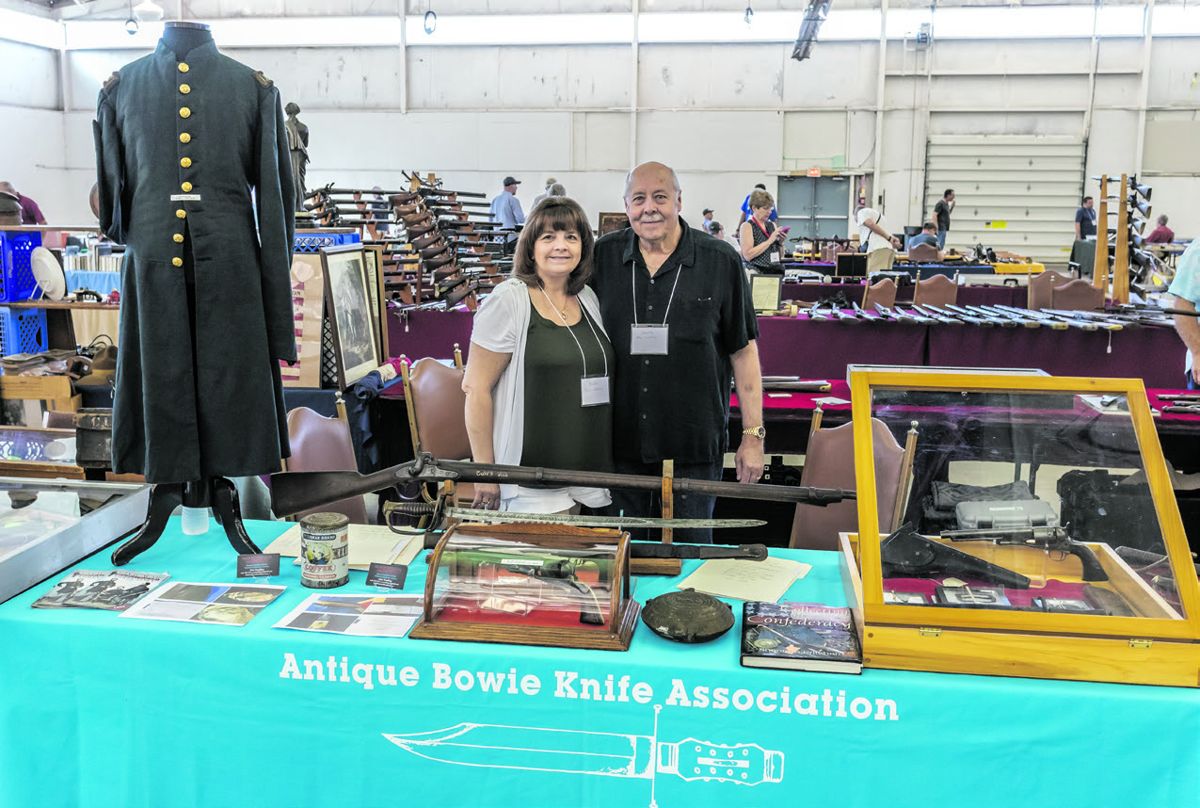
opponents. (Sandy Goss, Eagle Bay Media) (Paul Witt) A week before the Gettysburg reenactment, collector/dealer Allen Wandling and his wife Robin, offered unique Gettysburg artifacts for sale at the GBPA Civil War Show. The rifle-musket was picked up at Culp’s Hill after the battle, the revolver was used during the battle, the frock coat was worn by Lt. George B. Butler during the battle where he was wounded and had his right arm amputated. Allen owns Mid West Civil War Relics. His website is www.midwestcivilwarrelics.com.
(Sandy Goss, Eagle Bay Media)
When the Confederates charged over the rock wall they were met by a seemingly never-ending number of blue-clad enemies.
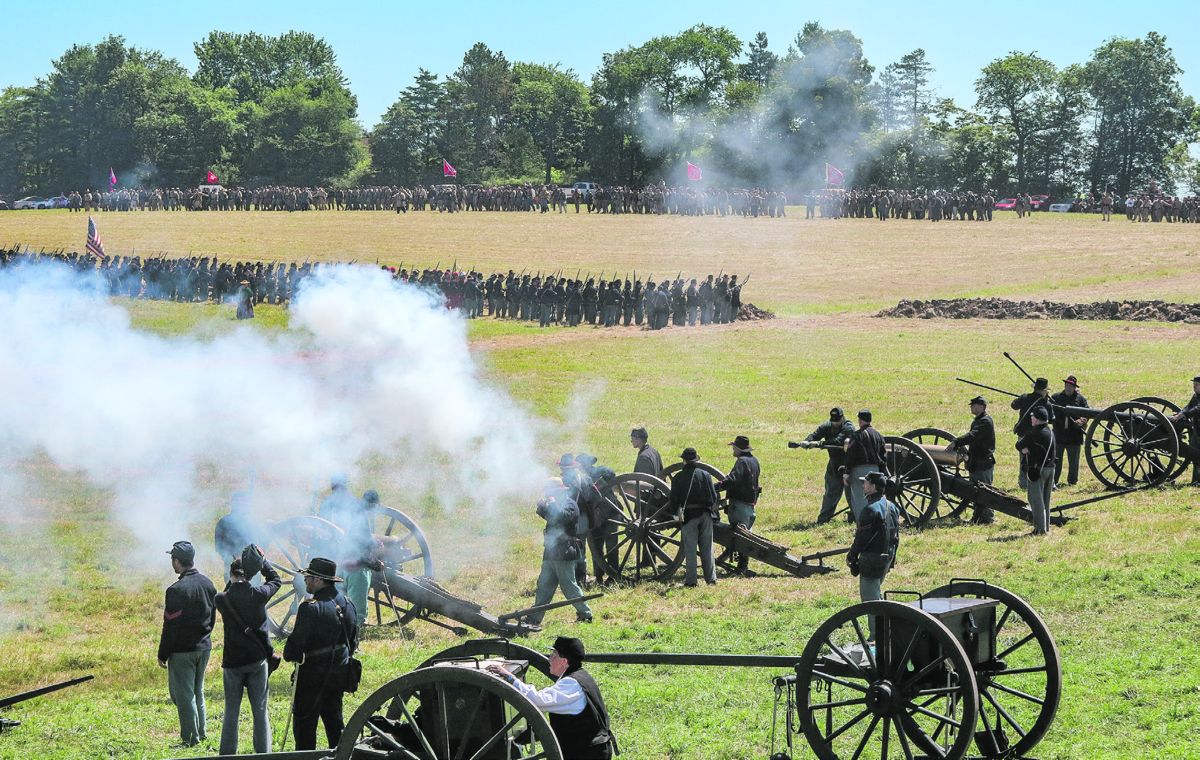
bloody norm. (Sandy Goss, Eagle Bay Media) (Paul Witt) Union skirmishers stationed at the split rail fence along the Chambersburg Pike retreat to safer positions behind a stone wall during the opening phase of the Confederate attack immortalized as “Pickett’s Charge.” (Sandy Goss, Eagle Bay Media)
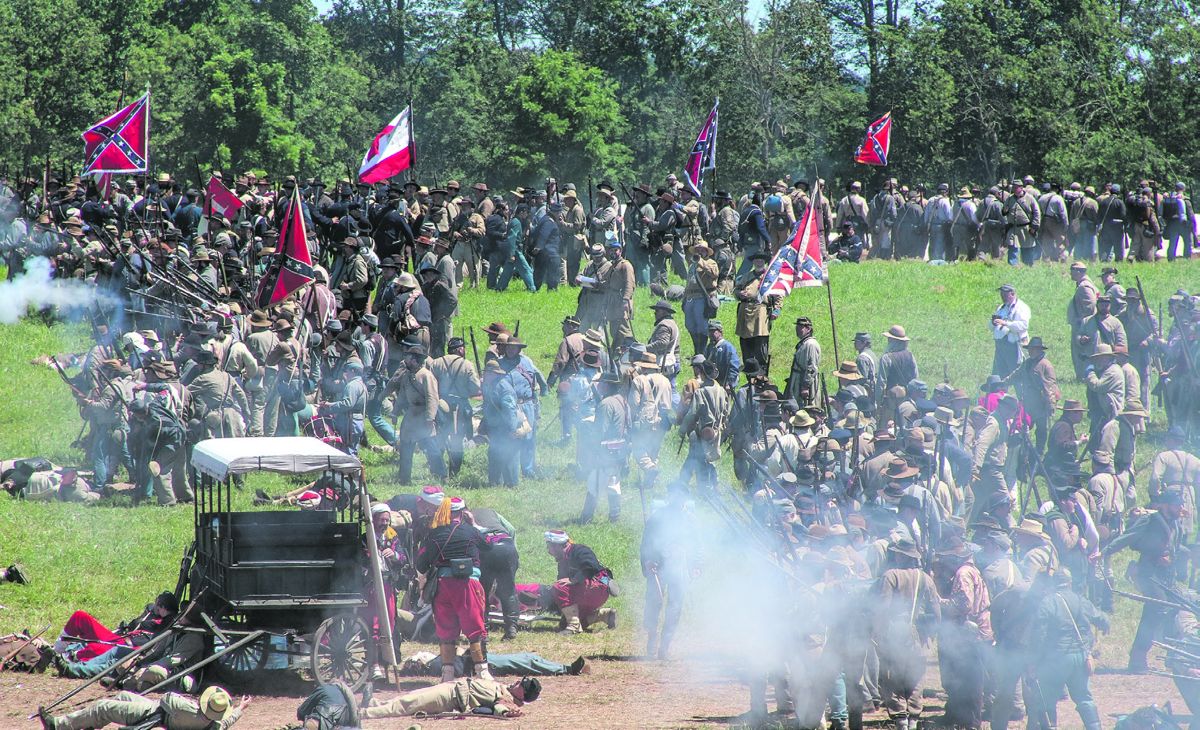
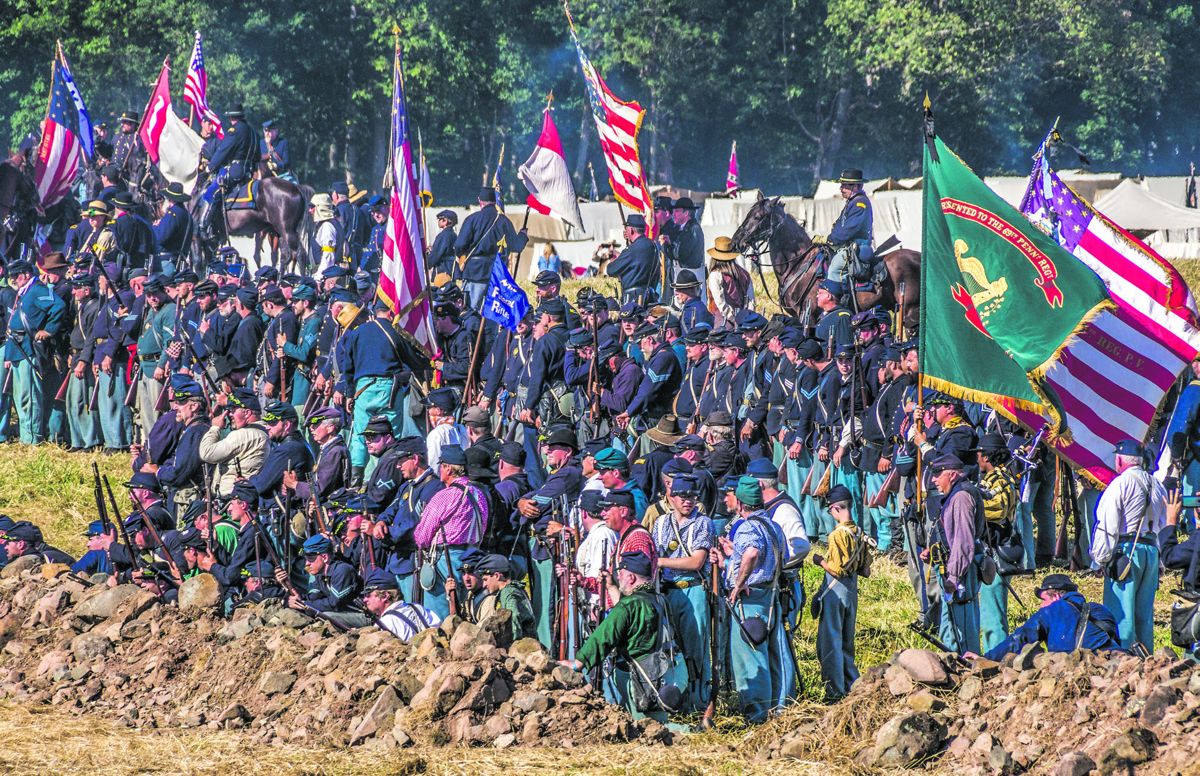
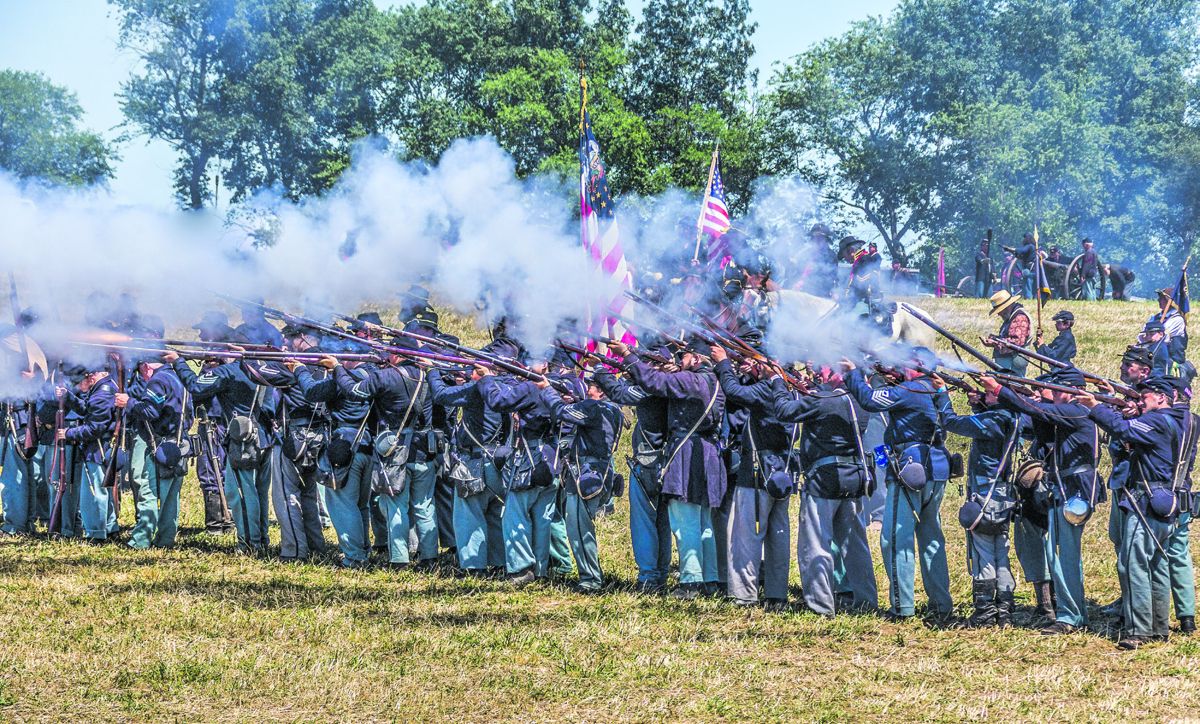
The Federals form a defensive line while the Confederates attack.
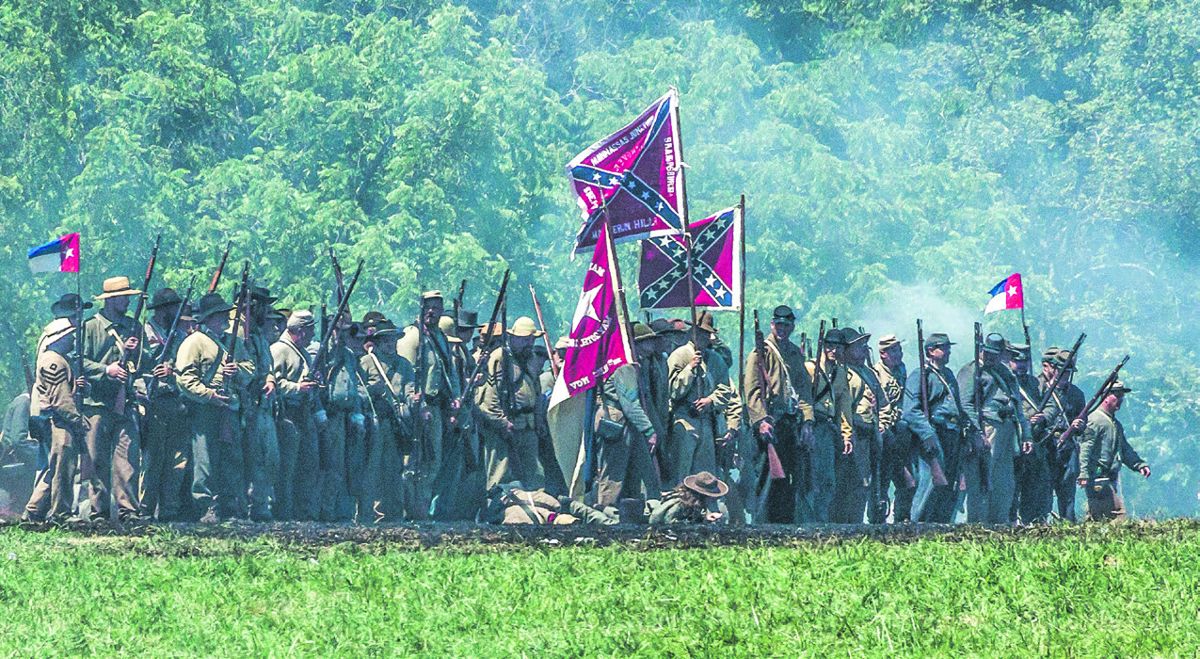
As they closed the gap between themselves and their Union opponents, the Confederate infantry broke into a dead run to reach their target – the stone wall at the center of the Union lines. Most would not make it. (Sandy Goss, Eagle Bay Media)
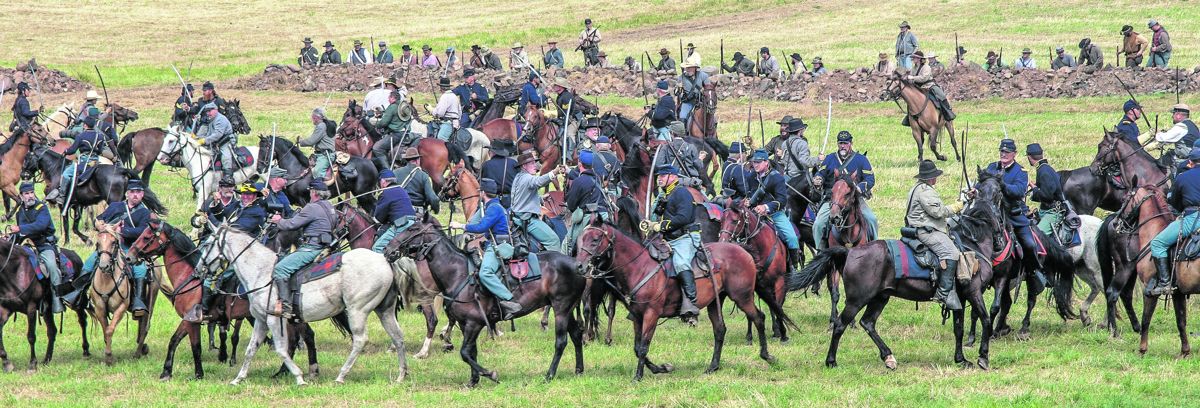
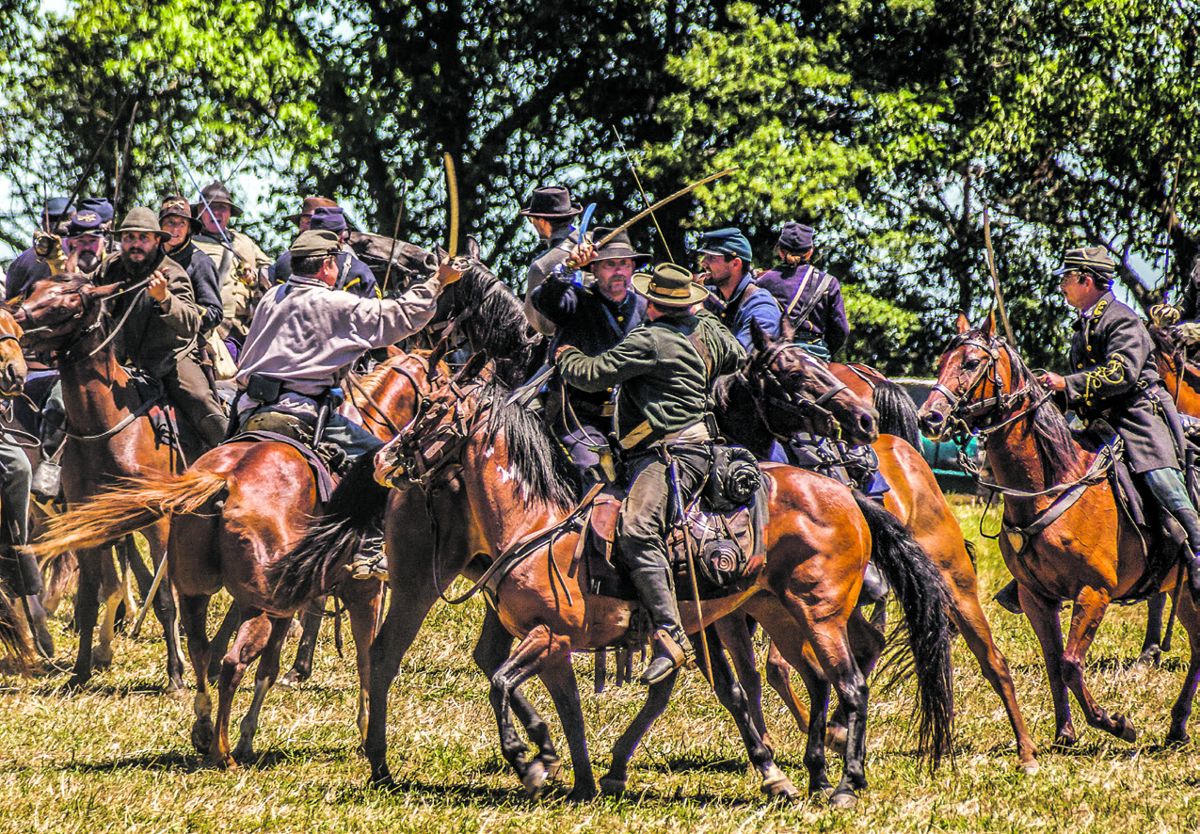
During the action at East Cavalry Field, Maj. Gen. George Armstrong Custer’s “Wolverines” unleashed wave after wave of attacks upon Confederate Maj. Gen. James Ewell Brown Stuart’s cavalry in a desperate attempt to protect the Union’s rear elements.
As the last of the valiant Confederates reached the rock wall’s summit, they realized there were no supporting troops behind them and their attack had failed. Numerous reports state that the Union soldiers held out their hands in friendship and respect, urging the Confederates to surrender; “come over here, we cannot kill such brave men.”
Composite units of Zouves and Union infantry move to their assigned positions prior to the climax of the battle, “Pickett’s Charge.” (Sandy Goss, Eagle Bay Media)
Dismounted elements of the 13th Virginia Cavalry move forward as skirmishers during the prelude to the fighting at the Wheat Field.