
First, Farthest, Last?
By Michael C. Hardy · Originally published September 2018 · p. 31
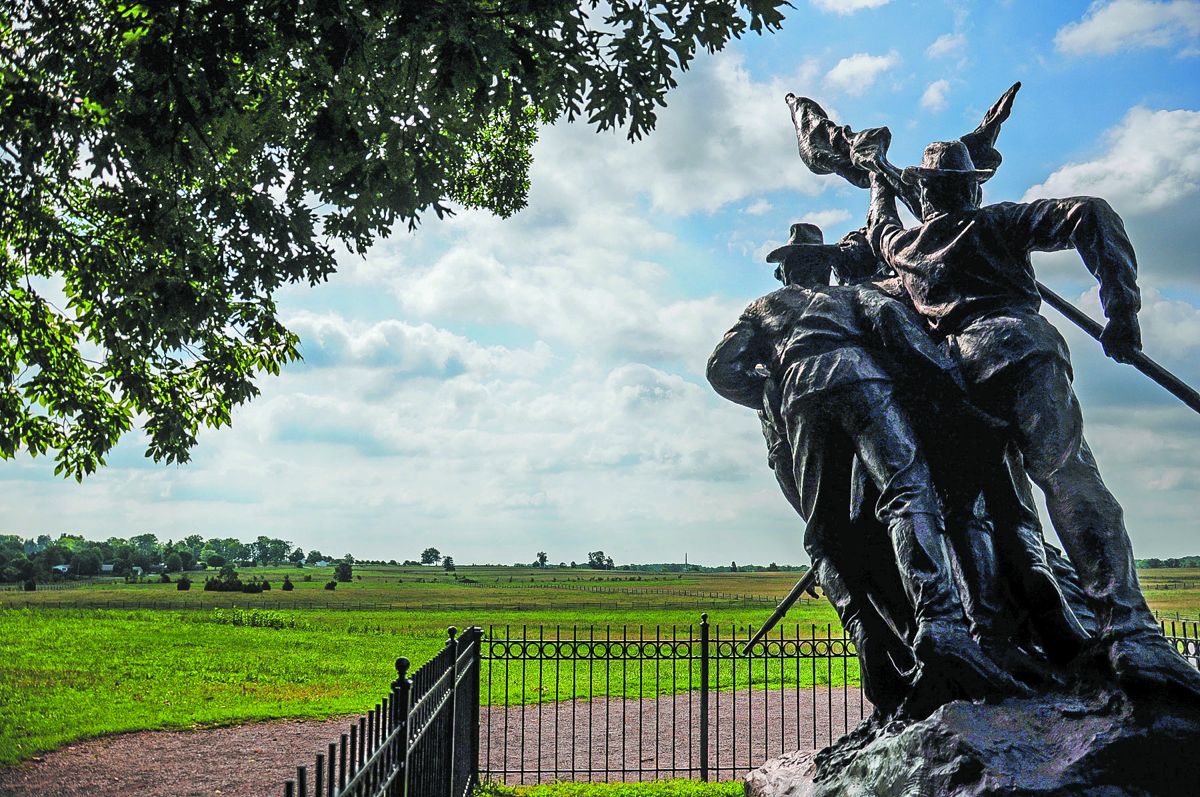
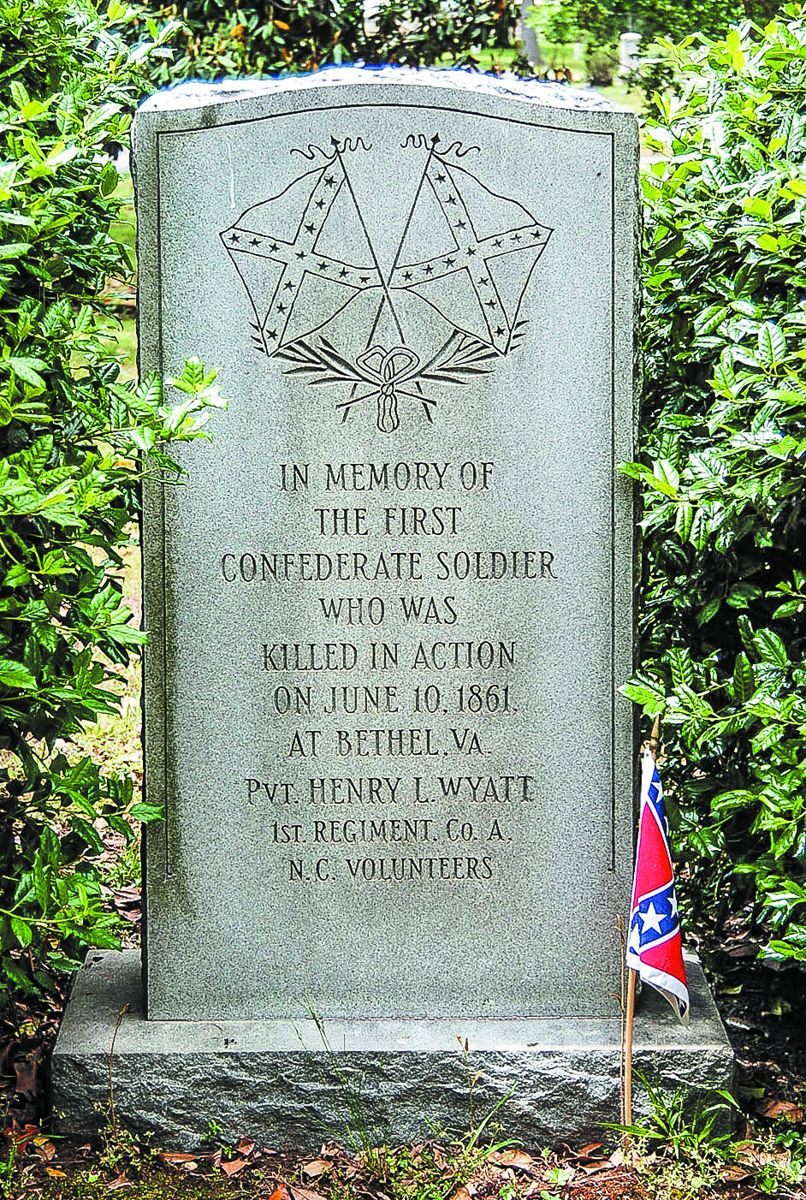
For decades, the phrase “First, Farthest, and Last” has encapsulated North Carolina’s role in the Civil War. Tar Heels proudly proclaim that they were the First at Big Bethel, advanced further than anyone at Gettysburg, and were last at Appomattox. Does North Carolina’s claim align with facts, or is it fiction? While similar words described the role of Confederate Tar Heels as early as 1874, the motto was firmly set in 1899: “first at Bethel, farthest at Gettysburg, and last at Appomattox”(Charlotte Observer May 10, 1899). “First” comes from the battle of Big Bethel, Va., June 10, 1861. Killed in the lopsided Confederate victory was Pvt. Henry Wyatt, a Virginia native who had lived in North Carolina for five years prior to 1861 when he enlisted in the 1st North Carolina Volunteers. Deeply lamented across the South, Wyatt was buried in Richmond’s Hollywood Cemetery and has markers both near Big Bethel where he fell, and on a statue on the grounds of the Raleigh statehouse (“The First Confederate Soldier Killed in Battle.” Southern Historical Society Papers, Vol. 20, 1892, 63-68). While Big Bethel was a goodsized scrap, Wyatt does not appear to be the first Confederate fatality. William R. Clark enlisted in an artillery company being formed by William D. Pender (later a Confederate brigadier general). On April 19, 1861, before going south, Clark was killed by Union soldiers during the Baltimore riots (Baltimore American and Commercial Advertiser April 20, 1861). Of course, while Clark was not officially mustered, Capt. John Q. Marr, 17th Virginia Infantry, killed June 1, 1861, in a skirmish at Fairfax Court House, Va., could be the first. There are undoubtedly others. While the battle of Big Bethel was a larger affair than the June 1 Fairfax skirmish (fewer than 200 involved at Fairfax; around 5,300 at Big Bethel), and it was a Confederate victory by mostly Tar Heel soldiers, Marr was killed in combat a week earlier. The “First” tagline is a myth. “Farthest” refers to the July 3, 1863, afternoon attack at Gettysburg, generally called Pickett’s Charge, although Pickett only commanded a third of the attacking force. The position where Pettigrew and Trimble’s Divisions attacked was 100 feet beyond where Pickett’s gallant charge culminated. Remains of numerous Tar Heels, like Lt. Iowa Michigan Royster of the 37th North Carolina and Capt. Edward F. Satterfield, 55th North Carolina, were found within feet of the inner angle’s stone wall. While Pickett’s men captured their section of the wall for the briefest of moments, Pettigrew’s and Trimble’s commands pushed 20-30 yards beyond the Virginians’ position (John R. Satterfield. “Last at Gettysburg: The Story of a Confederate Captain.” Gettysburg Magazine No. 26 (July 2002): 94-113). Another farthest claim came at Chickamauga, where five North Carolina regiments fought. The 60th North Carolina captured artillery and pushed on to the edge of Kelly Field while the 58th North Carolina pushed the Federals off Snodgrass Hill late on September 20, 1863. In both cases, North Carolina earned the title of farthest (Michael C. Hardy The Fifty-eighth North Carolina Troops: Tar Heels in the Army of Northern Virginia. Jefferson, NC: McFarland, 2010, 80-93). North Carolina’s other claim was that her soldiers were last at Appomattox. They captured the final cannon taken from the Army of the Potomac; Maj. Gen.
Brian Grimes planned the last battle; and Brig. Gen. W.R. Cox’s Tar Heel brigade made the last charge and fired the last volley. In that last attack, probably around noon April 9, Sgt. Ivy Ritchie, 14th North Carolina, was struck and killed. The remainder of his regiment was soon captured, probably the final members of the Army of Northern Virginia captured while fighting. For many years, Ritchie was interred in the Popular Grove National Cemetery, under a Union marker. In 2008, the Sons of Confederate Veterans argued he had been misidentified. The National Park Service agreed. North Carolinians, then, indeed have a claim on the title of “last” (Five Points in the Record of North Carolina in the Great War of 1861–65. Goldsboro, NC: Nash Brothers, 1904; 5971; Weymouth T. Jordan Jr., and Louis H. Manarin. North Carolina Troops, 1861–1865, A Roster. Vol. 5 Raleigh: Division of Archives and History, 1975, 471).
There were many then, just as there are now, disputing the First, Farthest, Last claims of North Carolina. Tar Heel soldiers shed blood at the battle of Big Bethel in June 1861, went further than Pickett’s Division at Gettysburg, and were still fighting at Appomattox as Lee attempted to surrender April 9, 1861. Perhaps there is more fact than myth to their claim. Michael C. Hardy is the author of twenty-three books, including General Lee’s Immortals, a history of the Branch-Lane brigade (Savas Beatie, 2018). He volunteers his time on the weekends serving as a historical interpreter at several historic sites in western North Carolina and eastern Tennessee.