
This And That
Determined Ladies Persevere
By Gould Hagler · Originally published September 2018 · pp. 26–27
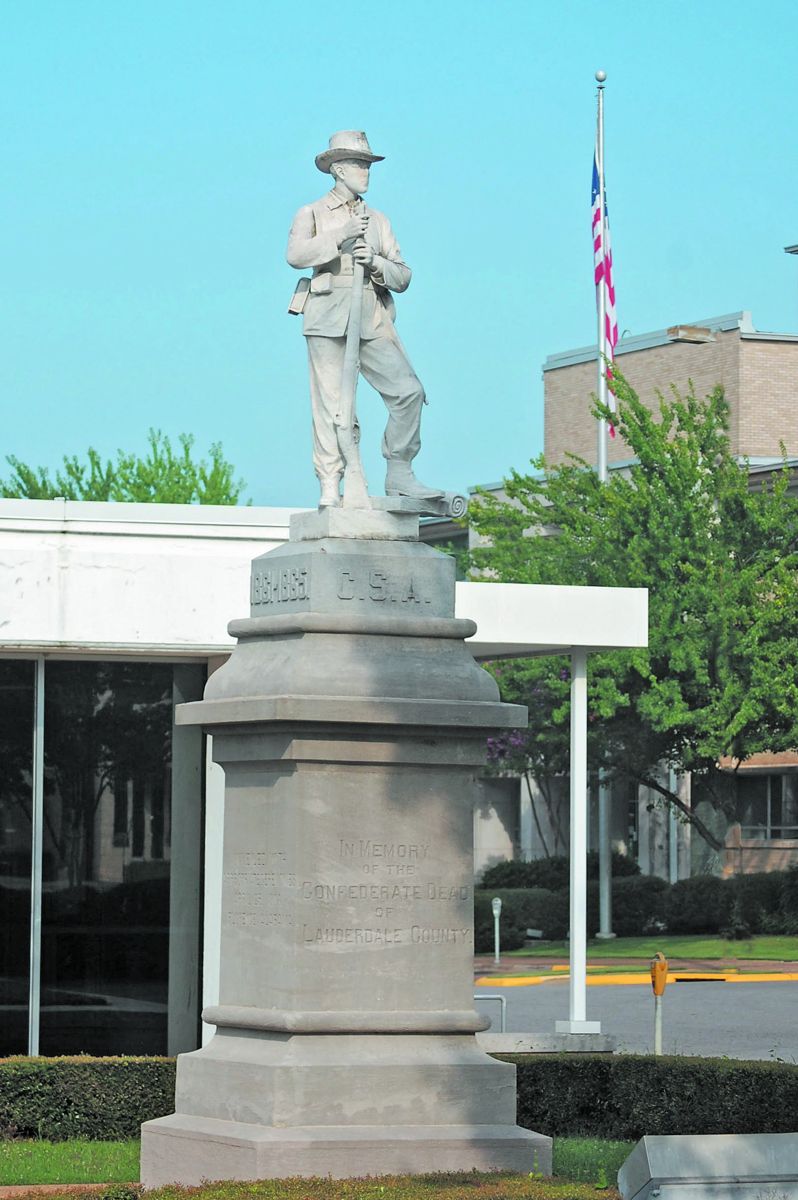
“Bank failures are becoming as common and plentiful as pig tracks in the road. Some dozen or more were reported in one day recently.” Florence Gazette, May 25, 1893 When numerous banks failed in the Panic of 1893, there was no FDIC to take over and pay off depositors. One of the many depositors ruined in the panic was the Ladies’ Memorial Association of Florence, Ala., which lost $1,000 when its bank went under. Plans to build a Confederate monument in the Lauderdale County seat were crushed by this demoralizing setback. The ladies had to start anew. The first public mention of the Florence monument appeared in May 1878, when the Florence Gazette reported that at Decoration Day ceremonies a dignitary took the podium and announced a plan of the Memorial Association to raise funds for a monument to the Confederate dead. The original plan was to divide the base of the monument into blocks and sell each block for $5.00. Each purchaser would obtain the right to have inscribed the name of a Confederate lost in the war on the block. As the monument ultimately erected contains no such names, we know the original plan was altered. In the first days of 1879, the LMA met “to consider ways and means to proceed to the erection of the monument,” which was to be placed on the Court Square. In March several “distinguished gentlemen” addressed the public at the courthouse to stir interest in the project. In August of that year the Florence Gazette reported that a Captain Bowser had arrived at the river landing with a barge loaded with stone for the memorial, which he then transported to the work site by wagon. In September the paper reported that the city “is now adorned with a derrick which is used in moving the stones that are being polished for the Confederate monument.” The work was underway but where was the money? Certainly not in the bank, at least not in a quantity adequate for a complete monument. Mrs. O.A. Cutler, the LMA’s president, appealed in the newspaper for donations. She asked “every man in the county to hand her the small sum of 25 cents to be used in purchasing a statue to crown the monument.” An insufficient number of the county’s men handed over their quarters, and though the stone base soon was in place the community waited long to see the statue. In the decade of the 1880s, local papers reported no activity regarding the monument. Meanwhile the statue-less base stood at the courthouse, patiently awaiting the hoped-for marble soldier. At the beginning of the 1890s, the ladies renewed their efforts to raise money. They also considered other locations for the memorial, as well as different kind of memorial—a library. Ultimately they stuck with the original design and approximately the same location. (For some reason—possibly the construction of a new courthouse—the monument was to be moved to another spot on the grounds.) By various means the ladies raised funds; gradually their bank account grew to $1,000; suddenly in the Panic of 1893 the money was gone.* The panic ended and the ladies resumed their work. In March 1896 an editorial in the Florence Herald called for donations. “This matter has been already too long neglected,” as published in the Herald. Hinting that money was not the only problem, the editors referred to a shortage of cooperation as well as a lack of dollars. The exact nature of this poor cooperation is not clear, but there is a clue. The newspaper in May 1897 contained, in a single edition, notices of two separate meetings to discuss plans for the monument, one held by the United Confederate Veterans and one by the Ladies’ Memorial Association. Since an earlier article in January, referred to the controversy over where to place the monument, it could be that the veterans and the ladies differed over that issue. If this was the case, the smart money would be on the ladies. But what about the money? How would you raise $25,000 today? At one event the keynote speaker was Gen. John B. Gordon, commander of the United Confederate Veterans and former Georgia governor and U.S. senator. On May 6, 1898, Gordon spoke on “The Last Days of the Confederacy.” “Gen. Gordon loved the South, and he has loved the Union since the days of which he speaks,” as published in the Herald. The governor of Tennessee also appeared, as did the former president of the LMA, Mrs. Cutler—widowed, remarried, relocated, and returning as Mrs. Cutler-Smith. Tickets to hear the lady were $.25 and $.35. In the fall of 1901 the ladies held an event with prizes and games to further the cause. The following year one local store donated to the monument fund one-tenth of its sales earned on April 15. The ladies also held a piano recital. Numerous appeals appeared in the paper. Weekly, the UDC named the donors on its “Roll of Honor.” One week the gifts ranged from $20 to $.05, the latter sum being contributed by an unnamed “Little Girl.” The ladies’ cash and credit combined to enable them to make the necessary purchases and contract for the statue and its installation. In August 1902 the Herald described the statue and the plans to place it atop the old base. “The Confederate monument will be completed by the last of September. The monument will be of white Italian marble and was shipped from Italy August 1st. It is seven feet high and will rest on a white flint eighteen inches deep. The main shaft will be moved from the old foundation north of the court house to the new foundation recently built.” The work—moving, cleaning and lettering the base, and setting the statue on the base—was to be done by an Atlanta company but the Memorial Association still lacked “several hundred dollars” of the needed $900. “Elaborate unveiling ceremonies will be held some time in October,” the paper announced confidently. Lack of funds (and perhaps other problems as well) postponed the ceremonies. In the month planned for the unveiling the LMA and UDC announced a fancy-dress ball. That same month they published a notice thanking nine gentlemen for their donations. The public recognition of the donors seems to have pulled some others’ guilt strings. Seventeen more gentlemen were thanked for their donations totaling $85. Six more gave in time to make the edition of January 23, 1903. In the spring of that year the work was nearing completion. On April 10 the Herald reported the “the work of transferring the monument to its new base was watched with great interest by the citizens of Florence, from the highest county officials to the little urchin in quest of amusement.” After nearly a quarter century of toil the monument was dedicated on April 25. On May 1 the Herald declared the day of the unveiling to be the “greatest day in the history of Florence.” The railroads cut their normal fares for the day. A vast crowd witnessed the proceedings and listened to the music and the oratory. Every merchant in town closed until the conclusion of the ceremonies. A “grand parade” stretched from the courthouse to the city cemetery. Crosses of honor were bestowed upon fortyseven aged veterans as the marble version of their much younger selves watched over the crowd. The people of Lauderdale County took justifiable pride in the result of their 25 years of work. However, the fundraising was not over. In July the Herald printed yet another appeal for money. The soldier stood at the courthouse, but he was not yet paid for in full.
*The current value $1,000 in 1893 would be about $25,000, according to one online source. Any estimate is very inexact.
Sources: Florence Herald Florence Gazette History of the Confederated Memorial Associations of the South, The Graham Press, New Orleans, 1904
Gould Hagler is a retired lobbyist living in Dunwoody, Ga. He is a past president of the Civil War Round Table of Atlanta and is the author of Georgia’s Confederate Monuments: In Honor of a Fallen Nation, published by Mercer University Press in 2014. He speaks frequently on this topic and others related to different aspects of the Civil War and has been a regular contributor to CWN since 2016. He can be reached at [email protected].