
Black Powder, White Smoke
Antietam in 1937, A Last Pass at Multiple Cylinders, Charlie Hahn
By Joe Bilby · Originally published September 2018 · p. 6
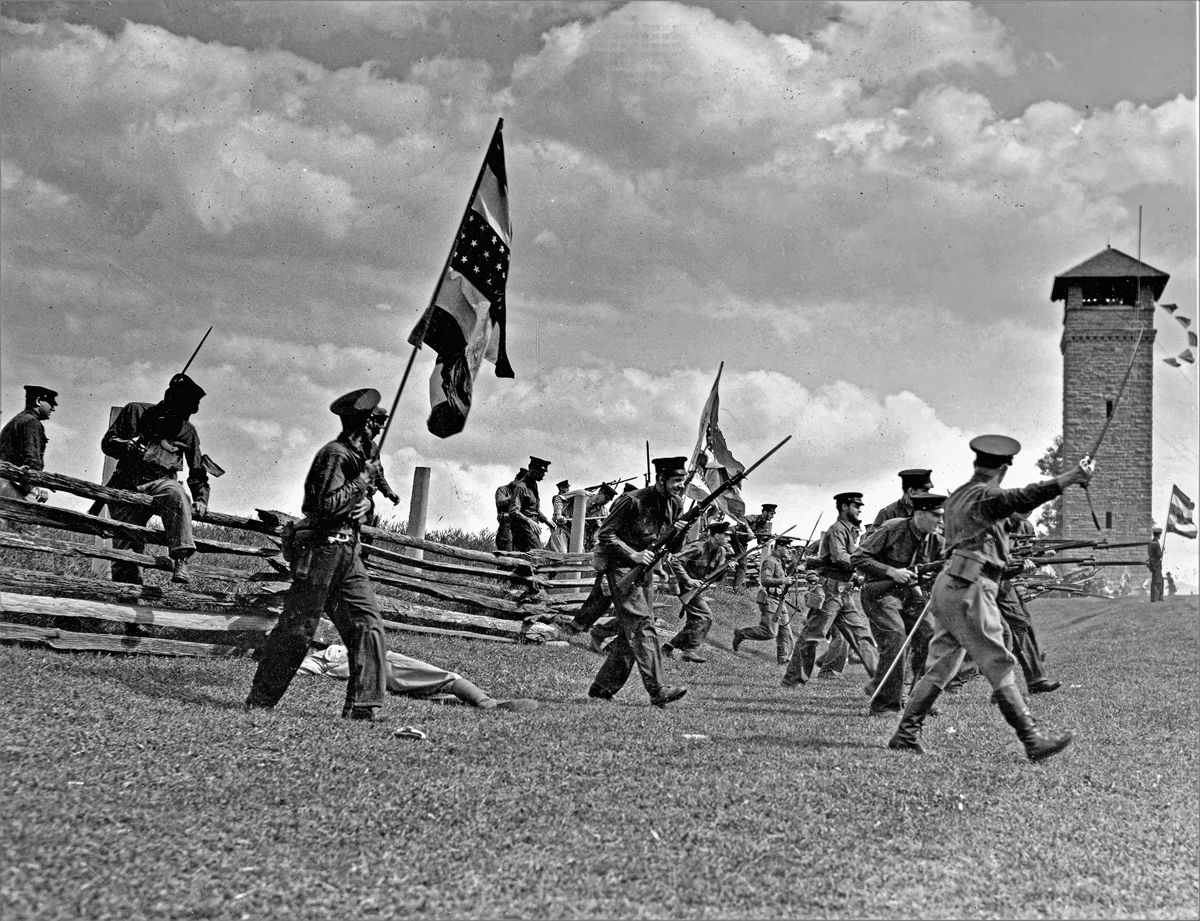
Bolt Action Rifles at Antietam? So, the Battle of Antietam was a testing ground for bolt action repeating rifles forty years before they were adopted by the U.S. Army. Who knew? Well that was not, unsurprisingly, the case, although the naïve observer from September 1937 might have come to that conclusion. This original news photo, another in my growing collection of old reenactment images, shows what was billed as a re-creation of the battle on its seventy-fifth anniversary. The caption on the back of the photo reads: “Antietam battle reenacted. The war between the states, concluded for over three-quarters of a century, lived again at the Antietam battlefield where Northern and Southern troops clashed at Bloody Lane simulating in realistic fashion the conflict that took place on the spot 75 years ago. Photo shows Union soldiers advancing into Bloody Lane.” Apparently, this reenactment was a huge event, with thousands of observers, including a few surviving Union and Confederate veterans and President Franklin D. Roosevelt, who took the opportunity to address the “vast crowd.” Lacking today’s crop of living history and reenactment enthusiasts, the National Guard was called on to portray the troops involved; they came in their modern uniforms carrying modern weapons. A newspaper account related that approximately fifty surviving veterans from both sides in the conflict attended the commemoration, and that “the bitterness of 75 years ago has disappeared and frequently men who fought for the South were seen arm in arm with soldiers of the North.” The reporter went on to write that “eagerly the old soldiers, all past four score and ten, watched the re-enactment of the Bloody Lane phase of the Battle of Antietam over the ground which many of them had traveled as young warriors three-quarters of a century ago. It was a day of pleasure for these aged men and after the program was completed many expressed themselves as delighted with their visit here.”
Last Bit on Revolver Cylinders – I Promise Reader and old west historian Michael Piatt advised me of a government report on 1837 weapons trials that involved, among other arms, Sam Colt’s revolving rifles and carbines. The Colt guns were entered in the trials with five cylinders each, and Colt proposed that they be carried loaded for quick reloading in the field. The Army rejected his design principally because, as I have pointed out in retrospect, changing cylinders required dismantling the gun which they deemed difficult in battle and on horseback. There were other reasons as well, though. As Mr. Piatt points out, “one was that the tests began with all guns unloaded… and they realized that muzzle loading and breach [sic] loading guns were getting off shots right away, while soldiers with Colt’s were still taking their guns apart and fiddling with detached loading levers and percussion caps (which might be dropped or lost). They especially did not like the added weight of loaded spare cylinders, 13 lbs., 14 oz for 35 shots, something modernday writers do not consider at all. They also were doubtful about the percussion system altogether, believing that placing caps on nipples in the dark, during battle, or on horseback was impossible. That concern proved incorrect, because the Army eventually adapted the percussion system and rejected flintlocks.” So, while in the earliest days of the revolver story, carrying loaded spare cylinders was an idea that sounded good and, although Sam Colt himself pitched the idea, it was rejected. By 1849, when Colt was back in the gun business to stay, he had dropped the idea himself, instructing buyers in the literature that came with his guns that “the cylinder is not to be removed when loaded.”
Sharps Cartridges for Today from Charlie Hahn I had a question from a reader as to the best type of paper to use for making cartridges for a Sharps percussion rifle or carbine, so I turned to my panel of experts. Bill Adams replied that: “The early Sharps catalogues [sic] described how to make cartridges that were much like the Charlie Hahn tubes used by many shooters. The best paper for making a truly combustible cartridge is hair curler papers such as those used by beauticians. I have used Kraft paper, onionskin paper, Hahn tubes, and hair curler paper as well as treated linen. All work well. If striving for accuracy, it is best not to use cartridges that are cut off by the gas check plate as the charges then vary from shot to shot. The hair curler papers also work well in Merrill and Starr carbines. “The stiff paper tubes do not burn up in the chamber on firing but get blown out (or rather sucked out) of the muzzle. If the paper or cardboard is too stiff, the tubes will stick part way up the barrel when fired. Charlie Hahn’s current tubes are about the same thickness as a thin business card and work much better than earlier brown cardboard tubes.” The Charlie Hahn referred to is: “Charles Hahn, Gunsmith” headquartered at 9 Locust
Court, Berlin, Maryland, 21881. Hanh not only produces paper cartridges but is a major gunsmith in the Civil War arms field. If you want your gun tuned up to snuff, Charlie is one of the guys to see. He replaces reproduction revolver barrels with N-SSA approved ones featuring the gain twist of originals and provides all kinds of competition grade forged and properly hardened parts for carbines, muskets, and handguns. For details, see his website: http://www.hahnmachineworks. com/index.html Joseph G. Bilby received his BA and MA degrees in history from Seton Hall University and served as a lieutenant in the 1st Infantry Division in 1966–1967. He is Assistant Curator of the New Jersey National Guard and Militia Museum, a freelance writer and historical consultant and author or editor of 21 books and over 400 articles on N.J. and military history and firearms, and as publications editor for the N.J. Civil War 150 Committee edited the award winning New Jersey Goes to War. His latest book, New Jersey: A Military History, was published by Westholme Publishing in 2017. He has received an award for contributions to Monmouth County (N.J.) history and an Award of Merit from the N.J. Historical Commission for contributions to the state’s military history. He can be contacted by email at [email protected].