
Who Shot General Mansfield? A Civil War Historian’s Search for Answers
By Steve Norder · Originally published October 2018 · pp. 14–15
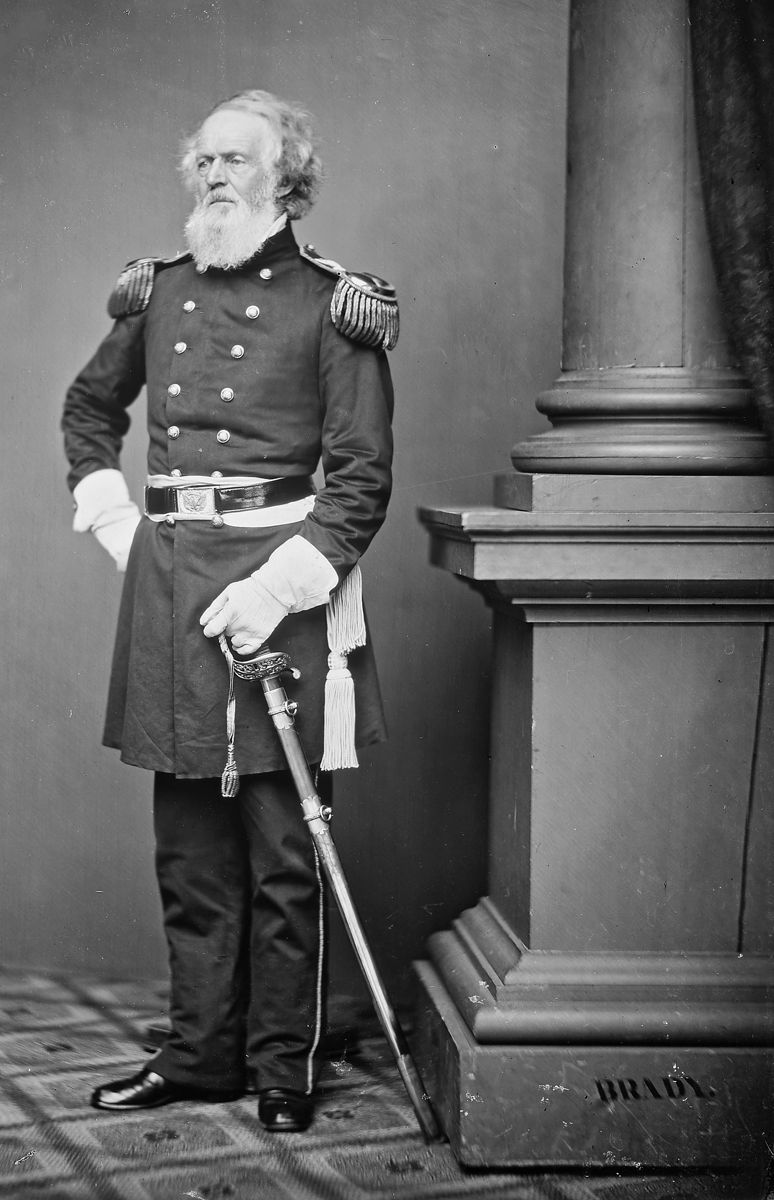
The 10th Maine Regiment of Volunteers crossed a plowed field as they shifted their column to a line of battle on Sept. 17, 1862. Some soldiers fell from heavy fire coming in the heavy woods to their front. At the tree line, the Mainers halted along a fence and finally got the order to shoot back. “On the rebel side we saw the men we were firing into, dodging from tree to tree, aiming at us, yelling, shaking their fists sometimes, and saucy generally,” John Mead Gould wrote after the war in the regimental history. “As well as we could tell, they were about as numerous as we, and it was a desperate fight we made of it.”1 On a knoll to the regiment’s right, Brig. Gen. Joseph K. F. Mansfield, the XII Corps’ new commander, noticed the shooting. He believed there were Union troops in those woods of large trees with little underbrush (the East Woods). At first the general “beckoned us to cease firing,” said Gould, the regiment’s adjutant, “and this was the very last thing we proposed to do, the few who saw him did not understand what his motions meant, and so no attention was paid to him.”2 Not getting the desired results from his arm motions, Mansfield rode down and along the line yelling at the Maine soldiers to stop firing. “I noticed Gen’l Mansfield and couldn’t keep my eyes off him,” Gould wrote in his diary that evening. “He at length came clear to the left, within 20 yards of the rebels and as his horse was hurt in the leg, he dismounted and helped [the horse] over the fence.”3 The Confederates in the woods “showed no colors,” Gould said. “They appeared to be somewhat detached from and in advance of the main rebel line.” A captain pointed out to Mansfield however, that they were the enemy. The general looked at the vague figures in gray shifting from one tree to another. He said, “Yes, yes, you are right.” But as he proceeded behind the 10th’s line, his coat blew open revealing he also had been shot. Gould helped him to an ambulance in the rear. Mansfield died the next day.4 Many years after the war, Gould had to be frustrated. He had written a history of the 10th Regiment of Maine Volunteers in 1871, but like all researchers and historians, Gould did not believe he knew the whole story of his regiment’s fight during the battle at Sharpsburg, Md. He continued to have questions. Which Confederate regiment faced off against the 10th Maine Infantry during the fight? And, therefore, which regiment mortally wounded the corps commander? These types of basic questions confront all Civil War researchers and writers. The who, what, when, where, why and how are part of every story. Without the answers to those questions, a story is incomplete. Gould, while writing the regimental history, discovered it was not easy to find answers about the battle of Antietam. He was there as the 10th’s regimental adjutant. Lieutenant Gould was on the firing line. He saw the enemy soldiers among the East Woods trees. He watched Mansfield ride along the regiment’s front. On that day, with the general taken to the rear, the battle itself continued. The fight moved from the northern fields and woods, next to the center and the area of the “sunken road,” and finally to Rohrbach’s (now Burnside’s) Bridge over Antietam Creek on the south. With the day’s fight over and Robert E. Lee’s army back across the Potomac River into Virginia, the burial of the dead commenced. As Gould pointed out after the war, the men of the 10th buried their Confederate counterparts. On the wooden grave markers, they wrote 20th Georgia. That was based on a corporal from the Maine regiment’s Company K claiming to have captured the 20th Georgia’s colonel, and another soldier said two other prisoners had the number “20” stitched on their caps. “We buried the rebels that we had killed, and ascertained that they were of the 20th Georgia, and we so marked their head boards,” Gould said.5 The war continued for Gould and the 10th. When his regiment’s enlistment ended in 1863, he, along with many others took a few months off from the war and then re-enlisted into the 29th Maine. Gould rose in rank to major. Following the war, he wrote the history of three related Maine regiments: first, tenth, and twenty-ninth. But he became obsessed with the Antietam battle and the death of Mansfield. His decades-long desire to know what happened and by whom led the former officer to become an early Civil War historian. Of course, Gould had advantages that today’s Civil War historians can only dream about. Besides being a participant in the war, and responsible for keeping the regiment’s records and orders as well as a meticulous daily diary of his own, Gould also wrote to as many of the regiment’s survivors as he could. “First, I wrote to and talked with about a hundred of you,” Gould said in the history, “till I learned thoroughly what we understood as the facts in the case…” He added, “We fought the 20th Georgia. Everybody so understood it.” Besides, it had been so officially reported by James S. Fillebrown, the 10th’s lieutenant colonel on Sept. 25, 1862.6 Like all good researchers, Gould did not stop there. “You will readily perceive as you read, why I made slow progress with such ‘facts’ as these to work upon, but after nearly two years of labor I believe I can state as genuine” that the 10th Maine “did not fight the 20th Georgia regiment.”7 At Antietam, the 20th Georgia was part of Brig. Gen. Robert Toombs brigade in Brig. Gen. David R. Jones’ Division, Longstreet’s Corps. They were not at the battle’s northern end. In fact, the 20th Georgia was about three miles away, defending against Burnside’s crossing of Antietam Creek far to the battle’s south. “I have the autographs [letters] of Gens. Longstreet and Toombs for this,” Gould said. “We therefore made a mistake when we carved ‘20th Geo.’ on those cracker-box head boards.”8 As Gould continued his research, he read the numerous post-war memoirs coming off the country’s presses. He found little to help his quest. The U.S. government also was publishing the series of official records documenting the war years. He therefore did what most of today’s Civil War historians do; he consulted The War of the Rebellion: A Compilation of the Official Records of the Union and Confederate Armies. More simply known as the OR, this multivolume set provides many of the answers to the Civil War’s basic questions, but not all the answers. “I thought I should surely learn everything now,” Gould wrote of the 1887 publication of the OR’s volume 19, which dealt with the battle of Antietam. However, Gould expressed a warning to all Civil War researchers then and now. “[B]ut, instead, there came with the reading a great confusion …” Gould, a participant in the battle, realized the OR could not be relied upon solely. “These reports are too meager, and often so erroneous that, as a whole, they are not trustworthy,” he said. As an example, he described the report written by the 10th Maine’s Lt. Col. Fillebrown, as five sentences written in a hurry, “four of which contain errors.” In addition, the lieutenant colonel “omitted all mention of Gen. Mansfield’s wounding …” It did not help that just as the fight started Fillebrown had been kicked so severely by a horse that he left the field.9 Another report in the OR muddied the information. The commander of the 125th Pennsylvania, a sister regiment to the 10th Maine, stated Mansfield was shot in their front. “Previous to this General Mansfield fell, some of my men carrying him off the field on their muskets until a blanket was procured,” he claimed. However during the 125th’s 1891 reunion at Antietam, which Gould attended, that commander, Jacob Higgins, told Gould he had no direct knowledge of the event and only wrote the report based on what his officers and men told him.10 Without answers coming from the OR’s reports, Gould turned to personal recollections of other participants. For modern researchers the “gold mine” of information comes from the soldiers themselves in the form of letters and diaries. While today the effort is finding the right letter with the right information, Gould simply had to ask for that information. For the regimental history, he contacted his fellow 10th Maine veterans. But to get a wider understanding of who could have been in the East Woods, he decided to correspond with other Antietam participants of both sides. He needed to learn about the whole battle. “I had now discovered that I didn’t know much about Antietam and that I had better learn my A B C’s for the next lesson,” he wrote in 1892. He expanded his correspondence both North and South, claiming that it was easier to find addresses for former Union soldiers, “but the Confederates are the better correspondents on the whole …” To find those Southerners, Gould often learned what part of a state a regiment came from and sent letters to the area post offices asking that they be forwarded to veterans.11 How great to write to a soldier who fought on that bloody September day to ask questions, seek clarification, and find out why his unit went this way instead of that way on the field. Gould asked those questions. After trial and error, especially in finding former Confederate soldiers, he received valuable information. He asked for clarifications. He weighed his correspondents’ responses against each other and against what he thought he knew. Unfortunately, the “gold” for today’s researchers is not as shiny. But when we find a soldier’s letter that describes an event we are researching, the tendency is to express “eureka.” Yes, we cannot write back with more questions. Yes, we still can be frustrated when that letter, or diary, does not tell us everything. But it is a step closer to learning what happened and, hopefully, how that particular participant felt about it. The same can be said for the letters Gould received. He wrote, “of the real fighters at Antietam a quarter did not care to write, another quarter have forgotten nearly all or, what is worse, have confused this battle with some other one. But by patience and persistence a few have been found in every regiment blessed by nature with the gifts of seeing and remembering. From them I have gradually got the story, though after all it is only a little fragment of the battle of Antietam.”12 Brigade by brigade, regiment by regiment, Gould corresponded with individuals asking them when and where they were during the battle. He found a possible regiment only to dismiss it as the Mainers foe in the East Woods. The 6th Georgia of Alfred H. Colquitt’s brigade. No. Roswell S. Ripley’s Georgia/ North Carolina brigade. No. The 5th Texas Regiment or the 4th Alabama of John Bell Hood’s division. No. Gould did receive a hint from his 4th Alabama correspondent. “He gave me one little item I was searching for,” Gould later wrote, “that while his regiment was entering the woods he met five companies of stray and unknown Georgia troops …” The historian felt he had the start of his “eureka” moment. “I thought I had almost found our ‘enemy,’ but I have been marching through Georgia these past 17 months for a little more light and certainty.” At last the editor of a Sparta, Ga., newspaper and a former private of the 6th Georgia regiment wrote Gould that early on Sept. 17, the “A” companies from all five of Colquitt’s Brigade were detached to fight independently. Those companies came from the 6th, 23rd, 27th, 28th Georgia and 13th Alabama regiments.13 Gould also took another step toward understanding Antietam, a step today’s Civil War historians recommend as important: He walked the battlefield. He visited Antietam three times. First came a trip in 1889 sponsored by his former regiment. He took with him the then-new invention, a Kodak camera, to record what he saw. The second visit was in conjunction with the reunion of the 125th Pennsylvania in 1891. That provided a chance to review his knowledge and refute that regiment’s claims. He also took along his son, Oliver Cromwell Gould, to help take pictures. Gould’s first attempt at photography had been unsatisfactory; he forgot to write down what each picture showed. The third trip came in 1894. It was during this visit when Gould believed he finally solved the mystery, with the help of William N. Robbins. The former Confederate major of the 4th Alabama Regiment in Evander M. Law’s Brigade, John B. Hood’s Division, had corresponded extensively with Gould, making the suggestion that it was the detached five companies from a different brigade, along with part of the 4th Alabama, that met the 10th Maine. Once adversaries, the two walked the area of the former East Woods, though by then most of the trees were gone, and agreed on the sequence of events some 32 years earlier. The 4th Alabama, on approaching the East Woods, came upon what Robbins described as a “half regiment” and Gould called a “skirmisher battalion” from General Colquitt’s brigade. They agreed to re-enter the woods on the 4th’s right. “All this was done in great haste,” Gould later wrote, “and in consequence of this and the broken character of the woods and the rush for shelter, the two commands were mixed all together.” Later, he added, the 5th Texas Regiment joined in the fight. “The Confederates opposed to us appeared to be equal to us in numbers and they were superior in experience and all that experience gives,” Gould said. “On all other fields, from the beginning to the end of our long service, we never had to face their equals.”14 In 1895, following that last trip to the Antietam battlefield, Gould published a pamphlet in an attempt to provide a final word on the mystery. He claimed: “It was bad enough and sad enough that Gen. Mansfield should be mortally wounded once, but to be wounded six, seven or eight times in as many localities is too much of a story to let stand unchallenged.”15 For Gould the story was explained, the mystery solved. He lived until 1930 believing he knew who his regiment faced at the East Woods near Sharpsburg and who shot General Mansfield. As Michael K. Shaffer repeatedly points out in his column on research sources, the gold standard is primary, original accounts. But as researchers we know (or have to be reminded) that primary sources are not always accurate. As humans, we make mistakes. We do not remember clearly. We remember parts but not other parts so we fill in the gaps of memory with what we believe are logical fillers, and while those become “facts” in our memories, they could be erroneous. Soldier accounts of battle are invaluable. However, events on a battlefield are confusing. The noise, the fear, smell and horror affect the mind to a degree. Gould wrote, “for many men are so constituted that in battle they see only what is going on under their own eyes …” There is no notice of events at an organizational level from the company on up.16 But historians take what can be found. Try to make sense of it, and then present it to other Civil War enthusiasts. Like Gould, we are prepared to revise our conclusions when new information comes along. All of that, from research to writing to revision, makes the study of the Civil War worthwhile. Endnotes: 1. John M. Gould, History of the First-Tenth-Twenty-ninth Maine Regiment In Service of the United States from May 3, 1861, to June 21, 1866 (Portland, ME: Stephen Berry, 1871), 238. 2. Gould, History, 240. 3. William B. Jordan Jr., ed., The Civil War Journals of John Mead Gould, 1861–1866 (Baltimore: Butternut & Blue, 1997), 194. 4. Gould, History, 240-241. 5. Gould, History, 247, 248, 249. 6. Gould, History, 248-249; OR, vol. XIX, pt. 1, p. 489. 7. Gould, History, 248-249. 8. OR, vol. XIX, pt. 1, p. 804; Gould, History, 249. 9. “Fighting Them Over …
What Confederate Troops Fought the 10th in East Woods?” National Tribune (Washington, D.C.), August 25, 1892, vol. XII, no. 4, p. 4, col. 1. 10. Jacob Higgins, “Report of Col. Jacob Higgins, One hundred and twenty-fifth Pennsylvania Infantry, of the battle of Antietam,” OR, vol. XIX, pt. 1, 492; “Fighting Them Over …,” National Tribune (Washington, D.C.), August 25, 1892, vol. XII, no. 4, p. 4, col. 2. As late as 1892, a former 1st lieutenant of the 125th insisted Mansfield was shot in their front writing Gould was wrong. Edward R. Dunigan, “Battle of Antietam,” National Tribune (Washington, D.C.), November 3, 1892, vol. XII, no. 14, p. 4, col. 3. 11. “Fighting Them Over …,” National Tribune
(Washington, D.C.), August 25, 1892, vol. XII, no. 4, p. 4, col. 1. 12. Ibid. 13. Ibid., cols. 1-2. There do not appear to be regimental reports for the five regiments in the OR, vol. XIX, to verify the separation of a company from each. 14. John M. Gould, Joseph K. F. Mansfield, Brigadier General of the U.S. Army: A Narrative of Events Connected with His Mortal Wounding (Portland, ME: Stephen Berry, Printer, 1895) 23, 31. 15. Gould, Mansfield, 3. 16. Gould, History, 242. Norder lives near Atlanta. His book, Lincoln Takes Command: The Campaign to Seize Norfolk and the Destruction of the CSS Virginia, is expected to publish early next year from Savas Beatie.