
USS Monitor Dahlgren Gun Conservation Continues
By Joan Wenner, J.D. · Originally published October 2018 · pp. 1–3
NEWPORT NEWS, Va.—The Mariners’ Museum & Park’s much-acclaimed Monitor Center is the official repository of artifacts from the famous ironclad since retrieval of its encrusted turret and celebrated return to Hampton Roads in 2002. (See also CWN in Sept. 2017).The vessel’s port XI-inch Dahlgren is undergoing conservation at the “tank farm” at its Batten Conservation Laboratory Complex. Conservation archaeologist Erik Farrell, the newest member of the exceptional Monitor team, admits to a longtime interest in conserving recovered historic weapons of war—laborious work to be sure. Erik came to the Center from the North Carolina Department of Natural and Cultural Resources where he was involved with the popular Queen Anne’s Revenge project. He earlier interned abroad at Bevaringscenter Fyn in Denmark. He explains his primary endeavor as assisting in conserving the Dahlgren cannons and summarizes some of the processes below based on a few questions I posed to him.
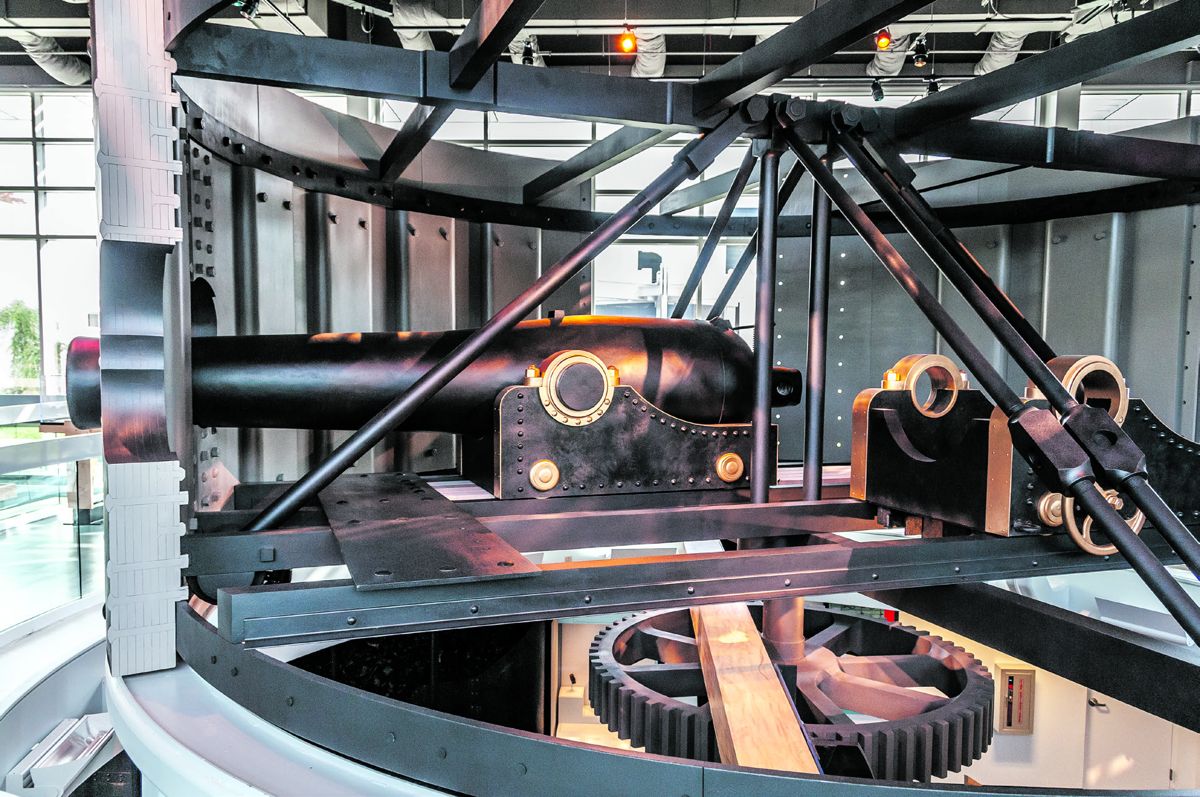
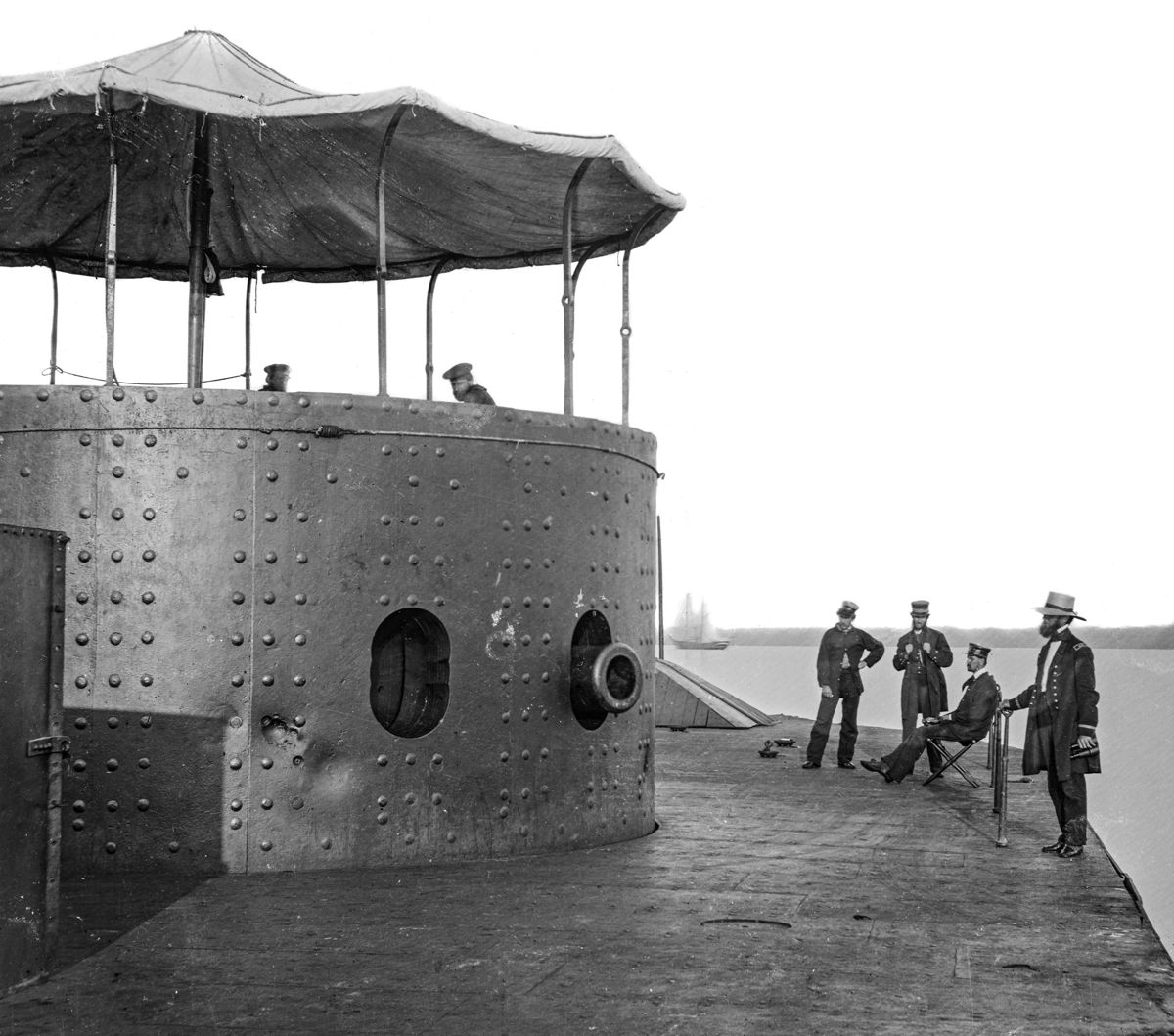
First Some Background The USS Monitor was built at Greenpoint, N.Y., at a cost of $275,000 as the prototype for a new class of vessel intended to destroy Confederate ships and control strategic ports and sounds. The Monitor had an anchor that could be raised or lowered from below deck, forced-air ventilation, and a flushing shipboard toilet among her unique features. Additionally, she had two XI-inch Dahlgrens on specially designed gun carriages in its revolving turret. The Monitor sank on Dec. 31, 1861, off the North Carolina coast. Her resting place remained unknown for over a century, notes U.S. Coast Guard CDR Kevin Saunders, Deputy of Maritime Security and Response. In August 1973 scientists using side-scan sonar aboard the R/V Eastward found the Monitor and verified the find in 1974. There was concern how to protect a site that was, at a time prior to the Law of the Sea Convention, lying in international waters. This was subsequently worked out and the site designated as the nation’s first national marine sanctuary in 1975. The sanctuary’s boundaries are presently under review for expansion, additional site surveillance, and enforcement methods to protect the Monitor wreck. One of the first steps of the Monitor turret conservation project occurred when the sunken turret was recovered in a special ‘spider-web’ apparatus by U.S. Navy, NOAA, and others, barged up the James River, and trucked to the Mariner Museum site and a prepared conservation lab.
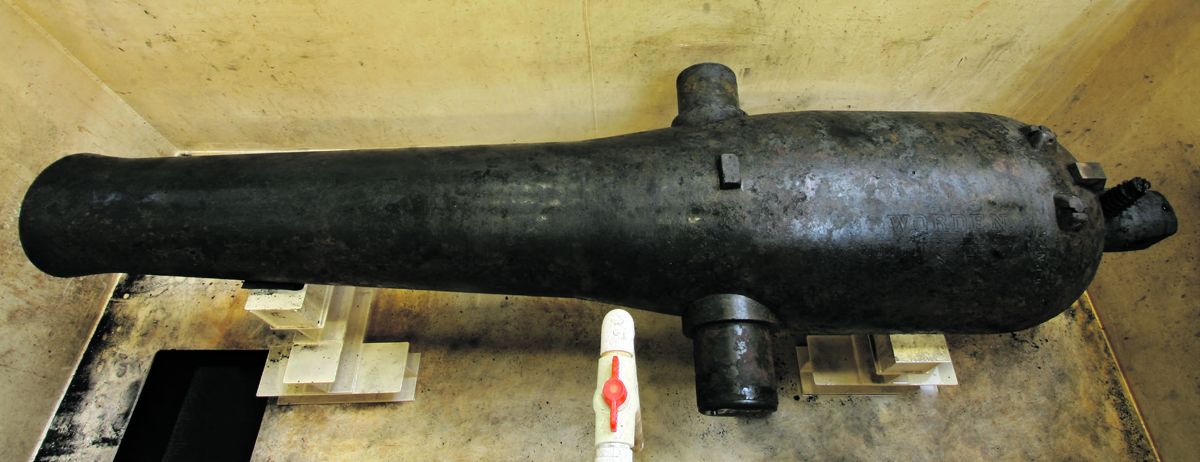
The Dahlgren Plan The strategy guiding the conservation to forestall oxidation and disintegration of the cannons, by containment in a moisture-free controlled environment with as little oxygen as possible, has been proceeding for some time. One task is for Erik to design a new coring drill adapter and mount to clean the cannon bores to their breech. Readers can get a feel for the conservation challenges, and sometimes re-conservation, with this artifact in Farrell’s answers. (Jack Melton) Q: Briefly explain for readers what the ‘tank farm’ is. A: The ‘tank farm’ is an outdoor covered storage area at the Mariners’ Museum’s Batten Conservation Complex, with a number of medium-sized storage tanks for objects recovered from USS Monitor. All objects remain wet until we have them fully stabilized to prevent their deterioration. The tank farm is one location where storage and wet treatment happens. People may be more familiar with the large storage and treatment tanks in the main lab area that can be seen from the viewing platform inside the Mariners’ Museum. The inside tanks hold big, multi-ton objects like the Dahlgrens, engine, condenser, and the turret. The tank farm is the same basic idea, but scaled down somewhat. The objects in those tanks are generally a few hundred pounds, although the technical maximum for the lifting equipment means objects
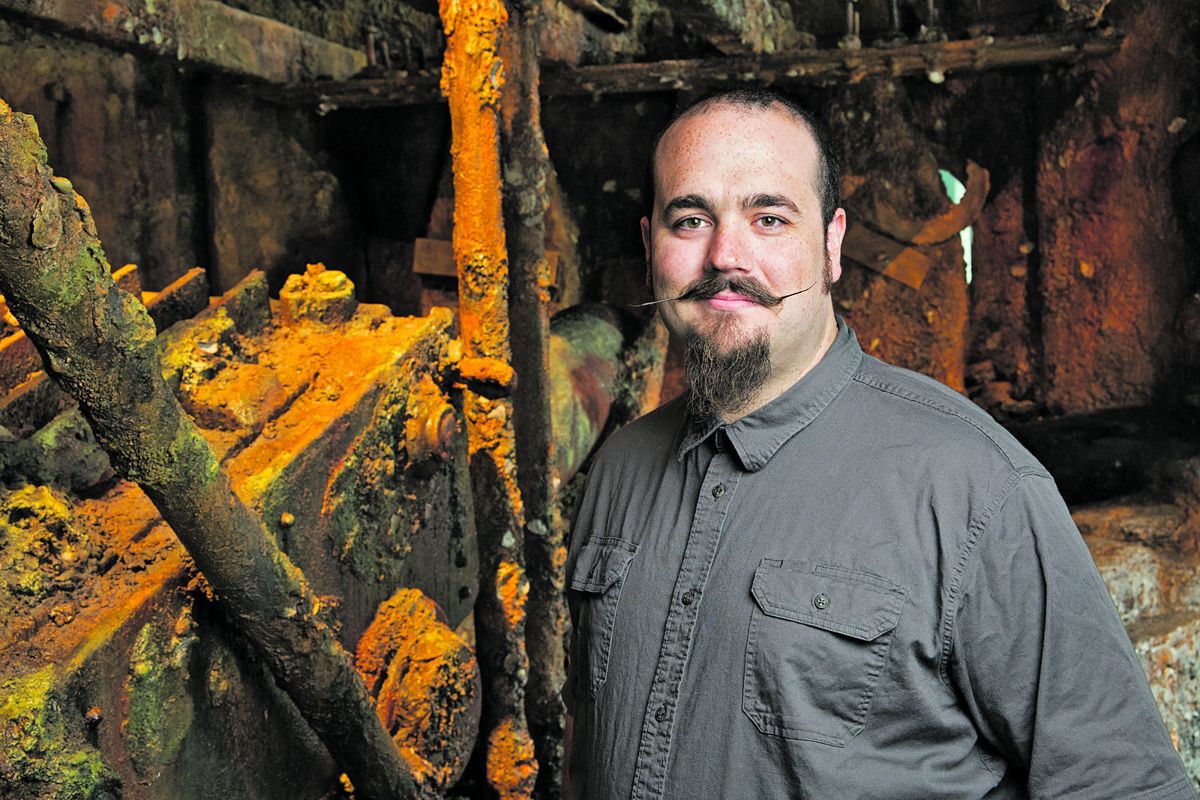
team. (Courtesy of Mariners’ Museum and Park) weighing 2 tons could be accommodated. We’re still dealing with big objects, just not in comparison to an XI-inch gun, much less a 120-ton turret! There’s also an open working area adjacent to the covered storage where we can do treatments that are extremely noisy, dirty, or otherwise best done outside.
Q: What are a couple of steps currently being done to combat erosion from the marine environment including scraping the inside of the cannon? A: Iron objects from USS Monitor and other saltwater wrecks are extremely unstable because they have taken on salt from the ocean. Unless an object is conserved, chloride from salt will cause the metal to rust until eventually nothing is left. All the treatment of iron objects is done to help remove salts. Dry ice blasting, for instance, is a surface cleaning method that removes corrosion products without damaging the metal surface by firing a stream of dry ice at the surface with compressed air. This physically removes any salt in the corrosion itself, and it exposes the metal surface so other treatment solutions can better reach it and more fully remove salt. Because of differences in condition, that method is used for wrought iron from the Monitor, but generally not on cast iron. Removing concretion and corrosion from inside a cannon bore serves a similar purpose. It cleans off corrosion products, and exposes the original surface so we can more easily remove salts. Because of the shape and limited access, cleaning inside a gun requires different techniques. Coring drills are the most common method used on smoothbore artillery because they allow relatively easy, controlled removal of the marine concretion and other corrosion inside the bore. The challenge is to make sure the drill is fractionally smaller than the bore so the least amount of corrosion possible is left without actually cutting into the gun. To do this, the drill and the gun bore must be perfectly aligned. Errors are compounded over distance; if you miss your alignment by a few degrees at the front of the muzzle, you could be off by several inches in any given direction at the breech. It’s important to have a core drill setup that lets you align everything properly, or else you end up doing damage to the gun. Q. Can you summarize examples of the most major challenges in the conservation effort and treatments? A. The sheer size causes probably the biggest challenge. This is compounded by their having been in salt water for nearly 140 years. The guns from the Monitor are about 16,000 pounds each, and the iron has corroded out of the surface layer leaving a fragile layer of (mostly) carbon instead. With a small gun (think-2,500 pounds or lighter) and guns with a less fragile surface, a drilling rig to clean the interior doesn’t need to be perfect. The guns are small enough to readily move, and you can manipulate the gun into position around the drill instead of the other way around. In most ‘standard’ setups for this sort of operation, shims and wedges are used to help with the left/right alignment of the gun with respect to the drill. With something big and fragile like the Monitor Dahlgrens you can’t do that; there is so much weight on such a fragile surface that applying similar methods will gouge pieces out. Brute force isn’t an option on something like this; the setup needs to allow alignment without applying force directly to the outside of the guns. Dahlgren shell guns also have a concave powder chamber; the back of the bore is not flat, but rather an elongated hemisphere of sorts. A single coring bit can’t get all the way to the rear; it can only go as far as the transition into the powder chamber. In order to clean out the final section, we’ll need a smaller core, then try to chip out the ‘corner’ of concretion that remains. We also need to be very careful about how far each bit goes in. Original diagrams exist which theoretically give values to within 0.1 inches for how deep we can send each drill bit, but original diagrams are often in a category I would describe as ‘trust, but verify.’ There’s a level of caution required; slamming the coring drill to the theoretical back of the bore as fast as possible is, as a general rule, a rather poor idea.
A lantern found inside the turret during excavation in 2002. Over the course of several months, this lantern was conserved by a three member team of the museum’s Conservation department. Notice the delicacy of the glass globe, pieces of which were reassembled back together carefully inside the lantern cage structure. MNMS.2002.001.338
Once the Dahlgrens are clean inside and out, they can finish desalination treatment until all salt is removed. After that, they will be dried in a controlled manner and protective coatings will be applied to help keep them in good condition for as long as possible. Even after been treated, they will likely need to be displayed in an environment with carefully controlled relative humidity to keep them from corroding again. Stay tuned for the progress or schedule a visit! For further information go to www.monitorcenter.org and click on “Conservation” and “Blog” and also view the conservation webcams. Also see www.marinersmuseum.org information.
for
Joan Wenner, J.D. is a longtime CWN contributor and book reviewer, Civil War history writer and modern maritime writer with a law degree. Her work has also appeared in The Artilleryman. Email: [email protected]
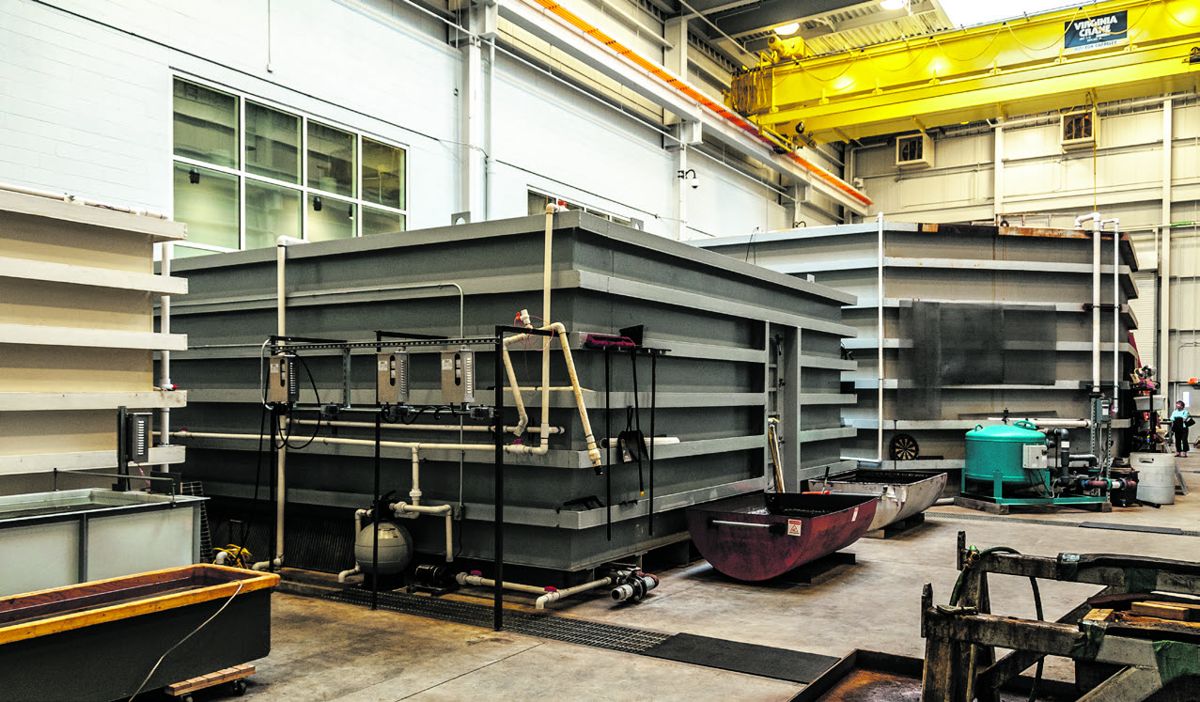
The anchor was recovered 495’ off the starboard bow of the wreck in 1983. (Jack Melton) View of the Wet Lab at the Batten Conservation Complex at The Mariners’ Museum and Park where the iconic gun turret, XI-inch Dahlgren shell guns, and mechanical components from Monitor’s engine room are being stabilized. (large tanks from L to R: condenser, engine, turret) (Jack Melton)