
The New York Times and Its Use of Gatling Guns During the Draft Riots: Fact or Fiction?
By Paul Taylor · Originally published October 2018 · pp. 20–21
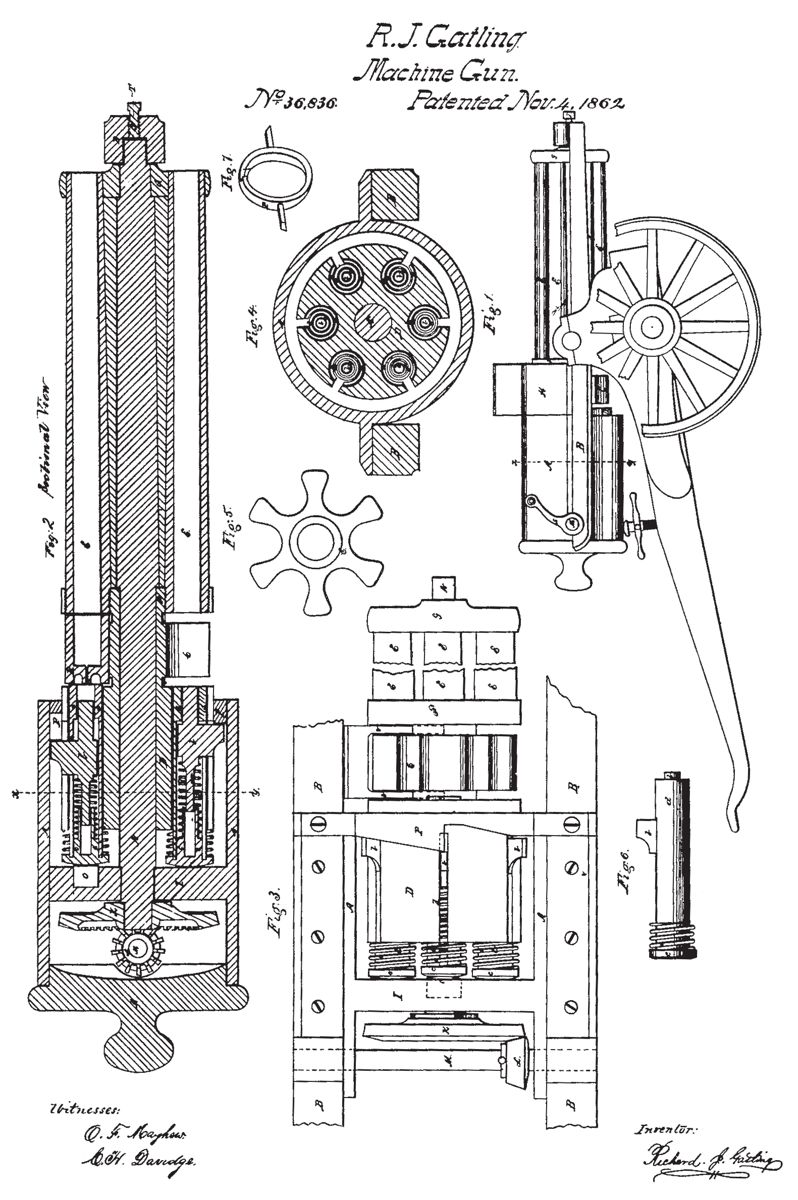
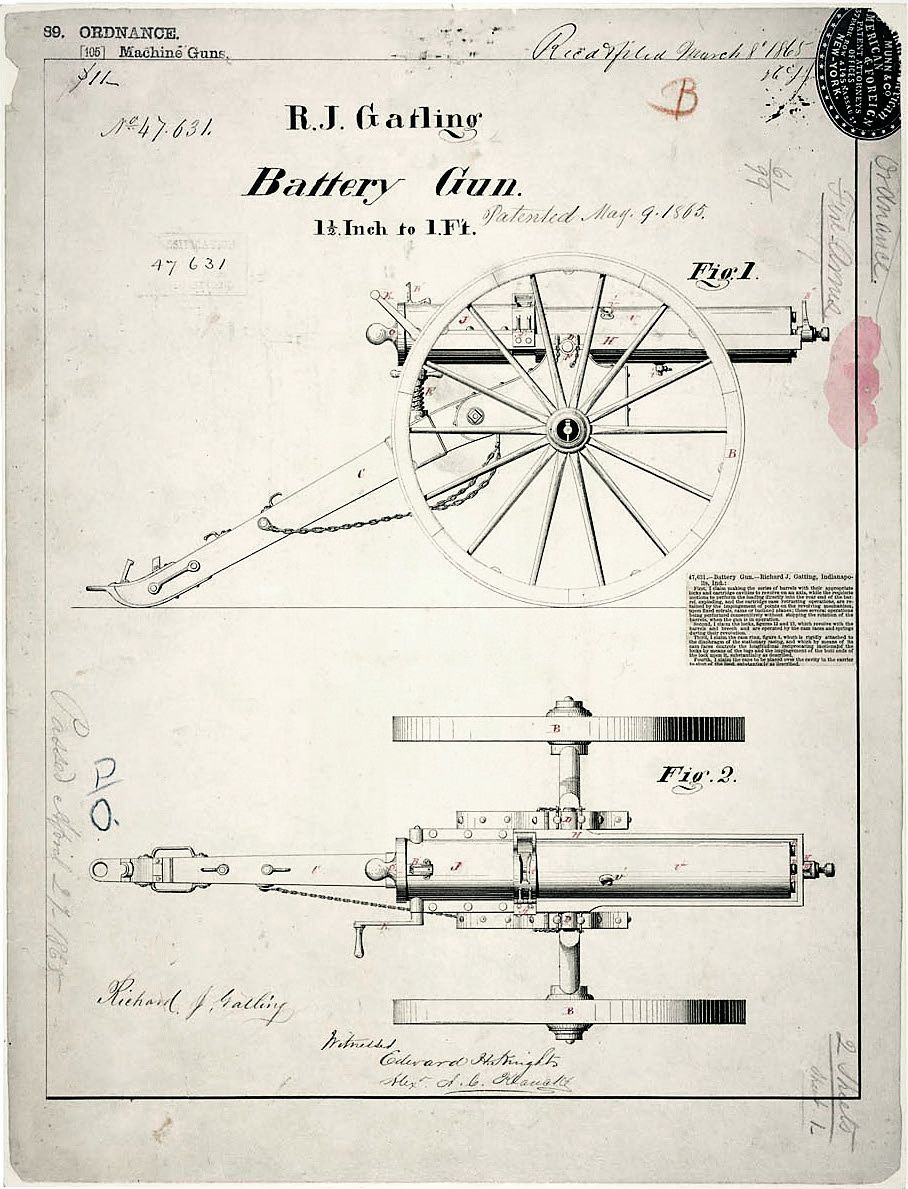
One fascinating tidbit of Civil War lore maintains that New York Times publisher Henry J. Raymond obtained three recently-invented “mitrailleuses,” a new type of hand-cranked, breech-loading mounted machine gun, to help defend his newspaper’s building during the bloody New York City anti-draft riots of July 13–16, 1863. More popularly known as “Gatling guns,” the story claims that two of these weapons were placed at windows on the ground floor with a third strategically placed in an upper-story window so that it could sweep Chatham and Centre Streets in any direction. Some anecdotes even allege that the third weapon was trained on the rival New York Tribune offices across the street, and in particular, on publisher Horace Greeley’s office window since there was little love lost between Greeley and Raymond. This third weapon was said to be manned by Times shareholder Leonard W. Jerome, future grandfather of Winston Churchill. Other employees were armed with rifles resulting in a stern display of resistance that was sufficient to prevent any rioters from attempting an attack against the Republicanleaning Times as they had done against the Tribune. Most of these particulars are found in Elmer H. Davis’s History of the New York Times 1851– 1921, which was self-published by the newspaper in 1921. Davis was Times editorial staff member and prepared his “historical sketch” with input from other colleagues in celebration of the paper’s seventieth anniversary. Davis reiterated the Gatling gun story on page 60, but admitted the story was “according to tradition through the President’s friendship with Raymond.” The book contains no endnotes so we can conclude from Davis’s own words that, as far as he was concerned, the story was based on oral tradition with no documentary evidence.1 The legend was repeated thirty years later in Meyer Berger’s Story of the New York Times 1851–1951, published as part of the paper’s centennial celebration. Berger’s version claimed that two guns were obtained, not three as Davis wrote, and that they were both placed in an upstairs north window “to sweep the approaches most likely to be used by the Bowery bully-raggers.” Jerome “joyfully” manned one of the pieces while Raymond took charge of the other. As was the case with Davis’s earlier work, no endnotes were supplied, nor did Berger mention how this story originated.2 This tale has been repeated in countless 20th- and 21st-century books. A Google search for “New York Times” and “Gatling gun” will reveal dozens of web pages that repeat the story. But just how accurate is this legend? By closely examining the period evidence or the lack thereof, this essay sets out to determine whether or not these weapons were really present at the Times office during the riots. First however, some historical context regarding the Gatling gun’s invention and subsequent production is necessary. The gun was the creation of thirty-three-year-old Dr. Richard J. Gatling, originally of Perquimans County, N.C., who was heartbroken at the sight of dead, mangled, and sick men returning home to Indiana in 1861. Realizing that most of those deaths were due to illness and not battle, Gatling, perhaps somewhat paradoxically, desired to create a weapon that one man could fire with such rapidity that it would eliminate the need for large standing armies. Gatling’s first prototype, which could fire one to two hundred rounds per minute, was displayed in Indianapolis in early 1862. Later that year on November 4, Gatling received the first of numerous patents for his weapon.3 Paul Wahl and Donald R. Toppel’s 1965 book titled The Gatling Gun was an important work in establishing the timeline of when and where Gatling’s initial guns were created and disbursed. Gatling displayed his lone prototype throughout 1862 while making numerous efforts to sell his invention to the U.S. Army, though with no success due primarily to cranking and cartridge feed problems. After Gatling made corrections, he arranged to have six guns built in Cincinnati; however disaster struck in late 1862 when the factory was burned to the ground, most likely by Confederate saboteurs. The six guns nearing completion were destroyed in the blaze. Gatling soon obtained the necessary financial backing to build thirteen more guns in between the spring of 1863, twelve were sent to Baltimore with the one remaining headed to Washington for another attempt to sell the weapon to the army or the navy.4 Wahl and Toppel reprinted portions of an interview Gatling conducted years later in which he claimed that the army’s Chief of Ordnance, Brigadier General James W. Ripley, received
Gatling’s Washington agent rather coolly and refused to consider the weapon. The navy, though, was willing to conduct tests which occurred at the Washington Navy Yard in mid-May and on July 17, 1863. Meanwhile, Major General Benjamin Butler, who happened to be in Baltimore, heard of the weapons and wanted to see them in action. The boisterous general imagined himself an ordnance expert and loved new gadgetry. As a result of the demonstration, Butler bought all twelve of the Baltimore-based guns for $12,000 out of his own pocket after the army refused to pay for them. The general had the guns shipped back to his command near Petersburg, Va., where they saw occasional action in 1864. So by the time of the July 1863 New York riots, twelve of the initial twenty guns were with Butler, six had been destroyed in the Cincinnati fire, Gatling’s original prototype was with him in Indiana, with the final gun in the care of Gatling’s agent in Washington.5 Therefore, if the New York Times Gatling gun story is true, then where did the Times’ guns come from? Wahl and Toppel asked that question in their 1965 book and concluded the answer was “a mystery” since the War Department had not formally purchased any. Moreover, they viewed the Times’ oral tradition of Lincoln arranging for Raymond to receive the guns as “improbable.” After all, if the Times’ oral history is to be believed, how did Lincoln know such guns were available in New York for Raymond’s use?6 For scholars and historians, the most obvious question is what do the primary sources have to say about this tale? It is certainly reasonable to conclude that the presence of these new, then state-of-the-art weapons would have merited some measure of commentary from the Times. The Gatling gun was certainly not a secret weapon, as it had been reported on extensively in Indiana newspapers during 1862. By making note of these new weapons, the Times also would have highlighted Raymond’s personal influence in being able to acquire them in the first place. Yet not one of the riot reports that appeared in the Times during the uprising or in the days following mentions the presence of these guns. Nor does the New York Tribune, the Republican rival and street neighbor of the Times, reference those weapons in any reports during or after the riots. Furthermore, a published report prepared in 1863 by New York’s metropolitan police department pertaining to its role in suppressing the riots likewise does not mention this new weaponry.7 An early biography of Raymond published in 1870 just after his 1869 death mentioned in passing that “revolving cannon” and other “death dealing weapons” were on hand at the Times to repel any attack during the riots, but without further comment. Frederic Hudson’s Journalism in the United States, from 1690– 1872, also reiterates the tale but with no sourcing mentioned or other citations. One of the earliest, oft-cited riot accounts is clergyman Joel T. Headley’s The Great Riots of New York, 1712 to 1873: Including a Full and Complete Account of the Four Days’ Draft Riot of 1863. Headley made no mention of Gatling guns, but did report that the Times had armed itself to protect its interests and that it had illuminated the area around its building to ward off rioters.8 The earliest primary source account I uncovered regarding the alleged employment of these guns was in The Volcano under the Streets, published twenty-three years after the fact in 1886. This “eyewitness account” of the New York riots was anonymously penned by “A Volunteer Special” though history now knows the author was William O. Stoddard, perhaps best known as one of President Abraham Lincoln’s personal secretaries from July 1861 to July 1864. His book states he was in New York and served as a volunteer for the first two days of the riot. Stoddard offhandedly mentioned that the guns were at the Times office on Tuesday, July 14, but does not state whether he personally saw them or how he obtained this information.9 Twelve years later in 1898, John Swinton, an editorial writer at the Times during the riots, penned his “Memories of the New York Times” for the paper. Swinton claimed to have personally seen the Gatling guns manned by Jerome and Raymond during those dark days, but also admitted he had never read about the story in any earlier account of the riot.10 The most highly-regarded, modern book-length treatments of the draft riots are Adrian Cook’s The Armies of the Streets (1974), Iver Bernstein’s The New York City Draft Riots (1990), and Barnet Schecter’s The Devil’s Own Work: The Civil War Draft Riots and the Fight to Reconstruct America (2005). Cook mentions the Gatling gun story, citing Davis’s and Berger’s 20thcentury secondary accounts. Dr. Bernstein’s work ignores the tale entirely, as does Schecter though the latter wrote that the Times and Tribune were both heavily armed by citing Headley’s 1873 secondary account.11 In 2008, author Julia Keller wrote the most recent history of the gun and its inventor titled Mr. Gatling’s Terrible Marvel. With colorful prose, Keller cites Wahl and Toppel’s work to assert that the weapon’s draft riot appearance was the Gatling gun’s most powerful and symbolic presence during the Civil War. Seven pages later, however, Keller seems to hedge her bet when she writes how the Times editors “reportedly” trained their Gatling guns on the rioters. A recently published 2016 book titled City of Sedition: The History of New York City during the Civil War by John Strausbaugh again recounts the Gatling gun tale, citing Schecter’s 2005 secondary account, which does not specifically mention the legend.12 Even modern histories of the New York Times persist in repeating this folktale. In The Most Fearful Ordeal: Original Coverage of the Civil War by Writers and Reporters of the New York Times, renowned Civil War historian James McPherson informs readers in his Introduction that they will learn of New York City’s terrible July 1863 draft riots. Those days were such, claims McPherson, that “Times employees stationed three newly invented Gatling guns on the roof to scare off rioters bent on burning down the building.” Yet, as previously noted, there is no such observation in the book’s lone period account of the riots. The book does not offer endnotes so readers are left wondering where
McPherson obtained his insight.13 In The New York Times Complete Civil War 1861–1865, Editors Harold Holzer and Craig L. Symonds also mention the Gatling gun tale as part of an introductory paragraph which discusses an offer of advice to Lincoln in the days after the riot. The editors cite a July 19, 1863, letter to Lincoln found in the Library of Congress’s Abraham Lincoln Papers; a letter which is indeed filled with counsel, however the letter makes no mention of Gatling guns. Moreover, as stated earlier, none of the book’s six reproduced articles make any mention of Gatling guns.14 In summation, there is no primary source documentation from during or after the riots that confirms the presence of these guns at the New York Times’ offices. Moreover, an examination of the historical record as to how many of these guns were built by Gatling and their locations during the riots’ July 13–16, 1863, timeframe refutes the Times story. Given the complete lack of period evidence, historians should conclude that this tale is a Civil War “urban legend,” repeated often enough through the years within secondary sources, but with no basis in documentary fact. Endnotes: Elmer H. Davis, History of the New York Times 1851–1921, (New York: New York Times, 1921), 60. 2. Meyer Berger, Story of the New York Times 1851–1951, (New York: Simon & Schuster, 1951), 24. 3. Paul Wahl and Donald R. Toppel, The Gatling Gun, (New York: Arco Publishing Co., 1965), 11-13. 4. Ibid., 17-19, 20. 5. Ibid., 19-20. 6. Ibid., 24-25. 7. Wahl and Toppel, Gatling Gun, 18.; David M. Barnes, The Draft Riots in New York, July, 1863: the Metropolitan Police; Their Services during Riot Week; Their Honorable Record, (New York: Baker & Godwin, 1863). 8. Augustus Maverick, Henry J. Raymond and the New York Press, for Thirty Years: Progress of American Journalism from 1840 to 1870, (Hartford, Conn.: A. S. Hale & Co., 1870), 164.; Frederic Hudson, Journalism in the United States, from 1690–1872, (New York: Harper & Brothers, 1873), 634-35.; J.T. Headley, The Great Riots of New York, 1712 to 1873: Including a Full and Complete Account of the Four Days’ Draft Riot of 1863, (New York: E. B. Treat, 1873), 218, 242. 9. “A Volunteer Special”, The Volcano Under the City, (New York: Fords, Howard, & Hulbert, 1886), 3-4, 133. 10. “Memories of the New York 1.
Times,” New York Times, March 27, 1898. Adrian Cook, The Armies of the Streets: The New York City Draft Riots of 1863, (Lexington: Univ. Press of Kentucky, 1974), 87-88.; Iver Bernstein, The New York City Draft Riots: Their Significance for American Society and Politics in the Age of the Civil War, (New York: Oxford Univ. Press, 1990).; Barnet Schecter, The Devil’s Own Work: The Civil War Draft Riots and the Fight to Reconstruct America, (New York: Walker & Co., 2005), 179. Julia Keller, Mr. Gatling’s Terrible Marvel: The Gun That Changed Everything and the Misunderstood Genius Who Invented It, (New York: Penguin Group, 2008), 16768, 175.; John Strausbaugh, City of Sedition: The History of New York City during the Civil War, (New York: Twelve Books, 2016), 279, citing Schecter 242-46. The Most Fearful Ordeal: Original Coverage of the Civil War by Writers and Reporters of the New York Times, (New York: St. Martin’s Press, 2004), xii. Harold Holzer and Craig L. Symonds, eds., The New York Times Complete Civil War 1861–1865, (New York: Black Dog & Leventhal Publishers. 2010), 11, 19. The endnote cites a July 19, 1863 letter from Henry Raymond to Lincoln. Neither I nor staff at the Library of Congress’s Manuscript Division could find such a letter. There is, however, a letter of that date from New York attorney David Dudley Field to Lincoln offering counsel, however there is no mention of Gatling guns in the letter.
Paul Taylor’s most recent book is ”The Most Complete Political Machine Ever Known”: The North’s Union Leagues in the American Civil War, which has just been published by Kent State University Press