Through The Lens
The Defender of Cincinnati
By Stephanie Hagiwara · Originally published October 2018 · pp. 10–11
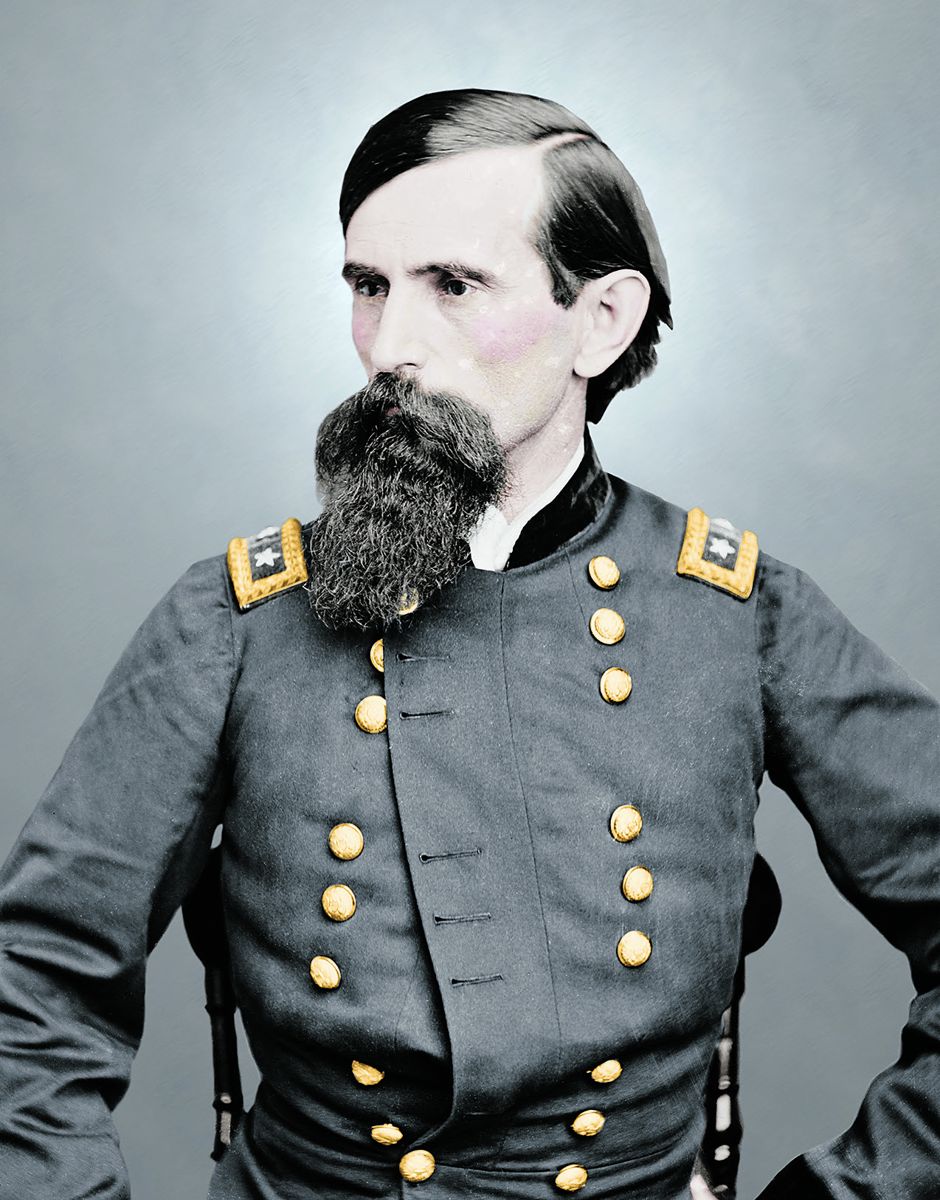
Colonels, I knew, were becoming generals every day, but I had yet to hear of generals dropping back into colonels. – U.S. Gen. Lew Wallace On Sept. 3, 1861, Lewis Wallace was promoted from Colonel to Brig. General. By the end of June 1862, he was relieved of his command of the 3rd Division. Wallace had become the Union’s scapegoat for the high casualty count at the Battle of Shiloh, Tenn. Consequently, U.S. Sec. of War Edwin Stanton was more than willing to accommodate Indiana Governor Oliver Morton’s request for Wallace to give recruitment speeches in his home state. Wallace, on the other hand, was determined to find his way back onto the field. However, as President Lincoln admitted, “A major general once out, it is next to impossible for even the President to get him in again.” In August 1862, Wallace’s efforts to get “off the shelf” were aided by the Confederates. As part of a two-pronged effort to control Kentucky, C.S. Gen. Braxton Bragg and U.S. Gen Don Carlos Buell raced to get to Louisville, Ky., first while C.S. Gen. Edmund Kirby-Smith and C. S. Gen. Henry Heth marched from Knoxville, Tenn., towards Lexington. It was Morton who reached out to avid fisherman Wallace, then mulling his options on the banks of the Kankakee River, Ind. To stop the Confederate momentum in Kentucky, Indiana’s raw recruits were being sent into the field. Morton offered Wallace an emergency appointment as the Colonel of the 66th Ind. To get back into action, Wallace accepted. In Lexington, Wallace pouring over maps, came up with a strategy that would avoid pitting his raw regiments against KirbySmith’s 20,000 veterans. Before he could act, on Aug. 24th, U.S. Gen. William “Bull” Nelson arrived to take command of all area troops. Wallace offered to stay as the Colonel of the 66th. Nelson declined, citing the presence of three brigadiers instead of the awkwardness of Wallace ranking him.
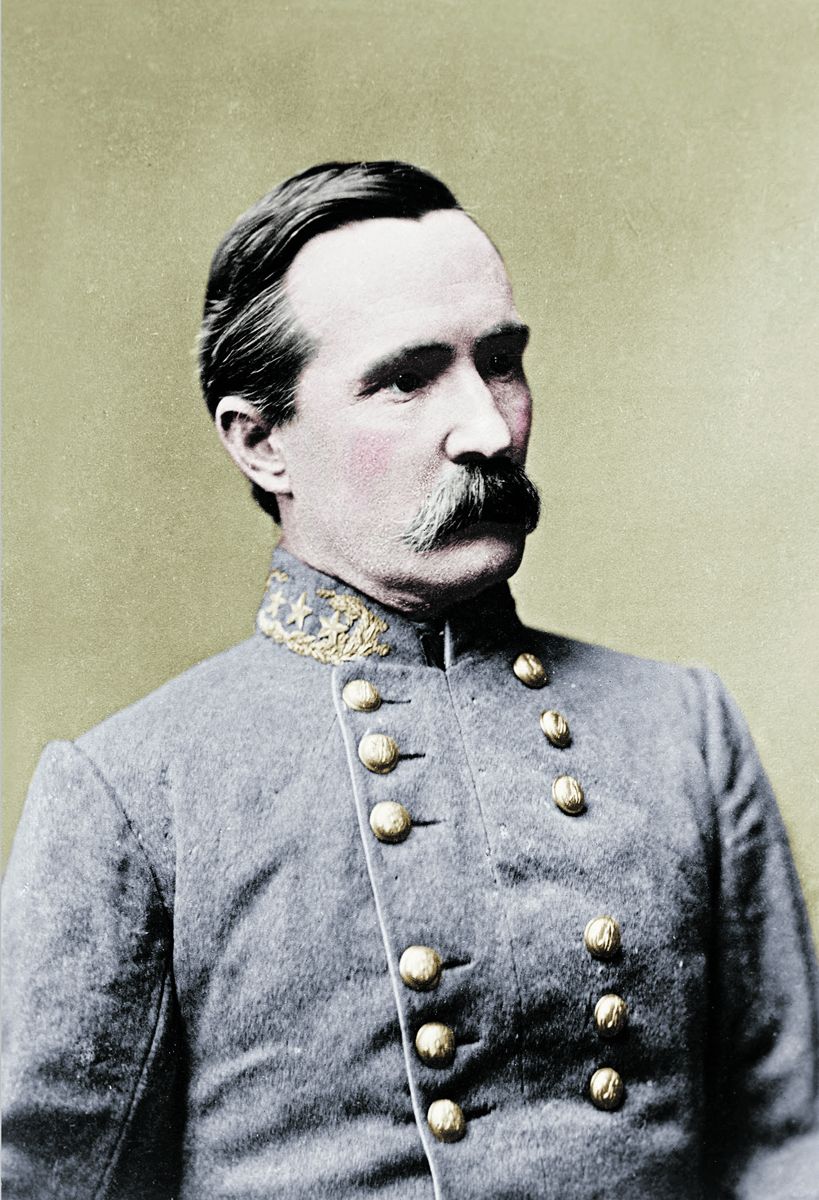
On Aug. 30, Kirby-Smith bested Nelson in one of the most decisive Confederate victories at the Battle of Richmond, Ky. On September 1, U.S. Gen. Horatio Wright, Cmdr. of the Dept. of Ohio, requested Wallace take command of the troops in Cincinnati, Ohio. The “Queen City of the West,” as the largest city west of Baltimore, Md., and north of New Orleans, La., was undoubtedly Kirby-Smith’s next target. As Wallace ranked Wright, he was not bound to accept the request. His staff pointed out, “There is nothing at Cincinnati with which to make a defense – not a solider, not a gun, not a fort. To try must end in failure.” Wallace, wanting vindication, came up with a plan. He requested Cincinnati’s mayor, George Hatch, pay him a call at his headquarters in the Burnet House. Wallace, the future author of the 19th century’s bestselling novel Ben-Hur, had a flair for the dramatic. He gave Hatch, Wright’s telegram to read. Stunned, Hatch asked if Wallace planned to defend the city. Wallace handed him a proclamation, published on Sept. 2, enacting martial law, informing “the citizens that an active, daring, and powerful enemy threatens them with every consequence of war; the cities must be defended, and their inhabitants must assist in the preparation. Patriotism, duty, honor, self-preservation call them to the labor, and it must be performed equally by all classes.” At 9 a.m. businesses would close and at 10 a.m. every able-bodied man would be given the choice “to work or fight.” Breastworks would be dug “in the hills in front of Covington and Newport. Think of the earth ten thousand men can move in one day! Then, if the Confederates give us a week, we can get half of Indiana and half of Ohio behind the breastworks.” Wallace requested Hatch personally direct the police to enforce the proclamation. He called in local surveyors and civil engineers to teach them military engineering, so they could construct the rifle pits and breastworks. On the second day 15,000 men were sent across the river to begin the defenses. Realizing the ferryboats could not move fast enough, Wallace called in the top local builders requesting construction of a pontoon bridge. They responded that it could be done within 48 hours. “… we will go up into the Licking River and fetch down coal-barges, which, with the help of a steamboat, we will tie and anchor and make into a bridge for you twenty-five feet in width from shore to shore”. The railroads were running day and night. The foundry at Cincinnati contributed ten 12pdr. Napoleon cannon. The arsenal in Indianapolis, Ind., sent all the ordnance they had. Both Ohio and Indiana sent men armed with their best weapons, some of which were Revolutionary War horse pistols. By the fifth day of the proclamation, 72,000 were prepared to defend the area, 60,000 of them were irregulars, a.k.a. the “Squirrel Hunters.” The men were fed by women making sandwiches around the clock. “If the enemy should not come after all of this fuss,” said a doubting Wallace friend, “you will be ruined.” On the 10th, C.S. Gen. Henry Heth and his column arrived at Covington. West Point graduate Heth may be best remembered today for initiating the Battle of Gettysburg, Penn. He was known for his fighting spirit and sense of humor. Heth’s intelligence had Cincinnati defended by logs painted black, hastily dug breastworks and impressed lawyers, doctors, shopkeepers as combatants; “… and that at the first shot they would break for the river.” Instead of ordering an assault, the rebels looked over the fort, the recently constructed breastworks and the masses of people behind them. Using the telegraph lines installed through the works, Wallace warned all to guard against surprise, to double the pickets and place the them forward. In the process the only skirmish occurred. On the morning of the 12th, the Confederates were gone. A couple of years after the War, Wallace and Heth happened to meet at Burnet House. The two indulged in a discussion of the “Siege of Cincinnati.” Both men talked about the subterfuges each used to gather intel. Heth felt he could have taken the city. He was in motion to attack when Kirby-Smith ordered him back as Bragg was retreating from Kentucky. Wallace asked, “Now, if you had taken Cincinnati, tell me, won’t you, what you would have done with it?” “I will answer Yankee-like,” he returned, good-naturedly. “What do you think Cincinnati worth?” “In money?” “Yes.” “Probably five millions.” “More than that.” he said. “Well, say ten millions.” “It is a great city,” he replied— “a great city, and rich, and the people think a great deal of it. And if I had proposed to its authorities to sack it from end to end or that they should redeem it with fifteen millions, or such a matter, which do you think they would have preferred?” Sources: • Wallace, Lew, Lew Wallace an Autobiography • McKee, Irving, “Ben-Hur” Wallace: The Life of General Lew Wallace • Morrison, James L., The Memoirs of Henry Heth Stephanie Hagiwara is the editor for Civil War in Color.com and Civil War in 3D.com. She also writes a column for History in Full Color. com that covers stories of photographs of historical interest from the 1850’s to the present. Her articles can be found on Facebook, Tumblr and Pinterest.