
The Graphic War
Our Heroes and Our Flags
By Salvatore Cilella · Originally published October 2018 · p. 18
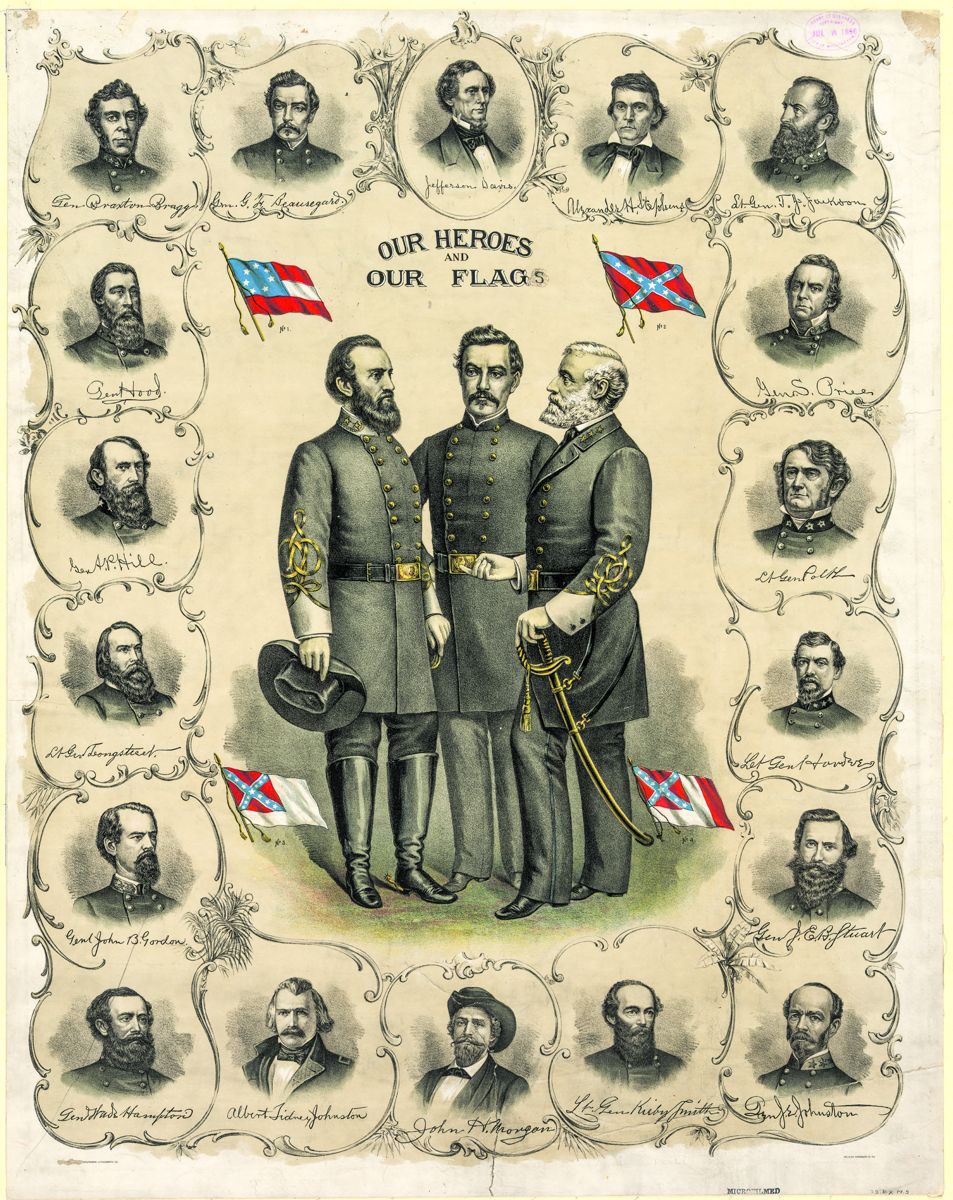
This occasional column highlights prints and printmakers from the Civil War. It discusses their meaning and most importantly, the goals of the print maker or artist. “The Lost Cause,” is a term long used since the war’s end to explain the South’s defeat to southerners and all others who would listen. With the horrors of the real war behind them, and reconstruction a bad memory, many southerners grasped the myth of the lost cause. In his article entitled “The Immortal Confederacy: Another Look at Lost Cause Religion,” Lloyd Hunter makes the excellent point that “myth is not synonymous with falsehood.” He goes on to quote two other authors who assert that myths “are not euphemisms for falsehoods, but are combinations of images and symbols that reflect a people’s way of perceiving truth” and that myth “seeks to transfigure reality so that it provides moral and spiritual meaning to individuals and societies.”1 After the war, printmakers north and south, along with other subjects, occasionally returned to the war. By the end of the century, the lens in which the war was viewed became extremely gauzy. The lithograph/chromolithograph entitled “Our Heroes/and/Our Flags” is a prime example of printmakers capturing the prevailing marketing opportunities provided by the Lost Cause. The print, published in 1896, shows Thomas Jackson, PGT Beauregard and Robert E. Lee in the center under the words: “Our Heroes, Our Flags.” In each corner is a version of the Confederate ks e e he d y r n m o c .
flag, an important icon for the lost cause. The borders are filled with vignettes of Confederate military commanders; Jefferson Davis and Alexander Stephens are prominently featured above the heads of the three central figures. Authors Mark Neely, Harold Holzer and Gabor Boritt are at a loss as to “what the printmaker had in mind with this design.”2 They question Beauregard’s (and Jackson’s) central placement, and the repetition in the border, with other Southern luminaries such as Bragg, Hood, AP Hill, Longstreet, Morgan, Kirby Smith, A. S. and Joseph E. Johnston and Jeb Stuart. Filling out the roster were John Gordon, Wade Hampton, Leonidas Polk, Sterling Price and Joseph Hardee. Other versions of the print included Lee and the Lee memorial. Still a third version of this print featured Joseph Johnston substituted for Beauregard. The final one “was advertised in the Confederate Veteran at the turn of the century for $7.50.”3 The printmaker/publisher is a mystery. The Library of Congress attributes the print to the Southern Lithograph Co., 105-107 Chambers St., New York City. That firm deposited the print held by the Library on July 6, 1896. Neely, Holzer and Boritt repeat that attribution. Research indicates that there were two, or possibly three, companies with that name, but none in New York. There was one in New Orleans and its successor company continues to this day. The New Orleans Lithographing Co. formed in 1883 and morphed into the Southern Lithographing Co., two years later. One of the original owners, Gustave Koekert left and formed his own company with John Walle in 1889. It remains in business today as the Walle Company. There is no mention of its relocation to New York or indeed, a company with that name in New York.4 Through a printer’s error, the Title “Our Heroes and Our Flags,” was originally published without an “s” after “Flags,” and most copies now found show a crude handwritten correction “s”
after the singular word “Flag.” But perhaps the most remarkable piece of the puzzle is that Robert E. Lee, the hero of the Confederacy, was never the subject of a portrait or print during the war. The South’s contemporary hero was Stonewall Jackson, whose martyrdom only increased his popularity. It was Jackson, not Lee, who dominated the printmaking world, north and south. “Contrary to the impression left by the plethora of surviving Lee prints,” all post war, “Lee did not emerge as a pictorial subject until after he had surrendered to Ulysses S. Grant.”5
Endnotes: 1.
Lloyd A. Hunter, “The Immortal Confederacy: Another Look at Lost Cause Religion.” In Gary W. Gallagher and Alan Nolan, eds. The Myth of the Lost Cause and Civil War History, Bloomington, Indiana University Press, 2000, 189. Mark Neely, Harold Holzer
and Gabor S. Boritt, The Confederate Image: Prints of the Lost Cause. Chapel Hill: University of North Carolina Press, 1987, introduction. Ibid. Jay T. Last, The Color Explosion: Nineteenth Century American Lithography, Santa Ana, California, Hillcrest Press, 2005, 216. Last lists the Southern Litho Co., in New Orleans, 1883-85 and another firm with the same name in Richmond, Va. 1873, (page 229) but none in New York. Neely, Lost Cause, 55.
Salvatore Cilella is retired after 43 years in the museum field. His last position was President and CEO of the Atlanta History Center. He is the author of several articles and books. His most recent books are Upton’s Regulars: A History of the 121st New York Volunteers in the Civil War (U. Press Kansas, 2009) and The Correspondence of General Emory Upton, 1856–1881 (U. Tennessee Press, 2017) edited.