
Inspection, ARMS!
Hiram Berdan’s Special Order Sharps Rifles
By Tim Prince · Originally published October 2018 · pp. 24–25
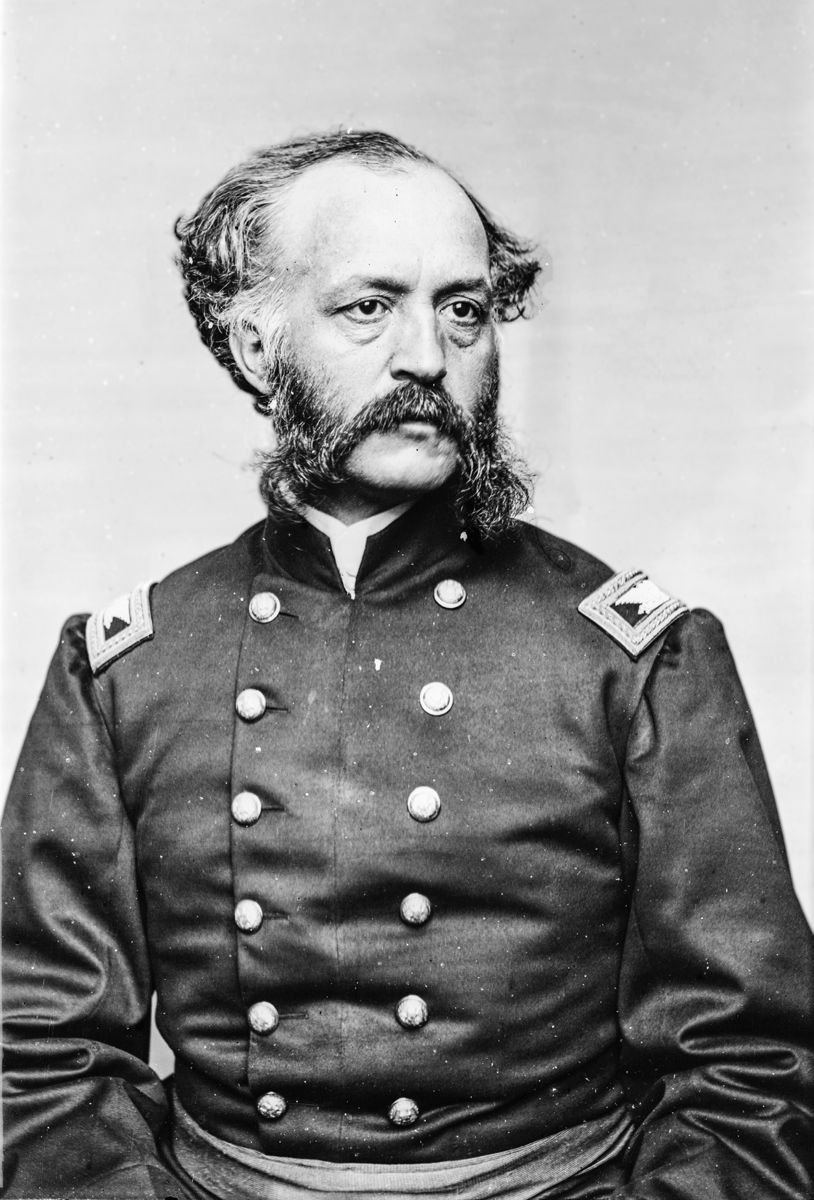
For the collector of arms related to sharpshooting during the American Civil War, the ultimate acquisition is certainly an original Confederate Whitworth rifle, certainly the most iconic of the conflict’s long range rifles. The second most desired weapon, and the one that is much more reasonably acquired in terms of both availability and price, is a “Berdan Sharps,” one of the special-order Sharps New Model 1859 Rifles issued to the 1st and 2nd U.S. Volunteer Sharpshooters, better known as “Berdan’s Sharpshooters.” Hiram Berdan was born on Sept. 6, 1824, in Phelps, N.Y. A highly-educated man, Berdan’s pre-war career was that of a mechanical engineer working in New York City. Berdan was responsible for a number of inventions including a machine to separate gold from ore, a mechanical bakery, artillery fuses, a submarine gun boat, a torpedo boat, the Berdan breechloading rifle, and the Berdan centerfire primer, just to name a few. Berdan was also a target-shooting enthusiast, and when the Civil War broke out, he was the “top shot” in the United States, a position he had occupied for more than a decade. During the summer of 1861, Berdan approached the War Department with the concept of recruiting a regiment of sharpshooters, men who were outstanding marksmen, who would be deployed as special purpose troops. In many ways, Berdan’s Sharpshooters, who would become the 1st & 2nd Regiments of U.S. Volunteer Sharpshooters, would be the first American use of organized “special forces” type regiments since Morgan’s riflemen in the American Revolution. It is fair to say that his force was the 19th century predecessor to the 20th century Army Rangers and Force-Recon Marine Scout-Snipers. Berdan set relatively strict minimum standards for his marksmen. For a candidate to even be considered for the regiment, he had to be able to keep 10 shots in a 10 inch circle at 100 yards offhand, and at 200 yards from a rest. Berdan also expected his men to be able to estimate distance, adjust their shots to compensate for shooting up or downhill (something many modern shooters still struggle with) and adequately compensate for wind as well. While initially he requested that his men provide their own target rifles, this soon became a significant problem. Many of the rifles were heavy barreled target guns weighing two to three times as much as a standard musket. Some were mounted with large and delicate optical sights that made them even more awkward to carry on a march. The biggest problem, however, was that each gun required its own specialized ammunition as they were not of a uniform caliber. This had to be resolved for the sharpshooters to function effectively in the field. Berdan searched for what he felt was the perfect long arm for his men and settled upon the Sharps New Model 1859 Rifle, with a few specialized features. The Sharps Rifle was the invention of Christian Sharps, with the
New Model 1859 being a significantly improved variant of his earlier production long arms. Sharps was born in New Jersey sometime in 1811. In 1830, Christian went to work at the U.S. Armory in Harpers Ferry, under the direction of firearms inventor and interchangeable parts pioneer John Hall. Sharps worked at Harpers Ferry for over a decade, learning the arms making trade, as well as the early concepts of assembly line production. In 1848, Sharps received his first patent for a breechloading carbine. The basic design concept would remain essentially unchanged for several decades and be produced to this day.

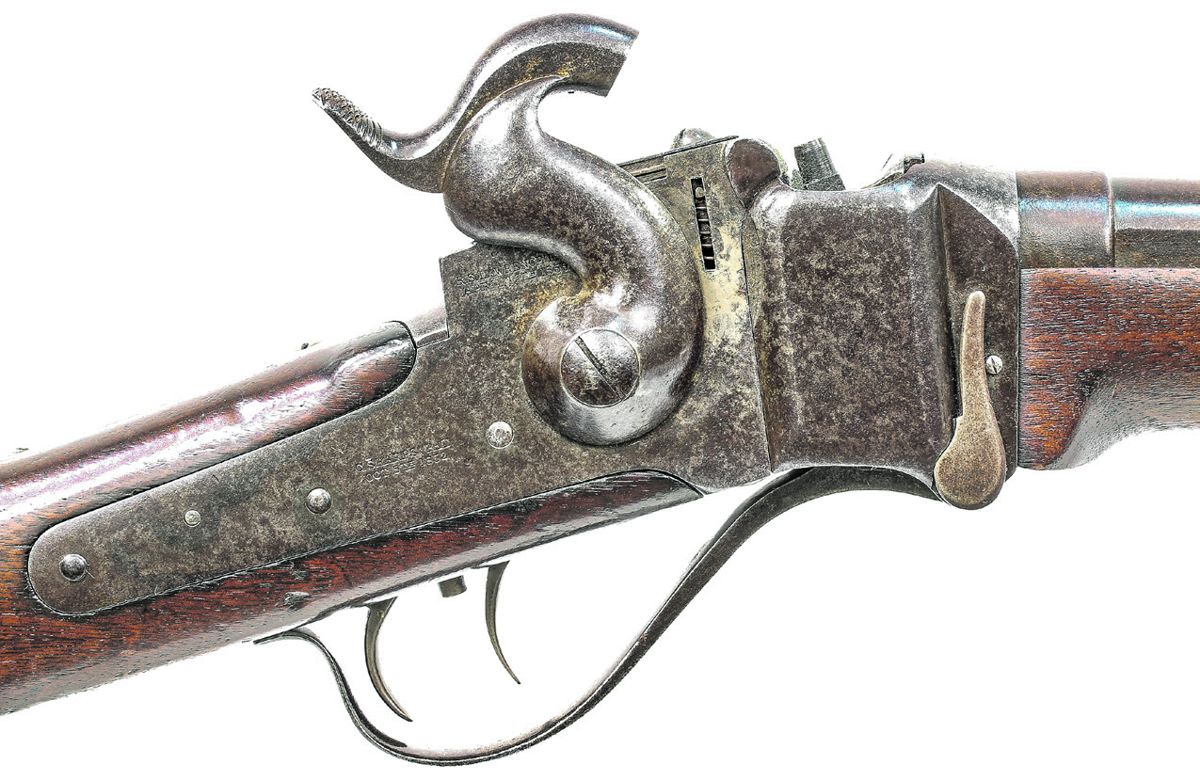
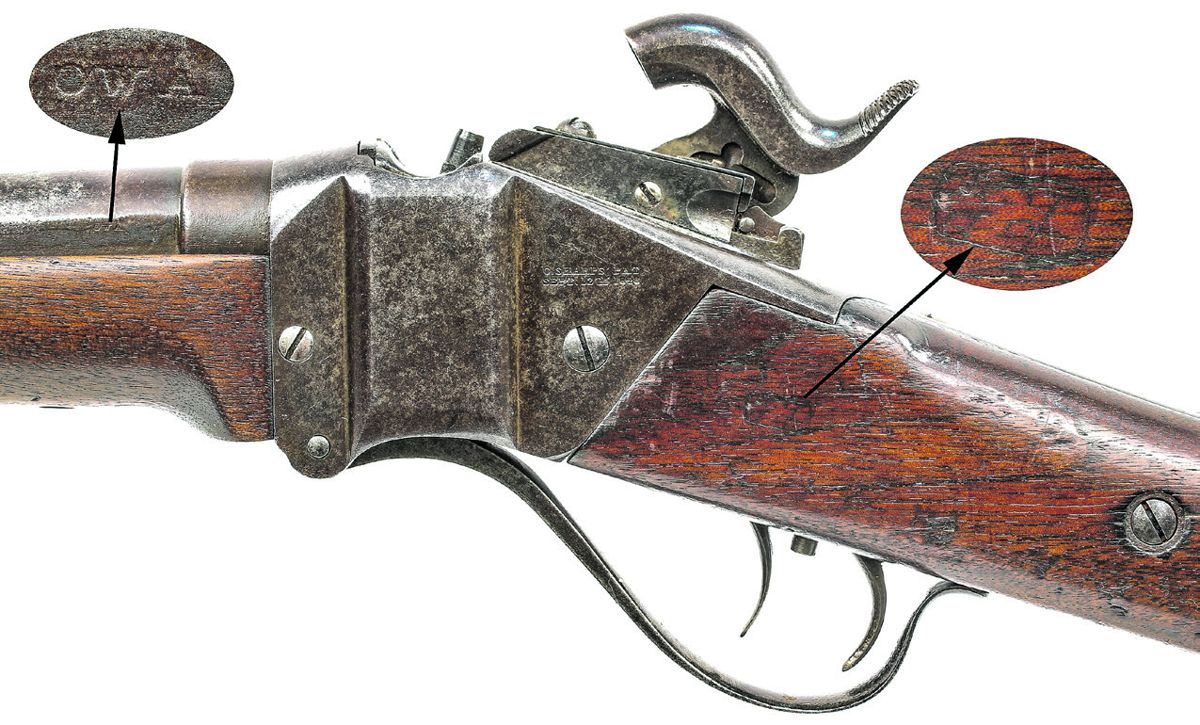
The simple and strong action utilized a breech block that could be lowered be “levering” the triggerguard forward. This exposed the chamber to load a cartridge. The paper or linen cartridge would then have its tail cut off when the breechblock was raised back into firing position, thus exposing the powder to the flash from the percussion cap or pellet primer detonated when the gun was fired. A.S. Nippes of Mill Creek, Penn., produced the first Sharps patent firearms in 1849 and 1850. By 1851, Sharps formed the Sharps Rifle Manufacturing Company in Hartford, Conn. As the company was not yet ready inch barrels and some of those stock, behind the triggerguard. Research conducted by Roy were made in .56 caliber. The barrels were secured by three Marcot indicates that the serial barrel bands held in place by number range for the approximatebarrel band springs in the bottom ly 2,000 Berdan Sharpshooter isof the forend. The rifles were sued rifles is from 54,374-57,514. made with both saber bayonet These rifles usually have double Close up of the Lawrence Patent rear sight of the NM1859 Rifle lugs under the barrel and with set triggers and the omitted lever that was standard on the Berdan contract guns. The patent a standard socket bayonet style latch. Additionally, these rifles information is partially obscured by the sight leaf. Also visible combination front sight and must have U.S. sub-inspection are the standard Sharps barrel markings with the company bayonet lug. It appears that the marks and an inspection carinformation forward of the sight and the model designation majority of the production was touche, although the marks are behind the sight. designed to accept the socket, often well worn on rifles that saw extensive service and combat to produce arms, Sharps entered death of the “slant breech” family termed “angular,” bayonet. Berdan specified that the guns use. Due to various bureaucratic into an agreement with Robbins and issued in the “New Model” & Lawrence of Windsor, Vt., to family of Sharps firearms. The delivered to his men were to have delays, the Sharps rifles Berdan manufacture arms for him. By New Model 1859 Rifle used the double “set” triggers and were to desired for his regiments were 1852, RS Lawrence (formerly of new Lawrence patented breech- eliminate the spring-loaded catch not made available until early Robbins & Lawrence) moved to block. It also featured Lawrence’s at the rear of the triggerguard summer 1862, with the 1st U.S. Hartford and became the master patent automated pellet priming plate that secured the combina- Sharpshooters receiving their armorer of the new Sharps Rifle system that turned out to be less tion triggerguard and lever in the rifles in May and the 2nd U.S. Manufacturing Company. The than effective in the field, leading closed position. The “set” trigger Sharpshooters receiving theirs transition to producing guns at most soldiers to utilize standard involved a second trigger (the in June. In the interim, many rear most) that could be pulled to men retained their original target the Sharps Rifle Manufacturing percussion caps instead. According to Sharps researcher take up the majority of the trigger rifles, or were issued Colt revolvCompany was rather slow, and Robbins & Lawrence produced Frank Sellers, the New Model pull weight, leaving a very light ing rifles, which they utilized many Sharps arms manufactured 1859 Rifle went into production pull on the front trigger to fire the with varied success. The 1st U.S. Volunteer during the 1852–1856 transition in 1859 and remained in rifle. The lightweight pull of this production through 1862, “hair trigger” added to the rifle’s period. The Sharps Rifle Manufacturing when it was superseded by the accuracy in the hands of trained Company finally took over com- New Model 1863. During the marksmen. The balance of the rifle was plete production in Hartford in approximately four years of October 1856. As production production, some 6,989 rifles pretty much a standard New of his “slant breech” series of were produced with the majority Model 1859, with a blued barrel, breechloading arms continued, being purchased by the U.S. case hardened receiver and furniand were constantly improved government for military service. ture, and an iron patchbox in the upon, RS Lawrence came up with The rifles were serial numbered butt. Even the standard Lawrence a solution to improving the gas sequentially with other Sharps patent leaf rear sight was utilized seal of the breechblock. Instead long arms then in production and on the special order Berdan riof the block being set at an angle not in their own serial number fles, as it was accurate enough within the receiver, Lawrence range, with the NM1859 rifles for the needs of the men and did proposed setting the block at appearing in the serial number not have the disadvantage of the complexity or fragility of many right angles to the chamber. The range 36,000-60,000. The majority of these rifles were target rifle sight designs. The rifle new breechblock started appearing on some arms during 1858, manufactured with 30 inch round was equipped with a pair of sling but when officially patented by barrels in .52 caliber, although a swivels, mounted on the middle Lawrence in 1859, it signaled the few were manufactured with 36 barrel band and in the toe of the
Sharpshooters mustered into service on Aug. 1, 1861, and served for slightly less than three years, being mustered out Dec. 31, 1864. During that time, some 1,388 men served in their ranks, and the regiment was present for nearly every major battle and campaign of the Army of the Potomac, including the Peninsular Campaign, 2nd Manassas (Bull Run), Sharpsburg (Antietam), Chancellorsville, Gettysburg, the Wilderness, Spotsylvania, Cold Harbor, and the Siege of Petersburg, just to name a few. The 2nd U.S. Volunteer Sharpshooters were mustered into service on Oct. 4, 1861, and remained in service through Feb. 25, 1865. Their record was equally storied, and the 1,132 men who served in that regiment contributed to the Army of the Potomac much as the men of the 1st USSS did, serving in the majority of the battles and campaigns listed above. The specialized nature of the regiments meant that they rarely fought as a cohesive regimental organization, but rather were often assigned to areas where they were needed on a company or even platoon level. One of the most famous efforts of the 2nd USSS was the support that some 12-15 men from that regiment provided to Company B of the 20th Maine during the defense of Little Round Top on July 2, 1863, at the Battle of Gettysburg.
Tim Prince is a full-time dealer in fine & collectible military arms from the Colonial Period through WWII. He operates College Hill Arsenal, a web-based antique arms retail site. A long time collector & researcher, Tim has been a contributing author to two major book projects about Civil War era arms including The English Connection and a new book on southern retailer marked and Confederate used shotguns. Tim is also a featured Arms & Militaria appraiser on the PBS Series Antiques Roadshow. Colonel Berdan, of the Berdan Sharpshooters, Practicing at a Target at Weehawken, New Jersey.
(Harper’s Weekly, Aug. 1861.) (Photos by Tim Prince)