
The Unfinished Fight
Confederate Soldier with P-56 Enfield Rifle
By Craig L. Barry · Originally published November 2018 · p. 8
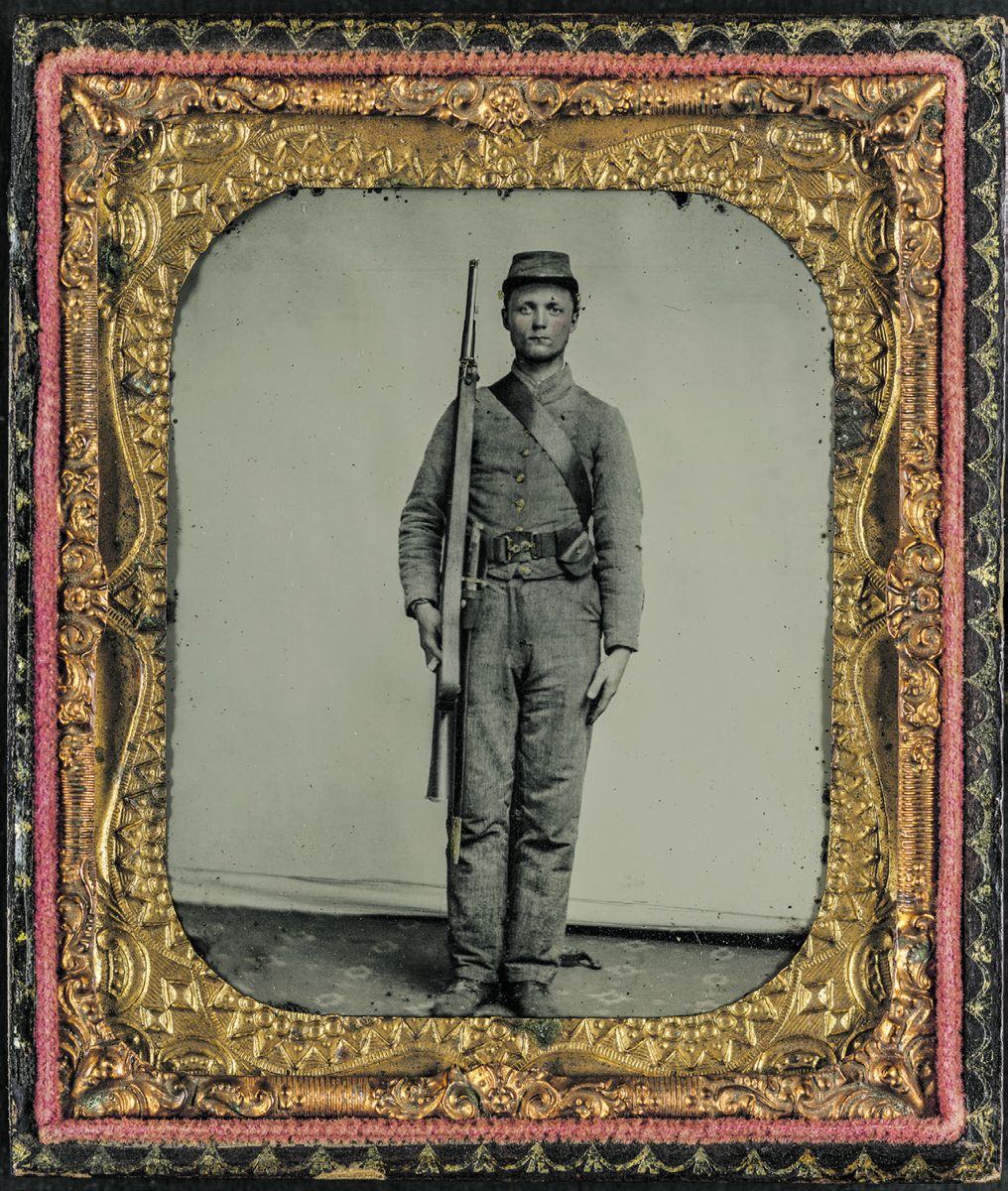
Here is an image of a Confederate soldier, well outfitted with what appears to be a matching jacket and trousers for his uniform, an Enfield Pattern 1856 “short rifle” with saber bayonet, rifle sling and at least a partial set of English accoutrements. Note the angle of the cap pouch and how it is worn. The cap pouch is supposed to be on the cartridge box sling in the English system. It is angled about 45 degrees downwards, because the soldier has it on his waist belt (with snake buckle) as was done with the American accoutrement system. The so-called “ball bag” and Enfield cartridge box are not visible in the image. One assumes the ball bag was discarded and an
Enfield type cartridge box is hidden from view behind his arm. What was the distinction between the Enfield “short” and “long” rifle? The Enfield pattern of 1853 “long rifle” had a 39 inch barrel with three barrel bands which is sometimes referred to today as the P-53 rifle-musket. It was by far the most common European military rifle imported by both sides during the Civil War. The Enfield “short rifle” had a 33 inch barrel with two barrel bands and could be either the Pattern of 1856, Pattern of 1858 or, less likely, Pattern of 1860. How common were imported two band Enfield short rifles? It’s hard to say because period records did not always distinguish between the Enfield “long rifle” (P-53) and the various “short rifles” (P-56/58/60), much less the exact model of short rifle. In the
Official records of the War of the Rebellion, Series IV, Vol. III, p. 383, in December 1862, Josiah Gorgas provides a summary abstract to Secretary of War Seddon of purchases made by Caleb Huse as follows: “131,129 stands of arms consisting of 70,980 long Enfield rifles, 9,715 short Enfield rifles, 354 carbine Enfield rifles, 27,000 Austrian rifles, 21,040 British muskets, 20 small bore Enfield, 2,020 Brunswick rifles. There were also 23,000 Enfield rifles in London awaiting shipment…” The ratio of roughly 7:1 is probably about right as the “short rifle” was about 25% more expensive than the P-53 rifle-musket. Perhaps it was due to the increased cost of the saber bayonet? It is more likely that manufacturers of both short and long rifles, especially in the same factory, the stock cutting machines had to be set up differently. For whatever reason(s) Enfield “short rifles” were much less common than the long rifles. If the short rifles had been cheaper versus more expensive, it probably would have been the other way around. Soldiers for their part referred to the Enfield short rifles as “lighter and handier.” They were often assigned to the sharpshooters as “accuracy was slightly better than that of the [Enfield] long rifle.” The majorities of Enfield “short rifles” used by both sides were a mix of two types of the Pattern 1856. The first type P-56 had the bayonet lug on the barrel while the later version had the bayonet lug on the top barrel band. A small number of P-58 Naval Rifles were purchased early in the war as well, at least by the Confederate States. The P-58 Naval Rifle was similar to the P-56, but with a few cosmetic changes and different rifling. The P-58 was a brass mounted rifle, instead of iron and had the rear sling swivel attached to the front of the trigger guard like the Enfield P-53 “long rifle” instead of being screwed into the stock behind the trigger guard like the P-56. The Naval Rifle typically retained the 1,100-yard rear sight of the P-56, but the 33 inch barrel was heavier and rifled with five grooves instead of three. However, the P-58 rarely (if ever) appears in period images where an Enfield short rifle can clearly be made out. Why so few? One factor that may have limited its utility is that the P-58 Naval Rifle was designed to accept a non-standard cutlass bayonet instead of the P-56 saber bayonet. Confederate orders of the P58 Naval Rifle appear to be very limited, perhaps as few as 700. The McRae Papers currently housed in the South Carolina Relic Room & Military Museum show two Caleb Huse 1861 C.S. contracts for P-58 Naval Rifles with saber (not cutlass) bayonets. The two orders total about 700 rifles. There were no known U.S. orders for P-58 Naval Rifles. Hence based upon the known documentation it appears that less than one percent of the Enfield short rifles imported by both sides during the Civil War were of the 1858 Naval Rifle pattern. The later Enfield Pattern 1860 “short rifle” had a very limited production run. It was first adopted in November 1860 by the British and soon afterwards, August 1861), replaced with the Pattern 1861 “Army Rifle.” Production at Royal Small Arms Manufactory did not commence until 1861, and only a few thousand were produced. The majority of these were held in storage at the Tower until converted to
Snider breechloaders in 1866–67. These would of course, not have been sold to either side in the Civil War. An unknown number may have been commercially made in Birmingham or London and sold, but surviving documents do not indicate exactly which pattern of Enfield “short rifle” was made to fill any specific contract, except as previously noted. Therefore, given the limited numbers of both the P-58 and P-60 produced, the greater likelihood is that the majority of Enfield short rifles in use during the Civil War were the original Enfield Pattern of 1856. Surviving images of C.S. soldiers with Enfield short rifles also bear this out. Craig L Barry was born in Charlottesville, Va. He holds his BA and Masters degrees from the University of North Carolina (Charlotte). Craig served The Watchdog Civil War Quarterly as Associate Editor and Editor from 2003-2017. The Watchdog published books and columns on 19th-century material and donated all funds from publications to battlefield preservation. He is the author of several books including The Civil War Musket: A Handbook for Historical Accuracy (2006, 2011), The Unfinished Fight: Essays on Confederate Material Culture Vol. I and II (2012, 2013) and three books (soon to be four) in the Suppliers to the Confederacy series on English Arms & Accoutrements, Quartermaster stores and other European imports.