
The Graphic War
Chattanooga and Lookout Mountain
By Salvatore Cilella · Originally published November 2018 · p. 18
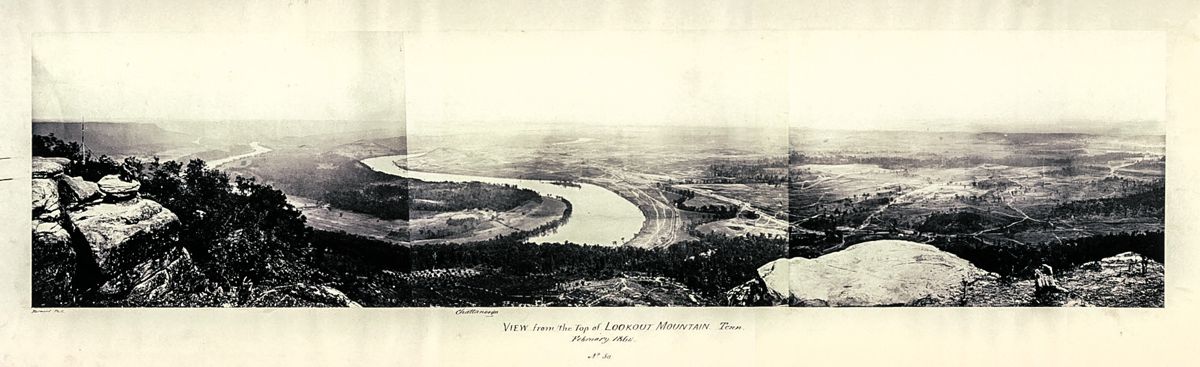
This occasional column highlights prints and printmakers from the Civil War. It discusses their meaning and most importantly, the goals of the print maker or artist. After its disastrous loss at Chickamauga, the Federal Army of the Cumberland under Maj. Gen. William Rosecrans retreated to Chattanooga, Tenn. Confederate General Braxton Bragg’s Army of Tennessee settled in on Lookout Mountain and Missionary Ridge, two formidable positions overlooking Chattanooga. From there, Bragg could see and control all below him—the river, Federal troops, supply lines, and the entire city. Rebel artillery had complete authority over all enemy activity in the valley. Determined to regain the initiative, Ulysses S. Grant replaced Rosecrans with Maj. Gen. George H. Thomas. By mid-November Union reinforcements under Hooker from the east and Sherman from Vicksburg bolstered the Federal line. Sherman manned the left flank facing Missionary Ridge; Thomas the center, and Hooker the far right facing Lookout Mountain. On November 24, 1863, The Battle of Lookout Mountain took place as Hooker’s men scaled heavily fortified Lookout Mountain and overran Bragg’s army. Hooker continued his assault north rolling up Bragg’s flank as Thomas’ troops rolled up and over Missionary Ridge. Compared to most Civil War engagements, casualties were light and some participants (Grant) downplayed the battle’s significance. American photographer, George N. Barnard (1819–1902), a colleague of well-established photographers Edward Anthony and Mathew Brady, began documenting battlefields in 1862 when he executed his wet plate views of the Bull Run battlegrounds. The next year, Barnard was appointed the Military Division of Mississippi’s official photographer. He was assigned to record fortifications, rail lines, camps, and maps for General Sherman. He accompanied Sherman’s army on its “March to the Sea.” In 1864, he captured the vast panorama as seen below Lookout Mountain down to the city of Chattanooga. Barnard entitled it simply “View from the top of Lookout Mountain Tenn. / February 1864.” He published a collection of his work in 1866 in Photographic Views of Sherman’s Campaign.
In 1897, the American Fine Art Co., of Milwaukee produced what appears to be an enhanced copy of Barnard’s 1864 photograph as a brightly colored lithograph. Entitled “Chattanooga / And / Lookout Mountain,” the print contains an inset in the lower right corner of Lookout Mountain. The title margin also contains keys to ten important landmarks in the larger picture, including the Chickamauga Battlefield, Missionary Ridge, and the National Cemetery, which had been established by General Thomas only one month after the battle. Little is known of the artist, Henry Wellge. He produced more than 150 views between 1878 and
1910 with his name prominently displayed. We do know he was a Midwestern Panoramic map artist and publisher. He initially worked for another artist, J.J. Stoner, but moved on to establish his own company in the 1880’s. According to the Library of Congress, “his views of towns in twenty-four states were issued under several imprints: Henry Wellge & Co., Norris, Wellge & Co., and the American Publishing Co.”1 He also worked with The American Fine Art Co., which was founded in 1894 and sold out in 1910 to another firm.2 Wellge disappeared from the historical stage, as little else is known of him.3 We do know that publishing firm Norris, Wellge, & Co. at 205 Second Street, Milwaukee produced a much larger view of Chattanooga in 1886.4 In all probability, George Barnard’s photo of 1864 was Wellge’s inspiration. Endnotes: 1. “Panoramic Artists and Publishers,” https://www. loc.gov/collections/panoramic-maps/articles-and-essays/ panoramic-artists-and-publishers/#HW. 2. Jay T. Last, The Color Explosion: Nineteenth Century American Lithography, Santa Ana, California: Hillcrest Press,
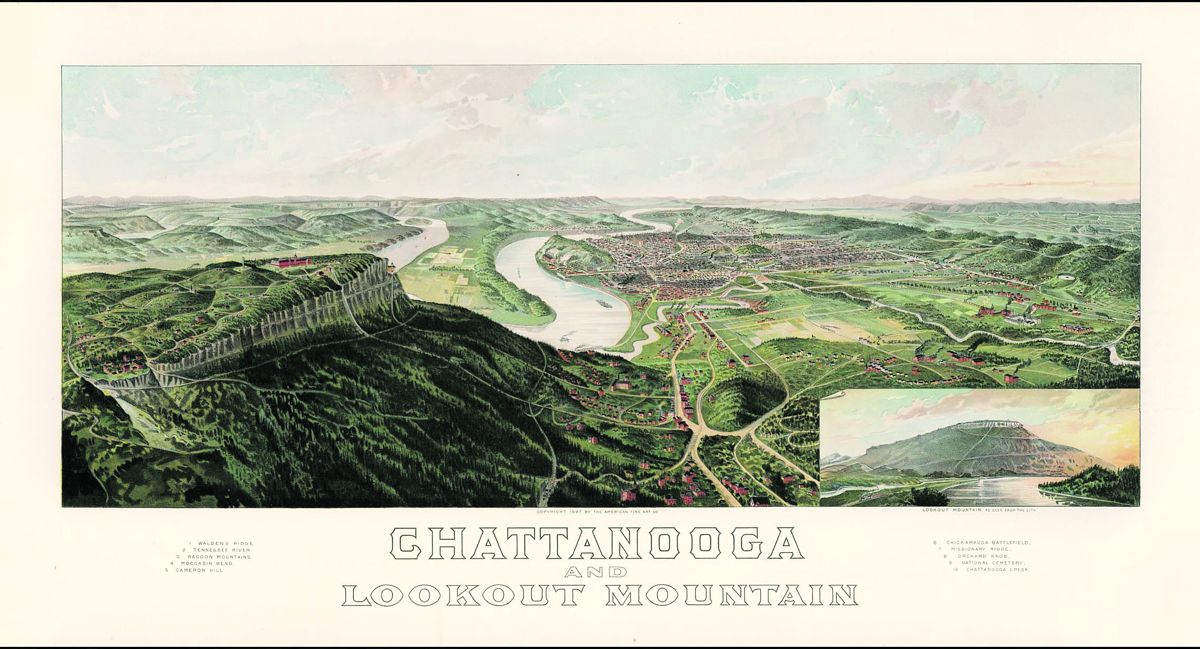
2005, 160. From 1895 to 1900, the American Fine Art Co. produced labels for Blatz Brewing of Milwaukee and famous American photographer; Edward Steichen worked for the company. 3. He is listed in the definitive, John W. Reps, Views and Viewmakers of Urban America: Lithographs of Towns and Cities in the United States and Canada, Notes on the Artists and Publishers, and a Union Catalog of their Work, 1825–1925. Columbia: University of Missouri Press, 1984, 200 and 507. 4. Ibid, 507. Salvatore Cilella is retired after 43 years in the museum field. His last position was President and CEO of the Atlanta History Center. He is the author of several articles and books. His most recent books are Upton’s Regulars: A History of the 121st New York Volunteers in the Civil War (U. Press Kansas, 2009) and (U. Tennessee Press, 2017) edited.