
Through The Lens
Capturing Old Sherman
By Stephanie Hagiwara · Originally published November 2018 · pp. 10–11
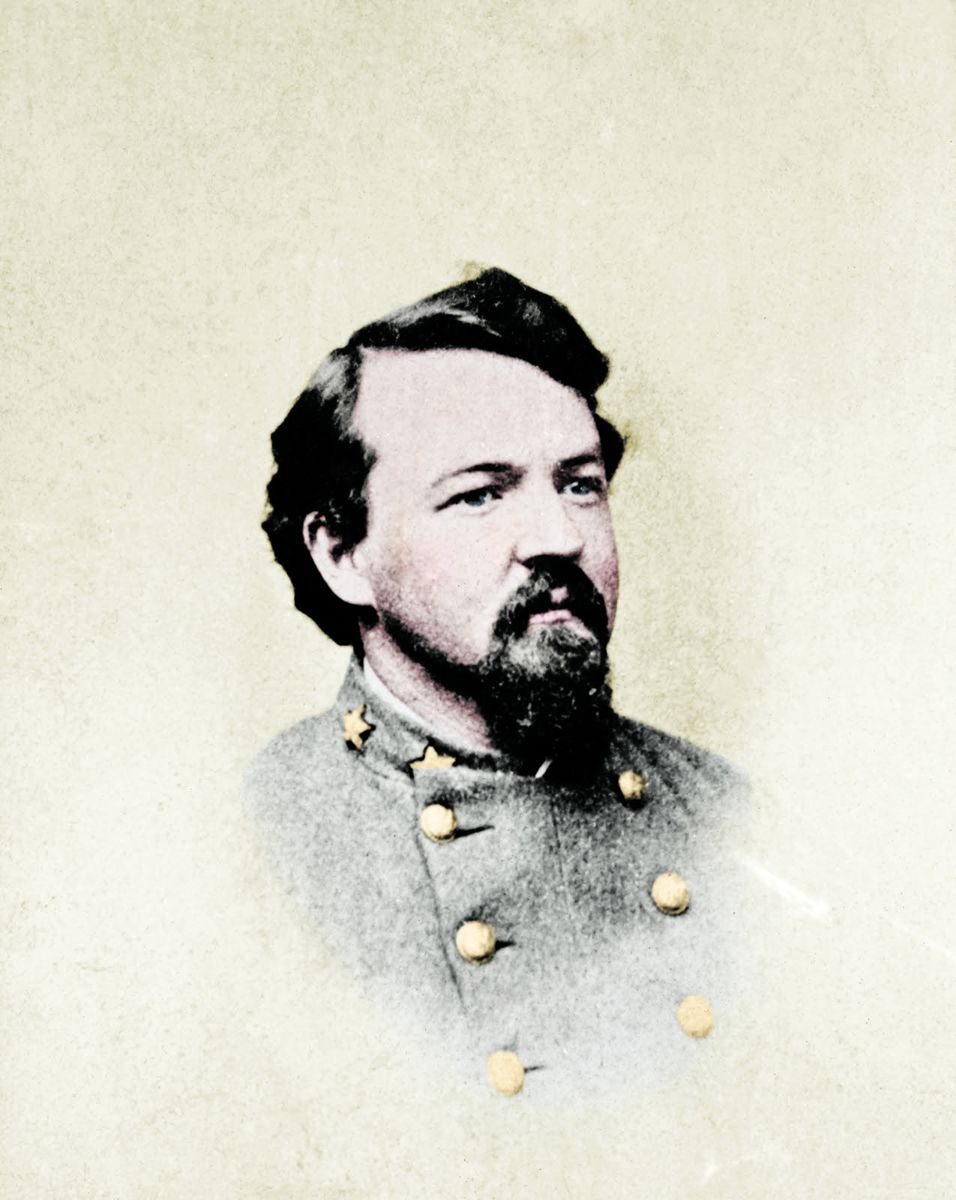
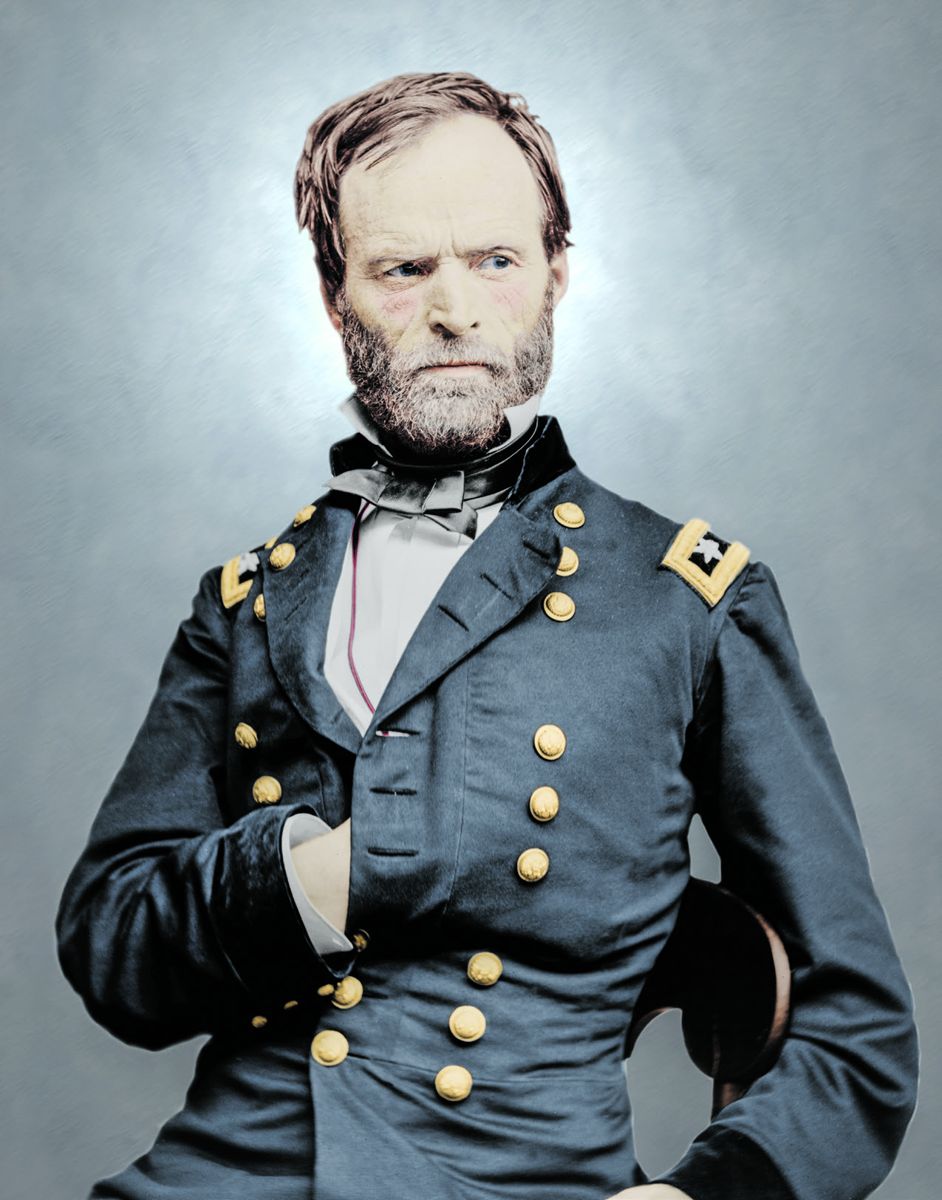
“The government pays me to fight not surrender.” – U.S. Gen. William Tecumseh Sherman On Sunday, Oct. 11, 1863, U.S. Gen. William T. Sherman, his staff, eight companies of the 13th Infantry and their horses were traveling by a special train from Memphis, Tenn., to Corinth, Miss., to prepare his troops to reinforce the Federal position in Chattanooga, Tenn., due to the “alarming dispatches” from the September 18–20, Battle of Chickamauga, Tenn. Sherman was despondent over the sudden death of his nineyear-old son, Willy, who had died of typhoid fever seven days earlier. He was also frustrated by orders to defend the Memphis & Charleston Railroad as part of the Federal supply chain. The day before he wrote U.S. Gen. Ulysses
S. Grant, “I don’t like this railroad, it lies parallel to an enemy’s country, and they can break it when they please.” Instead of assigning men to protect and repair the railroad, Sherman would prefer to “move about and learn to live on the corn and meal of the country.” To disrupt the Memphis & Charleston Railroad, C.S. Brig. Gen. James Chalmers was ordered to capture the Collierville, Tenn., depot, 24 miles east of Memphis. The First Battle of Collierville began with Chalmers’ 2,500 cavalrymen and eight pieces of artillery vs. U.S. Col. DeWitt C. Anthony’s 240 men of the 66th Ind. Inf. In preparation, Chalmers assigned two separate companies to cut the railroad east and west of the depot. Chalmers’ plan was to attack a fort protecting the brick depot from both the front and rear. At daybreak, an advance guard attacked the nearby camp of the 7th Ill. Inf. and Federal pickets. Hundreds of men scattered in every direction as the Confederates chased after them. Chalmers’ men made their way through the woods towards the fort, and established a skirmish line 400 yards away. The Federals held them off with artillery. Chalmers was ordering the 3rd Miss. Cav. to attack when Sherman’s train rolled past about noon. On Sherman’s overloaded train, the officers were occupying coaches while the 260 men were riding on top of the cars. About a mile before reaching Collierville, the Federals spotted “three men riding hard towards the track. They were armed with crow-bars instead of guns. One of our men let fly a shot at them, and the battalion was immediately in arms.” While passing Collierville, the depot’s telegraph operator ran out, waving his gun, motioning the train to stop. Colonel Anthony rode out to the stopped train and updated Sherman, who had been dozing when the train stopped. Sherman ordered the long, heavy train back up hill, half a mile to the station under fire. Chalmers sent an officer waving a white flag, to demand unconditional surrender, adding “that refusal would mean a useless sacrifice of lives, because he had 3100 cavalry, infantry, and artillery in his command.” Sherman had Anthony and his aide, U.S. Col. Dayton, take their time conveying his compliments to Chalmers while declining to surrender as U.S. Col. McCay rushed to send a wire for immediate reinforcements. The 13th, U.S. regulars, dismounted from the train, quickly marched two or three hundred yards toward the enemy and lay down in a battle line. Parley over, the firing began. The 13th was ordered to fall back to the fort and entrenchments. Sherman “was mad as a march hare at being trapped in such a manner. … The interior of this earthwork contained about thirty or forty men and quite a number of cooks, waiters and followers of the headquarters’ guard. The general with his hat off in the broiling sun was a marvel to look at. When a man was shot he would get one of these headquarters’ employees and say to him, ’Don’t you see that man is killed? Take his cartridge box and his gun and load it. Fight for your country, sir.’” Realizing that a nearby house, filled with commissary stores, obstructed the field of fire and sheltered the Rebels, Sherman shouted, “Sixty days furlough for the man who sets it on fire.” A brave member of the 69th Ind. took the challenge. More than one home was burned.
com/cwn. (Library of Congress)
Sherman was directing the action from one of the most exposed positions in the works, ignoring the men falling around him. U.S. Sgt. Patrick Carmody warned Sherman, “General these men are being killed from the trees and you will surely be hit if you don’t keep under cover.” Sherman responded, “Attend to your business, sir; attend to your business, I will take care of myself, sir.” One of the train’s conductors claimed, “I was somewhat frightened at first but when I saw such a great man as he so unconcerned amid all the balls flying around him, I did not think it worth while for me to be scared.” Chalmers, who was with the men attacking the front of the fort, tasked 18-year-old C.S. Lt. James Bleecker with updating the men attacking the rear. Noticing at the back of the train, “a number of our men in the cars throwing out saddles, bridles, blankets, and bundles;” Bleecker tied up his own horse to join the plundering. Inside the empty coach, he picked up a “handsome sword” with “Lieut.-Col. Ewing, Gen. Sherman’s Staff,” on the scabbard. He ran out to the men gathering saddles, spotting the car with horses. Due to lack of a ramp, it hadn’t occurred to them to seize the horses. Bleecker told them, “Make them jump out.” Inside the car, the Negro groom repeatedly claimed ignorance of who owned which horse. Bleecker “untied a fine horse, and led him to the door. After much urging the horse jumped out. It did not require much time for the boys to get the others out.” Using the “nice shirts” found in U.S. Col. Audenreid’s valise as tinder, the train was set on fire. The Confederates galloped off with their plunder, including a huge cake. Instead of overwhelming the garrison, Chalmers was fighting Sherman’s practiced shooters. The Southerners had climbed trees to fire into the fort. His artillery’s “… practice was miserable – the poorest, General Sherman said, that he had ever witnessed on their part.” He knew reinforcements were coming. After three hours of fierce fighting, it was time to withdraw. Meanwhile U.S. Lt. James, 13th Inf. asked permission to take 30 men and drive the Rebels out of the woods. Rapid fire was heard. James returned in a stretcher, shot in the chest but the sharpshooters had been driven off “like sheep.” After the fighting was over, Sherman discovered that one of his favorite horses, Dolly, had been captured. He wrote to his wife, “I have the satisfaction to know She will break the neck of the first Guerrilla that fires a pistol from her back.” Sherman’s men found a fine Southern replacement for Dolly. The replacement’s owner was given an order on Gen. Chalmers. In the morning, track and train repaired, Sherman went on to Corinth. Although he would continue to mourn his son’s loss, the battle refocused Sherman’s attention on fighting. It also gave Sherman ample reason to eschew having a train-based supply line during his “March to the Sea.” Years later, Sherman asked Chalmers about Dolly’s fate. Chalmers recalled that the replacement’s owner had “hunted him up in South Alabama and presented the order” and that Bleecker had captured Dolly. It is not known if Chalmers mentioned that Burton, Bleecker’s servant, had changed “Dolly” to “Sherman.” Burton would often say, “his marster captured Old Sherman.”
Sources:
Dinkins, James, 1861 to 1865, by an Old Johnnie. Personal recollections and experiences in the Confederate army Sherman, William T., Memoirs of General William T. Sherman
Hurd, E.O., The Battle of Collierville Carmody, Patrick, The Battle of Collierville
Stephanie Hagiwara is the editor for Civil War in Color.com and Civil War in 3D.com. She also writes a column for History in Full Color. com that covers stories of photographs of historical interest from the 1850’s to the present. Her articles can be found on Facebook, Tumblr and Pinterest.