
Inspection, ARMS!
An Identified Civil War Period Shotgun
By Tim Prince · Originally published November 2018 · pp. 24–25
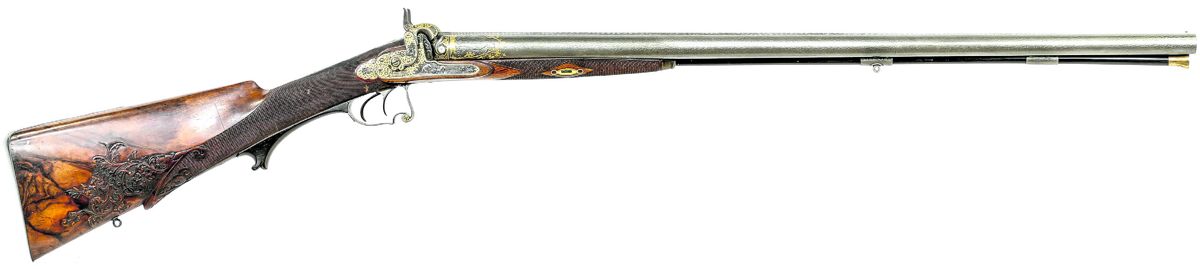
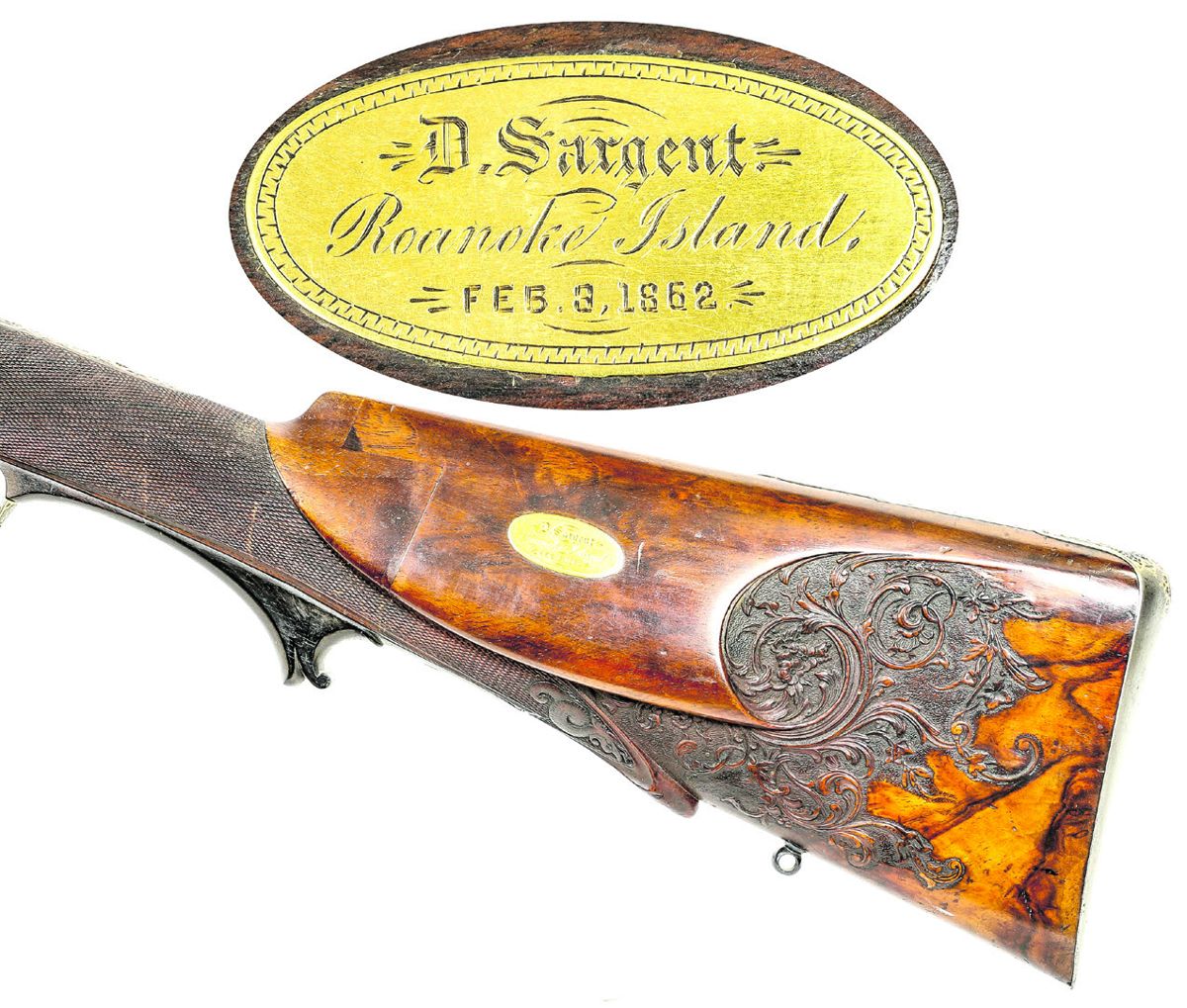
It is the history of a given weapon that captures the passion of most antique arms collectors. Some collectors are fixated upon condition, others upon exquisite quality and still others on arms identified to a specific person of historical import or a specific historical event. In the end, it is the item’s historical associations that seem to have the greatest and most universal appeal to collectors. While it is possible that all these qualities can be found in a single item, it rare that a historically important firearm with iron clad identification is found that is of both exquisite quality and in fantastic condition. The gun that is the subject of this month’s column is one such item. The gun is identified, was made by one of the most famous continental gun makers of the 19th century, is an exhibition grade piece in fantastic condition, and has wonderful Civil War association related to the Battle of Roanoke Island. This firearm represents the pinnacle of mid-19th century European excess as the gun is covered in relief engraving with gold damascene highlights and features an exquisite rococo carved and checkered stock. The shotgun was made by Johann Springer of Vienna. Springer was a Hungarian engraver who had grown up in Leutschach in Upper Hungary and relocated to Vienna during the late 1830s. There he met and married Catherine Nowotny. Catherine was the sister of leading Vienna gunsmith Mathias Nowotny. Nowotny had established his business in Vienna in 1836 and had been so successful that opened a second location in Vienna (probably a retail outlet) rather quickly. Springer apparently knew and worked with Nowotny for some fifteen years, establishing a strong relationship with the family. In 1856 Mathias Nowotny committed suicide; the following year his widow sold the company to Johann Springer. The company was now in the hands of the late Nowotny’s sister and brotherin-law. Springer wasted no time in changing the company name and spent the next two decades concentrating on producing some of the finest grade sporting arms in the world. To quote from the website of Joh. Springer s Erben (yes the company is still in business today), “he specialized in the production of luxury hunting weapons and won because of the quality of his products many medals at exhibitions. Kaiser Franz Josef was one of his regular customers and awarded him in 1872 the “k. u. k Chamber Title,” which is a higher award than the Hoflieferantentitel.” The grammar is somewhat stilted due to the translation to English. Springer would be universally celebrated for his extremely high-quality sporting arms. Upon Springer’s death in 1875, his sons took over the company, and it continued to grow and expand. The list of their customers during the late 19th and early 20th century reads like a “who’s who” of European royalty, including the Kaiser Franz Josef, the ill-fated Archduke Franz Ferdinand and Archduchess Maria Theresa, and such families as the Liechtensteins, Esterházys, Coburgs, and Orlowskis. The company remains in business today as the premier sporting firearms and hunting company in Austria, with four Vienna locations, offering a wide variety of arms and services, including firearms auctions. The gun has a gold plated oval escutcheon plate applied to the reverse of the butt, in the middle of the check rest. The plate reads in three lines: D. Sargent / Roanoke Island / FEB. 8, 1862. An inspection of the Union and Confederate military personnel records and cross-checking those records against those relating to Burnside’s North Carolina expedition reveal that this plate can refer to only one person: Lieutenant Daniel T. Sargent, Company E, 24th Massachusetts Volunteer Infantry. Daniel Sargent was the third of six children born to Boston attorney Henry J Sargent and his wife Margret. Daniel was born circa 1840–41; records are not in agreement about a birth date, although one shows it as March 16, 1840. Daniel was born into a wealthy Boston family that could trace its lineage back to the early days of the Massachusetts Bay Colony. His grandmother had been born during the height of the American Revolution. The 1860 Census listed Daniel as 20 years of age, employed as a “brokers clerk” living with his family at 73 Beacon Street; now that is some prime Boston real estate! His father was extraordinarily wealthy for the period and listed as owning real estate valued at $50,000 (more than $20 million dollars in today’s money) and with a personal estate (cash, etc.) valued at $2,000 (more than $800,000 today). As such it is more than safe to assume that Daniel had the best of everything while growing up. On September 2, 1861, Daniel entered the Massachusetts Volunteer Infantry as a 2nd Lieutenant, and on Dec. 6, 1861, was commissioned in Company E, 24th Mass. Volunteer Infantry. The 24th Mass. was placed in Foster’s Brigade and assigned to Burnside’s Expeditionary Corps, with their destination being the coast of North Carolina. On February 8, 1862, the 24th received their baptism under fire at the Battle of Roanoke Island. They subsequently fought at the Battle of New Bern (March 1113, 1862) and remained in the region (initially as part of the Department of North Carolina and then the Department of the South) through much of 1863. During the summer of 1863, the regiment took part in the Battle of Secessionville, S.C., and the siege and ill-fated attack on Battery Wagner, located on Morris Island. This event is depicted in the classic Civil War film Glory. The regiment remained in the Charleston area through early 1864, at which point they moved to Florida and operated primarily along the St. John’s River near Jacksonville. In the spring of 1864, the regiment was recalled to Virginia and assigned to the Department of the James. They fought at Port Walthal Junction, Chester Station, Swift Creek, Fort Darling, Drewry’s Bluff, and were on the Bermuda Hundred line. By mid-June they were moved into position to participate in the last major action of the war, the Siege of Petersburg. During that campaign, the regiment saw action at Deep Bottom Run (June-August 1864), Strawberry Plains, Chaffin’s Farm, New Market Heights, and Darbytown Road. The regiment was not engaged in the final death throes of the Confederacy that was the Appomattox Campaign, and spent the last days of the war but the rest of 1865 on guard duty in Richmond. During Lt. Sargent’s duty, he was “wounded by musket ball through the neck” at the Battle of New Bern on March 14, 1862. That day the regiment suffered 56 casualties, including 10 dead, 45 wounded, and 1 missing. He was furloughed home to recover on March 22, 1862, and returned to service by July 1, 1862. His muster roll cards state that he was “Commanding Company since Dec. 23/62,” suggesting that the 1st Lieutenant and Captain were not present for duty during that time. On January 19, 1863, he was promoted to 1st Lieutenant, the regiment’s executive officer. Interestingly, the promotion was directly by the Governor of Massachusetts, but the muster rolls don’t reflect the promotion until May 1863, and through April 1863, Sargent was paid as a 2nd Lieutenant. On September 3, 1863, he was promoted to captain, which he declined. It may be that the period of time he spent as acting company commander soured him on the heavy burden of command. During the first quarter of 1864, Lt. Sargent was absent on furlough in Massachusetts by Special Order 138. The order probably put him on “recruiting duty,” but more likely it was a result of his family’s wealth and political pull; allowing young Daniel to spend the winter in comfort at their Beacon Hill home, rather than in the wilds of north-eastern Florida. Sargent is listed as wounded again at Deep Bottom Run on Aug. 16, 1864, where the regiment suffered losses of 17 killed, 66 wounded and 10 POWs on that day, with a total of 19 dead, 80 wounded, and 12 POWs during the Deep Bottom Run campaign. No details of this wounding were listed in his service records. On October 14, 1864, he was discharged due to his three-year term of service having expired and he returned to Boston. No request for an invalid pension can be found, nor is there any indication that Sargent’s wife Alice, who he married after the war, applied for a widow’s pension. Sargent died of pneumonia on Feb. 18, 1892, and was listed as being 51 years, 11 months, and 2 days old. This
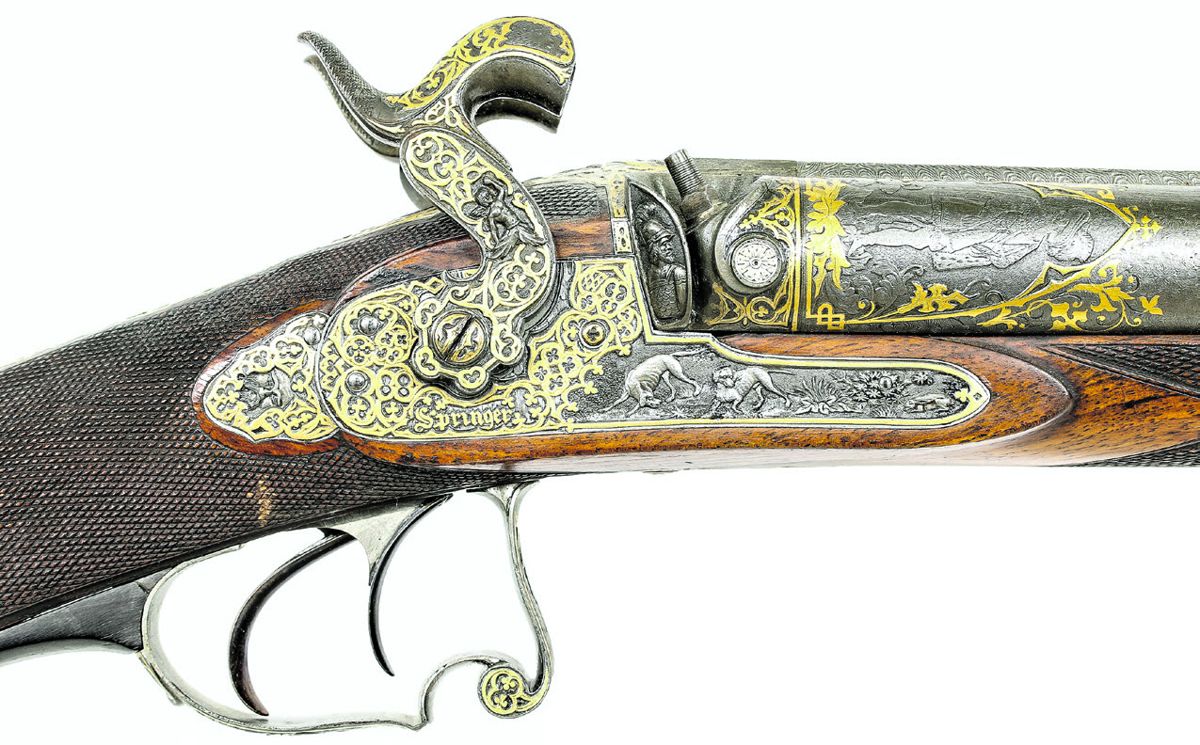
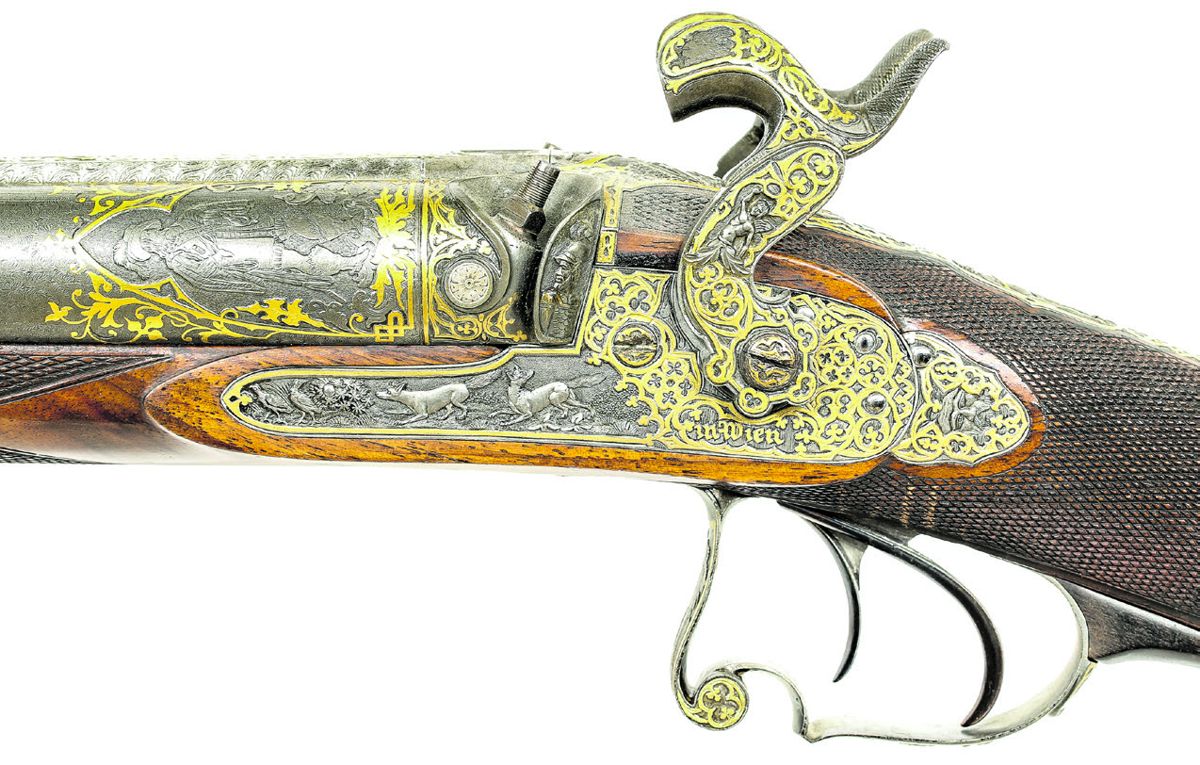
The barrel marking and exquisite decoration of the barrels and breeches of the shotgun. Reverse butt of shotgun showing the D. Sargent presentation plate and relief carved decorations.
would indicate that his birthday was in 1841. His 1890 dated last will and testament indicated that $7,000 was to be forwarded to his lawyer to distribute in a manner that was private and known to the attorney; the balance of his estate was to be given to his mother, if she survived him, and to be evenly distributed among his siblings (or their heirs if they had passed) should his mother pre-decease him. It seems, based upon this document, that Sargent had no children, and that his wife pre-deceased him as well. It is interesting that this shotgun has descended through the Sargent family of Boston until
Overall view of the Johann Springer made, Lt. Daniel Sargent identified shotgun.
(All photos by Tim Prince)
2017, when it was sold by the estate of Elaine Sargent. How young Lt. Sargent acquired the gun is unclear, but a number of examples of guns captured during the North Carolina expedition are known, and I have had the pleasure to offer another shotgun related to this campaign in the past. That gun is now in the possession of the Department of North Carolina Historic Sites and is on display or will soon be on display at the New Bern unit. The shotgun is a double-barreled, side lock gun with 28 inch barrels and .708 inch caliber bores, which means it is nominally 13-bore, or roughly equivalent to the modern 12-gauge “modified” choke. The gun is 45 ¼ inches in overall length, with 14 ¼ inches length of pull and a 3 ¼ inches drop of comb. The gun is marked clearly on both the locks and the barrel rib as being the work of Johann Springer. The right-hand lock is simply marked Springer under the hammer with the left-hand lock marked in Wien in the same location. The barrel is marked in Gothic script Johann Springer in Wien in letters that are about 1/3 inch tall, with the entire legend measuring about 3 inches in length. All the lettering is highlighted with gold damascene. A substantial amount of additional gold decoration is present, with decorative gold geometric and floral designs present on the hammers, locks, barrel rib, breech plug tang, buttplate tang and triggerguard. The locks, hammers, breeches and furniture are also profusely engraved with chiseled relief hunting scenes and classical motifs. The hammer necks feature winged cherubs, while the hammer noses depict lion’s heads. The right lock shows two dogs in search of a rabbit in its warren, while the left lock shows two dogs in pursuit of two grouse. The tails of both locks depict the face of a wizened man. The breeches feature engraved platinum blow-outs and both barrels are engraved with a pair of large, caped musketeer type characters with capes and large feathered hats, surrounded by gold damascene foliate decorations. The center rib depicts a whippet or greyhound over the breeches and intertwined gold damascene geometric patterns. The breech plug tang is relief carved with a dog having taken down a buck near the breech and a depiction of Apollo with his bow and quiver, with quiver, arrows and sling highlighted in gold. Additional gold damascened geometric patterns are found along the length of the tang. The top of the buttplate is engraved with a scene of a buck and doe in the forest, with more gold damascened patterns, and the triggerguard depicts a hunter and his dog in the field. The barrels and rib are matted by a swirling Damascus style pattern, with the barrels appearing to have been left in the white, while the double triggers are fire blued. The stock is made of two pieces of highly figured walnut, with the buttstock joined to the wrist with a large, single dovetail joint that measures slightly more than 1 ¼ inches wide at the notch and appears original and intentional. It seems that Springer wanted to use an even more figured piece of wood for the butt and jointed the stock to the rear of the wrist allowing slightly plainer wood to be used where the figure would be concealed by the checkering, allowing the intense swirling grain to be visible at the rear of the butt. The stock is attached to the barrel via a single key in the checkered forend, which is tipped with a horn forend cap. The two key escutcheons are gold plated and show simple decorative engraving while the key and escutcheon screws are fire blued. The buttstock features a raised check rest and relief carved Rococo decorations on both sides in swirling foliate scroll motifs. The toe of the butt, behind the pistol-grip style horn triggerguard extension, is carved with an owl motif. A fire blued sling sporting style sling swivel ring is present in the toe of the stock and the upper ring is located on the middle barrel ramrod pipe. The brass tipped ebony ramrod is secured by two metal thimbles and the horn entry pipe. The rod has a removable cap that conceals a ball puller. This gun is a gorgeous mid19th century, exhibition-grade, high-art quality Austrian shotgun with a great identification and Civil War provenance. While it seems unlikely that this gun was carried by a Confederate in the defense of Roanoke Island (although many shotguns were), it was likely taken as a trophy from the home of a wealthy planter or landowner. Daniel Sargent thought enough of it to make sure it came home to Boston, and his family thought enough of the gun to hand it down and preserve it for some 155 years after the date on the plaque. It is worth noting that after an exhausting study of Civil War period shotguns documented in our new book, Confederate & Southern Agent Marked Shotguns, this is the only Austrian made gun we have encountered. The gun is a stunning piece of the gun maker’s art and Civil War history, tied to an officer who served most of the war, and was wounded twice in the service of his country. Tim Prince is a full-time dealer in fine & collectible military arms from the Colonial Period through WWII. He operates College Hill Arsenal, a web-based antique arms retail site. A long time collector & researcher, Tim has been a contributing author to two major book projects about Civil War era arms including The English Connection and a new book on southern retailer marked and Confederate used shotguns. Tim is also a featured Arms & Militaria appraiser on the PBS Series Antiques Roadshow.