
Critic's Corner
Wounded at Peachtree Creek
By Stephen Davis · Originally published May 2018 · pp. 34–35
A very readable and reliable narrative by a member of the 15th Texas Cavalry who saw much service in the Western theater; the volume deserves more attention than it has heretofore received. Well, “attention,” here we come. The above assessment is from Nevins, Robertson, and Wiley’s Civil War Books, about which we wrote in this space back in June 2016. The book in question is Robert M. Collins, Chapters from the Unwritten History of the War Between the States; or, the Incidents in the Life of a Confederate Soldier in Camp, on the March, in the Great Battles, and in Prison (St. Louis, 1893). I recently made the pleasant acquaintance of Collins’ memoir, in the original edition, at the Atlanta History Center. I noted that Bob Younger’s Morningside Press reprinted it in 1988. Collins served as lieutenant in the 15th Texas Cavalry after the regiment was mustered into Confederate service in April 1862. He was a clerk in a dry goods store in Decatur, Wise County, Texas, when he decided to volunteer. “The idea of the Yankees heading for Texas soil to despoil our fair homes, insult our women, and eat up the subsistence of the people,” he recalled, “was just a little more than we proposed to submit to.” So Collins signed up to serve in a mounted company called the Wise Yankee Catchers that became part of the 15th Texas. The regiment and five others formed Middleton Johnson’s brigade of Texas Cavalry. The Lone Star Staters were feeling their oats, as Collins attested in his memoir. “When these six regiments,” he wrote, “were strung out in line of battle on the prairie, it just appeared that we had men enough to whip the United States, with Canada and Mexico thrown in for good count.” He added, “At the beginning of the war young Texas in the saddle was regarded as a whole set put together in thirds, one-third man and bell spurs, one-third gun, pistol and knife, and one-third pony.” The brigade was sent to Arkansas, where the new recruits tasted the pleasures of adventure. Collins, in the Fifteenth’s Company B, remembered that he and his comrades “put in all the bird-singing month of June in rollicking around over them high mountains, living high and making love to them pretty, honest Arkansas girls.” In late July 1862 the 15th, 17th, and 18th Texas Cavalry were dismounted (their horses sent home), whereupon the horse soldiers suddenly became foot soldiers. Colonel George Sweet of the 15th confessed he “had a hard time breaking five thousand wild Texans into the infantry business,” according to Collins. That fall Collins’ unit was sent to Arkansas Post, a river fort that surrendered in January 1863. He was exchanged three months later, though many others had died at Camp Douglas. The 15th Texas survivors were ordered to join Braxton Bragg’s Army of Tennessee at Tullahoma. There, as part of James Churchill’s Brigade, they were added to Patrick R. Cleburne’s Division. “Due to the loss of men during incarceration,” John R. Lundberg writes in his excellent history of Granbury’s Brigade, Bragg directed Churchill to consolidate his regiments. The 15th Texas was combined with the 6th and 10th Texas Infantry to form one regiment. Lieutenant Collins, who early on boasted that a brigade of Texans could whip the U.S., Mexico and Canada, began to despond when Bragg was maneuvered out of Chattanooga by Rosecrans in September 1863. “If we can’t check them and whip them with the advantages of the river and mountain-locked passes on the right and left of Chattanooga, where is the place we can?” Collins wondered. He and the 6/10/15th fought at Chickamauga, by now in the brigade commanded by James Deshler. After Deshler was killed in battle, James A. Smith took charge of the brigade. When Smith was wounded at Missionary Ridge, Hiram Granbury took command of the brigade formed by the 6/10/15 Texas, 17/18/24/25 Texas Cavalry (Dismounted), and the 7th Texas Infantry. After Bragg’s defeat at Chattanooga, Collins expressed worry. “This, Captain, is the death-knell of the Confederacy,” he told an officer, Capt. Jack Leonard, “for if we cannot cope with those fellows over the way with the advantages on this line, there is not a line between here and the Atlantic ocean where we can stop them.” Leonard admonished him: “Hush, Lieutenant, that is treason you are talking.” Collins and his comrades went into winter quarters at Dalton, in northwest Georgia. “In our winter quarters,” he recalled, “there was as great a variety of architecture as there is to be found in any city or town in the country.” For many veterans of the Army of Tennessee, the winter in Dalton was memorable for the heavy snowfall of March 22, 1864. Of course, a great snowball battle broke out, with brigades attacking one another. Collins was hit in the head by “a big half ice and half snow ball” hurled by a Mississippian. The blow was so hard that his left eye was temporarily blinded. “To this day,” he noted, writing in 1892, he could not see well with that eye. Collins was not the lone casualty. As I wrote some years ago, “black eyes, bruises, knots on the head and a whole variety of aches and pains were the chief injuries sustained by the combatants” in the great snowball fight. Sherman opened his campaign for Atlanta on May 4. Four days later, as Federal artillery shelled Joseph E. Johnston’s lines at Rocky Face Ridge; Lieutenant Collins was again stunned, this time by the fragment of an enemy projectile. He had another close call near Kennesaw Mountain in mid-June, when a Yankee sniper’s bullet singed his moustache. A month later, President Davis relieved Johnston of command and promoted John B. Hood to lead the Army of Tennessee. Collins recalled how his comrades reacted to hearing the news: “the boys all threw down their cards… they were all dissatisfied.” But they eventually settled upon the conclusion that with Hood in command, “hell will break loose in Georgia sure enough now.” It sure enough did. Within forty-eight hours of taking charge, Hood launched a major attack on Federal infantry north of Atlanta. In this July 20 Battle of Peachtree Creek, Cleburne’s Division was held in reserve. Toward the end of the fight, Hardee ordered Cleburne to prepare to send in his division. Granbury’s Brigade was thus moving into position when it came under enemy artillery fire. It was at this time—about 6 p.m., according to Robert Jenkins, the historian of the battle—that Robert Collins received a serious wound from a shell explosion. In his Chapters memoir, written three decades after the war, Collins describes the experience with unusual vividness. I was impressed as well with the details of his surgical care. I’d like to devote the balance of my space to extended quoting from his book.
(Don’t be put off by his references to himself in the plural, which I find to be a rather charming literary flourish.) I’ve also added explanatory notes on a few points of interest (at least to me). He begins with the movement of Granbury’s infantry. On we go, now the lines come to the fence on the farm already referred to, the line halts, and the men take hold of it and just bodily lift it from its foundation and throw it down; just at this moment a blinding flash right in our front and a shell explodes. It seemed to be filled with powder and ounce balls. It laid a good many of the boys out and among the number was Capt. Ben Tyus, and the writer.1 The former was wounded in the ankle, while the latter received an ounce ball in the upper third of his left thigh. As we fell we noticed that about two inches square of our gray Georgia jeans pants had gone in with the shot; this was conclusive that a piece of the shell had passed through our thigh and had necessarily cut the femoral artery, and that therefore we would be a dead Confederate in just three minutes, as our understanding is that the femoral artery cut would let all the blood in a man out in that time. However we made a grip on the wound with our right hand intending to stop the blood as much as possible and thereby hold on to life long enough to give our past history a hasty going over and to repeat all the prayers we knew. Four big stout fellows picked us up on a litter and started back to the line of breastworks. We had to pass through a galling fire of minnies, shot and shell; we were not alarmed at all at this, because our mind was made up to quit the earth, and we were now only waiting, as the saying goes, for death to strike us square in the face. We finally ventured to inquire of one of the men carrying us, “If we were bleeding much.” He was witty Irishman, and replied, “Not a drop of the rudy current to be seen, Lieutenant.” These words brought back our hopes that had already gone over the hills out of sight, and made us remark that an improvement in gait would soon land us out of reach of these Yankee bullets, and then we chuckled in our sleeve when the thought occurred may be this wound will win a good furlough and if it does, won’t we have fun with those Georgia girls. This may all sound like a strange line of thoughts to run through one’s mind in so short a time and under such circumstances, but all this is sound common sense compared to some things we are guilty of doing during our natural lives. Pretty soon we were dumped over on the safe side of our earth-works, the field surgeon examined our wound and pronounced it an ugly one, but not necessarily fatal. We thanked him from the bottom our heart for these words. About ten of us were piled into an old ambulance and the driver pulled out for Atlanta. We were landed at the City Hall, the commons around this building having been turned into a carving pen,2 and the doctors had more subjects than they had table room. We were laid on a big broad pine table and four stout men put to hold us, one to each arm and leg, while Doctors D.F. Stuart of Houston3 and C. Lipscomb of Denton, went into the ugly wound with probes and fingers in search for the missing piece of our Georgia jeans; chloroform was too scarce and costly to be used on us and besides there were so many needing attention that the doctors could not spare time to administer it except in very bad cases, therefore we had to endure the pain. The ball that struck us was mashed flat on one side to about the size of a quarter, and went in the flat way turning on the femoral artery. We were then stored away on a nice clean cot in a new tent in a little park just across the street in front of the Trout House,4 and remained there overnight and were shipped away early next morning along with many others down to a little city on the Macon road called Forsythe.5 And now being away from our command we plead our lack of any knowledge as to what the boys were doing as an excuse for devoting so much time to our personal experiences in a Confederate hospital, and to our raids over the country while on furlough. All the Texas fellows were located in an old two story hotel on the southeast corner of the square, chicken, good coffee, fresh butter and a clean bed here was rich fare, compared to what we had been having in the army. Capt. Ben Tyus, a young man from Memphis, Tenn., and the writer, were assigned to a room on the second floor and immediately over the office. We not only had a nice clean room, good beds and good grub, but the lady who was head boss of our ward was better than all these. She was so kind and attentive to our every want, that we were soon at war amongst ourselves about whose sweetheart she would be as soon as we got on crutches, but to our great astonishment the nearer well we got the less attention she paid to us, and by the time we were going around she didn’t know us at all. How strange these women do sometimes act. But seriously, she was in the right, because if she had undertaken to listen to the love that all of us soldiers would have made to her, her time would have been consumed and those needing attention neglected. We were having what might be called a hog-killing time, until the breakbone wounded man’s fever set up in this mortal coil. When our wound commenced suppurating, matter pressed on what the doctor called the femoral nerve, causing the most acute pain in our left arm and leg, the tender place in our knee and the sugar bone in our left arm were the points most affected; the pain was so great that we certainly would have had lock-jaw had we not been kept under the influence of morphine for 18 days and nights. The head surgeon, a doctor Patterson6 from Murphysboro, Tennessee, we remember very kindly, but that slick hat fellow from Memphis, was doubtless a good doctor but we owe him one if we ever meet up with him on this side of the river. Proud flesh formed in our wound, causing great pain and we were making lots of noise about it. The way it protruded from the big hole in our thighs made it look more like a big rank red rose at a certain distance from it than anything else we can compare it to. He sat us down one hot afternoon, on the side of our cot, and while a big Irishman by the name of Pat Bates from New Orleans held our arms behind us, he gouged in to the wound with the sharp corners of a chunk of bluestone, until he burned it as white as the paper we are writing on, it was a terrible ordeal to pass through, and when the Irishman turned us loose we struck the doctor one of the best blows we had ever struck with our fist, right on top of his slick nail keg hat, and drove it down on his head to his ears. He laughed and took it all good naturedly. The next falling out we had was when he suddenly cut off our supply of morphine. We lay wide awake four days and nights. We made so much noise about it that the doctor finally brought us a quart bottle of Confederate whisky. We threw it at him. We didn’t know then that a couple or more good bumpers of it would cause sleep to come. From this time on we commenced to improve, and were soon able to go on our crutches down to the regular dining-room. About the first of September, a rich old Georgia planter by the name of Cleveland came in with his fine carriage and driver, and hauled Maj.-Gen. W.B. Bate of Tennessee, Lieut. McCracken and this scribe to his fine old plantation on the Chattahoochee.7 He was a hardshell Baptist preacher. We remained at his house about one month, and to say that we luxuriated on his old “peach” and candied honey therein, and fed on young pigeons, and the fat of the land would be telling simple plain gospel truth. Gen. Bate was one of the best talkers we have ever met in life, and that old peach and honey kept his tongue oiled up to a queen’s taste. Near mid-November 1864, Lieutenant Collins had recovered health sufficiently to return to Hood’s army. He fought at Franklin and Nashville. Then, in January 1865, he boarded flatcars with the remnants of the Army of Tennessee for the long trek to North Carolina. He surrendered as part of Joe Johnston’s capitulation to Sherman near Durham on April 26. I wish to thank Prof. John Lundberg, who teaches at Tarrant County College in Fort Worth, Texas, for having put me onto Collins’ fascinating memoir through his extensive quoting of it in his Granbury’s Texas Brigade: Diehard Western Confederates. John—I sent him an email of thanks as I finished writing this piece—ends his stellar unit history by quoting Captain Samuel Foster, another officer in the brigade, who wrote in his diary two days after the surrender: “Who is to blame for all this waste of human life? It is too bad to talk about. And what does it amount to? Has there been anything gained by all this sacrifice? What were we fighting for, the principles of slavery?” Foster seemed to answer his question with this: “And now the slaves are all free and the Confederacy has to be dissolved. We have to go back into the Union.” Notes: 1. Capt. Benjamin R. Tyus led Collins’ regiment on July 20. The 6th/15th lost 2 men killed and 15 wounded by the enemy’s artillery (OR, vol. 38, pt. 3, 748). 2. By the time of Peachtree Creek, most army hospitals had been moved out of Atlanta to points farther south. City Hall was surrounded by open park land, a whole block in size. Wilbur Kurtz’s map of the area is in my What the Yankees Did to Us: Sherman’s Bombardment and Wrecking of Atlanta, p. lxviii. 3. David Finney Stewart served as senior surgeon for the 6th/10th/15th Texas (Joseph
Jones, “Roster of the Medical Officers of the Army of Tennessee,” Southern Historical Society Papers, vol. 22 [1894], 256). The four-story Trout House, opened in 1854, was at the time of the war Atlanta’s finest hotel. It was located at Decatur and Pryor Streets, several blocks northwest of City Hall. Forsyth, Ga., was a town 78 miles south of Atlanta via the Macon & Western Railroad. Forsyth became a major army hospital center after Johnston ordered most Atlanta hospitals to be evacuated on July 5 (Steve Davis, “Another Look at Civil War Medical Care: Atlanta’s Confederate Hospitals,” Journal of the Medical Association of Georgia, April 1999, 21). Dr. John Patterson of Murfreesboro, Tenn., became surgeon in charge of the Clayton Hospital in Forsyth in January 1864. I have not been able to identify “that slick hat fellow from Memphis” (Stephen Davis, “A Confederate Hospital: Surgeon John Patterson and the Clayton during the Atlanta Campaign, 1864,” Journal of the Medical Association of Georgia, January 1986, 16). Lt. James L. McCracken served with Collins in the 15th Texas and surrendered with him in North Carolina (John R. Lundberg, Granbury’s Texas Brigade: Diehard Western Confederates [Baton Rouge: Louisiana State University Press, 2012], 240-41). Maj. Gen. William B. Bate, a division commander in Hood’s army, was severely wounded on August 6, 1864, by a bullet to the knee. He rejoined the army in October, when Hood was marching into northwest Georgia (Park Marshall, A Life of William B. Bate [Nashville: Cumberland Press, 1908], 136).
Sources: Norman D. Brown, ed., One of Cleburne’s Command: The Civil War Reminiscences and Diary of Capt. Samuel T. Foster, Granbury’s Texas Brigade, C.S.A. (Austin: University of Texas Press, 1980). • R.M. Collins, Chapters from the Unwritten History of the •
Maj. Gen. Patrick Ronayne Cleburne (1828-1864), in whose division Granbury’s Brigade fought in the second half of the war. Cleburne earned a resolution of thanks from the Confederate Congress for the defensive stand his division made at Ringgold Gap, Ga., as Federals were pursuing Braxton Bragg’s beaten army from Missionary Ridge. Cleburne also earned a nickname, bestowed by the Atlanta Intelligencer on Dec. 25, 1863: “The Stonewall of Our Armies.” (Library of Congress)
•
•
•
War Between the States; or, The Incidents in the life of a Confederate Soldier in Camp, on the March, in the Great Battles, and in Prison (St. Louis: Nixon-Jones, 1893). Steve Davis, “The Great Snowball Battle of 1864,” Civil War Times Illustrated, June 1976, 32-35. Robert D. Jenkins, The Battle of Peach Tree Creek: Hood’s First Sortie 20 July 1864 (Macon: Mercer University Press, 2013). John R. Lundberg, Granbury’s Texas Brigade: Diehard Western Confederates (Baton Rouge: Louisiana State University Press, 2012).
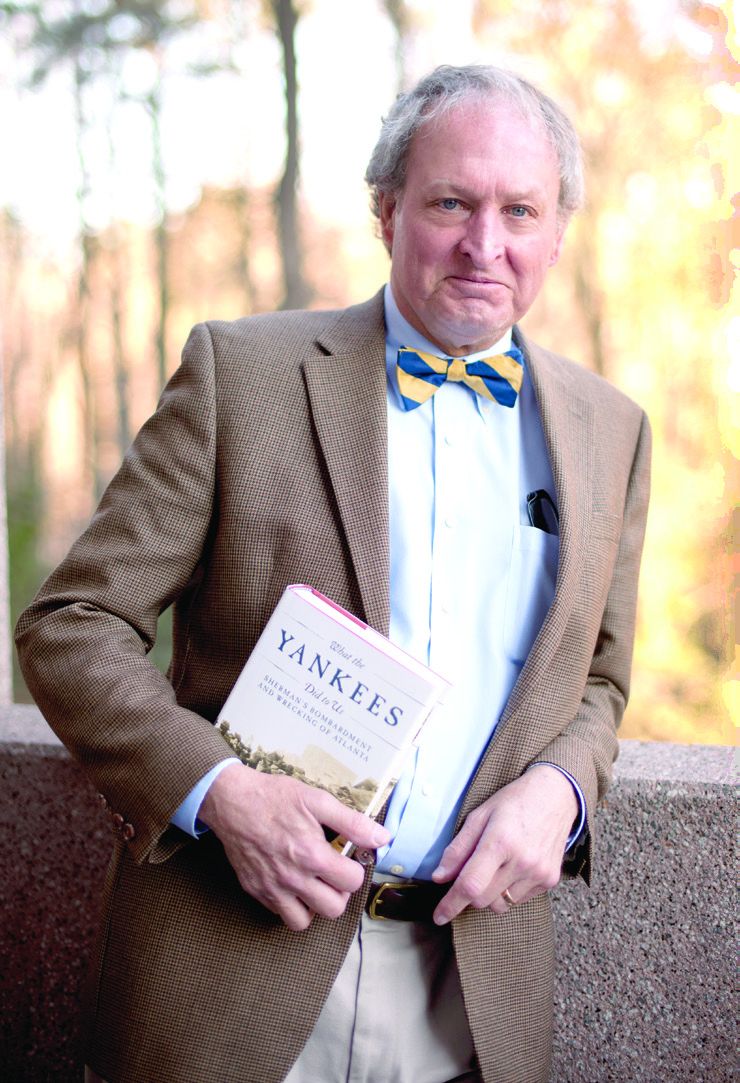
Stephen Davis of Cumming, Ga., is Book Review Editor for Civil War News. He is currently writing a study of how the Atlanta Intelligencer, the city’s leading daily newspaper, covered the war, 1861–1865. His co-author is Bill Hendrick, veteran journalist of forty years, writing for the Atlanta Journal-Constitution, Associated Press and many other publications. Their book will be published by the University of Tennessee Press.