
Who Burned the Confederate Privateer Judah?
By Wayne L. Wolf and Bruce S. Allardice · Originally published May 2018 · pp. 12–13
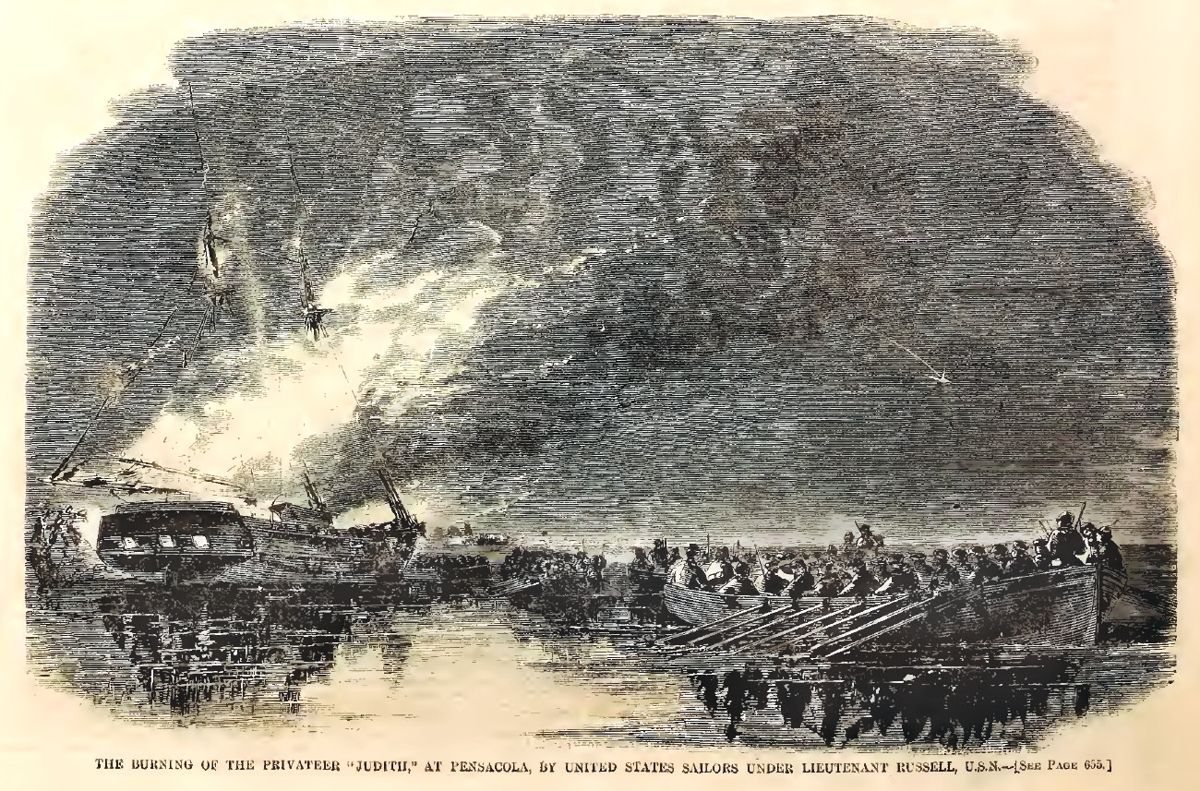
The USS Colorado, recommissioned on June 3, 1861, sailed from Boston Harbor two weeks later as part of Commodore William Mervine’s task force. Its orders were to interdict crucial war supplies entering the Confederacy. Commanded by Captain Theodorus Bailey, the Colorado was a 3,500 ton three-masted, steam, screw frigate outfitted with 40 guns. In early September, Commodore Mervine became convinced that the Confederate schooner, the William H. Judah, was going to be armed as a privateer. The Judah was a two masted schooner recently contracted to the Confederate government for an indefinite period to carry essential war materials through the blockade. Commodore Mervine’s suspicions were correct. The Confederates equipped the Judah with four broadside cannon and a pivot gun. She was moored at the Pensacola, Fla., Navy Yard wharf, ready to sail, when destroyed by a Union expedition of soldiers, sailors and marines. What happened on this raid
Theodorus Bailey.
Tecumseh Steece has been opened to dispute by a recently discovered letter from Acting Master Tecumseh Steece of the Colorado to Captain Theodorus Bailey dated Nov. 4, 1861. Steece, a member of the Union boarding party the night of Sept. 13/14, 1861, contradicts Commodore Mervine’s official report. There is no discrepancy as to basic facts: the boarding party left shortly after midnight and silently rowed 3-1/2 hours, boarded the Judah, fended off Confederate resistance, and burned the Judah to the water line, leaving at least six men dead and eleven more severely or mortally wounded. These men became the first Civil War battle deaths in Florida. The Confederate crew put up a stiff resistance to the boarding party, but was forced to retreat to the pier and watch the Judah break her mooorings and drift, sinking near Fort Barrancas. Admiral David Dixon Porter called the Judah raid “without doubt the most gallant cutting out affair that occurred during the war.”1 However, Tecumseh Steece was upset that the official report of the raid was based on second hand, unreliable information that
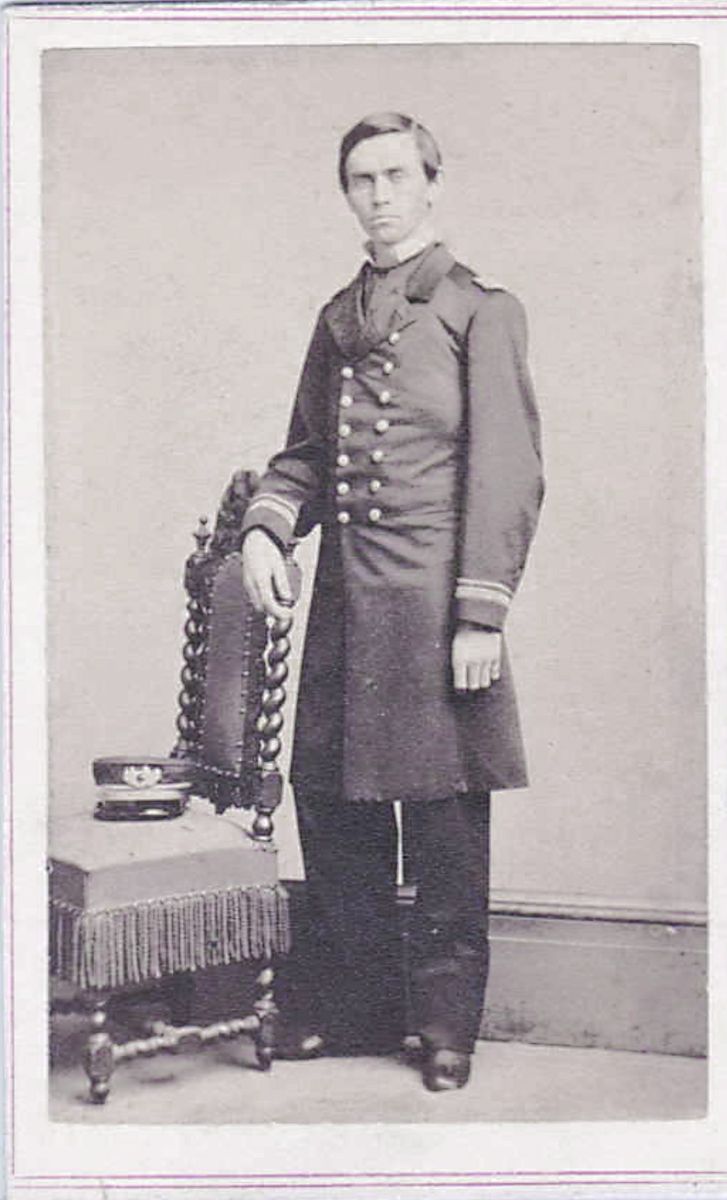
(Earl Sheck Collection) falsely gave credit where it was not due. In a telling letter to Captain Bailey, he outlined his objections to the commodore’s official report. The letter was his recently discovered attempt to set the record straight. While Commodore Mervine’s report2 credited Assistant Engineer George H. White and Private Patrick Driscoll with setting the fatal fire, Steece contends it was himself, Robert Simpson, and Private Hartman used a turpentine soaked cotton ball, to ignite the cabin fire, that destroyed the Judah. Maryland-born Tecumseh Steece (1839–64) graduated from the U.S. Naval Academy in 1861. Considered a rising star in the navy, Steece unfortunately died of yellow fever in 1864 while a lieutenant on the San Jacinto. Captain Theodorus Bailey (1805– 77) relinquished command of the Colorado on May 1, 1862, was promoted to Commodore July 16, 1862, and went on to become Commandant at Portsmouth Naval Yard. Hopefully this new evidence will correct the facts about one of the Union navy’s first victories. U.S.S. Colorado Nov. 4, 1861. Capt. T. Bailey, Sir: My attention was attracted by the statement in Flag Officer Mervine’s Report of the burning of the Judah that the fire that consumed her was built in the cabin by Mr. White and coal bearer Driscoll. At the time of the occurrence, I attached little importance to the fact as to who built it and would have left the Flag Officer’s Report unchallenged, had it not ignored my own, thus making it appear that I from some cause, stated more than I positively knew. In my presence, you mentioned to Mr. Russell3 this evening, that I had asked a correction, and he replied that there was a difference of opinion about many points. Perhaps there is; but in the following report, which I make at your suggestion, I state nothing but what will be attested to by others, but what can be proved leaving no room for “difference of opinion.”
(Naval History & Heritage Command, NH 56069)
When the boats pulled off, Driscoll told Mr. White of his doings, and Mr. White in turn told Mr. Blake,4 yourself, and perhaps Mr. Russell. That was how Mr. White and Driscoll were credited with it. Mr. White did not say he himself had anything to do with the fire in the cabin. I will refer you to Mr. White for so much. You are aware, sir, of the indefiniteness of my orders, and I need not allude to it here. Where Mr. Sproston5 landed, I did likewise. My boat struck the corner of the wall at the opposite side of the slip from the schooner. We
ascended the wall by steps at the head of which a piece was posted (See my report). Unable to do anything there, I went to the support of Mr. Blake, who passed me just then to attack the schooner. (Consult Mr. Blake and my boats crew). Reaching her, we boarded across his boat. I had previously saturated a bunch of cotton with turpentine. A bright light was burning on a stand in the cabin. The stand was just inside the window under the break of her poop. By this, I light my torch and throwing it into a bunk on the port side of the cabin, row ashore. (Consult McDermott, coal heaver, or foreman, and Corporal Moore). Returning I entered the cabin, and told the men close by to come down and help me. Robt. Simpson and private Hartman did so. The cabin being small, I said that was enough. Driscoll was not in the cabin then, and neither of the men saw him there afterwards. (Consult either). We then proceeded to build a fire of whatever we could. The smoke becoming dense I left the cabin. Attaining the deck, I found it clear. My boat was waiting at the side and the men were telling me to come on, that the other boats were shoved off. I then told the other men to make haste. Simpson came first. As Hartman approached the side, he observed a musket, which he picked up and passed into the boat. (To verify these facts, consult either or both of them, and my boat’s crew). They were the only men beside my crew in my boat on returning. Driscoll left in some other boat and so did Mr. White. We then shoved off, and found the other boats outside the slip. (For the truth of this statement, I refer you to Mr. Blake, who delayed firing his howitzer when ordered because my boat was between him and the schooner). My boats crew told me they had shoved off supposing I was in some other boat; but some one said I was wounded on board, and they came back for me. (Consult them). Shierson deserved a great deal of praise for his behavior. Mr. Higginson6 and Mr. White attempted, I believe to build a fire in the hold, and there may have been many trials, but I am merely reporting for my own boat. They can best tell you what they did. In making the foregoing statement I do not wish to detract from the deserts for one, believe since it appears that considerable importance is attached to the fact of building the fire, it is not just that Driscoll should receive credit due Simpson and Hartman. And it is mortifying to me that my statements are virtually denied, by the Commodore on the authority of second-hand stories, originating with a man whose veracity I have such strong reasons to doubt. Allow me to say sir, however, that I am willing you should prove erroneous my report I may make in the future, but I ask that you will not, without trying to do it, attribute what I say to bombast, excitement or intoxication. Very respectfully, Tecumseh Steece Endnotes: 1. David D. Porter, The Naval History of the Civil War, p. 50. 2. In the Official Naval Records, Series 1, vol. 16, pp. 670-672. 3. Lt. John Henry Russell
(1827–97), USN, who led the expedition. Russell later rose to the rank of Admiral. 4. Lt. Francis Barron Blake, USN (1837–1907), son of the commandant of the Naval Academy. 5. Lt. John Glendy Sproston, USN (1828–62). 6. Midshipman Francis J. Higginson, USN (1843–1931), who later became an Admiral. Bruce S. Allardice is Professor of History at South Suburban College in Illinois. He is a past president of the Civil War Round Table of Chicago. Wayne L. Wolf is past president of the Lincoln-Davis Civil War Roundtable.