
Black Powder, White Smoke
Revolvers and Revolvers
By Joe Bilby · Originally published May 2018 · p. 4
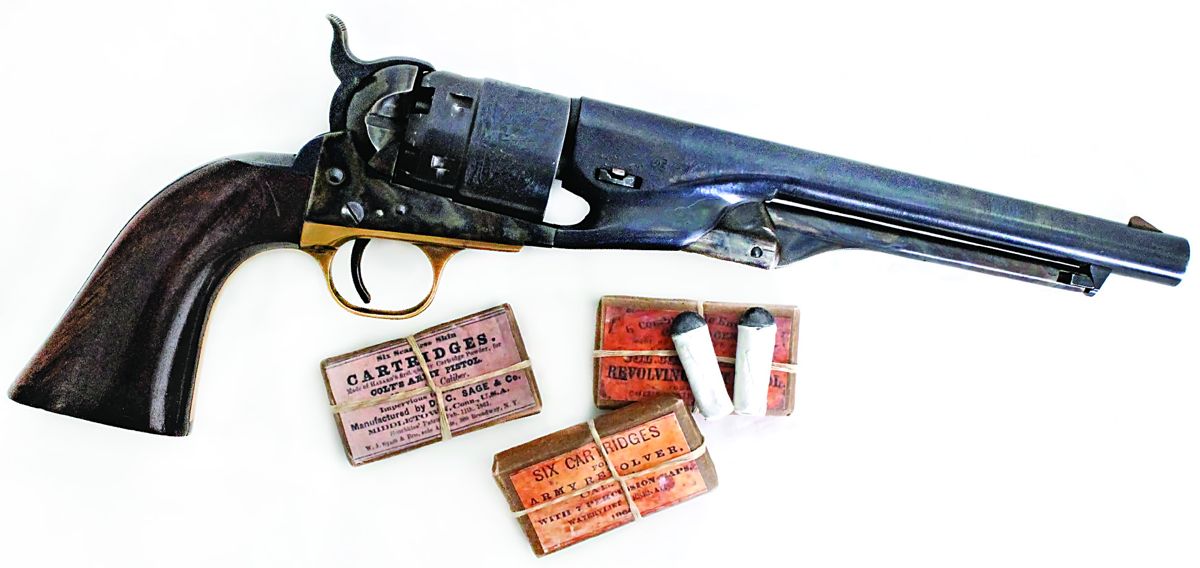
One thing I neglected to mention in my Civil War revolver rant last month is that yes (and I have mentioned it in the past), there was one branch of service that made provisions for carrying extra cylinders for quickly reloading revolvers. The cylinders were not, however, separately purchased for that purpose. The U.S. Navy apparently had a practice of removing cylinders from some existing guns in a shipboard arms room and giving them as spares to landing party sailors armed with revolvers. The sailors carried them, presumably loaded and capped, in a special leather belt pouch.
Sixgun Living History While still kicking around ideas on Civil War revolvers, original and reproduction, I began thinking that the ultimate handgun “living history” project would be loading and firing a Civil War revolver using original live combustible cartridge ammunition. Making such rounds is beyond the skill level of the average black powder shooter, including me, so I looked around for a remedy. I found several possibilities. Buffalo Arms, located at 660 Vermeer Court, Ponderay, Idaho, has been in the business of supplying loaded ammunition and various types of black powder, bullet molds, and reloading accessories, as well as related items, for black powder muzzle loading and cartridge gun aficionados for almost thirty years. Owner Dave Gullo is a black powder shooter himself and states that he “put together a company with knowledgeable people and products necessary to get the old guns shooting.” Buffalo Arms recently began making hand rolled and properly tapered black powder paper cartridges for both .44 and .36 caliber percussion revolvers. The .44 caliber Buffalo Arms cartridges are loaded with Hornaday swaged round balls in .454 diameter backed by a charge of 28 grains of FFFG powder; the .36 caliber rounds use a .375 ball and a 14 grain FFFG charge. The paper is nitrated and combustible; the cartridge seams are sealed with sodium silicate, the way the originals were made. Buffalo Arms rounds are packed six to a box, and each box bears a copy of an original label. Prices range from $13.44 to $14.99 a box, depending on the size of the order. That may seem a little steep for a whole afternoon of shooting, but making these rounds is a labor-intensive process and shooting them will be a great way to get the true feel of loading and firing during the era. Buffalo Arms recommends that the chamber mouths of the loaded cylinder be greased to “prevent chain fire and to lubricate the ball.” As I noted in my last column, chain fires ignited from the front of the cylinder are rare, since a tight-fitting ball prevents flame from a fired chamber igniting an adjacent unfired one. Most chain fires occur due to ill-fitting percussion caps at the rear of the cylinder. Having said that, and considering the varying chamber diameters of original and reproduction revolvers out there, I fully understand Buffalo Arms’ caution, and approve of it. For more information, check out the Buffalo Arms website at https://www.buffaloarms.com/. You can also call directly at 208263-6953 (M-F 8-4:30 PST). Dave often picks up the phone himself.
Authentic Cartridges Another source for a slightly different type of Civil War era revolver cartridge is Authentic Cartridges of Oak View, California. The company, owned by Brett Gibbons, makes a whole range of 19th century ammunition, including authentic Enfield dummy rounds for living history presentations. They also sell Minie balls, both unsized or lubed and sized. None of their products, however, include powder charges. The buyer must supply and load his own powder. As with the Buffalo Arms round, the Authentic Cartridge .36 caliber paper cartridge is crafted from potassium nitrate impregnated paper and sealed with sodium silicate. There is a thinner piece of nitrated paper at the cartridge base to insure ignition from the exploding cap.
The bullets used are conical, as were those in most Civil War issue ammunition, and based on a Colt projectile from the 1850s. The company does not offer a .44 caliber round currently. As noted, Authentic Cartridges’ revolver rounds are shipped without powder. To load, remove the bullet, add 14 grains of FFFG to the cartridge and reinsert the bullet. The bullets fit snugly but can be secured for longer term storage by wiping the base with a glue stick before inserting. Price is $7 for seven rounds packed in a tin case with sliding lid. To order, or for more information, see the company’s website: https://www.papercartridges. com/home.html
Jersey Skylarking To keep to the subject, I will finish with a historical revolver anecdote. In 1861, New Jersey was called on by President Lincoln to produce four regiments of militia for 90 days’ service. One of the regiments, the Second, was from Hudson County and composed mostly of men from Jersey City. On April 27, the regiment got a big sendoff from Jersey City as it boarded a train for Trenton to join the rest of the brigade before leaving for Washington. The New York Tribune wrote that “nearly all” the men in the regiment were “provided with revolvers and bowie-knives.” Later, when the New Jersey militia brigade left Trenton by boat,
(Buffalo Arms)
an overenthusiastic soldier from the Second, likely well lubricated with alcohol, started “skylarking” with his revolver, shooting it in the air, and accidentally wounded another militiaman. Then, as now, handgun shooters need to be doubly muzzle conscious. Joseph G. Bilby received his BA and MA degrees in history from Seton Hall University and served as a lieutenant in the 1st Infantry Division in 1966–1967. He is Assistant Curator of the New Jersey National Guard and Militia Museum, a freelance writer and historical consultant and author or editor of 21 books and over 400 articles on N.J. and military history and firearms, and as publications editor for the N.J. Civil War 150 Committee edited the award winning New Jersey Goes to War. His latest book, New Jersey: A Military History, was published by Westholme Publishing in 2017. He has received an award for contributions to Monmouth County (N.J.) history and an Award of Merit from the N.J. Historical Commission for contributions to the state’s military history. He can be contacted by email at [email protected]