
The Unfinished Fight
RB Barrel Mark
By Craig L. Barry · Originally published May 2018 · p. 5
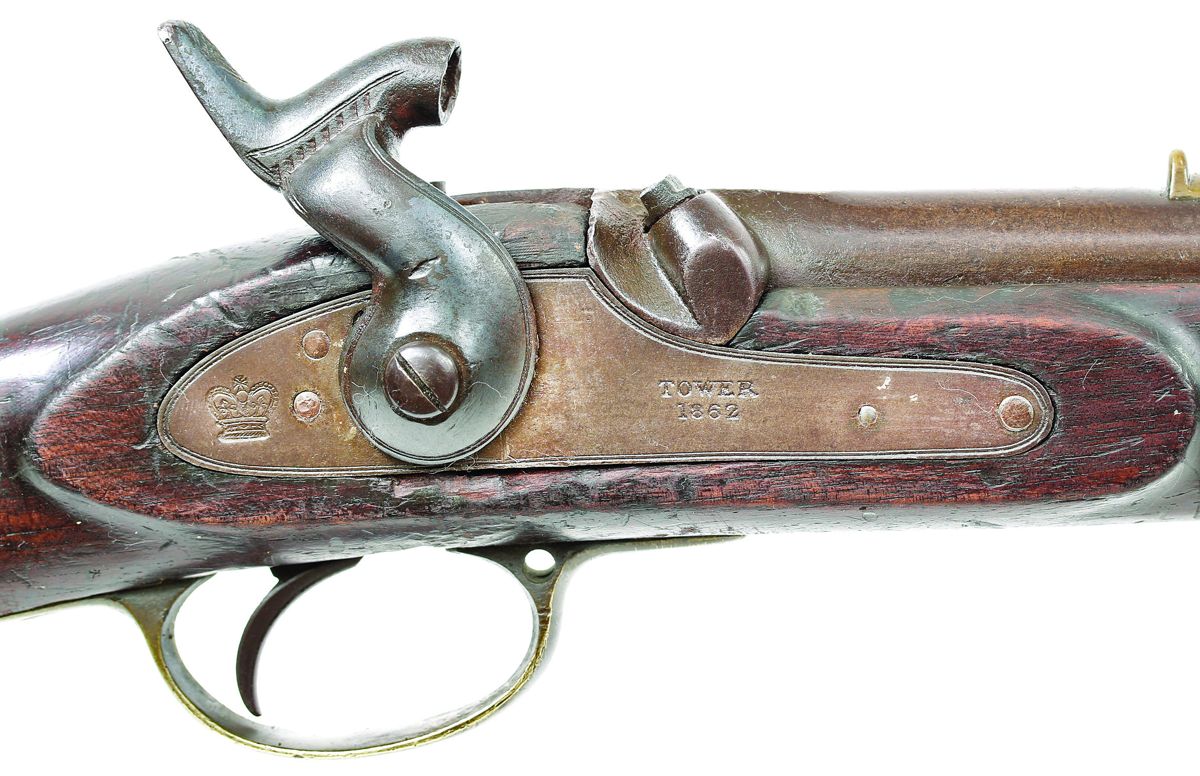
There was a recent discussion on one of the Civil War forums about a Birmingham manufactured (Tower marked) Pattern 1853 (P53) with the initials RB marked on the barrel near the breech. There was also a round cartouche on the side opposite the lock. The discussion went in the direction of the initials meaning “repaired [in] Birmingham.” RB does not mean the barrel was repaired in Birmingham. These are either makers marks or often inspector and sub-inspector marks. I have seen the initials RB in the same exact place on Enfield barrels with SH&G (Sinclair, Hamilton & Co.) markings, in excellent condition with all the bluing intact. If “RB” was a sub-inspector for SH&G, then this is almost definitely a Confederate contract arm; however, inspector marks are usually in the stock. The circular cartouche with initials in it is almost always an inspector’s mark. The stock maker usually put his name between the two lock plate screw escutcheons (washers) if it was marked at all by the stock maker. Most were not marked. No markings on this particular Enfield are clear enough to be otherwise distinct. It looked like a garden variety 1862 B’ham Tower marked commercial P53 that saw heavy use. I’m not an expert, but will admit to being a student of Enfield’s many variations and peculiarities. For almost any “rule” you can cite about commercially made P53s that saw considerable service here with both sides, there will be notable exceptions. I do know that certain patterns emerge, such as where inspection marks are placed. There was an earlier discussion on this same internet forum about stock and gun barrel markings on a Colt Special Model of 1861, which were discovered to be one particular sub-inspector stamps beginning in 1864. So who was “RB” and why was this stamped on the barrel? We know RB would not be “Repaired B’ham” on a Civil War Enfield because arms imported by both sides were not shipped back to England for repairs. Further, when the British sent off their own arms for service they were marked ‘Pimlico’ because that was the repairing facility where they were refurbished or repaired. If removed from service they had condemnation marks, like X-ing out the proof marks on the barrel of government arms. Birmingham was a commercial manufacturing area where military arms were set up and sold to a variety of different countries as well as the British government. Put in modern terms, do you send your Toyota automobile back to Japan for repairs or do you have your local dealer service it? Stateside, both American armies had gunsmiths and armorers in their camps to perform necessary repair work, even on imported arms. In fact, for the first half of the war, most military arms in use were imported from Europe and the P53 Enfield saw extremely wide usage, perhaps more so in the Union Army than the Confederate, if the numbers are to be trusted. This changed in mid-1863 when the U.S. Government canceled their unfilled contracts with Birmingham Small Arms Traders. Whatever the case, field repairs were pragmatic; for example, if a rifle-musket barrel was damaged toward the muzzle; it might be cut down to short rifle length, etc. An example comes to mind and while I don’t have the exact citation handy it is from The Civil War Musket (2006). It is anecdotal and concerns a Union soldier camped outside Washington, D.C., who was issued an Enfield. The percussion cone snapped off below the shoulder and was stuck in the bolster, as he noted: “…being too much case hardened and brittle.” He mentions having to walk 16 miles from his camp in Virginia up to Washington, to take the Enfield for repair. They did not have a replacement cone in the English thread size (the Enfield being 5/16 x 18) and the
RB stamp on top of barrel near the breech.
(Photo of lock by Tim Prince) armorer had to re-thread the bolster to the U.S. standard 5/16 x 24 thread size. The point here is two-fold, one that most marks in the stock or stamped into the metal are there for one of very few reasons. The Enfield passed inspection before being crated and shipped to America if it was accepted, or the maker of the part marked it before it was assembled. The English gunmakers liked doing business with the Americans because “… their inspections are laxer than at the Tower (government inspection facility) and not performed with gauges.” This resulted in fewer rejections. Then, once the arm was received in America, it was subject to a final inspection before being issued. The arms were marked in various ways by inspectors at both intervals, but they were not usually disassembled unless there was a problem. Inspector marks are often found in the same general area, like in the stock between the lock plate screws. The barrel maker “RB” put this mark on the barrel before it was sent for proof at the Birmingham proof house. This was done so if a problem was encountered, it could be charged back against the right maker. So who was most likely the “RB” that stamped their initials on the gun barrel? There has been excellent research into the world of the commercial Civil War-era Enfield by the authors of The English Connection (Pritchard, Huey and our own columnist Tim Prince). Their research suggests the “RB” barrel marking was most likely the stamp of Rose
Brothers, a barrel maker located at Hale’s Owen Mills, near Birmingham in Worcestershire. The firm held several patents for “improvements in combining metals for the manufacture of arms and cutlerly” which date as far back as late August 1858, according to Mechanics’ Magazine and Journal of Science, Arts, and Manufactures, (Volume 69, Sept 1858) as well as the London Gazette. The Birmingham city directory lists “Rose Brothers” as gun barrel makers doing business at 25 Newton Street not far from the Gun Quarter. Their barrels are found on other commercial contract P53s as well as some civilian hunting arms such as shotguns. Makers’ marks and inspection marks on an Enfield are not necessarily a definitive be-allend-all on its history either. They just offer clues on which foreign government may have purchased the weapon. Not all stock marks are authentic to the time period. It is not unheard of for unscrupulous arms dealers on internet gun auctions to add inspection marks to give a Civil War Enfield more of a Confederate flavor, shall we say? Even if it did service around the Khyber Pass guarding flocks of sheep by night. Craig L Barry was born in Charlottesville, Va. He holds his BA and Masters degrees from the University of North Carolina (Charlotte). Craig served The Watchdog Civil War Quarterly as Associate Editor and Editor from 2003-2017. The Watchdog published both books and columns on the material culture of the mid-19th century and donated all funds from publications to battlefield preservation. He is the author of several books including The Civil War Musket: A Handbook for Historical Accuracy (2006, 2011), The Unfinished Fight: Essays on Confederate Material Culture Vol. I and II (2012, 2013) and three books (soon to be four) in the Suppliers to the Confederacy series on English Arms & Accoutrements, Quartermaster stores and other European imports.
P1853 British Enfield marked TOWER / 1862 is pictured for an example of the lock plate area found on the “RB” stamped rifle-musket.