
The Graphic War
PhotoShopping: 19th Century Style Part II
By Salvatore Cilella · Originally published May 2018 · pp. 30–31
![C. Union / painted By T[ompkins] H. Matteson ; engraved by](/article-images/cwn-2018-may/cwn-2018-may-photoshopping-19th-century-style-part-ii-01.jpg)
This occasional column highlights prints from the Civil War. It will discuss their meaning and most importantly, what the print maker or artist was trying to achieve. Last month we explored what Lincoln Scholar Harold Holzer called: “an abundance of outright fakery” in producing prints during the middle of the 19th century.1 We looked at two portraits of Abraham Lincoln which, in the heat of commercial expediency were altered from the originals of The Pathfinder, soldier, politician, and first Republican
Party candidate, John C. Fremont in one case and Francis Preston Blair: politician, lawyer, and soldier in the other. They shared a few political commonalities— free soil and Republican, therefore placing the face and head of the first Republican president on their engraved portraits did not raise eyebrows. But Lincoln’s face placed on the shoulders of a major American figure as well known and influential as John C. Calhoun was noteworthy, but to do it on two different occasions was truly remarkable. Calhoun was a strict constitutional constructionist, state’s rights advocate and nullification promoter—nearly the opposite of the 16th President. In 1849, Calhoun sat for his portrait for Mathew Brady. It was a year before he died. That following year, the year of the Great Compromise of 1850, Bucks County, Pennsylvania, native and artist Thomas Hicks, using Brady’s photograph, created a full-length portrait of Calhoun, probably because Calhoun died March 31, 1850 (Fig A). From that painting, Alexander Hay Ritchie created a mezzotint engraving substituting Abraham Lincoln’s face for Calhoun’s (Fig. B). The original was published in 1852. William Pate, Fulton Street, Boston, probably published the Lincoln alteration in 1865. Although Ritchie did portraits, he is best known for several large, sweeping black and white engravings, especially his First Reading of the Emancipation Before the Cabinet (1864) and Sherman’s March to the Sea, (1866). It was one of those oversized patriotic engravings where Lincoln replaced Calhoun not once,
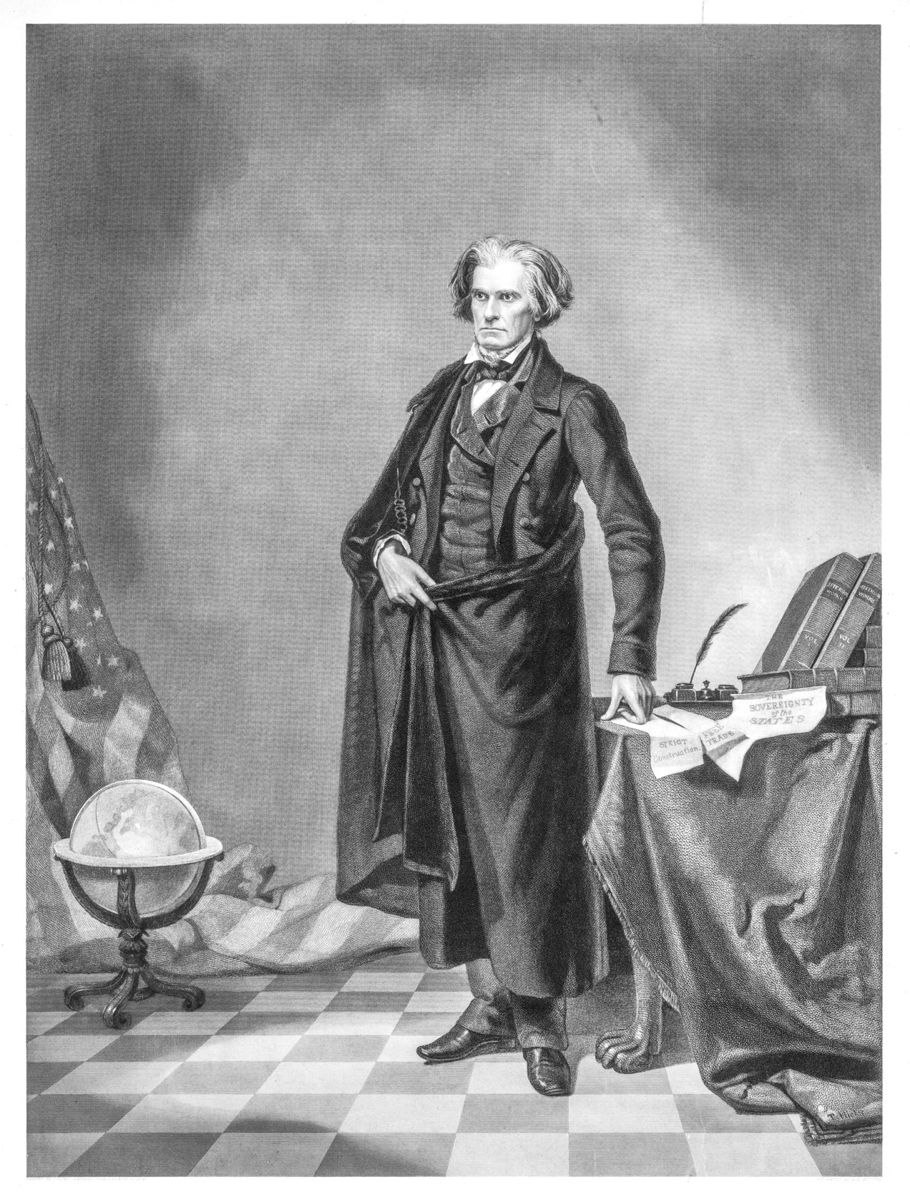
John C. Calhoun
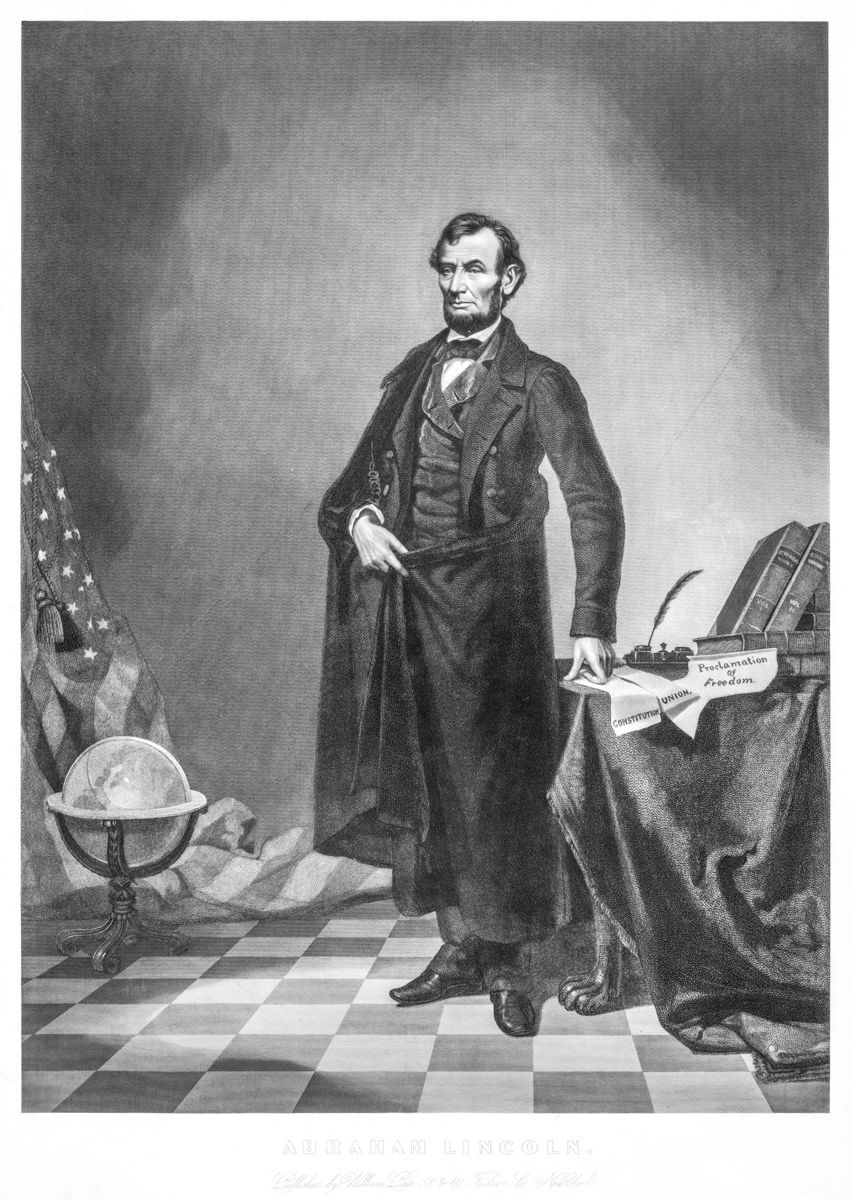
Abraham Lincoln B. Abraham Lincoln.
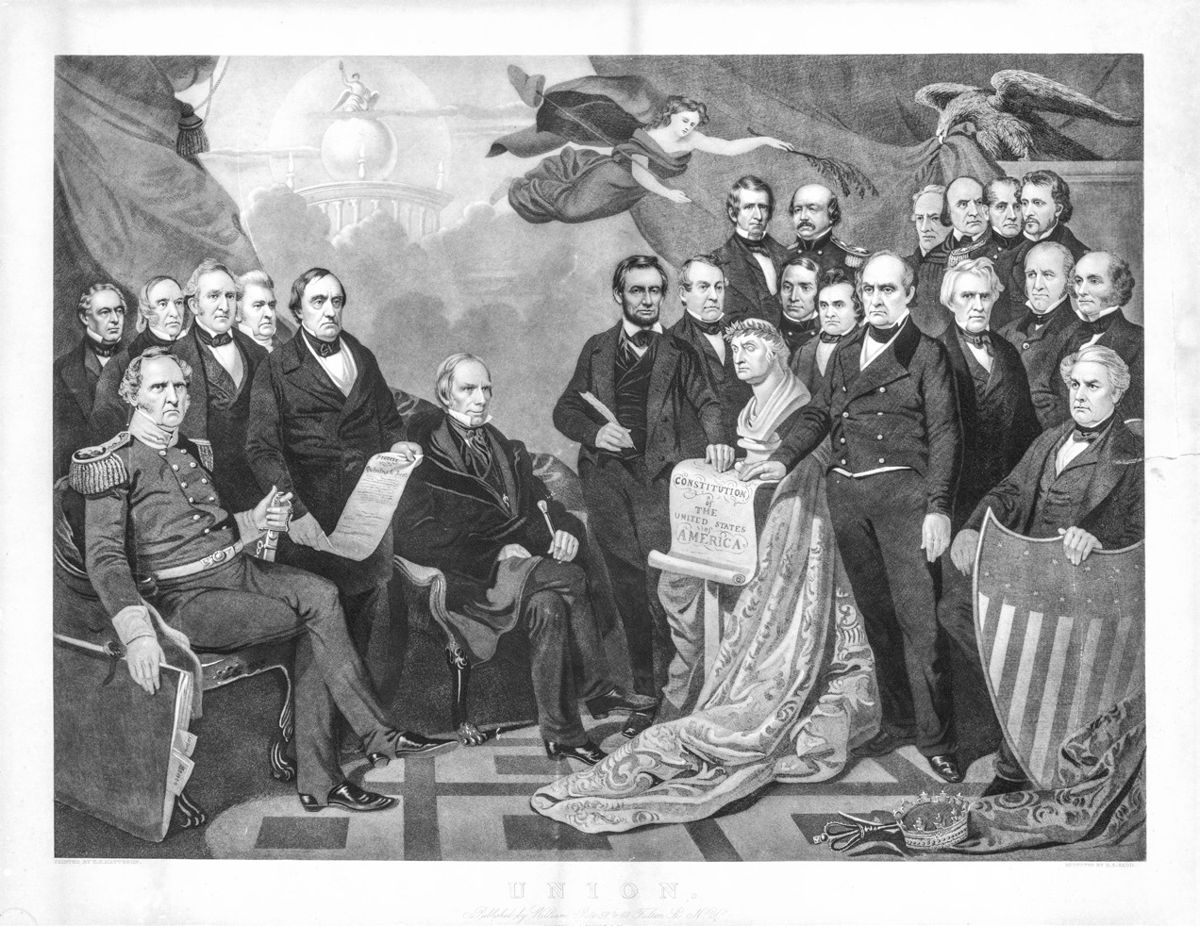
H[enry] S. Sadd. but twice (Fig C). It wasn’t just Calhoun who was replaced. The prewar print dealt with the wishful thinking that the Compromise of 1850 would save the Union. Tompkins Harrison Matteson, painter of large patriotic canvases probably painted Union in late 1850 or early 1851. Henry S. Sadd, engraved Matteson’s work and William Pate published it in 1852. It celebrated something that today’s congress seeks on a daily basis, compromise and consensus. The piece’s central figure is Calhoun directly under the Angel of Peace. To his left is a seated Henry Clay, and to his right, next to the bust of Washington, is a standing Daniel Webster, to the far left is Winfield Scott, seated and to the far right, Millard Fillmore holds the Union Shield. Calhoun, Clay, and Webster had all passed away by the time the print came to market. It was a rare, bi-partisan show of unity with Whig and Democrat represented. Both parties put the Compromise on their platforms that year and the artist gave nearly equal representation to northern and southern legislators. Some of those shown were members of the Senate’s so-called “Committee of Thirteen.” According to the Library of Congress finding aid: In the left background are (left to right): Speaker of the House Howell Cobb of Georgia, Virginia representative James McDowell, Thomas Hart Benton of Missouri, and former secretary of state John M. Clayton of Delaware. In the second row at right: Ohio senator Thomas Corwin, James Buchanan, Stephen A. Douglas, attorney general John J. Crittenden, and senators Sam Houston of Texas and Henry Foote of Mississippi. Behind, beneath a genius carrying a laurel branch and liberty staff, are senators Willie P. Mangum of North Carolina and W. R. King of Alabama. At far right, below an eagle, are Daniel S. Dickinson of New York, Supreme Court justice John McLean of Ohio, and senators John Bell of Tennessee and John C. Fremont of California. In the background curtains are drawn to reveal a gleaming temple with a colonnade surmounted by a large ball, a figure holding a liberty cap, and a phoenix.2 Fast forward nearly ten years and the print resurfaced ca. 1861 (Fig D). As Holzer cryptically wrote, “Steel plates endure, but politics change rapidly.”3 Responding to national events and the opportunity to “re-market” the old print, the original engraver burnished out southern sympathizers and replaced them with pro-Union men. The most radical change is the substitution of John C. Calhoun Lincoln’s head on John Calhoun’s body, once again. The transition is clumsy and shows Lincoln without a beard; the inclusion of Robert Anderson of Fort Sumter fame (right behind Washington’s head replacing James Buchanan), suggests the print was re-worked later in 1861. Other changes include the addition of Edward Everett at the far left who replaced “Howell Cobb, W. P. Magnum, and William King,” who are depicted to Lincoln’s left under the angel’s outstretched arm. They were “replaced by William Seward and Benjamin Butler.”4 Four years later, the print was revived a third time, probably in reaction to Lincoln’s assassination and published in 1865–1866. This edition featured only one change—Abraham Lincoln with a beard, reminding us once again that 19th century printmaking was the nexus between art and commerce. Sources: 1. Harold Holzer, Gabor S. Boritt, Mark E. Neely, Jr. The Lincoln Image: Abraham Lincoln and the Popular Print. (New York) Scribner Press, 1984, 204-205. Hereafter Holzer, Lincoln Image. 2. Library of Congress finding aid, https://www.loc.gov/ resource/pga.02601/. 3. Holzer, Lincoln Image, 69. 4. Ibid.
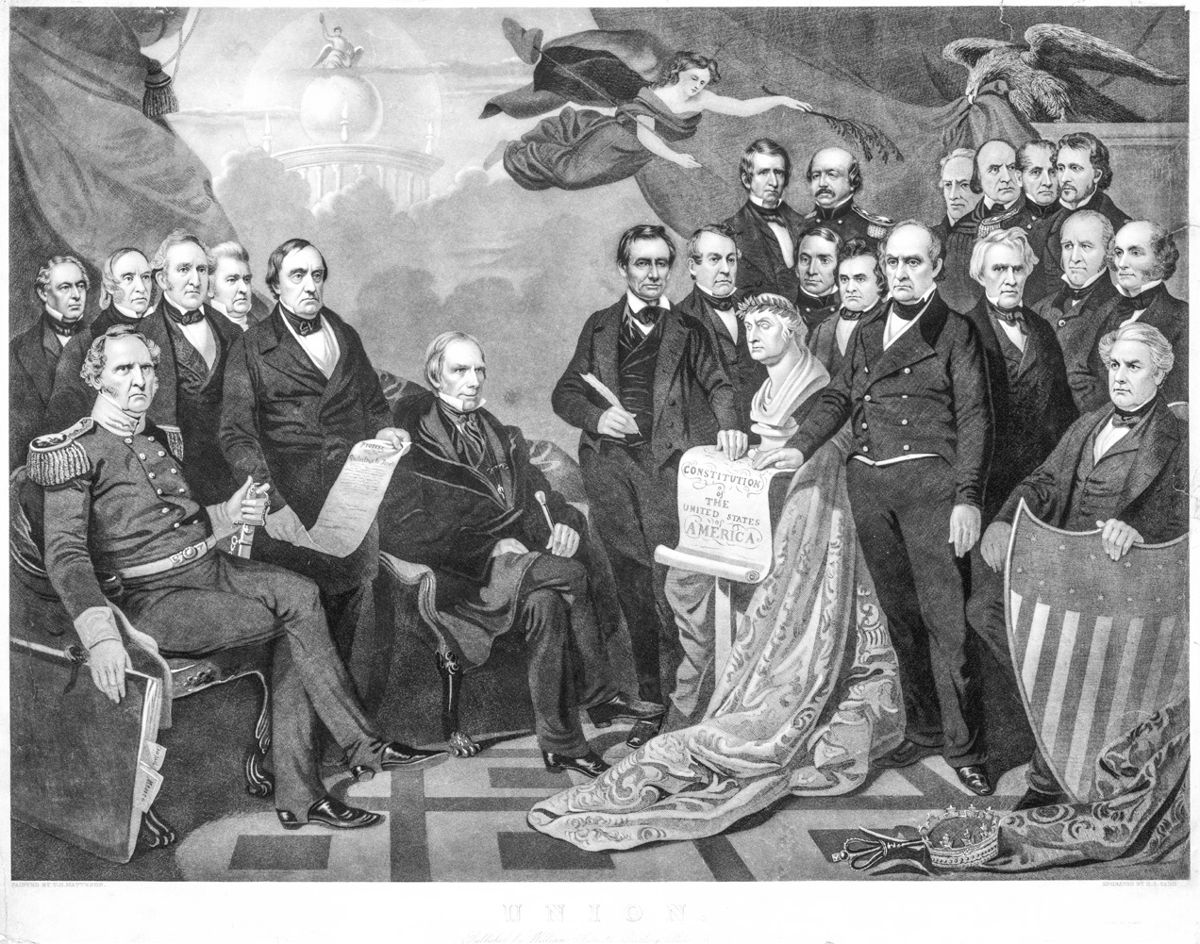
Abraham Lincoln without a beard. Salvatore Cilella is retired after 43 years in the museum field. His last position was President and CEO of the Atlanta History Center. He is the author of several articles and books. His most recent books are Upton’s Regulars: A History of the 121st New York Volunteers in the Civil War (U. Press Kansas, 2009) and he edited The Correspondence of General Emory Upton, 1856–1881 Abraham Lincoln with a beard. (U. Tennessee Press, 2017).