Inspection, ARMS!
Confederate “Double Barreled” Guns
By Tim Prince · Originally published May 2018 · pp. 18–19
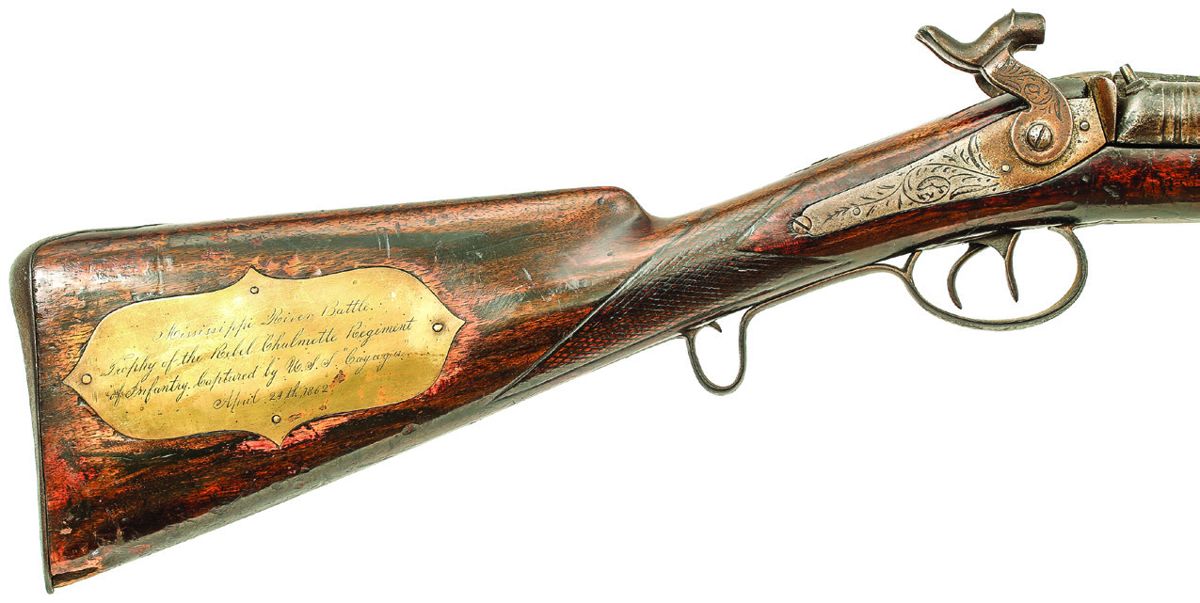
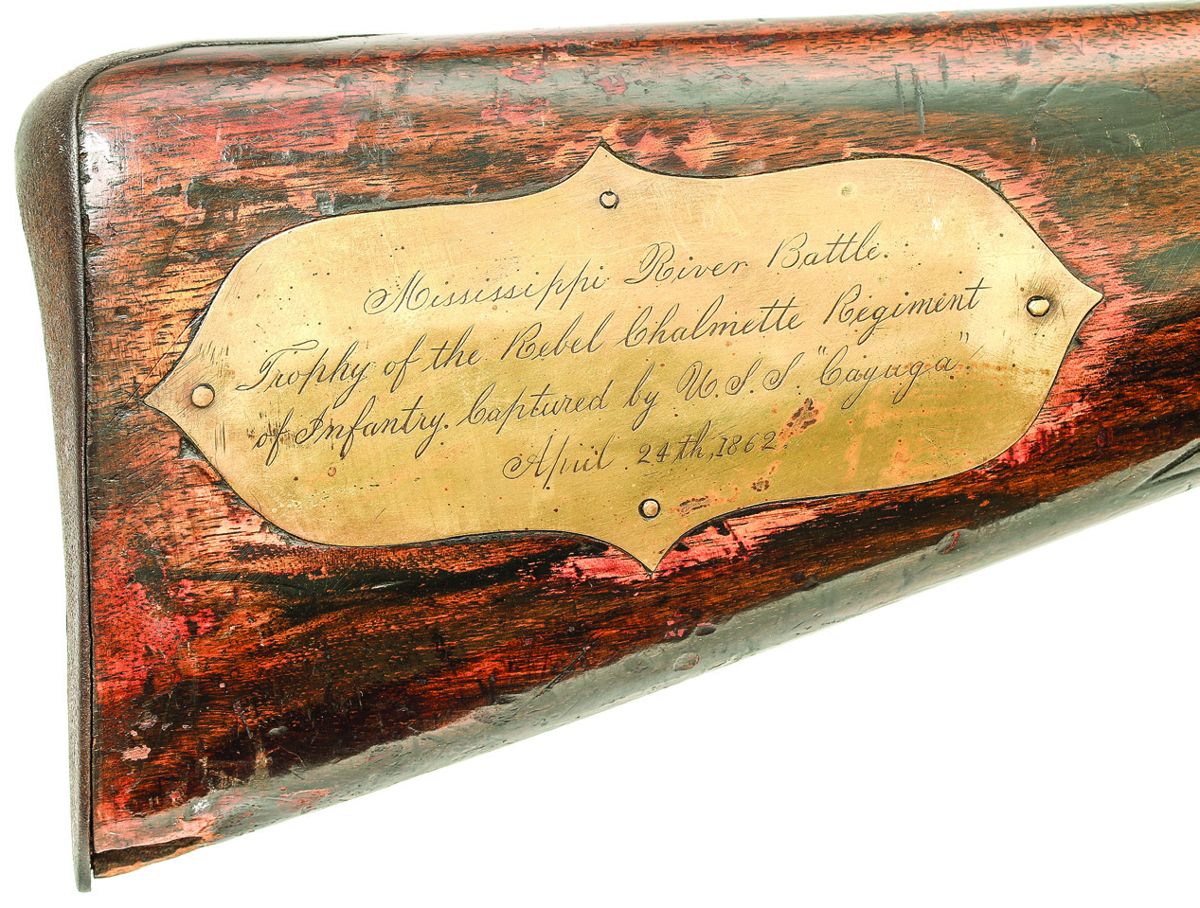
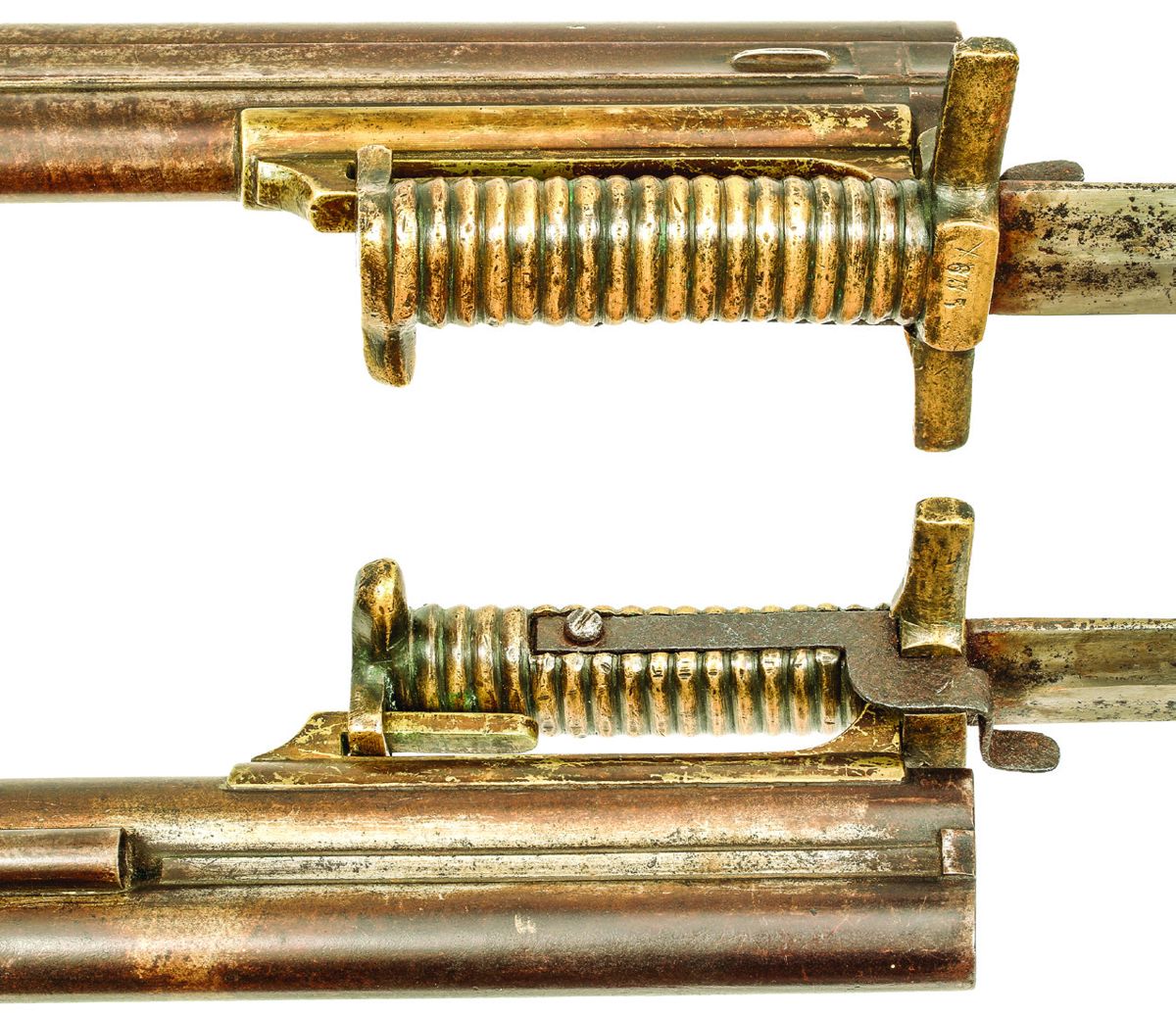
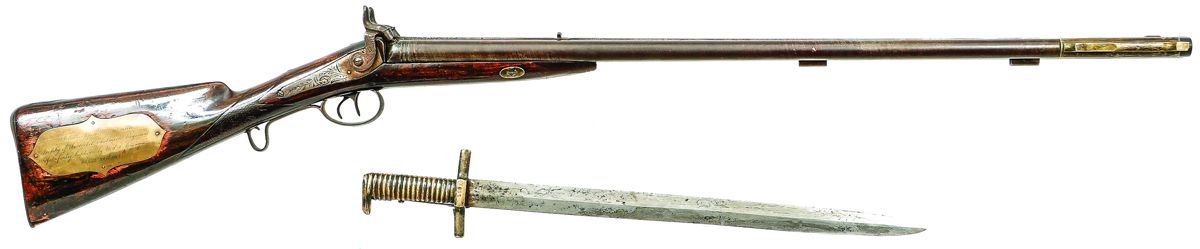
Rarely does a military artifact provide a concrete identification to where and when it was used, and a direct tie to the regiment that used it during the course of a conflict. Even more rarely can an item’s history be traced in minute detail from the time it was accepted for military service until the time that it was no longer in use in the field. This significant regimentally identified Confederate used and altered cape gun is just such a unique item. It has a very clear history that can be established through a combination of period documents and a wonderful period capture plaque that is set into the gun’s stock. When the Civil War broke out, the new southern Confederacy found itself woefully unprepared in terms of having available the necessary military equipment and supplies to put an army into the field. One of the greatest issues was a lack of small arms, or the ability to manufacture them with any expediency in large quantities. The most commonly encountered firearms in the south during this era were percussion ignition muzzle loading shotguns and rifles; weapons the common man used in everyday life to put food on the table and to defend his family and property from unruly intruders, whether four-legged or two-legged. As a result, an industry dedicated to the militarization of such civilian arms arose overnight, and gunsmiths, cutlers, blacksmiths, and mechanical artisans of all types went to work to turn the common civilian arms of the south into something resembling military arms. Country rifles were re-bored to a quasi-standard .54 caliber; sometimes the octagonal barrels were turned down at the muzzle to accept socket bayonets; either old U.S. surplus ones or newly made local blades. Shotguns were altered depending upon their intended use. Those destined for the cavalry often had their barrels shortened, were equipped with larger “musket sized” cones (nipples), and often had some sort of sling system attached; either swivels or sling bars and rings. Numerous receipts exist from southern gun makers engaged in modifying civilian shotguns for cavalry use. As an example, receipts in the Confederate Citizen Files (National Archives Record Group M346) from the Memphis firm of Schneider & Glassick that show the firm repaired hundreds of double barreled shotguns for military use and, in at least a couple of instances, the receipts specifically mention shortening barrels and adding sling rings. One receipt, dated September 19, 1861, lists: “16 shotguns cut off, new tubes; rings & locks repaired @ $3.00 - $48.00.” That same invoice lists on the next line: “29 guns, new tubes & rings @ 1.25 $36.25.” It appears the term “new tubes” does not refer to barrels as we use the word today in reference to shotguns, but probably to new percussion cones (nipples). The prices charged would bear out that it is not a reference to barrels, as barrels would have been much more expensive, and if “new barrels” were being installed, the first set of shotguns would not have been “cut off.” The mention of “rings” clearly suggests the installation of sling rings for cavalry use. Another Schneider & Glassick invoice from 10 days earlier also lists “30 shotguns, cut off and rep. @ $3.00 – $90.00.” These shortened guns were obviously for the use of the cavalry. Shotguns intended for infantry use were altered in a different manner. These guns were often modified to accept some form of bayonet, typically a large brass handled saber style blade. In New Orleans, the firm of Cook & Brother had undertaken to manufacture “short Enfield rifles” based upon the British Pattern 1856 rifle, complete with saber bayonets. Thus, it was no surprise that the Confederacy looked to Cook & Brother to manufacture saber bayonets for use on other weapons as well. The firm developed a large, two-pronged, brass lug that could be brazed onto shotgun barrels, and manufactured a brass handled saber bayonet to engage this lug. Again, receipts reveal hundreds of saber bayonets being produced by Cook & Brother; in some cases they refer to altering shotguns to accept saber bayonets. One such invoice from the spring of 1862 lists the following: “April 5 – For bayonets attached to 12 double ble guns $9.00 - $108.00.” An additional receipt goes along with this invoice that Close up of the cape gun’s muzzles, clearly showing the rifle and shotgun barrels, was well as the brass two-pronged Cook & Brother bayonet lug, with the forward prong broken. (All photos by Tim Prince) reads as follows: “Received New Orleans April 5th, 1862 from Cook & Brothers. The written inventories (?) and twelve double barrelled (sic) guns with Saber Bayonets & sheaths & frogs. (signed) J.C. Rousseau, Orderly Sergt. of Company H Chalmette Regiment.” An earlier receipt, from March 24, 1862, refers to these twelve guns being delivered to Cook & Brother for alteration and bayonets and reads in part: “Received New Orleans March 24th, 1862 from Co. H Chalmette Regt twelve double barreled guns for to fit on Bayonets.” While there were certainly other guns that were so altered by Cook & Brother and receipts that have survived indicated that they produced at least two thousand saber bayonets (typically at $8 each with scabbard & frog), this small trail of period paperwork proves that at least a dozen “double barreled guns” were altered by Cook & Brother for use by the Chalmette Regiment, had bayonet adapters installed, and were supplied with bayonets & scabbards for $9 each. It appears obvious, based on the other receipts, that the bayonet lugs and their installation on the guns were billed at $1 each. The Chalmette Regiment of Louisiana Volunteer State Troops was mustered into service on March 1, 1862, for 90 days and was officially mustered out in May 1862. The regiment would be briefly recalled for service a year later, in May 1863. The regiment’s 90 days of initial service was ignominious at best. The regiment had been raised to help with the defenses of New Orleans, as it became more and more apparent that a major Federal incursion into that region was going to take place. Under the command of Colonel Ignatius Szymanski, the regiment of slightly more than 300 men was ordered to Quarantine Station, six miles upriver from Fort St. Philip, where it took positions between the city and the fort. They were to provide protection for the river fort should it be assaulted from its rear and were also a final line of defense against any landing forces that might try to circumvent the fort and attack New Orleans directly.