
Book Reviews
Book Reviews — May 2018
Originally published May 2018 · pp. 32–39
A Southern Loss through Logistics Suppliers to the Confederacy Volume Three: British and European Imported Quartermaster Goods, Artillery and Other Ordnance. By Craig L. Barry & David C. Burt. Illustrations, photographs, appendices and select bibliography, 519 pp., 2017. Booklocker, BookLocker.com. $39.95 hardcover. Reviewed by Richard J. Blumberg
Logistics does not win wars. However, its mismanagement can cause wars to be lost. Suppliers to the Confederacy is a series that in part explores this phenomenon. The series relates the Confederate government’s attempt to address shortfalls in the waging of war by a predominantly agrarian society and infrastructure, rather than an industrial one. Volume One examines the Confederacy’s strong reliance on various imported goods that could not be easily acquired elsewhere. The English negotiated various supply contracts and sold a tremendous amount of essential supplies/materiel to the Confederacy.
Volume One provides detailed information regarding the contractual arrangements and goods sold. It covers muskets, rifles and assorted ball bags, cap pouches and muzzle stoppers. Volume Two, which is actually the third book in the series, continues the review of various manufacturers and imported goods. It also provides descriptions of tools obtained from actual battlefields. Additionally, it includes new items discovered as a result of the authors’ continued research. Canteens, percussion caps and haversacks are detailed in this work. Volume Three provides detailed analyses of the following: 1) English and Austrian imported artillery and other ordnance; 2) cloth and leather-related items like blankets, socks and shoes; 3) buttons; and 4) a comprehensive review of the Confederate Quartermaster Department and its leaders. Barry and Burt also emphasize modern-day logistical sustainment imperatives that ensure the correct items in the requested quantity arrive at the correct place at the right time. Some of these are moving, fueling, fixing and sustaining the force (supplies and materiel, like food/ammunition and goods related to health and sanitation). One of the most significant results of their research is to show the tremendous lack of blankets and cloth to make them that existed throughout the entire Confederacy. The Confederate government, expecting a short war, planned for near-term operations. This meant activities that should have started right away did not. Some of these included:
- The staffing and related training of Quartermaster Department personnel at all levels. 2. Developing strong distribution channels. 3. Managing rail, land and water transport systems. Although several of these items were ultimately addressed, it was too little, too late. Like the preceding works, Volume Three has excellent illustrations and photographs. The clarity of the photographs continues to be exceptional. This makes them valuable tools, allowing readers to gain a better understanding of what specific items looked like and how various manufacturers marked the goods they made. This volume, like the others in the series, can stand alone, or be part of a complete and comprehensive set that describes Confederate logistical operations. The low price of $39.95 makes this work a wonderful bargain. The research and analysis process used are brilliant and worth more than the cost of the book. This reviewer specifically requested to review this third volume in the series. Volume Three, like the previous two volumes, receives his strongest recommendation. It is an excellent reference tool for those interested in logistical operations, relic hunting, or as a comprehensive review of many largely unexplored facets of the American Civil War. Richard Blumberg has a master’s in Civil War studies. He has served as a book reviewer for 17 years. His article on hospital transports was featured in the February 2017 issue of Civil War News.
Humor: Lincoln’s Life Preserver Lincoln’s Sense of Humor. By Richard Carwardine. Illustrations, notes, bibliography, index, 177 pp., 2017. Southern Illinois University Press, www.siupress. com. $24.95 cloth. Reviewed by Wayne L. Wolf
A part of the Concise Lincoln Library Series, this volume does not a merely catalogue Lincoln’s jokes and anecdotes, but demonstrates how they were used to make a moral point, illuminate a policy position, or overcome a period of personal melancholy. Humor was an essential part of Lincoln’s life. It expressed his humanity in all its facets. Yet, he was able to alter his humor to meet the changing needs of his career. His early sarcasm, satire and ribald humor, frequently giving his enemies fodder to disparage him, evolved into stories which stressed a moral or political aim, disparaged an opponent’s position or connected him with “common folk.” By the time of the Civil War, Lincoln’s overwhelming desire to preserve the Union suppressed his humor, which Democrats and Copperheads used to lampoon his conduct of the war. Essentially, the Civil War cost Lincoln his laugh. What little humor left elicited righteous positions of justice and fairness for all or became a moral critique of those opposed to slavery or the cost of war. Lincoln’s political opponents continuously attacked him, using his humor as an indication that he lacked both principles and gravitas toward the war as well as the suffering he was forcing the nation to endure. To them he became the “National Joker” who told obscene jokes, kissed young women, and disrespected the dead and wounded on battlefields. Much of this characterization would today be labeled “fake news.” But it put Lincoln’s loyalists on the defensive during both his presidency and particularly during the 1864 reelection campaign. Without the military victories in Atlanta, Mobile Bay and the Shenandoah Valley these attacks may have cost Lincoln reelection. Few of his opponents cared that humor was Lincoln’s life preserver against both his melancholy and the burdens of office. Richard Carwardine does an excellent job of placing Lincoln’s humor in the context of 19th Century thought and usage. He forcefully argues that when Lincoln, the man, is romanticized and ennobled, much of the original and authentic richness of his humor and satire is lost. This volume is his attempt to understand Lincoln’s use of anecdotes, jokes and satire in the context in which they occurred. In this task this book both succeeds and deserves a place on any Lincoln collector’s bookshelf. It might also serve as a political lesson for President Trump, whose use of bawdy remarks and Twitter, and lack of self-deprecation have given his Democratic opponents fodder to attack his motives, policies and fitness for office—much as they did to Lincoln. If Lincoln had social media would he have used it to criticize McClellan (Little Mac) supporters? The parallels are striking and perhaps would lend themselves to a volume on presidential actions that embolden the opposition. Wayne Wolf is Professor Emeritus at South Suburban College in Illinois and the author of numerous Civil War books and articles including The Last Civil War Scout and Two Years Before the Paddlewheel. His current research focuses on discovering and publishing letters and diaries previously unavailable for research that focus on the emotions of the common soldier.
A civil war inside the Civil War Georgia’s Civil War: Conflict on the Home Front. By David Williams. Bibliography, footnotes, index, illustrations, photographs, 298 pp., 2017. Mercer University Press, www.mupress. org. $35.00 hardback. Reviewed by Gould Hagler
The Civil War was not as clearcut as North versus South. The fissures which rent the American polity were myriad and complex, creating not only a border between the eleven seceding states and the other twenty-three, but also splits within states and within families. David Williams’ book on Georgia’s Civil War demonstrates how profound these divisions were in one Southern state and how they affected the war’s outcome. Williams, a professor of history at Georgia’s Valdosta State University and author of eleven other books, draws on numerous sources to weave his account of the conflicts on the state’s home front. He marshals information from newspapers, diaries, letters, government records and slave narratives recorded during the 1930s to convey the story of this war within the war, a story of Georgian versus Georgian. After an introductory chapter on the antebellum period and the runup to war, the book is arranged chronologically, taking the reader through the war years as the crises multiply and worsen. Williams paints a vivid picture of life in wartime Georgia. He places much emphasis on the shortages and ruinous inflation which created unbearable stress for ordinary people—people who lived hand-to-mouth even before the trials of war. Knowing their families’ woeful plight, soldiers deserted in droves so they could care for their loved ones. Deserters and draft-dodgers were so numerous—and so capable of defending themselves—that the authorities often were helpless. Impressment officers forcibly took supplies and paid at government-set prices that “were almost always far below market value.” Worse, these officers were often corrupt, selling impressed goods for their own gain and taking bribes from those who could pay them to stay away. Williams also stresses that many Georgians were not merely war-weary but were anti-Confederate from the outset. His account includes the stories of many who opposed secession and actively supported the Union cause by one means or another. Slaves too undermined the Confederacy’s efforts by every means available to them—everything from work slowdowns and petty sabotage to violent uprisings and flights to join the Union army. In two areas—the causes of inflation and food shortages—readers may want more analysis to accompany the anecdotes and the simple explanations cited in the newspapers of the time. There is more to the story than speculators hoarding supplies and planters refusing to grow corn instead of cotton. In another area—desertion—Williams may overstate his case. In the prologue, he quotes Jefferson Davis’ 1864 speech in Macon, when the president said that two-thirds of the army was absent, and that while some were sick or wounded most were absent without leave. Later in the book the quote morphs. Williams states that Davis “publicly admitted that two-thirds of the army had deserted.” That is not what Davis said. However, the key point is that, whatever their causes, inflation and shortages plagued the Confederacy, as did desertion (however one does the counting) and the other severe problems covered in Georgia’s Civil War. The book tells a story of conflicts within a society at war while the shrinking armies of that society battled against an external enemy. Largely through the words of people who lived through this internal strife we learn how their troubles hampered the South’s fight for independence. Williams’ portrait is a grim one. One wonders how the Confederacy lasted four years. Gould Hagler is the author of Georgia’s Confederate Monuments: In Honor of a Fallen Nation (Mercer University Press, 2014). The book is available from Mercer University Press, retail outlets, online sellers and directly from the author (gould.hagler@ gmail.com).
Sloshing toward the End of Slavery with Illinois as the Pivot Making an Antislavery Nation: Lincoln, Douglas, and the Battle over Freedom. By Graham A. Peck. Maps, tables, 288 pp., 2017. University of Illinois Press, www.press.uillinois.edu. $34.95 hardcover. Reviewed by Frank J. Williams
Concentrating on Illinois, the author uses the state as a case study for the national debates regarding slavery. He views Abraham Lincoln’s political rise as far from guaranteed. Antebellum Illinois helped bring the slavery conflict to a head. The issue, according to Peck, pitted the idea of equal opportunity to work land when free against that of continued wealth and status possessed by whites through slavery. To the author, Illinois was “ground zero” for the end of slavery. Passage of Stephen A. Douglas’s Kansas-Nebraska Act and his failure to find peace with this legislation led to Abraham Lincoln’s anti-slavery nationalism. While a fine narrative of Civil War politics, Making an Antislavery Nation is loaded with detail but the author’s claims seem often beyond reach. Neither Douglas nor Lincoln predominates in this interesting explanation of the victory of antislavery forces in America prior to the Civil War. Even Lincoln’s election, with only 39 percent of the vote, was not preordained.
As the first antislavery president, he was instrumental in resolving the struggle between slavery and the promises contained in the Declaration of Independence. Peck points out that many Northerners supported abolition but accepted slavery in the South, while Southerners hated abolition, arguing that slavery was compatible with the freedom of whites. This created a massive conflict upon which the future of the United States would depend. Peck, in considerable detail, explores the issue from the Northwest Ordinance of 1787 until Lincoln’s election and defeat of his political rival, Stephen A. Douglas, in 1860. What Lincoln accomplished was to frame the argument as a return to the vision of the founding principles, thereby promoting an unprecedented sense of nationalism. Frank J. Williams is founding Chairman of The Lincoln Forum and author of Lincoln as Hero.
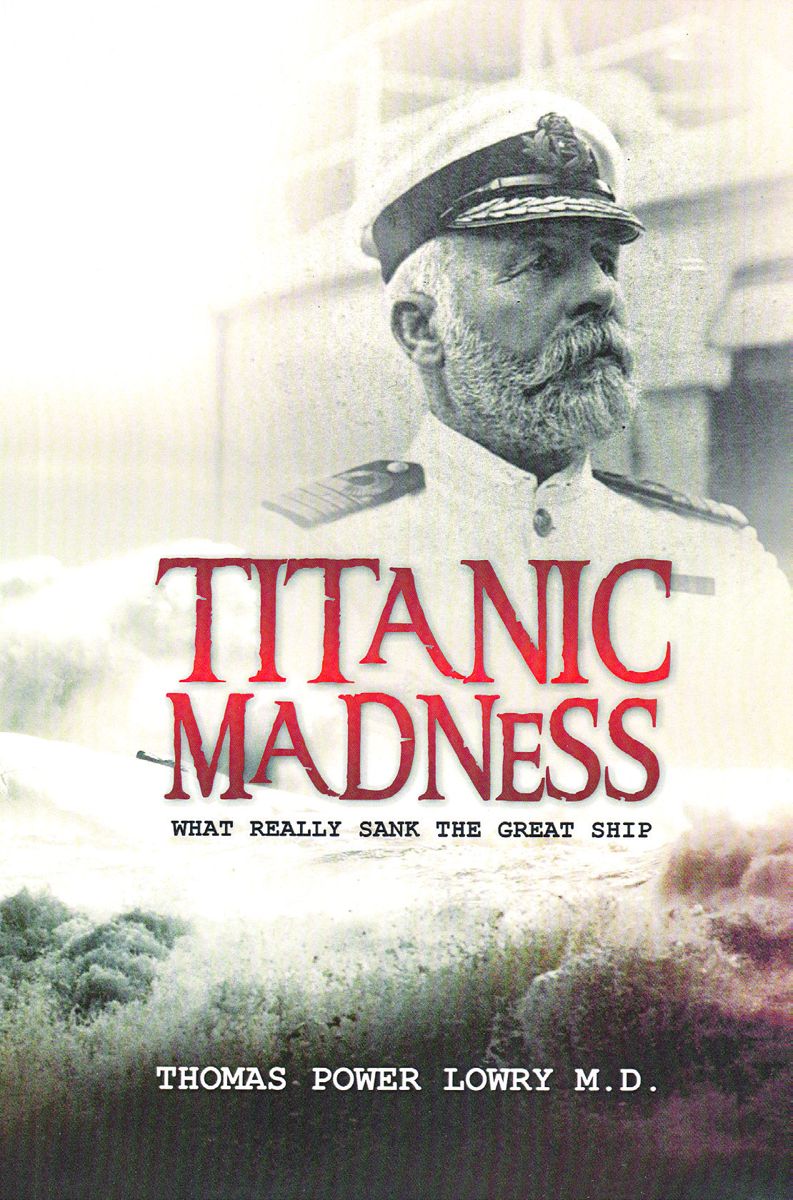
Compelling Book about Three Brothers Daily Life during the Civil War Three Brothers: Death and Love in the Civil War. By Thomas Power Lowry, MD. Illustrations, photographs, 118 pp., 2017. Idle Winter Press, www. idlewinter.com. $11.99 softcover. Reviewed by David Kindy
In 1861, as the United States was being torn apart by deep divisions, three brothers from Pennsylvania shared their thoughts in letters as they pondered their future and that of their country. Two would join the Union army and meet their fate at the calamitous battle of Fredericksburg. The surviving brother would go on to a long career as a journalist. The letters they wrote in that fateful year survive today and tell an intriguing story about life on the precipice of tragedy. Some of their reflections are piercing and insightful, others are frivolous and petty. All are poignant, and brimming with portents of what was to come as young lives cast their eyes to an uncertain future. Prolific author Thomas Lowry has written an interesting but short book about his relatives at the outbreak of the Civil War. He transcribes each letter in its entirety and provides deep background on the political, religious and moral issues referred to by the brothers, offering useful context for an extremely divisive moment in American history. The letters of Emanuel and Michael Lowry and their half-brother John Suhre are like looking through an open window to a distant, faded past. They provide glimpses of the fears and frustrations, joys and jubilations, anticipations and apprehensions of young men—boys, really—trying to make sense of the crazy world around them while at the same time attempting to find where they fit in to such a place. Historians will find the book compelling because of the brothers’ insight into issues of the day. Indeed, they write in detail about the pending war and the efforts to avert the bloodbath to come. Michael was the most prescient in writing, “And such a war! What mortal imagination can conceive of the awful horror attending it!” Though his writing was the most basic and rudimentary, John would become the brother most remembered. His name was focused in the spotlight just a few years ago when historian John Matteson discovered that it was John who was Louisa May Alcott’s “prince of patients.” While serving as a nurse, Alcott was deeply affected by the serenity of a severely wounded soldier. Three Brothers: Death and Love in the Civil War is another important volume about the impact of the Civil War on everyday lives. But it could have been so much more. David Kindy, of Plymouth, Mass., is a lifelong student of history and researcher of Civil War veterans from his hometown area.
Final Volume in Overland Campaign Series On to Petersburg: Grant and Lee, June 4–15, 1864. By Gordon Rhea. Maps, illustrations, notes, index, bibliography, 427 pp., 2017. Louisiana State University Press, www.lsupress.org. $45 cloth. Reviewed by Chris Mackowski
Like every other student of the Overland Campaign, I’d been eagerly awaiting the fifth and final installment of Gordon Rhea’s landmark campaign study. It’s a story he began in 1999 with The
Battle of the Wilderness, continued with The Battles for Spotsylvania Courthouse and To the North Anna River, and had previously ended with Cold Harbor. His fifth volume takes readers On to Petersburg to close out the Overland Campaign and shift to the nine-month siege operations around the Cockade City. The best thing about this book—and there are many great things about it—is that Rhea’s highly readable writing has only gotten better over time. On to Petersburg is a remarkable capstone to his series, and it reads as crisply, clearly and engagingly as anything he’s written. He has a masterly sense of pacing, he portrays characters as effectively as a best-selling novelist, and his deep research shows in every sentence. Rhea opens the book with a succinct summary of the campaign thus far—no mean feat considering that the story previously required four full books to adequately tell. Rhea’s obvious command of the material shows in his adroit handling of the summary, which is the best synopsis of the campaign anyone has ever written. As events progress from the Wilderness, the narrative goes into more and more detail as it approaches Cold Harbor, appropriately setting up the events Rhea recounts in this book. A common misperception people have about the battle of Cold Harbor is that it ended after Ulysses S. Grant’s massive, doomed attack on June 3. But as Rhea explains, “During the week following the big attack at Cold Harbor … the Army of the Potomac and the Army of Northern Virginia sparred like two boxers searching for openings… .” For the soldiers it was, Rhea says, “a dismal existence of unbearable heat, unrelenting insects, incessant shelling, and whirring bullets from sharpshooters. Localized skirmishes rather than grand offensives [came] to characterize life at Cold Harbor.” Rhea spends time describing each of those skirmishes, impotent as they all tended to be in the overall efforts of each army to dislodge the other. High command tended to brush off the engagements as unimportant, although the trench-level view Rhea offers shows how tense those encounters were for the men involved. “Some of our boys say that one of these skirmishes would have been called a ‘battle’ twelve months ago,” a Richmond newspaper said—an observation that underscored both the intensity of some of the fights as well as, ironically, how desensitized the men had become to them. The keys, of course, were the defensive works both sides constructed that made grand assaults foolish. At Cold Harbor, soldiers of both sides elevated earthworks to an art form. “I have never seen such extensive works constructed with such magical rapidity, or that press so hard to the enemy’s,” marvels a newspaperman whom Rhea quotes. “Nor are they simply straight ditch and embankment. They are intricate, zig-zagged lines within lines, lines protecting flanks of lines, lines built to enfilade an opposing line, lines within which lies a battery which must be kept silent. A maze and labyrinth of works within works, and works without works, each laid out with some definite design either of defense or offense.” As Rhea demonstrates, soldiers
“endured a numbing existence in which death could strike at any moment.” As the author leads readers through those days, he also sets the stage for Grant’s move across the James River. Grant, whom Rhea calls “a master at improvising, as he had demonstrated multiple times over the previous month,” was “juggling a host of cooperating elements .” Rhea, too, does an impressive job juggling a host of elements: forces under Grant, Lee, Benjamin Butler, P. G. T. Beauregard, David Hunter and the U.S. Navy, plus a number of cavalry operations, a looming presidential election, Virginia’s two largest cities, an incredibly long pontoon bridge, and more. I especially appreciated the way he unpacked the controversy around a truce the armies called on June 7. Also of particular note, I found Grant’s jump across the river amazing, and Smith’s failure at the gates of Petersburg palpably frustrating, all thanks to Rhea’s fine writing. The narrative is necessarily Federal-heavy because of “the comparative paucity of Confederate material,” Rhea explains, but he does capture Lee’s perspective. The army commander’s catalogue of woe was long. His former superpower—his ability to get into the heads of his opponents—seemed useless against Grant, whom he could not read. The Army of Northern Virginia had been backed up against Richmond, negating its ability to maneuver. Political considerations colored everything because of the impending election in the North. And worst of all, during the course of the first six weeks of the campaign, Lee had lost nearly half the men of his army, and although reinforcements had since bolstered his numbers, he had no others to draw on. “And with Stuart dead, Longstreet seriously wounded, Ewell on assignment to Richmond, and Hill increasingly sick,” Rhea says, referring to the army’s corps commanders, “Lee’s high command was in shambles. The Army of Northern Virginia could ill afford more victories whose net effect was to accelerate its demise.” The tense environment led to bickering among the Confederate commanders, but surprisingly, the Federal high command comes across as far worse. The tension of the campaign, the strained relationship between Grant and Meade, the addition of the troublemaking William “Baldy” Smith, and the lack of respect anyone had for Ambrose Burnside makes the Federal command look more dysfunctional than anything Braxton Bragg ever had to deal with out west. Many readers will be surprised by the dynamics, but it’s an example of one of Rhea’s most invaluable talents: he brings real insight to the history he recounts and gives readers much to think about. That’s what makes the book’s conclusion, in particular, so invaluable. I won’t offer any spoilers here—you deserve to think about it for yourself—but it does bear noting that the book’s conclusion isn’t just the campaign’s conclusion—it’s the mature result of twenty years’ worth of research and reflection by the foremost authority on the Overland Campaign. That, more than anything, has made the wait since the Wilderness entirely worth it. After all that time, Gordon Rhea has given us much to think about, indeed—and I, for one, am grateful. Chris Mackowski, Ph.D., is the editor in chief of Emerging Civil War and the historian in residence at Stevenson Ridge, a historic property on the Spotsylvania Court House Battlefield. He teaches writing at St. Bonaventure University.
When Johnston Surrendered We Ride a Whirlwind: Sherman and Johnston at Bennett Place. By Eric J. Wittenberg. Maps, photos, notes, appendices, index, 249 pp., 2017. Fox Run Publishing, www.foxrunpub. com. $34.95 hardcover. Reviewed by Daniel T. Davis
On April 9, 1865, Gen. Robert E. Lee surrendered the Army of Northern Virginia to Lt. Gen. Ulysses S. Grant at Appomattox Court House. Lee’s capitulation, however, did not bring an end to the Civil War. Another Southern force, Gen. Joseph E. Johnston’s Army of Tennessee, was still operating in North Carolina. Since his return to command in February, Johnston had contested the advance of Maj. Gen. William T. Sherman’s army group as it marched through the Carolinas from Savannah. The loss of the Confederacy’s most significant command in Virginia convinced Johnston that further resistance was useless. He resolved to meet with Sherman and seek terms of surrender. The two old foes met at James Bennett’s farm west of Durham Station. Unlike the brief conference in the parlor of Wilmer McClean’s house, Sherman and Johnston met three times on April 17, April 18 and finally on April 26. The outcome ultimately led to the surrender of not only Johnston’s army, but Confederates in the Carolinas, Georgia,
Florida and Tennessee, totaling over 89,000 men. Eric J. Wittenberg, the authority on Civil War cavalry operations, has moved away from his recognized subject of expertise to re-tell this compelling story. Relying on a variety of primary sources, including the writings of Sherman and Johnston, Wittenberg takes readers inside the walls of the Bennett House with the two antagonists. He examines each meeting in detail, the terms of surrender offered by Sherman and agreed to by Johnston, and the political ramifications of those momentous days. The text is supplemented by outstanding maps by Mark A. Moore, the authoritative cartographer of the war in North Carolina. Extensive endnotes provide biographical information on the key individuals of each side. Wittenberg’s quick-paced prose makes for an enjoyable read; one could easily finish the book over the course of a weekend. Especially of value is the epilogue, which traces the history of Bennett Place through the Civil War’s Centennial and its establishment as a state park. Readers will also find the appendices of great interest. They include an Organization of Forces, an examination of Sherman’s motivation in offering his initial set of terms to Johnston, correspondence between Jefferson Davis and his chief cabinet members prior to Johnston’s surrender, and Lt. Gen. Wade Hampton’s actions after the surrender. This is an excellent and highly recommended work on a forgotten episode of the Civil War. Daniel T. Davis is the co-author of six books in the Emerging Civil War Series published by Savas Beatie, LLC. His forthcoming book, The Most Desperate Acts of Gallantry: George A. Custer in the Civil War, will be released in the spring of 2018. He is a Managing Editor of the Emerging Civil War blog and resides in Fredericksburg, Va.
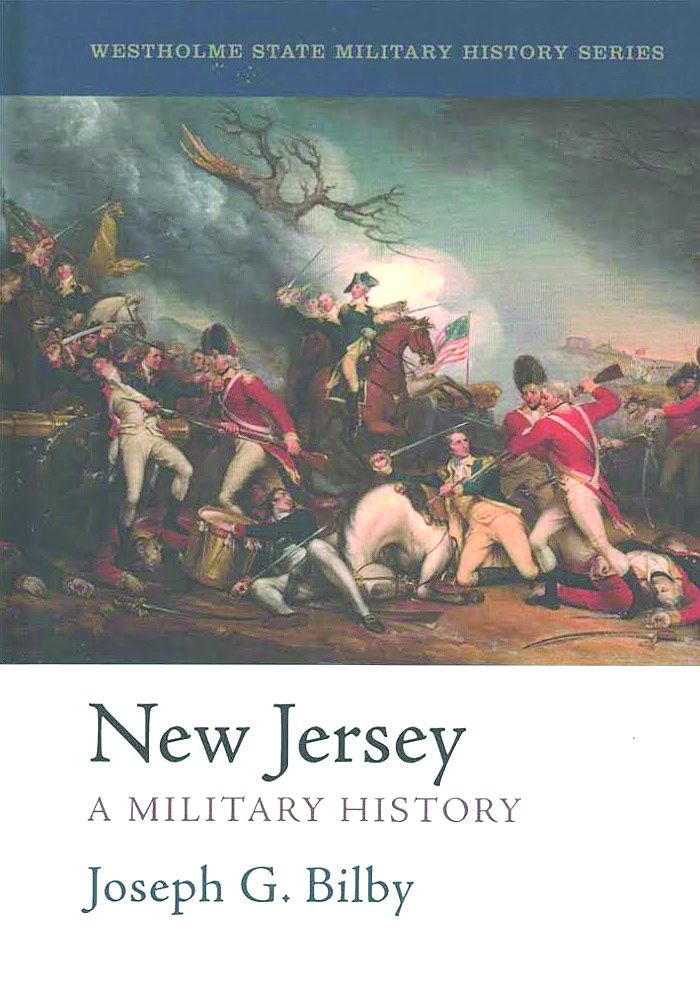
Crossroads to History New Jersey: A Military History. By Joseph G. Bilby. 291pp., Index, notes, bibliography, 291 pp., 2017. Westholme Publishing, www.westholmepublishing.com. $35 hardcover. Reviewed by Joseph Truglio
As a native New Jerseyian I knew there was more to my home state than the Sopranos and depressing industrial sites along the Turnpike. However, what I was not aware of is the extent of its military history in the formation of the nation. Well, that is no longer the case. In this brief but encyclopedic presentation one is presented with everything one needs to know and more. The history is presented in eleven chapters covering all aspects of military activity from pre-colonial times to the present day. Told in chronological order, we learn of a multitude of engagements starting with clashes with Native Americans, progressing to the American Revolution, War of 1812, etc., etc., right up to the present time. Along the way we are introduced to many participants of note as well as important military actions and their effects on forming the state and nation. We are introduced to such personages as Clara Barton, Richard Stockton and Stephen Kearny, Jerseyians all. We are given descriptions of important battles like Trenton, Princeton and Monmouth. Listed above is just a sample of the people and events depicted in this book. Most of these activities are brief in form, but an excellent bibliography provides many resources for further study. There is enough information to satisfy any interest one may have. I was personally intrigued with the info on the Nike bases during the Cold War of the 1950’s and the Navy’s armed guards during WWII. My father served in one of those units and the information should help me in further my research in his service. The book concludes with a chapter on New Jersey monuments, historic sites, museums and memorials. Each has a short history and, in some cases, directions to their locations. I found this book to be extremely interesting. It is easy reading and can be a great primer in learning of the state’s history. One need not be from New Jersey to enjoy this book as its history relates to the nation as a whole. It is a valuable tool in the study of military history and should be in every military buff’s library. I highly recommend you to get a copy and start your journey. Joseph Truglio is a lifelong student of Civil War history. He is a member of several round tables, the Lincoln Group of New York, and is currently president of the Phil Kearny Civil War Round Table of Wayne, New Jersey.
Conservatism in Crisis The Stormy Present: Conservatism and the Problem of Slavery in Northern Politics, 1846–1865. By Adam I.P. Smith. Notes, bibliography, index, 331pp., 2017. University of North Carolina Press, www.uncpress.org. $45.00 cloth. Reviewed by Wayne L. Wolf
This book presents an in-depth analysis of the two decades before the Civil War and how America was beset by political and social differences which ultimately propelled the country to war. Slavery was the catalyst, the white elephant in the room, that threatened the political stability so cherished by the heirs of the founding fathers. Conservatives were being forced to act as revolutionaries. Their faith in the institutions formulated by the founders was being attacked. The politics of compromise that had protected the Union was being rejected. The majority of Americans were being forced to enter the debate over how much freedom could be preserved without sacrificing social order. Conservatives, representing continuity with the past, had to reconcile their love for stability against the requirements of the Compromise of 1850, the Fugitive Slave Act, the Kansas-Nebraska controversy, the Dred Scott decision and the Lecompton Constitution.
The Union could only be saved if clear lines could be drawn between the slave and free states so each side could tolerate the moral and legal system of the other. The inability to do this placed the nation on the brink of catastrophe. It was a failure of conservative politics that ultimately led to a war between people’s liberties and a centralized, monarchical rule. Adam Smith’s The Stormy Present expands on this meaning of conservatism from previous historical analyses by historians Patrick Allitt (The Conservatives: Ideas and Personalities Throughout American History) and Rachel Hope Cleves (The Reign of Terror in America: Visions of Violence from Anti-Jacobinism to Antislavery). Smith sees conservatism as laying the foundation for restoring the antebellum balance between liberty and power, a battle we are still fighting today between states’ rights and a concentrated Washington power center. Hence the Civil War did not break the mold of American political thought. Everything was changed by the war, yet nothing was different in the struggle of liberty versus power. Freedom had done battle with despotism and won but only temporarily. The Stormy Present is well written and voluminously footnoted with primary source material. It offers a historically accurate portrayal of conservatism’s changing definition in antebellum America. It chronicles how basically conservative Northerners were led to accept radical change and discusses the question, was the Civil War a war to abolish slavery or preserve the Union? For readers who want to gain a better understanding of how Northerners were led to accept Abraham Lincoln’s view of America, this book is a valuable tool. It is highly recommended for its treatment of slavery and how the majority of Northerners rejected extremism until forced to make a choice because of secession. A similar text regarding the Southern evolution of political thought during this same period which impelled them to secession would be a welcome companion volume. Wayne L. Wolf is Professor Emeritus at South Suburban College and the author of numerous Civil War books and articles including The Last Confederate Scout. He currently is finding and transcribing recently discovered Civil War soldiers letters’ to make them available to Civil War researchers.
New Study of a Big Battle River of Death: The Chickamauga Campaign July – September 1863. By Donald S. Lowry. 734 pp., 2017. CreateSpace Independent Publishing Platform. Don.lowry@excite. com. $27.95 hardbound. Reviewed by Lee White
The Battle of Chickamauga has been the subject of a recent renaissance of interest and publications in the past decade, and rightfully so. The battle had the second highest butcher’s bill of casualties in the American Civil War, and had enough recognition among veterans to be established as the nation’s first national military park in 1890. However, with the passing of the veterans, the war’s focus shifted away from the western theater to the battlefields of the east. It has only been in recent times that focus has returned back to the west and to Chickamauga in particular. Donald S. Lowry has made the newest contribution to the current surge of historiography of the battle with his River of Death. Coming in at 734 pages, don’t let that fool you; the author writes in a very easyto-read style that does not get lost in the massive tactical and small unit details of what many consider to be a very confusing battle and campaign. This book delivers a middle-ofthe-road approach to the battle, not getting bogged down while not being too short of details. Using the most recent studies of the battle and campaign, the author crafts a narrative that explains the tactical and strategic elements that made the campaign noteworthy. Another element that stands out in this work is that the author places the campaign for Chattanooga in the big picture of what was going on throughout the country in the bloody summer of 1863. He covers the aftermaths of Vicksburg and Gettysburg and how the eyes of the nation then shifted to events in northern Georgia as the summer of 1863 began to fade. Lowry’s treatment of the battle incorporates recent scholarship and presents an accurate narrative of the battle free of many myths that haunt older narratives. The battle itself dominates the last half of the book, beginning with the opening moves and lost opportunities at McClemore’s Cove, Ringgold, and Rock Spring. He then takes us into the beginning of the fight on September 18th with the struggle for the crossing points of the Chickamauga, then into the full-blown fighting that began the morning of September 19th and raged almost unabated through the evening of the 20th. In all this, Lowry takes a brigade-level of study for the fighting that will help those who are interested in the mechanics of the knock-down fighting. This, however, does lead to one complaint I do have for this book: the lack of maps makes it hard to follow along at times. With that said, I do recommend this book for those interested in the Chickamauga campaign. It offers a lively narrative and does a highly commendable job of giving us the big picture of the war in the days after Gettysburg and Vicksburg. So if you are looking for a military history of the battle or something between the very general and highly detailed, this is the book for you. William Lee White is a Ranger at the Chickamauga and Chattanooga National Military Park and also the author and editor of several works connected to the Western Theater of the war, including a forthcoming book, Let Us Die Like Men: The Battle of Franklin, November 30, 1864.
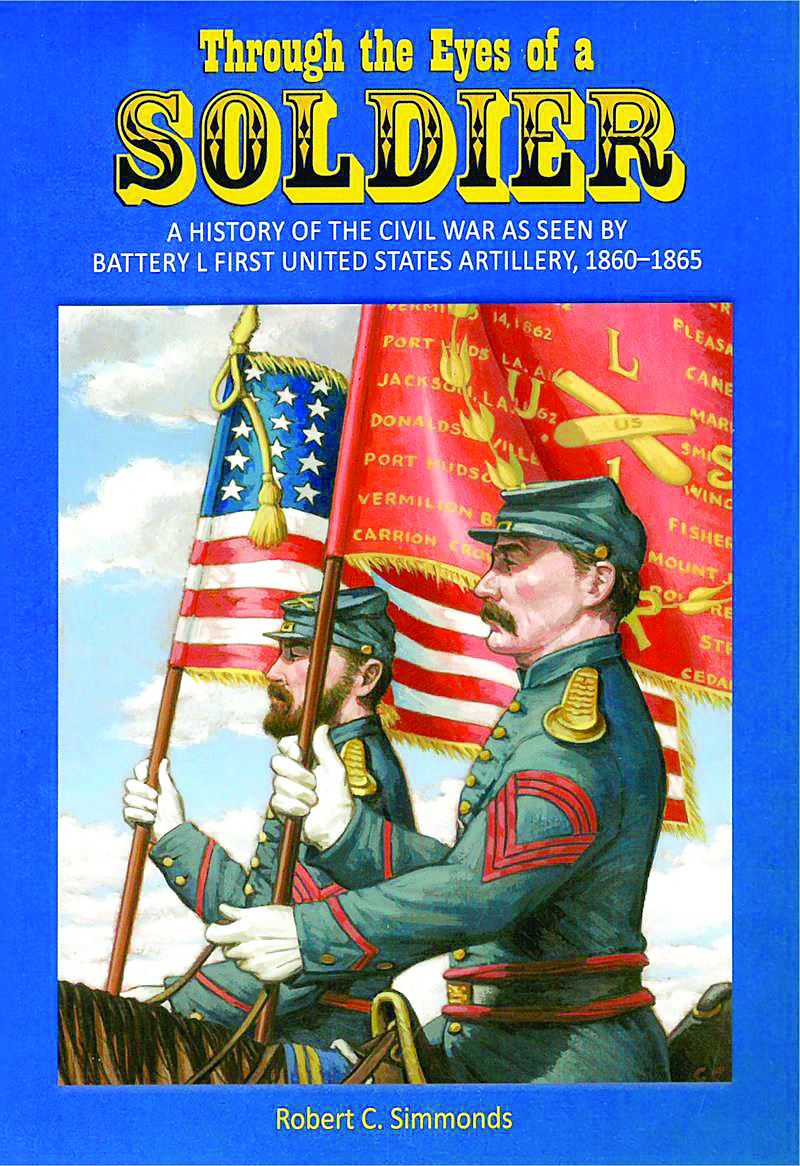
A Mission through the Civil War with an “Old Army” Unit Through the Eyes of a Soldier: A History of the Civil War as Seen by Battery L First United States Artillery, 1860-1865. By Robert C. Simmonds. Maps, illustrations, tables, photographs, notes, appendix, sources, index, 846 pp., 2017. Peter E. Randall Publisher, media@perpublisher. com. $49.95. Reviewed by David Marshall
Through the Eyes of a Soldier tells the story of a small regular United States Army unit: Battery L of the 1st Regiment of Artillery. It also is a history of the Civil War emphasizing the Western theater, where this group of men spent the majority of their service time during the conflict between the Union and the Confederacy. However, these soldiers were finally transferred to Virginia, to fight with General Philip Sheridan in the Shenandoah prior to the end of the war in 1865, when they witnessed the end of hostilities. Robert Simmonds opens the 846-page monograph with interesting anecdotes and details of this “old army” unit’s service prior to the start of the fight. His insight into the men’s patriotism, reasons for protecting their borders and love of soldiering is fascinating. Their regiment originated on March 2, 1821. They participated in the Mexican War in 1847 but were not involved in any fighting. Prior to 1861, their time was spent in New York, Florida and in Texas. These soldiers experienced the drastic changes happening in the South prior to the first shots fired at Fort Sumter. Somehow the battery and regiment escaped in 1861 from secession in Texas and reached safety at Fort Jefferson, off Key West, Fla. The men in blue spent a great deal of time in Florida, as well as in important battles along the Mississippi supporting Winfield Scott’s Anaconda Plan. Additionally, Simmonds provides significant information and demonstrates understanding of their service during the Red River Campaign, which is not always mentioned in historical works of this period. This feature is itself an important bright spot in the narrative and will be important to future work by scholars.
The author concludes with Battery L’s involvement in defending the U.S. against the Fenian Brotherhood raids from Canada as well as returning to Fort Pickens in 1872. This battery ceased to exist with an act of Congress on February 2, 1901. A History of the Civil War as Seen by Battery L First United States Artillery, 1860–1865 offers clarity of organization and accuracy of description. Coupled with interpretive perceptions, the text enables the reader to grasp both details and the larger picture of the war. More than three hundred illustrations, maps, tables, drawings and photographs help bring the treatment to life and will be of interest to enthusiasts and buffs. The author provides an interesting appendix dealing with the fall of New Orleans. I consider this treatise to be the definitive study of Battery L, 1st Regiment of Artillery; it is based upon years of research and is a welcome addition to this genre. While some might think this book is only for a niche market, I would ask that you reconsider. It is truly an admirable account of the entire war which will be useful to all students of this important period in United States history, as well as to those interested in military history. However, it would have been helpful to have included more first-hand accounts from soldiers. Since this a very large text, notes at the bottom of the page take up a great deal of space and might have been placed at the back of the book. The extensive sources and index will prove to be most useful to academics and veteran students. Simmonds’ effort adds tremendously to our knowledge of both Battery L and the Civil War. The tapestry is lucid, informative, well researched and extremely detailed with good analysis. Simmonds is to be complimented for such a complete and accurate history of Battery L. The author’s great-grandfather; who served with Battery L during the Civil War, would be proud of his effort. David Marshall is a high school American history teacher in the Miami-Dade School district for the past thirty-one years. A lifelong Civil War enthusiast who became interested during a family visit to Gettysburg when he was 10, David is president of the Miami Civil War Roundtable Book Club.