
Black Powder, White Smoke
NC Cavalry “long range guns,” Southern Starrs & Colt Sales
By Joe Bilby · Originally published March 2018 · p. 6
We are back at the battle of New Bern again. Another interesting newspaper clipping arrived from my North Carolina friend Skip Riddle. First lieutenant William A. Graham Jr., then in command of Company K, the 2nd North Carolina Cavalry, felt he had some explaining to do, and on March 29, 1863, took pen in hand to write a letter to the North Carolina Semi-Weekly Standard. The Standard printed Graham’s letter in its April 16 edition. It seemed that Graham had heard somehow that there were “various unfavorable reports spread throughout the state concerning the behavior of the 19th North Carolina Troops (2nd Cavalry) in the battle near New Bern on the 14th instant.” The lieutenant went on to claim that those reports were “false.” He never specifically addressed the rumors, but gave an account of his unit during the battle.
Graham’s Company and Company A, under a Captain Hayes, were ordered to dismount and report to Colonel Vance of the 26th North Carolina Infantry, then in defensive earthworks awaiting the arrival of advancing Union troops. It turned out that the two companies were not randomly selected, but chosen due to their arms. Graham explained that they were equipped with “long range guns.” What were these guns? Well, “Co. A had Mississippi rifles and Company K Hall’s carbine.” It is presumed that the 26th was armed with smoothbore muskets. Graham related that his men never got the chance to try out their “long range” Hall carbines, but were told to withdraw because they were outflanked. They subsequently found that their horses were not where they left them, and the lieutenant wrote “that they had been ridden off…some say by the militia, others by men with uniforms.” So the horseless horsemen continued their retreat on foot. That scenario may have been the source of the embarrassing rumors, but I had another interest—in the casual reference to “long range guns” that happened to be Hall carbines. The Mississippi rifle was indeed a rifle, although the original sights on that weapon were far from “long range” capable in the usual sense. The Hall carbine, on the other hand, was originally a smoothbore arm. One source states, however, that a number were rifled after they were no longer standard service arms. My friend Bill Adams advised that Halls had been fired at his club’s annual black powder introductory shoot for collectors. He reported that shooters had advised that Hall rifles and carbines were quite accurate at fifty yards, and presumably greater distances. This does not include the “Fremont Halls,” part of a notable acquisition scam early in the war. Those guns had been rifled, but apparently the bore was enlarged by the rifling, and not the chamber. Bill wrote that surviving Fremont guns fired today have proved quite inaccurate. The Halls used by the North Carolina cavalrymen were probably Hall rifles cut down to carbine length. The Raleigh Register of Oct. 2, 1861, noted that, among other projects, the Fayetteville Arsenal was altering “Hall’s breech loading rifles to carbines, and they make an excellent cavalry service gun.” Graham’s men, by the way, eventually found their horses in Kinston.
Southern Starr? De Bow’s Review was a New Orleans magazine dealing with Southern agriculture and commerce. The magazine’s “Editorial Miscellany” column for April 1861 notes: The proprietors have placed in our hands a self cocking hair trigger revolver, which is one of the simplest, cheapest and most powerful instruments of defense with which we have met. The agent for New Orleans is O. S. Jennings, 20 Camp Street. Our contemporary of the “Crescent” says most truthfully of the weapon: ‘Starr’s revolvers – We made a trial with one of these pistols a few days since, and must acknowledge that we were agreeable surprised by its great range and accuracy. Without being heavier than is desirable for a serviceable belt-pistol, they carry a sufficiently heavy ball to be effective, and, in the hands of a good marksman, a man could be brought down every time at from one hundred to one hundred fifty yards. The trial we made convinced us of this, and further, that they possess all the advantages of the Colt army and navy revolver, with additional ones of being better adapted for quick shooting, and having conveniences for cleaning and keeping in order what in active service will render them less liable to damage. Military companies, about supplying themselves with side arms, could do no better than choose this pistol.’ The story reveals that there was at least one Model 1858 double action Starr revolver in New Orleans at the outbreak of the Civil War, and probably a few more.
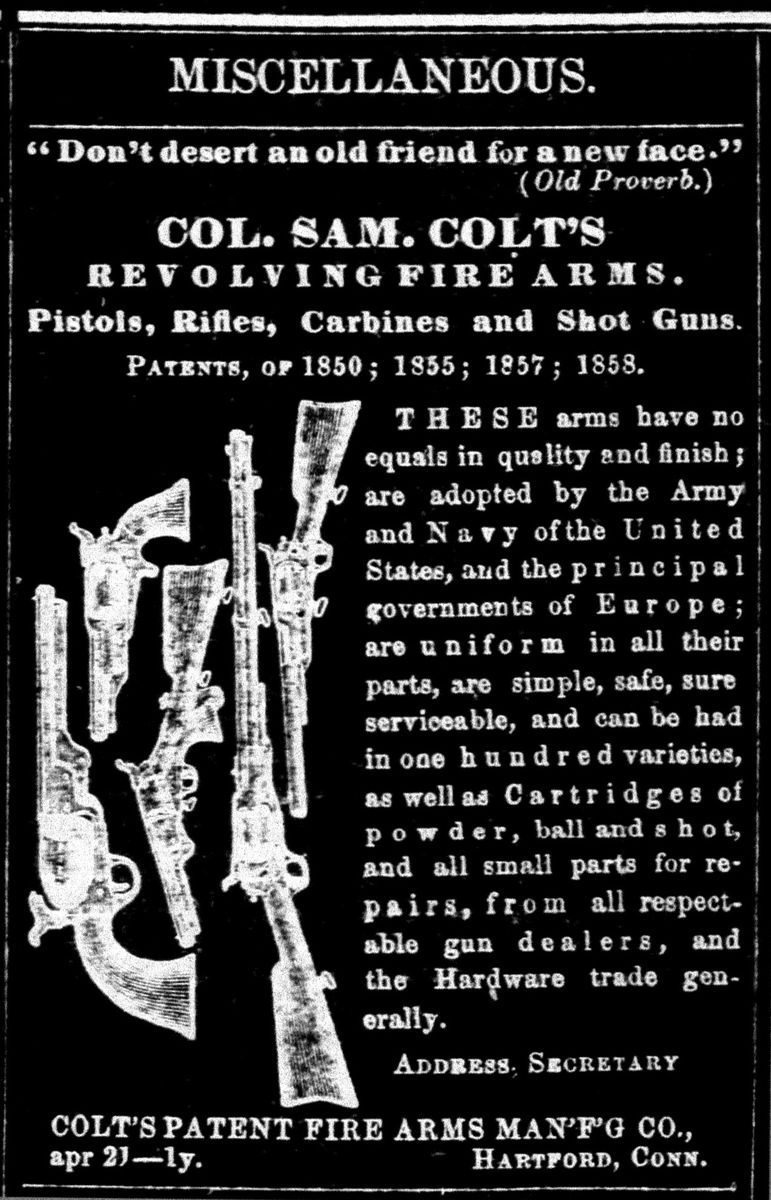
Colt Sales It was no secret that Sam Colt kept selling his products in the Confederacy until the first shots were fired at Fort Sumter. Colt advertisements appeared in southern newspapers all during the secession crisis, and the one pictured here actually ran on June 5, 1861, in the Raleigh Register. The ad was from the Colt company itself, not a local merchant, but I doubt any guns were still going south by that date. Most likely the advertisement had been paid for in advance and ran its course. Of course local merchants probably still had some new Colts in stock as of that date. Joseph G. Bilby received his BA and MA degrees in history from Seton Hall University and served as a lieutenant in the 1st Infantry Division in 1966–1967. He is Assistant Curator of the New Jersey National Guard and Militia Museum, a freelance writer and historical consultant and author or editor of 21 books and over 400 articles on N.J. and military history and firearms, and as publications editor for the N.J. Civil War 150 Committee edited the award winning New Jersey Goes to War. His latest book, New Jersey: A Military History, was published by Westholme Publishing in 2017. He has received an award for contributions to Monmouth County (N.J.) history and an Award of Merit from the N.J. Historical Commission for contributions to the state’s military history. He can be contacted by email at jgbilby44@ aol.com