
Laurel Hill: It’s All About the Past
Originally published March 2018 · pp. 3–4
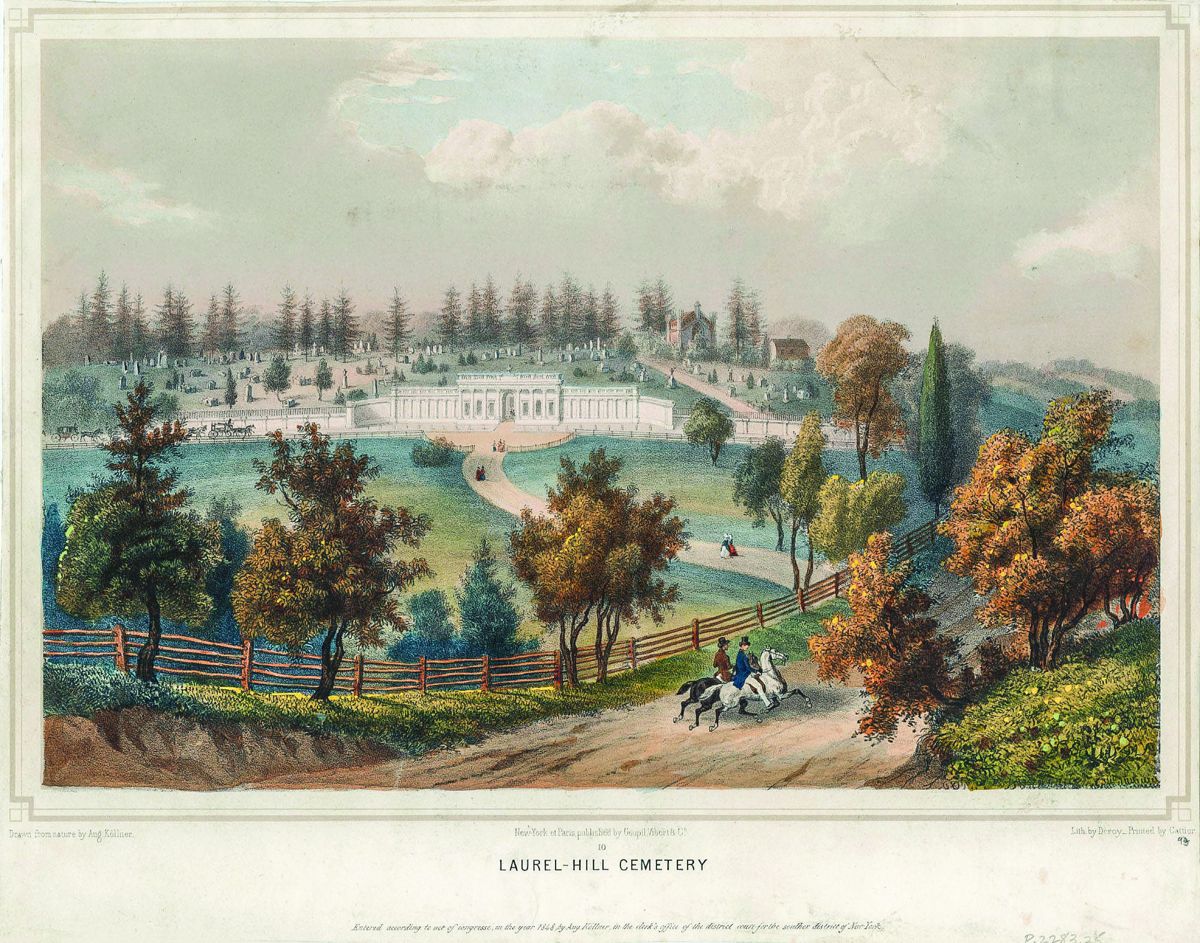
It was a sunny fall day, cool and crisp. Ambling along an unfamiliar trail, each turn brought interesting changes of scenery, soulful sculptures and monuments befitting those entombed; a legacy of individuals, wars and the shaping of a nation. Actually, it could be pretty much any day or season in Laurel Hill Cemetery in Philadelphia’s East Falls section, terraced high above the Schuylkill River. Philadelphia is a city of graveyards. By 1830 historians tell us local burial customs were in flux from churchyard burials of members in good standing (that were fast becoming crowded), and others to “potters field,” to the rise of “social” cemeteries, non-sectarian in nature which offered respectable interment to an emergent middle class. In late 1835, John Jay Smith, (who built an entire career around librarian, editing, and publishing pursuits (including printing several guides for the Laurel Hill cemetery), would declare, “[T]he living population has multiplied beyond the means of accommodation for the dead.” In early 1836, Smith, along with some collaborators including a former Mayor, a merchant, and a druggist, consulted books with a view toward preserving as much of the former estate of Joseph Sims as possible—the rocky bluffs, stunning vistas, and proper distance from the city proper. They also examined proposals from architects William Strickland, Thomas Ustick Walter, and, from one John Notman. John Notman was a Scottish-American artist and architect. Notman (1810-1865) would be the chosen designer of the iconically American cemetery built between 1836 and 1839. Also the designer of Richmond’s Hollywood Cemetery, his is an interesting story. Educated at the Royal Scottish Academy, Notman emigrated to the U.S. in 1831 and settled in Philadelphia where one of his first commissions was Laurel Hill in 1835. According to the Washington, D.C., headquartered American Institute of Architects’ Archivist Nancy Hadley, an entry in Withey’s Biographical Dictionary of American Architects (Deceased) notes Notman as a founding member of the Pennsylvania Institute of Architects, which affiliated as a local chapter of the of the American Institute of Architects in 1869, (the organization of today’s architects), He is credited with introducing the Italianate style to America, the first being his designed Athenaeum of Philadelphia in 1845. Churches and other buildings including a lunatic asylum in New Jersey, soon followed. The Philadelphia Architects and Buildings database at www.philadelphiabuilding.org holds the Philadelphia Chapter records, including many of the predecessor group. A new AIA online resource with links to additional information can be found at www.aia.org/about/history/ aiab082017. During the Civil War, the sheer number of dead dispelled the aura of festive curiosity and sentimental domesticity evidenced by picnics and relaxed family outings that had surrounded rural cemeteries. The cemeteries absorbed their share of casualties and, ultimately, war celebrities. Laurel Hill is said to be one of the nation’s first ‘garden’ cemeteries. Lying adjacent to East Fairmount Park, it has variously been described as an outstanding example of containing what is known as ‘funerary’ art with a reported 33,000 marble and granite monuments, an outdoor sculptural garden, a horticultural gem, and a truly unique historical resource with few rivals. It also happens to be one of the few islands of eternal repose in the United States honored with the designation of National Historic Landmark. With East and West’s Laurel Hill’s 78 acres of art and history, “see for yourself why Laurel Hill has earned its distinction as Philadelphia’s underground museum,” says its preservation organization, http://librarycompany.org. Burial records are available online. The Victorians for whom John Notman designed many of the carved tombs and sepulchral monuments were prominent Philadelphians of the day, industrial magnates or otherwise distinguished in some way. Notman himself would be buried there upon his death in 1865. There was artist Augustus Kollner, a German born illustrator, printmaker, and prolific landscape sketcher—black ink on cream on smooth woven paper, ex. Rockdale, Near Manayunk, Penn. Some were Revolutionary War officers like General Hugh Mercer, one of George Washington’s generals, while many including Major General George Gordon Meade, had a Civil War military connection, even a few who fought in the armies of the Confederate States. In final repose is the Confederacy’s General John C. Pemberton, west pointer and Mexican War veteran who resigned his commission to join the Confederacy, in part said due to his Virginia-born wife’s influence, then returned to Pennsylvania after the war and subsequently died. There is west pointer and New Jersey born Samuel Gibbs French, a wealthy planter in the South and another Confederate officer. The remaining were Union veterans. There is Isaac J. Wistar, a native Philadelphian who became a trapper, mountaineer, Indian fighter, and lawyer before the war. Deemed unremarkable as a commander he received many battle wounds leading his troops. There is Commodore Hull, U.S. Navy, who had a Civil War gunboat named in his honor. There is Garrett Pendergrast, commander of the Civil War sloop USS Cumberland. Rear Admiral John Dahlgren, head of the Navy’s ordnance department and who would become known as the “father of American naval ordnance” for his bottle-shaped 9 and 11-inch guns, is buried there, as is Samuel Crawford, Union Army general and surgeon on duty during the firing on Ft. Sumter, S.C. He later commanded the Pennsylvania Reserves in the Washington defenses, fought at
Major Gen. Samuel Crawford. (Library of Congress)
Gen. Charles F. Smith, died on April 25, 1862 of a foot infection he got in jumping from one boat to another in opening stages of Shiloh Campaign. (Library of Congress) Gettysburg, and authored The Genesis of the Civil War in 1887. It is Charles Ferguson Smith’s final resting place, Philadelphia born and career army officer, he was another West Point graduate and instructor whose dignity and unselfish character made him a mainstay of one of his pupils at the Academy—Ulysses S. Grant. Modern day Philadelphia curator Aaron Wunsch, in preparing an exhibition relating to Laurel Hill, made reference to a mid-nineteenth century author’s speaking to building a ‘City of the Dead,’ saying, “Laurel Hill is among the most celebrated—and most densely populated—swaths of Greater Philadelphia. Beneath its 78 acres of lawn, trees and monuments lie some 70,000 bodies—a sprawling and silent subdivision that took shape over nearly two centuries.” When it opened in 1836, he says, “it was Philadelphia’s first “rural” cemetery. This was a new kind of institution growing out of competing impulses; attached socially and economically to the city, it stood physically and symbolically in the countryside.” That paradox underlies this exhibition noted Wunsch. Garden, graveyard, and civic amenity—a place of mourning and recreation—Laurel Hill was public and private, rural and urban, a scene of development and a possible antidote to it.” Laurel Hill Cemetery has been listed on the National Register of Historic Places as a National Historic Landmark since 1998, and is a primary destination for visitors who appreciate and come to admire funerary art in the framework of a serene and bucolic setting. Some readers may wonder how cemeteries are evaluated for potential National Register of Historic Places eligibility as was Laurel Hill. In most cases professionals having expertise in archeology, anthropology, art history, architectural history, history of landscape architecture, horticulture, American history, cultural geography, and historical preservation are consulted. Within most of these disciplines is the specialized field concentrating on studying funerary art and custom, and even to the fields of iconology, ethnology, and occasionally folklore! Individuals in these fields can more easily identify characteristic elements of burial sites, including prehistoric, cemetery landscapes, buildings and monuments, for example, historic photographs in plans and on-site inspections. Information can be gleaned from grave markers, inscriptions and epitaphs, artistic and architectural style, embodied in a sculptural monument, chapel, gatehouse and mausoleum; changing attitudes are revealed about death, and an afterlife. Forms and symbols that hold special meaning used by monument makers in various historic periods are revealed. Trends in community planning and aesthetic taste are evident plus historic events such as an area’s settlement and, of course, as in the case of Gettysburg, military actions. To gain National Register listing there must be an historical or cultural “area of significance” or if “associated with the lives of persons significant in a region or our country’s past.” Abraham Lincoln’s tomb in Springfield, for example, is obviously significant as to the person and as a focus of commemorative monumentation. Laurel Hill is more than just a burial ground that celebrated its 175th anniversary in 2011. It is a glorious reflection of many whose lives played a part in Philadelphia’s rich history. It’s caretakers (visit www.thelaurelhillcemetery.org and www.librarycompany.org, help maintain an extensive archives which are an exciting connection with, and a glimpse into, the personal and public history of the souls interred within its peaceful landscape. In 2011 Laurel Hill staff staged a special Civil War exhibit commemorating the war’s Sesquicentennial, the “Elite Eleven,” which centered on the Cemetery’s notable military and civilian figures of that time. Civil War-related guided tours are periodically conducted at the site. •
Suggested Reading
•
• •
•
•
Joan Wenner, J.D. is a longtime contributor to CWN, The Artilleryman and other historical publications, and member of CWN Editorial and book review staff. Comments are welcomed at [email protected]
Smith, R.A. Smith’s Illustrated Guide To and through Laurel Hill Cemetery, W.P. Hazard, 1852. (In Library Company of Philadelphia Collection along with Guide to Laurel Hill Cemetery, Near Philadelphia, C. Sherman, 1847.) Dickey, John M., Historic Structure Report, Laurel Hill Cemetery, 1979. The Pennsylvania Horticultural Society – McLean Library, Philadelphia, www.pennsylvaniahorticulturalsociety.org West Laurel Hill Cemetery, Philadelphia, Penn., (Listing of trees and shrubs in West Laurel Hill Cemetery). Additional publications are available by contacting Friends of Laurel Hill Cemetery, 3822 Ridge Avenue, Philadelphia, Pa 19132-1840.