
Through The Lens
I Fights Mit Sigel
By Stephanie Hagiwara · Originally published March 2018 · p. 10
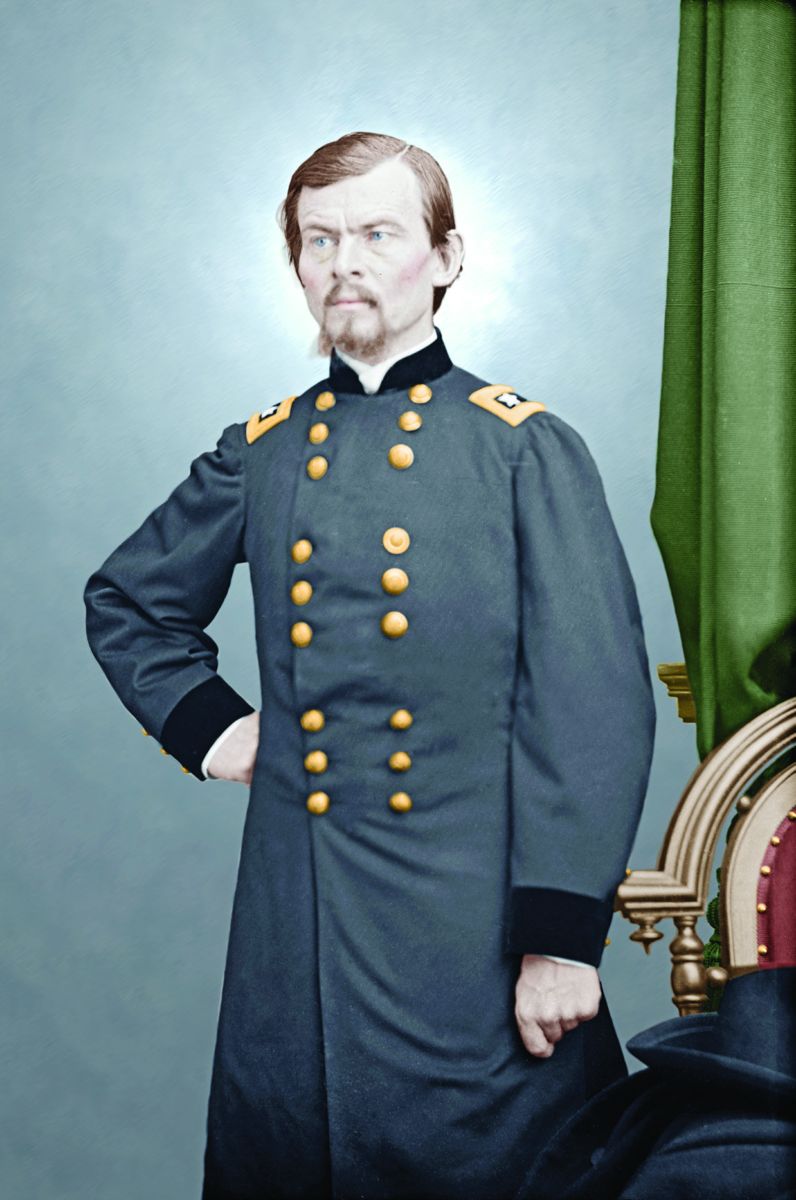
“A charge of infantry like that last closing scene has never been made on this continent.” – U.S. Gen. Samuel Curtis Missouri began the War as a slave state torn between a rural population that had migrated from the Southern states and an urban population of former Northerners, German, and Irish immigrants. The city of St. Louis controlled the waterway hub of the Missouri, Ohio, and Mississippi Rivers, keeping the state in the Union. Franz Sigel, an idealist and “champion for democracy,” rallied the immigrant community to the Union cause. “I fights mit Sigel” became a hallmark of German American participation in the War. Siegel was born in Germany, graduated from a military academy, and made a name for himself fighting in the failed Revolution of 1848. Emigrating to New York
(Library of Congress)
City, he taught school; moving to St. Louis, he became a leader in the large German community. Between his avid supporters and raising troops in St. Louis, Siegel was promoted to Brigadier General. It was the start of the idolatry of Sigel that would last decades after the War. Popular ballads and poetry touting loyalty to Sigel were circulated. Sigel received hundreds of letters of support. In December 1861, Sigel went on medical leave. On the 25th, U.S. Gen. Samuel Curtis was appointed commander of the Army of the Southwest. Sigel, feeling slighted, resigned his commission to return to teaching. Union military leaders, who considered Sigel “superior in theoretical [tactics), incompetent in battle, and hell on retreat,” accepted his decision. However, the German community sprang into action. Committees were formed in New York and Chicago; a Congressional investigation was demanded, German soldiers threatened to resign. Sigel was presented a sword engraved with the inscription, “Defender of Liberty,” and a silver goblet. In the end, Sigel returned to the army under Curtis’s command. Both sides had designs for Missouri. Confederate General Earl Van Dorn, Commander of the Army of the West, planned on capturing St. Louis, but Curtis moved first. Some 12,000 Federals left Rolla, Mo., for the Springfield, Mo., encampment of C.S. General Sterling Price during a blustery snowstorm. They arrived three days later, on February 13, to find Price’s men had abandoned the city. Not expecting a winter attack, the Confederates had spent their time sacking the city instead of building defenses. Determined to fight, Curtis followed the Confederates over the ice and snow-covered roads into Arkansas. Curtis positioned himself on high ground above Little Sugar Creek. The upcoming March 6–8, 1862, battle that would determine Missouri’s fate centered on Mr. Cox’s Tavern near Pea Ridge, Ark. The tavern served as the local post office and telegraph terminus, had space for lodgers, and sported a skull and antlers on the ridgepole, hence the name Elkhorn Tavern. Van Dorn decided to split his men and circle behind Curtis in a surprise attack. To travel fast, each man would carry three days rations and a blanket. Anticipating a flanking move, Curtis had his engineers place obstacles along the way. He would also turn the army, so it would face north instead of south with his back to his own entrenchments. “In one hour they will be ours,” Rebel Gen. Benjamin McCulloch told an aide as he rode, forming a line on the extreme right of the Federal line at Leetown. With the attack set, McCulloch wanted to observe the Federals for himself. “l will ride forward a little and reconnoiter the enemy’s position. You boys remain here,” he told his staff. “Your gray horses will attract the fire of the sharpshooters.” As he rode over a small rise, McCulloch was clearly visible against the blue sky, heading straight towards the 36th Illinois sharpshooters. McCulloch was soon tumbling to the ground, dead, a bullet to the heart. The Confederates waited until McCulloch’s body was accidently discovered. Command passed to James McIntosh, who preferred leading his men from the front. McIntosh ordered the assault that McCulloch had prepared. He took his place in front, rode forward and was shot dead near where McCulloch had perished.
Command passed to Colonel Louis Hébert who heard the gunfire but had no idea the generals had been killed. Without receiving the order to advance, Hébert decided to move forward anyway, running into Battery A, 2nd Illinois Light Artillery. “Suddenly something like a tremendous peal of thunder opened all along our front.” recalled the 3rd La. Inf.’s William Watson. U.S. Capt. William Perkins Black, with a Colt repeating rifle, held off the onslaught as four of the Battery’s six cannons were saved, earning the Medal of Honor. In the thick brushwood, Hébert’s men retreated, stumbling into McCulloch’s waiting division. Soon Hébert and three of his officers were captured, leaving the division leaderless again. In the meantime, Van Dorn was fighting the Federals at Cross Timber Hollow, waiting for McCulloch to arrive. After hours of fierce fighting, Van Dorn realized that Price’s division was larger than the Federals. He ordered Price to extend his flank beyond the Union’s, and captured the Tavern at dusk. After midnight, Sigel rode out to observe the enemy camps. He realized the Confederates had united and would probably attack the Federal right wing. Sigel spent the night gathering, feeding, and moving his men into position. At 6 a.m. he ordered Col. Peter Osterhaus to reconnoiter the field. At 6:30 a.m. Curtis opened the battle with his artillery. He rode over to Sigel to ask him to bring his troops into his line. Sigel refused, “I have taken my position General Curtis.” As the men argued tactics, Osterhaus returned, reporting he had “found an excellent position to deploy.” Sigel’s men cheered as his batteries opened fire with deadly accuracy. For two hours the cannon roared as Sigel rode between them. About 10 a.m., Curtis said, “General, I think the infantry might advance now.” The entire army, infantry, cavalry, and artillery, 10,000 men began to move forward. “With banners streaming, with drums beating, and our long line of blue coats advancing upon the double quick, with their deadly bayonets gleaming in the sunlight, and every man and officer yelling at the top of his lungs. The rebel yell was nowhere in comparison,” recalled Capt. Eugene Payne. The Confederates scrambled to get out of the way, retreating in three different directions. “Oh, dot was lofely,” proclaimed Sigel. Curtis rode up and down the cheering lines, swinging his hat yelling, “Victory.” The victory at Pea Ridge gave the Union control of Missouri for the next two years. Van Dorn moved his army to the Mississippi River. Sigel was promoted to Major General. Although he would eventually lose his command, Sigel’s supporters never wavered. At his death in New York City in 1902, 25,000 people attended his visitation. In 1909, 100,000 people in New York City honored his memory with a parade. Statues have been dedicated, schools, parks, and a WWII Liberty ship have been named after the man who inspired German-Americans to fight for the ideals of freedom and democracy. Sources: • Engle, Stephen Douglas, Yankee Dutchman: the life of Franz Siegel • Shea, William, War in the West: Pea Ridge & Prairie Grove • Giffen, Lawrence E., “The Strange Story of Major General Franz Sigel: Leader and Retreater.” Missouri Historical Review, Volume 84 Issue 4, July 1990 • Foote, Shelby, The Civil War: Fort Sumter to Perryville Stephanie Hagiwara is the editor for Civil War in Color.com and Civil War in 3D.com. She also writes a weekly column for History in Full Color.com that covers stories of photographs of historical interest from the 1850’s to the present. Her articles can be found on Facebook, Tumblr and Pinterest.
The original Elkhorn Tavern was built around 1833 by William Reddick and his son-in-law, Samuel Burks. In 1858, Burks, sold the house and the 313 acres to Jesse & Polly Cox for $3,600.