
Letters of General Nathaniel McLean from March 1865
By Bruce S. Allardice and Wayne L. Wolf · Originally published June 2018 · p. 3
Nathaniel Collins McLean was born to Supreme Court Justice John McLean and his wife, Rebecca (Edwards) McLean, in Warren County, Ohio, on Feb. 2, 1815. He earned his BA from Augusta College (Ky.) in 1834 and his LLB from Harvard Law School in 1838. Prior to the war he practiced law in Cincinnati. In 1858, he married his second wife, Mary Louise Thompson (1835–1908).
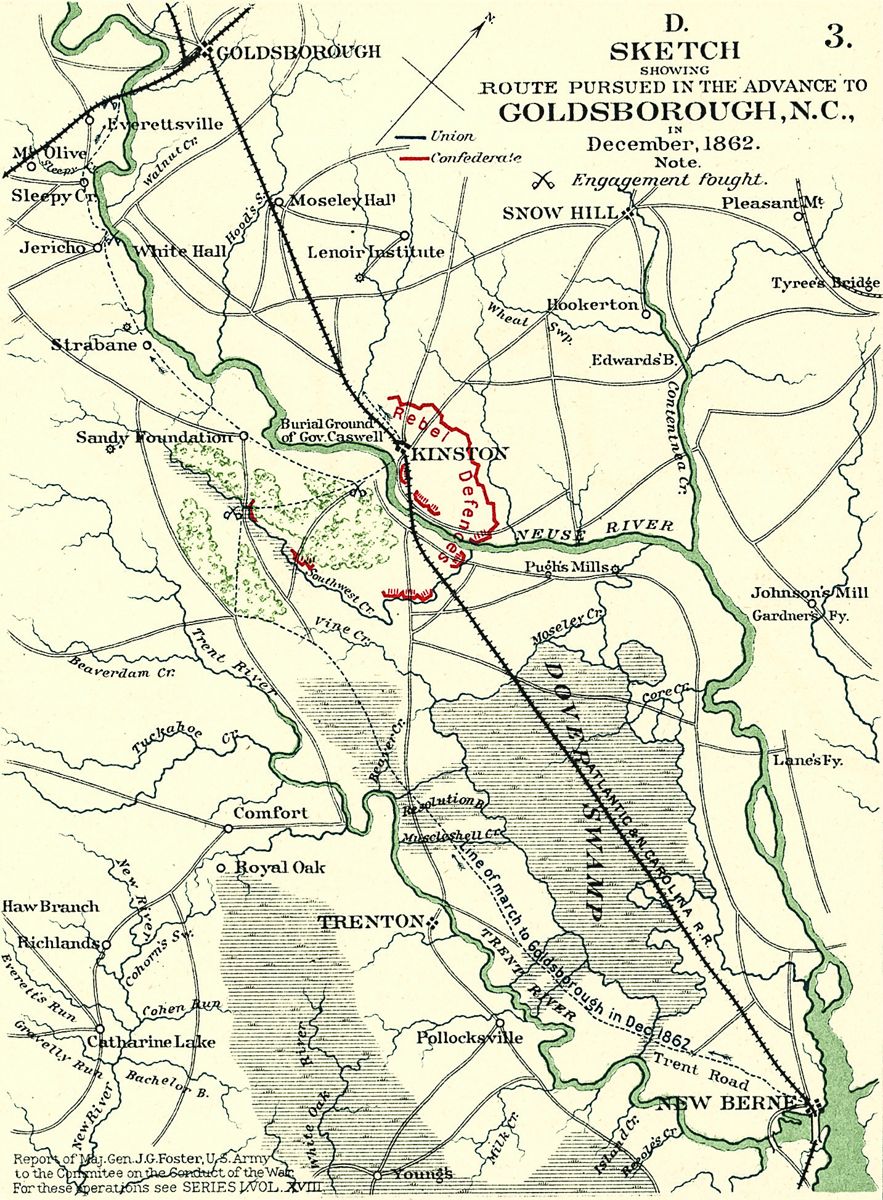
Gen. Nathaniel McLean. (Library of Congress) At the beginning of the Civil War, McLean organized the 75th Ohio Infantry. In 1862 he was appointed brigadier general and commanded a brigade in the XI Corps at Chancellorsville. McLean led the 1st Division of the XXIII Corps in the Atlanta Campaign. Finally, McLean commanded the 3rd Brigade, 2nd Division, XXIII Corps, in the Carolinas Campaign, before resigning his commission in April of 1865. After leaving the Army, McLean returned to his family in Ohio. He moved to Frontenac, Minn., and later to Bellport, Long Island, N.Y., where he lived in comparative retirement until he died on January 5, 1905. During the war, Mclean often wrote home to his wife. The two letters transcribed here are from his service in Carolinas Campaign. In February 1865, the XXIII Corps was transferred from the West to Wilmington, N.C., to aid in the Carolinas Campaign. The corps and other units were to advance from New Bern and Wilmington, westward to Kinston and Goldsboro, repairing the railroads, and then link up with and resupply Sherman’s army. As can be seen from the letters, McLean shared the prevailing view that the war was about to end. He could see the Confederacy was collapsing; however, the Confederate army would fight a few more battles, including Kinston and Bentonville, prior to their final surrender in April. For more on this campaign, read The
Battle of Wyse’s Forks, March 1865, by Wade Sokolosky and Mark A. Smith.
Head Qrts. 2nd Div. 23 A.C. Wilmington, N.C. March 5th, 1865 Sunday has come and daylight has gone without bringing me a letter from you dear wife. It will be my last chance of hearing from you for some time, and unless there comes a letter before morning, I must march without a word from you to comfort me on the way. We start at six o’clock in the morning and march until we strike the railroad between Goldsboro and Newbern, so that everything in the shape of mail will meet us on the other road. How long it will take us to get to the end of our march I cannot tell but it be somewhere between five and ten days. If you do not hear from me therefore for some little time you will understand the reason. Have no fears on account of our march for I do not think we will have much difficulty from the enemy on the way. All things here seem to point to a victorious course for our army. Unless we are wrongly informed the rebels are so disheartened that but comparatively feeble resistance will be made to our troops, and when our whole army is united there is nothing here at present that can prevent our onward march. Indeed if we only had transportation enough I do not doubt that we would immediately strike out as Sherman has done. The rebels will no doubt concentrate their forces as rapidly as possible, but their effort to do this is lessening their army very much by desertion. The troops from this state our deserting and coming to their homes whenever they get a chance, and the effort to take them out of the state to Virginia or anywhere else only makes them leave more quickly. God grant that this may go on rapidly so that the leaders may speedily find that they are left alone to fight for their bad cause. I cannot help feeling that the end is near at hand, and the thought of once more being permitted to go to you dear wife and remain with you peacefully and happily at home, with my whose duty performed, fills me with such anxiety to accomplish this result that I become inpatient of all delay. Should the rebels meet with a decided success anywhere so as to prolong the war my disappointment would be very great. A few short weeks now and the spring campaign will open when I pray for a victory which will settle the whole war. Today I have been to church. There were not many citizens present as I suppose the people are generally rebels and did not like to hear the President of the U.S. prayed for. The prayer was made however whether sincere or not on the part of the minister.1 I cannot go tonight as I would like to as I am expecting momentary marching orders which in turn I must give to the different brigades. I reclaim your two letters to keep for me as they will be pleasant to read years hence perhaps. Love to Lindy [Malinda Thompson, his wife’s sister] and the children with loving kisses to you darling wife. McLean
Head Qrs. 2nd Division 23 A.C. March 24th, 1865. Goldsboro, N.C. No mail and of course no letter dear wife from you. It is provoking for I hear that there is a large mail for my division at Kinston. We march in the morning for Mosby Hall some fifteen miles from here, so that this will no doubt further delay our mail. Your letters are great treasures to me dear wife although they take so long to reach me. I value them more for the assurance of your love than for the news they contain, and therefore they are of less consequence. Sherman is concentrating his whole army at and near this place so that will have force enough to withstand any army that can be brought against us. There is no danger of our being attacked at this place, and we will have to march out to find an enemy. The rebels have gone away from us badly beaten by a portion of our army, so of course they will not dare to encounter us in our present shape. Two divisions the 1st & 2nd of our corps under Genl. [Darius] Couch have been ordered along the lines of railroad between here and Kinston to protect the road from raiding parties of the enemy who might seek to destroy our lines of communication upon which our supplies are to arrive. The cars are expected to run as far as this place by tomorrow or next day, and we will soon have the road from Wilmington completed also, as that we can have supplies from two points, Wilmington and Newbern. Genl. Sherman says that it will probably take until the tenth of April to properly refit his whole army and he intends this shall be done before he begins another march. This gives us some resting time, and in the meantime perhaps
Grant may be able to strike a blow which will settle the war. Genl. Lee cannot long remain in Richmond, as he will certainly be crushed between Sherman and Grant. His only hope to prolong the war for a little longer is to safely evacuate Richmond and endeavor to either escape without a fight or else meet only one of our armies at a time. Either alternative is dark to him, for both of the armies are singly large enough to withstand him. He could not fight a great battle with either army without losing from the service in killed, wounded and missing at about twenty-thousand men, and even a victory at such a price would ruin him for he would undoubtedly in a very short time have to fight again a fresh army which from its superior numbers could easily crush him. His only hope is in escaping altogether and this only puts off the evil day for a short time for he must make a stand somewhere. Our prospects are bright and soaring. Soon dear wife I hope to be able to come home to you for good and all hours happy I shall be there to feel that I am at liberty fully and freely to enjoy home and all its pleasures with my darling. When I think of this my longing for the time to come speedily increases, and I wait with impatience for the final blow to be struck which will close this war. The weather here is warm and all the trees are in blossom, but
(Official Records Atlas, Plate 91)
the face of the country is so different from ours that it does not seem like spring. Almost the only green there is remains all winter for the pines and evergreens. There is no grass and very few flowers. Nothing but sand everywhere you go, and I long for the sight of the beautiful green grass, which I never before missed so much. Have you seen Col. Morgan2 yet & has he paid you the $200—I loaned him at Wilmington? Love to Lindy. Wish the children with loving good night kisses to darling wife which I would give everything to be able to deliver in person. McLean 1. The Wilmington Herald, March 6, 1865, reports that “yesterday” in several churches the usual minister declined to officiate, rather than give the mandatory prayer to President Lincoln. However, Rev. Robert E. Terry (1826–91) of St. John’s Episcopal Church preached. 2. Probably Col. Christopher A. Morgan (1821–66), an old Cincinnati friend of the McLeans.
Bruce S. Allardice is Professor of History at South Suburban College in Illinois. He is a past president of the Civil War Round Table of Chicago. Wayne L. Wolf is past president of the Lincoln-Davis Civil War Roundtable.