
Black Powder, White Smoke
The Calcium Light Infantry Sharpshooters
By Joe Bilby · Originally published July 2018 · pp. 4–5
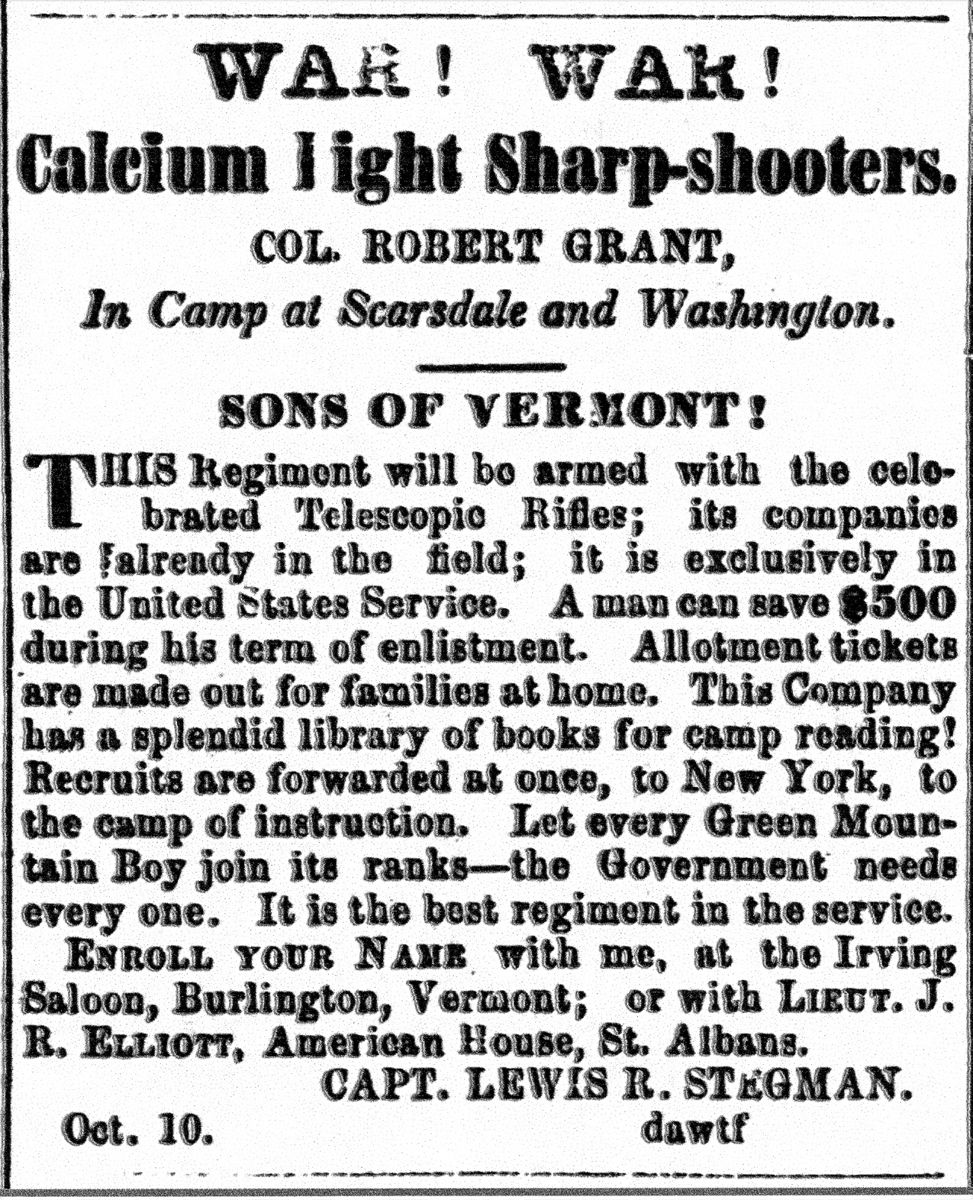
Calcium Light Infantry Sharpshooters? I decided to run some of the names mentioned through the excellent online Civil War Research Database (http://www. civilwardata.com). The results were interesting. I came up with no Colonel Robert Grant, and no Lieutenant Colonel Isaac G. Edge. I did find Lewis R. Stegman, who enlisted as a captain in New York City on Sept. 30, 1861, with no unit noted. Stegman was appointed as a captain in the 102nd New York Infantry on March 3, 1862. Journalists reporting on company officers Captain Bertrand and Lieutenant Shuster, who were present at the night time Weehawken spectator shoot, commented that both were “excellent men and first-class shots.” They had reportedly been “accepted in Berdan’s regiment, but preferring this, were transferred to it.” Lieutenant Shuster does not appear in available service records, nor does Captain Bertrand. A Lieutenant Bertrand is noted in three New York regiments, the 93rd and 58th Infantry and the Enfants Perdu, between 1861 and 1863, but he was either transferred, discharged, or cashiered from each unit. In conclusion, it seems likely that the grand idea crashed early on. Recruits may have transferred into Colonel Berdan’s regiments, although one account notes that the unit was actually a single company of the 102nd New York Infantry, which is supported by the story of Captain Stegman. In fact, calcium lighting, fielded by the ubiquitous Robert Grant, still a civilian, was effectively used in 1863 by General Quincy Gillmore’s troops during the siege of Charleston to spotlight enemy artillery positions at Fort Wagner as well as to illuminate blockade runners at night. The Calcium Light Infantry Sharpshooters, however, played no part in these operations, and, after their brief newspaper notoriety, faded into history. I would like to thank my friend Anthony Gero, who specializes in writing and researching African-American and New York state soldiers, for initiating this story. When he comes across something he thinks I may be interested in, like the New York
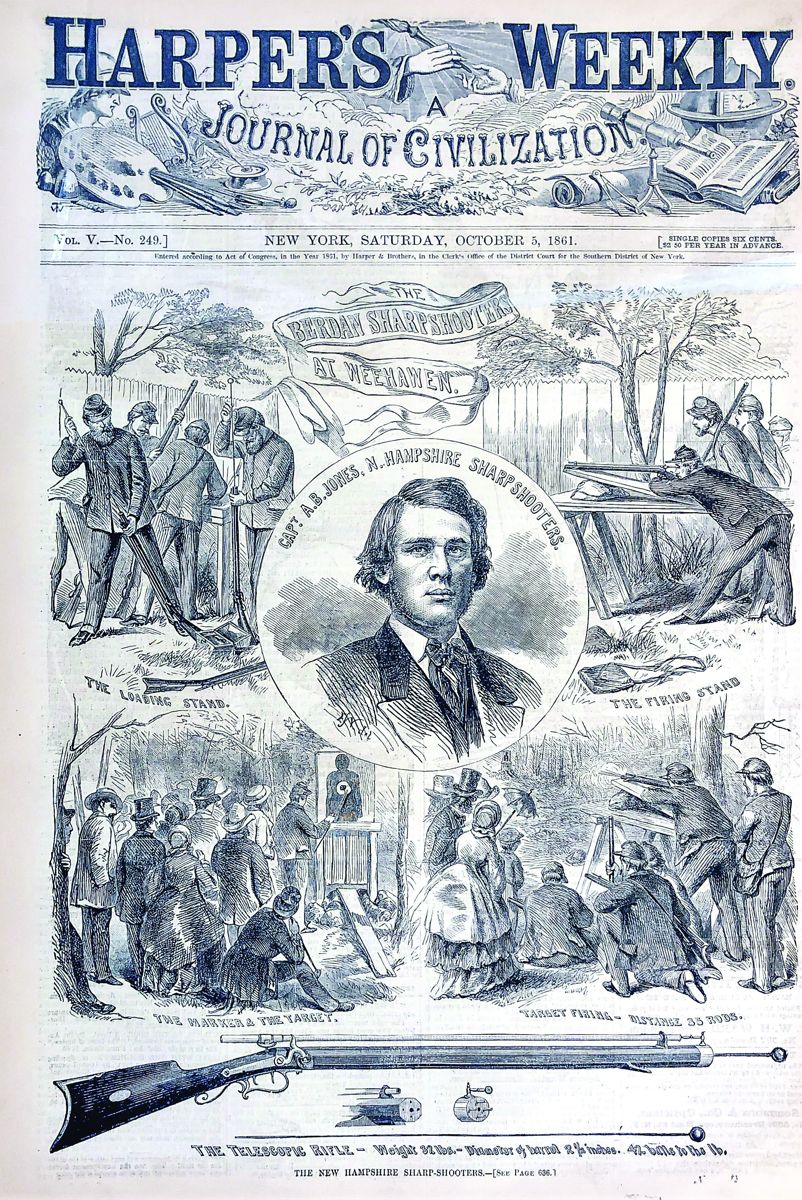
The newspapers were full of war news, from assurances the army was recovering its morale following the Bull Run debacle to stories of local men joining up for the fight. At least some accounts, the product of overheated journalism, look, in retrospect, rather dubious, or at least somewhat inaccurate. One such story I was unaware of until recently was the tale of the “Calcium Light Infantry Sharpshooters.” According to a New York Tribune article on August 28, 1861, the unit, composed of companies from different states, was organizing in Weehawken, N.J. This was different from Colonel Hiram Berdan’s specialized sharpshooter regiment also being organized at the same time in Weehawken. The regiment’s title was derived from the “calcium light,” an early form of floodlight or searchlight. Also known as “limelight,” the method of illumination was initially invented in the 1820s and used from the 1830s on to illuminate theater performances and light houses. Since I make no claims to scientific expertise, I did some research and discovered that calcium light was created by “directing oxyhydrogen flame at a cylinder of calcium oxide (quicklime) which can tolerate heat up to 4,662 °F before melting.” In the summer of 1861, Professor Robert Grant, a well-known proponent of calcium lighting, reportedly used the method to assist Union forces at Fort Monroe “for reconnoitering purposes” to disclose enemy night movements. When his work “created a favorable impression upon all” the military men who reviewed it, Grant had allegedly been “authorized by the War Department” to form the new regiment and the papers reported that he would be named as its colonel. Grant’s lieutenant colonel was reportedly a “Mr. Edge,” who turned out to be Isaac G. Edge, a Jersey City fireworks manufacturer who “joined the regiment with 250 men.” Edge promised to enhance the unit’s firepower by supplying it with rockets that fired incendiary shells. The basic idea was that the “Calcium Sharpshooters” would be the Union army’s night fighters, using projected illumination to define and fire accurately on enemy positions in the dark. The publicity surrounding the unique unit drew a large crowd of spectators to Weehawken the evening of August 26, 1861, to witness a “midnight sharpshooters” demonstration. A small mock battery position covered by a “maze of green branches” was the target and “a brilliant calcium light was shone upon them, revealing everything as if by daylight.” The “battery” was then “riddled at leisure by the sharpshooters” for the onlookers’ entertainment. Recruits were being sought for the Calcium Light Sharpshooters as late as October 1861, when Captain Lewis R. Stegman requested candidates to come see him at the Irving Saloon in Burlington, Vt. According to Stegman, the regiment, commanded by Colonel Grant, would be “armed with the celebrated telescopic rifles” and was currently encamped at Scarsdale, N.Y., and Washington, D.C. So, what happened to the
Tribune article, Anthony sends me a copy While discussing the Calcium Light Infantry Sharpshooters with some friends, we realized that the use of lighting in ground tactical warfare persisted until well into the twentieth century. Both German and allied forces used searchlights in Europe in World War II and I was reminded of my own experience in Vietnam. I was a lieutenant in the First Infantry Division Military Police Company; one of our duties was escorting convoys to forward bases. I was awakened late one night in early 1967 and advised that the 199th Light Infantry Brigade was in a stiff firefight and needed our assistance. I was tasked with taking a twenty-truck convoy of ammunition and gasoline up Route 1 towards Tay Ninh. I was assigned five tanks since the job was kind of dicey. Around 1 a.m. we reached the Hoc Mon Bridge, which had been blown up by the enemy. There was a rickety looking substitute bridge erected by the Twenty-fifth Division Engineers and while I checked with them as to the safety of the structure for heavy vehicles, the cavalry lieutenant deployed his armor and the tanks shined their powerful search lights over the adjacent rice paddies. We made it through okay, and on reflection today, I think it must have been the spirits of the Calcium Light Infantry from Weehawken guiding those M-48 lights across the landscape that helped bring this Jersey boy home. Joseph G. Bilby received his BA and MA degrees in history from Seton Hall University and served as a lieutenant in the 1st Infantry Division in 1966–1967. He is Assistant Curator of the New Jersey National Guard and Militia Museum, a freelance writer and historical consultant and author or editor of 21 books and over 400 articles on N.J. and military history and firearms, and as publications editor for the N.J. Civil War 150 Committee edited the award winning New Jersey Goes to War. His latest book, New Jersey: A Military History, was published by Westholme Publishing in 2017. He has received an award for contributions to Monmouth County (N.J.) history and an Award of Merit from the N.J. Historical Commission for contributions to the state’s military history. He can be contacted by email at [email protected] Colonel Berdan, of the Berdan Sharp-Shooters, Practicing at a Target at Weehawken, New Jersey. Harper’s Weekly, August, 1861.