
The Unfinished Fight
Salt Pork
By Craig L. Barry · Originally published July 2018 · p. 6
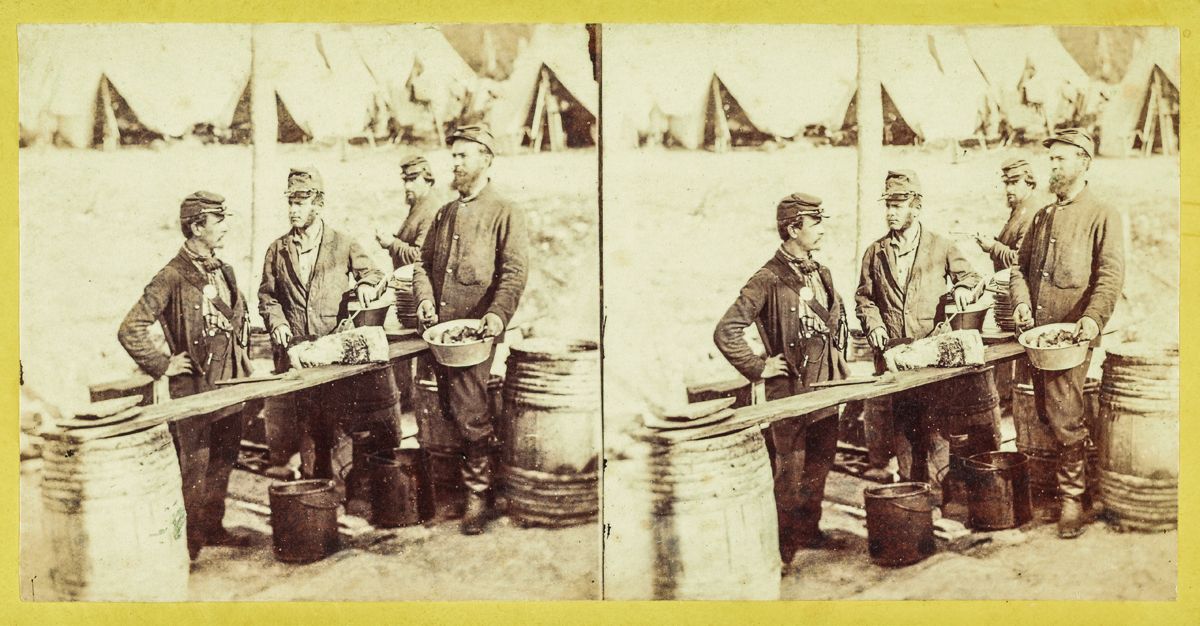
“November 27, 1863: Cold, disagreeable day…we are issued salt pork again.” – Civil War diary of Capt. James Penfield, 5th NY Cavalry The high water mark for salt pork as a military ration is undoubtedly its wide use during the Civil War. It was the principle, although not the only meat ration, most commonly issued with hard bread, beans, and wheat or corn (in the Confederacy) flour. Salt or brine is the time honored method for preserving pork. The leaner cuts of pork were normally eaten fresh or processed into sausage; the rest of the pig was salted, smoked, or otherwise preserved. Pork was particularly well known as a meat which preserved well, either through smoking, drying, corning, brining, or salting. In livestock terms, a “pig” becomes a “hog” when its weight exceeds fifty kilograms. The names change as follows; when the animal is born, it is a piglet; weaned, it is called a shoat. Growth in piglets is rapid, often reaching adult weight in six months. From there the terms revolve around gender; with the immature females being called gilts and then, when they reach breeding age, sow. Adult males are known as boars. Those males that are minus the particular parts necessary to become boars are called barrows. The terms “hogs,” “pigs,” and “swine” are well known words used interchangeably, but technically, “swine” is the family name for both sows and boars. Swine were not native to America, and the first animals were European varieties that arrived with Spanish settlers in 1539. Escaped livestock eventually became the North American feral pig found widely across the southern states, mountains, and coastal areas by Colonial times. The flank, which lies just below the ribs, is salted and smoked, and furnishes “bacon.” Saltpeter or nitrate preserving was also used, a process still in use today. “Salt pork” chiefly came from pork bellies. It was the cheapest preserved meat available and was most commonly used by civilians for cooking, rather than eaten as a main course. Salt pork is so named because of how it is cured. It is often confused with “fatback,” a similarly unsalted fatty cut, but from the top of the hog. The distinction between bacon and salt pork was not always made in the mid-19th century, but salt pork was fattier than what we know as bacon today. The salt pork available, either as military rations or for civilian use, during the Civil War is not exactly the same as the product sold as “salt pork” in grocery stores today but slab bacon is still available. As might be expected, modern slab bacon is processed differently, smoke cured, then dried. 1860s salt pork was not. The two products are not actually that close in flavor. The reason for salt curing is that it inhibits bacterial growth. In other words, water is drawn out of the meat by osmosis due to the high concentration of salt outside. The bacteria lose water until they reach a state where they cannot survive. The concentration of salt outside needed to inhibit growth depends on the type of microorganism. Salmonella is inhibited by salt concentrations as low as 3%, Staphylococcus, needs up to 20% salt, 12% salt for Listeria monocytogenes. Fortunately the growth of many undesirable organisms normally found in cured meat and poultry products is inhibited at relatively low concentrations of salt. Salting can be accomplished by adding salt to meats either dry or dissolved in brine. Dry salting, also called “corning,” originated in Anglo-Saxon cultures. Meat was dry-cured with coarse “corns” or pellets of salt. Corned beef of Irish fame is usually made from a beef brisket, although any cut of meat can be corned. Salt brine curing involves creating a brine of salt, water, and other ingredients such as sugar, sodium erythorbate (made from sugars in beets or cane), and nitrites. The age-old tradition was to add salt to the brine until it floated an egg. Today, it is preferable to use a hydrometer or carefully mix measured ingredients from a reliable recipe. Once mixed and placed into a suitable container, the food is submerged in the salt brine. Brine curing usually produces an end product that is less salty compared to dry curing. Injection of brine into the meat can speed the curing process. While no one can be completely certain exactly when the practice began, it was long, long ago. The following appeared on the subject in a Civil War-era newspaper: Richmond Dispatch Thursday February 16, 1865 A Chapter on Ancient Cooking. “The favorite dish of the Romans in the later days of the Empire was “Hog a la Trojan.” This was a Greek importation, and was so named because the hog was cooked whole, and, being stuffed with ortolans (a game bird), thrushes and other birds, and even small animals, was intended as an imitation of the soldiers enclosed in the belly of the Trojan Horse…Having thus prepared the roast, put it into a pot sufficiently large, with onions, cloves, carrots, chopped ham, celery, a bouquet of parsley and thyme, mignonette, several slices of salt pork well salted, pepper, salt, fine spices, coriander seeds, and one or two sprigs of garlic.”
by E. & H. Anthony & Co. N.Y. (Library of Congress)
The Richmond paper does not give its sources, but Lucius Columella (4 CE to 70 CE), the foremost writer on ancient Roman agriculture, noted that the salting process (for pork) should be performed at a time when “the moon is waning” (luna descrescente), especially during the middle of winter. The role of the moon’s phase is lost to history, but cold weather has traditionally accompanied the beginning of pork processing. It was noted the price of salt often went up in late autumn as a result of the increase in demand. So what was meat known as salt pork like during the Civil Warera? The “salt pork” available today (by that name) bears little to no resemblance to the product of the same name in the mid-19th century. It is often said that the meat products available as “salt pork” and “bacon” are similar with the primary difference being that bacon is smoked and salt pork is not. This is true but also somewhat understates the differences in cut of meat as well as preparation. For one thing there were various grades of salt pork in the 1860s. Virginia Mescher wrote an article for The Watchdog (Summer 2006) called “The Ubiquitous Pork Barrel” which noted, “Bacon is the cured and smoked meat of the breast-pieces, sides and belly of the pig, the breast-pieces being generally employed for choice ‘breakfast-bacon” (Grocer’s Encyclopedia). There were also various grades of bacon. “Bacon. – Made from the shoulders and ribs, known as rib, clear rib, having the backbone sawed out, and clear being free from both backbone and rib.” Salt pork was not just “salt pork.” There were 15 grades of salt pork, all of which differed according to where it came from on the pig and how much fat it had (the fatter the better). Prices varied according to the grade. There were illustrations in the article for pork cuts, period recipes for salting pork, cooking salt pork, the differences between bacon, ham, fatback, and sow belly. It is not that hard to replicate good mid-19th century salt pork if you get your butcher to cut you some “pork belly,” then soak it in brine. I would also add, use solar salt if you can and use it generously. Personally, I like salt pork for cooking as an ingredient in something for a “mess.” The salt in the meat precludes the need for seasoning whatever it is cooked in. Beans are good soaked overnight and then cooked that way in particular. Craig L Barry was born in Charlottesville, Va. He holds his BA and Masters degrees from the University of North Carolina (Charlotte). Craig served The Watchdog Civil War Quarterly as Associate Editor and Editor from 2003-2017. The Watchdog published both books and columns on the material culture of the mid-19th century and donated all funds from publications to battlefield preservation. He is the author of several books including The Civil War Musket: A Handbook for Historical Accuracy (2006, 2011), The Unfinished Fight: Essays on Confederate Material Culture Vol. I and II (2012, 2013) and three books (soon to be four) in the Suppliers to the Confederacy series on English Arms & Accoutrements, Quartermaster stores and other European imports.