
The Graphic War
“Marching into Dixie”
By Salvatore Cilella · Originally published July 2018 · p. 20
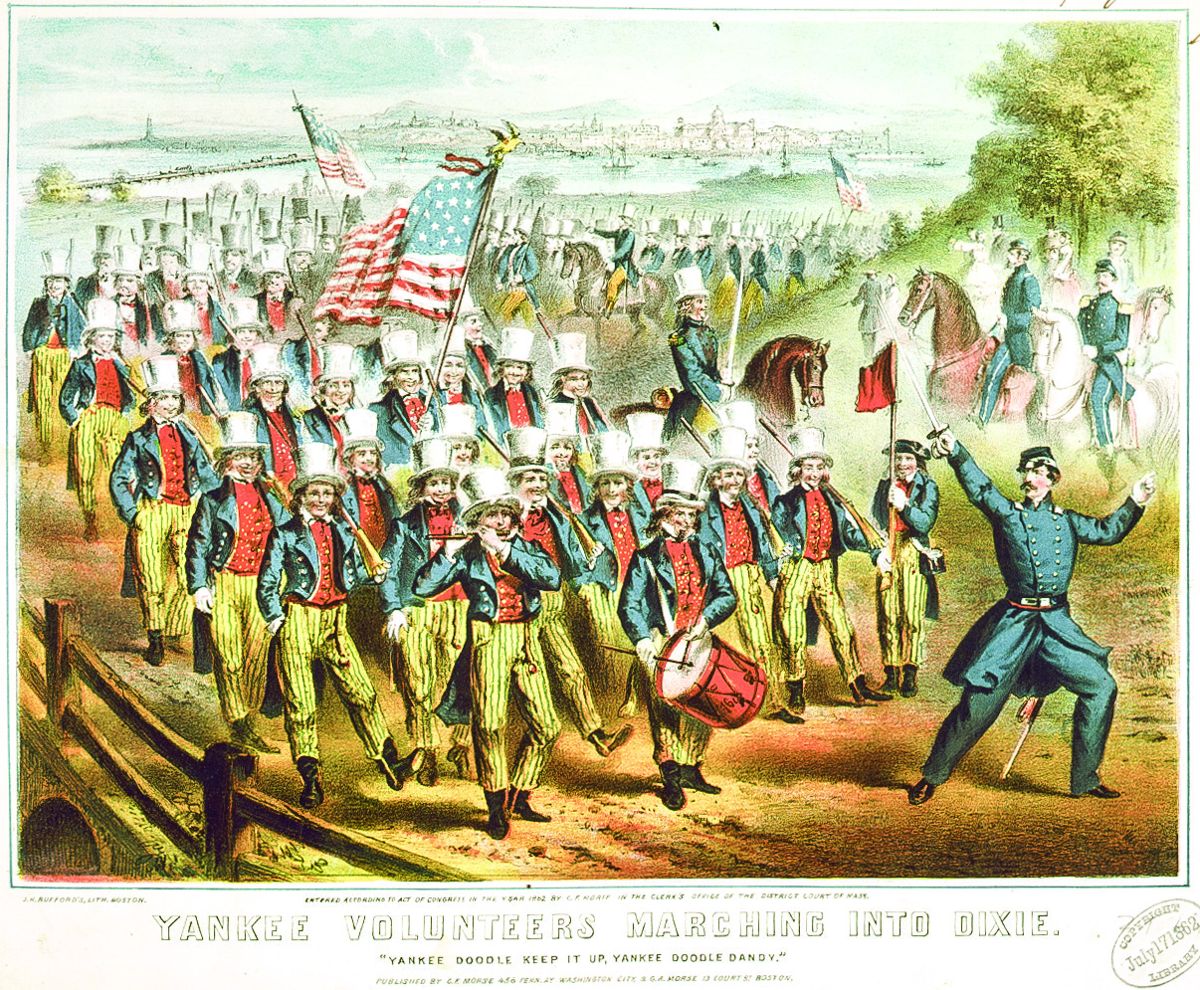
This occasional column highlights prints and printmakers from the Civil War. It discusses their meaning and most importantly, the goals of the print maker or artist. While Currier and Ives has become a household name thanks to an influential group of early 20th century collectors, very few know the name of lithographer John Bufford (1810–1870). He was a native of Portsmouth, N.H., and came to the lithography trade and business as it was “beginning to develop as a commercial printing technique.”1 He opened shop in Boston after an apprenticeship with the Pendleton printmakers and later moved on to New York City. In Boston, his advertisement boasted: “The Oldest Established Lithographic House in the United States/The Best Talent in the World Employed/Satisfaction Guaranteed to All.”2 Indeed, one of his stable of trained academic artists was Winslow Homer, who also went on to sketch during the Civil War. In New York, Bufford produced every conceivable illustration imaginable: sheet music covers, posters, book illustrations, city views of Boston and New York, whaling scenes, still life’s; until 1840 when he moved back to Boston for good. His career spanned the entire “Golden Age of Lithography,” through his brothers and sons after his death (1870), until the firm folded in 1911. Famed print collector, Harry Peters said of Bufford: “His work is almost invariably good, his sense of the essential in the general field seems to have been second only to that of Currier and Ives, his importance can be seen, and his contribution to Americana is in the very first rank.3 The Civil War prompted Bufford, along with many other lithographers and printers, to record the historic events engulfing the nation. He produced small folio portraits of Union generals and Abraham Lincoln, large-scale troop movements such as his “The Retreat. The Wagon Trains of the Army of the Potomac en Route from Chickahominy to James River, Va. during the Seven Days Fight.” John Bachelder, famed chronicler of the Gettysburg Battlefield was that artist, but the Bufford lithographic company printed it. His most outrageous printing was entitled The second line reads “Yankee Doodle keep it up, Yankee Doodle Dandy.” It was published by C. F. Morse, Boston, ca. 1862. Several major institutions own the work. The Library of Congress calls it a “music cover showing a patriotic but fanciful portrayal of Union forces marching on the South at the opening of the Civil War.” The prancing, cavorting troop of men is “led by a blue-uniformed officer with a drawn sword.” The library’s collection description continues: “All are dressed in the large white top hats, striped pantaloons, and jack boots characteristic of Yankee character Brother
Jonathan. In the background, to the north, is the Potomac River and, beyond, the Washington skyline with the Capitol building.” The library has two copies, one black and white and one printed in colors. It is labeled as a music sheet cover. The Library’s impression of the print was deposited for copyright on January 27, 1862, and received in the State Department on July 17 the same year.4 The Smithsonian makes no mention of the work as a music sheet cover but calls it a “color print.” They describe the men wearing “’Uncle Sam’ costumes: striped blue pants, blue tailcoats, red vests, white top hats, and carry rifles over their shoulders. A drummer and fife player are at the front of the group and several Union flags are flying. A city, probably Washington, D.C. is across the river in the background.”5 The Metropolitan
Museum of Art in New York has a copy simply labeled, “Machine-colored lithograph,” with no mention of sheet music. The Library Company of Philadelphia calls its copy a political cartoon. It’s unclear if Bufford intended to create a sheet music cover, s stand-alone print, or both. None of the institutions holding this print have the entire song sheet with music and lyrics. Nevertheless, this early war image was representative of the nation’s enthusiasm for an unfolding tragedy whose length and breadth was unknown. Above all, the nation’s print makers remained businessmen first and foremost. “Profit was their goal. Their advertisements…sound like” modern day enticements: “‘Free!,’ ‘Discount!,’ ‘Premium!,’ ‘Latest!,’ pepper their copy. The often sensationalist verbiage appealed to passions that had little to do with art.”6 The absurd and naïve “Yankees Marching into Dixie” is a prime example of that mindset.
Endnotes: 1. Jay Last. The Color Explosion: Nineteenth Century American Lithography. Santa Ana CA.: Hillcrest Press, 2005, 47. Hereafter, Last, Color. 2. Ibid. 3. Harry Peters. America On Stone: The Other Printmakers to the American People. New York: Doubleday & Co., 1931, 127. 4. A. LOC Black and white http://www.loc. gov/pictures/resource/
cph.3a07824/?co=civwar B. LOC Color http://www. loc.gov/pictures/resource/ cph.3g01977 5. C. Smithsonian Color: h t t p : / / a m h i s t o r y. s i . e d u / petersprints/enlarge. cfm?id=311582 6. Peter Marzio. The Democratic Art: Chromolithography 1840–1900. Boston: David R. Godine, Publisher, 1979, 213.
Salvatore Cilella is retired after 43 years in the museum field. His last position was President and CEO of the Atlanta History Center. He is the author of several articles and books. His most recent books are Upton’s Regulars: A History of the 121st New York Volunteers in the Civil War (U. Press Kansas, 2009) and The Correspondence of General Emory Upton, 1856–1881 (U. Tennessee Press, 2017) edited.