
Inspection, ARMS!
Confederate Keen, Walker & Co. Breechloading Carbine
By Tim Prince · Originally published July 2018 · pp. 14–15
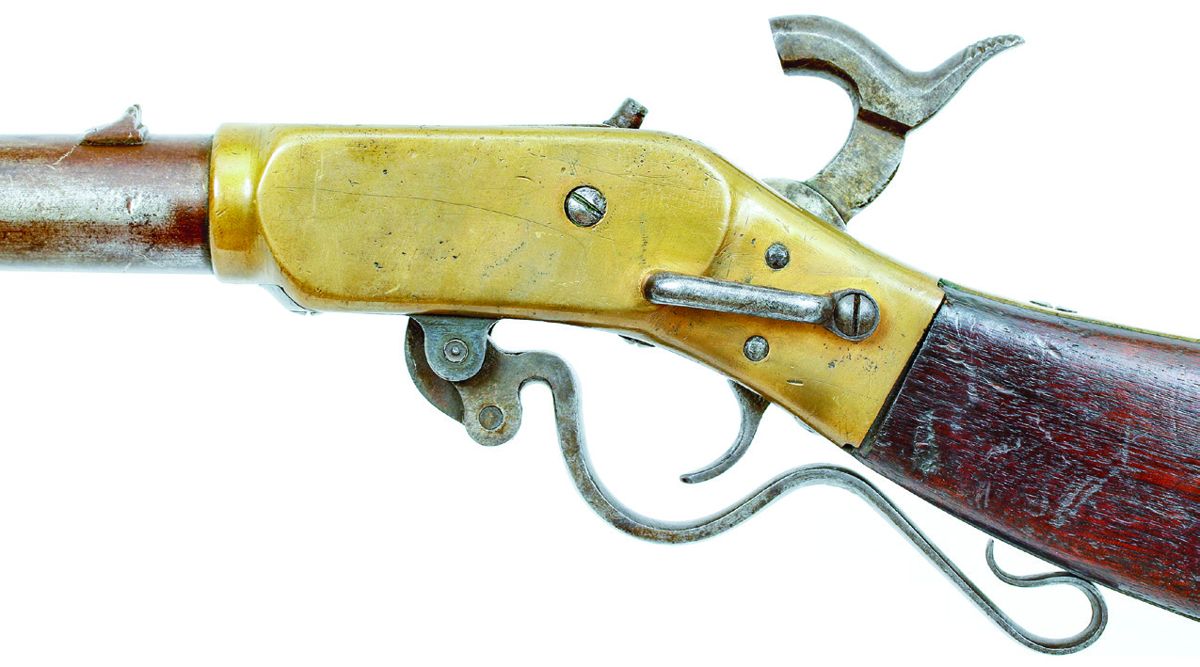
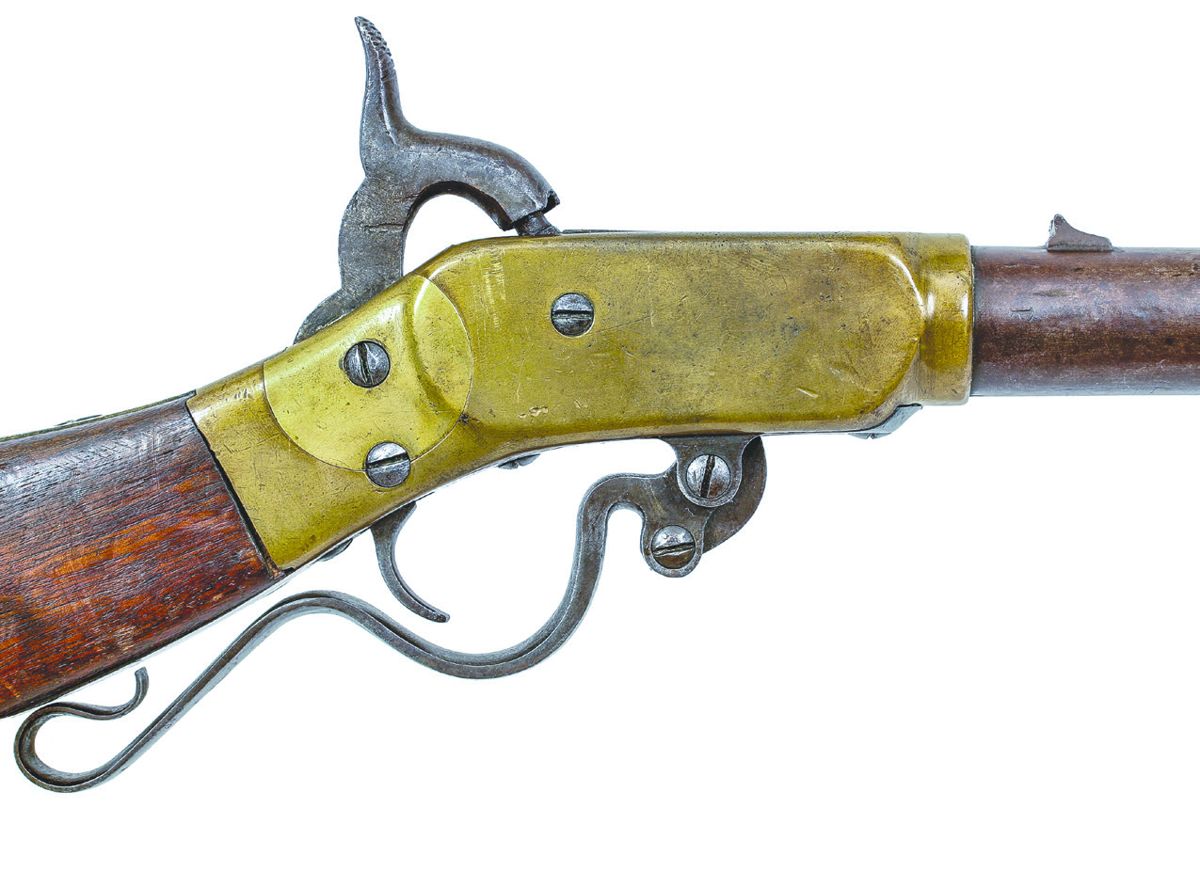
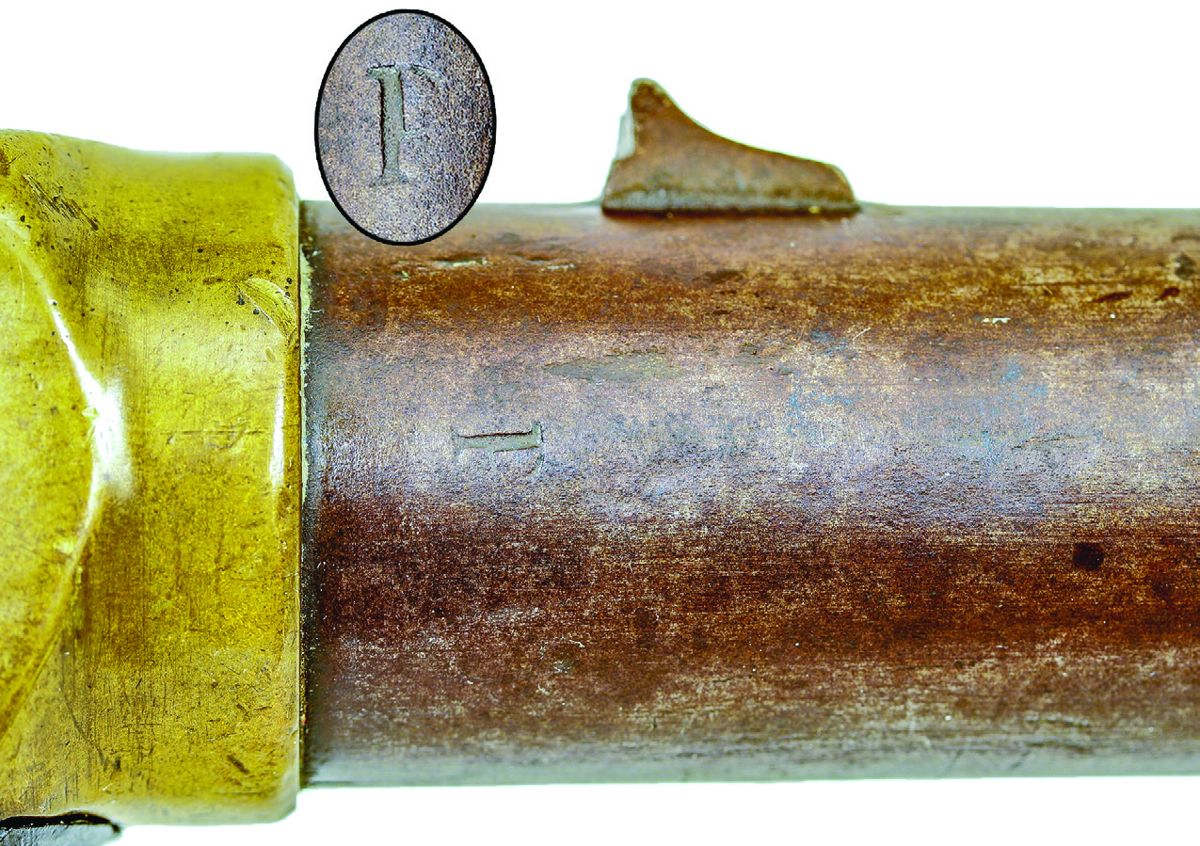
Last month we took a look at the Confederate muzzle loading carbines produced by Bilharz, Hall & Company. This month we will look at another Confederate carbine produced by a company in the same Virginia county, only about twenty miles away. It is interesting that Pittsylvania County, Va., would become the birthplace for so many intriguing Confederate manufactured arms during the course of the American Civil War. The only “city,” or even town of note, within the county was Danville and in that location two Confederate arms making companies were established; Keen, Walker & Company and Read & Watson. Only twenty miles to the north, in Pittsylvania Courthouse (now named Chatham), the firm of Bilharz, Hall & Company was established. The irony of the establishment of these three manufactories within some 20 miles of each other is that Bilharz, Hall & Company and Keen, Walker & Company would both produce unique Confederate breechloading carbines on a very limited basis and Read & Watson would spend their energies “altering” pre-war U.S. made Hall’s patent breechloading rifles to muzzleloaders! Keen, Walker & Company remains an enigmatic firm whose origins are somewhat unclear; even the actual names of those who were involved in the company remain up for some debate. The “Keen” in the name is not specified in most references and the only one I can find notes that it was an “E.F. Keen.” A search of the 1860 U.S. Census for Pittsylvania County, Va., reveals no one with that name living in the county. However, a substantial number of “Keens” lived there and were obviously a prominent family, going back at least three generations in the county. The majority of the Keen heads of household were listed either as “Farmers” or “Tobacconists,” with some of the working age sons listed as “Factory Hands.” One Keen, a William W., is listed as a farmer with substantial holdings and real estate valued at $30,800; the total value of his personal property was listed at $69,630! According to www. meauringworth.com the $69,630 from 1860 equates to a 2017 hard currency equivalent of slightly over $2.12 million dollars, based solely on inflation. From a practical matter of what that amount of money or worth really represented in 1860 versus 2017, the calculator notes that the 1860 personal wealth of $69,630 would be the economic equivalent of over $29.7 million dollars today! Obviously, William W. Keen was a very wealthy man. Mr. Keen was also one of the 41 shareholders in the Richmond based Union Manufacturing Company, established in 1861 to convert flintlock arms to percussion and to try to produce small arms as well. I would be more than willing to bet that William W. Keen was the primary shareholder and investor in Keen, Walker & Company, because he had already invested in the Richmond based firearms company and now had an opportunity to invest “at home.” The identity of the second name in the firm, Walker, is somewhat better known, but the information must be gleaned from multiple sources. James McKenzie Walker was an hotelier in Danville, Va., and listed in the 1860 Census as having real estate valued at $13,900 and personal property valued at $15,050 ($423,000 and $458,000 respectively in today’s hard currency). While nowhere near as wealthy as Keen, Walker was obviously another major player in Pittsylvania County. On April 23, 1861, Walker enlisted in Company A, 18th Virginia Infantry as their 2nd Sergeant. Walker only served a very short time, and on Oct. 5, 1861, he was discharged by special order of the Secretary of War, number 171. I have not been able to find a copy of this order, but it seems almost certain that the discharge had something to do with the formation of Keen, Walker & Company. Murphy & Madaus, in their groundbreaking work Confederate Carbines & Musketoons, reference a letter from a Danville resident dated Dec. 30, 1861, referring to the establishment of the firm of Keen, Walker & Company, noting that for that purpose: “Keen has…moved to Danville… he an(d) several others have gorne [sic] in to the Manufacture of Guns for the army. at $40 a peace [sic]. (T)hey buy the Barrels in North Carolina an [sic] dress them up an [sic] bore them out an [sic] stock them an [sic] finish off them in Danville all by Machinery.” The original misspellings and grammatical errors have been retained, but clearly the letter suggests the formation of the company, in the fall and winter of 1861, was a big deal in Danville. The gun that would finally be produced by the company has been referred to over the years as a “Confederate Perry” carbine, or a brass framed “Confederate Maynard.” From outward appearances the gun looks quite similar to the 1st Model Maynard carbine, with a very narrow, flat wood stock, small frame, and a round barrel without a forend. The semi-serpentine lever that operates the action of the carbine, and doubles as its triggerguard, also has a distinctly “Maynard” like appearance. The operation of the gun is more akin to that of the Perry carbine, as lowering the lever tilts the breechblock down in the rear, raising the breechblock‘s front, and exposing the chamber for loading. This is essentially the same principle upon which the Hall rifles and carbines operated, which is also a bit ironic as between and touched upon below. This “tilting breech” mechanism was quite different from the Maynard, whose frame remained rigid and whose barrel tilted downward for loading when the lever was operated. The percussion ignition carbine had a round .54 caliber iron barrel and was rifled with seven grooves. The barrel was nominally 21 ½ inches measured to the front of the frame, and about 22 ½ inches when measured to the front of the breechblock. These “North Carolina” barrels originated in Jamestown, N.C., the heart of North Carolina gunmaking and the home of such Confederate arms makers as H.C. Lamb and Mendenhall, Jones & Gardner, just to name two. The iron breech block had a bronze ring at the front that was intended to provide a partial gas seal and also solve the problem that had plagued the Hall breechloading design; the leaking of hot gasses into the face of the shooter! The frame was bronze, although some sources call it brass. The official composition of the frames of the guns can be determined by an invoice from The Confederate States to Keen, Walker & Company, dated July 8, 1862, for “4,940 lbs of bronze – $1,976.” Brass is an alloy of copper and zinc (usually about 60% copper to 40% zinc), while bronze is an alloy of copper and tin (usually about 85% copper to 15% tin) that can also contain other ingredients like aluminum, magnesium, arsenic, phosphorus and silicon. The bronze used in the Keen, Walker & Company carbine frames has the distinctive reddish tone of a high copper content, typical of the Confederate alloy often termed “red brass” by collectors. Bronze is much harder and more corrosion resistant than brass and has a higher melting point. As such, it is much more suited to gunmaking than brass. Typically, Confederate made bronze varied in the percentage content of the various ingredients, so the color of two pieces alloyed in different batches and then used in the production of the same gun rarely match exactly in color or tone. The guns had simple fixed rear sights and a long brass blade front sight dovetailed into the top of the barrel, near the muzzle. The barrels were either browned or blued, and guns with remnants of both types of finish are known among extant examples. The balance of the iron parts were reportedly case colored, although some may have been blued, or the case coloring may have been oil quenched, resulting in more muted, dusky bluish colors than are typically associated with that type of finish. The wooden buttstock had a simple iron buttplate and was secured to the frame with two screws through the brass tang extension on top and two more screws through the iron extension on the bottom. Interestingly the screws were “common wood screws,” exactly the type that Major Downer of the Richmond Arsenal complained about when he examined the muzzleloading carbines supplied by Bilharz, Hall & Company 20 miles north of Danville. A short sling bar was mounted on the left side of the frame from which a small iron sling ring was suspended. The guns were unmarked with the exception of a P proof that appears on most barrels; the same type of “P” appears on the barrels of Bilharz, Hall & Company carbines. The only other marks are internal assembly marks, typically large, crude Roman numerals and sometimes a small witness alignment mark at the barrel to frame joint. The first delivery of the Keen, Walker & Company tilting breech carbines was on May 10, 1862, when 101 guns were accepted at the Danville Arsenal and inspected by Lieutenant E.S. Hutter, who approved them and the accompanying invoice for $5,050, a price of $50 per carbine. In midJune, the company advertised that it was looking to “employ 20 to 30 steady gunsmith hands.” It is not clear if they were for the production of additional carbines or for another project that they would be undertaking shortly. In either case, two more deliveries of the tilting breech carbines were made in September 1862 at the lower rate of $40 per gun. The first delivery was on the 3rd for 100 guns, with the invoice paid on the 9th; the second delivery was 81 guns on the 16th, with the invoice paid on the 19th. No further deliveries of the carbines are noted. Based upon the original documents only 282 of the guns were delivered, all between May and September 1862. The firm then applied all their efforts to doing work for the other Confederate gunmaker in Danville, Read & Watson. Keen, Walker & Company worked to alter pre-war Hall rifles, made with a very similar tilting breech mechanism as their carbines, converting them to muzzleloading rifles and carbines. It seems incredibly strange that a company producing a sorely needed breechloading cavalry carbine would then concentrate its efforts on taking a breechloader and turning it into a much less useful muzzleloader. One of the last documents related to Keen, Walker & Company found in the Confederate Citizen Files is an invoice from the Confederate States to Keen, Walker & Co. dated April 18, 1863, for $177.90 for “five hundred ninety-three pounds iron @ thirty cents per pound.” The invoice was paid on May 8, 1863, and the iron was likely used in the alteration of the Hall rifles that Keen, Walker & Company was modifying on behalf of Reed & Watson. It appears that after the summer or fall of 1863, Keen, Walker
& Company ceased to exist, although William W. Keen would continue to do business with the Confederacy for the balance of the war, providing rental space to the quartermaster department and selling foodstuffs to them as well. Walker would be the last Confederate mayor of Danville, Va., and would also serve as the town’s first post-war mayor, during the early days of reconstruction. The Keen, Walker & Company “Tilting Breech” Carbine depicted in the accompanying photographs appears to be 100% complete and correct in every way, with the exception of the sling ring that is missing from the sling bar. The gun bears the assembly number XXV on the inner surfaces of both the iron and brass frame tangs and in the upper recess of the buttstock. The barrel is full-length, measuring 22 ½ inches to the face of the breechblock and 21 5/8 inches to the frame juncture. The barrel is marked with the Danville style P proof on the righthand side, just forward of the frame juncture. The only other exterior mark is a small witness line scribed between the barrel and frame, to indicate the correct indexing of the barrel. These Confederate made breechloading carbines are extremely rare today, as only 282 were produced. Even if the guns survive at the ludicrously high rate of 10% of their total production (most Confederate arms seem to survive at rates between .1 of 1% and 1% on the high side), less than thirty would exist today. These interesting carbines provide a great juxtaposition of Confederate manufacturing ingenuity and the hopelessness of the cause from a manufacturing standpoint; the firm literally went from producing newly manufactured beech loaders to turning pre-existing breechloaders into muzzleloaders! As such, the firm and its products are a somewhat baffling part of the story of Confederate arms manufacturing during the American Civil War. Tim Prince is a full-time dealer in fine & collectible military arms from the Colonial Period through WWII. He operates College Hill Arsenal, a web-based antique arms retail site. A long time collector & researcher, Tim has been a contributing author to two major book projects about Civil War era arms including The English Connection and a new book on southern retailer marked and Confederate used shotguns. Tim is also a featured Arms & Militaria appraiser on the PBS Series Antiques Roadshow.
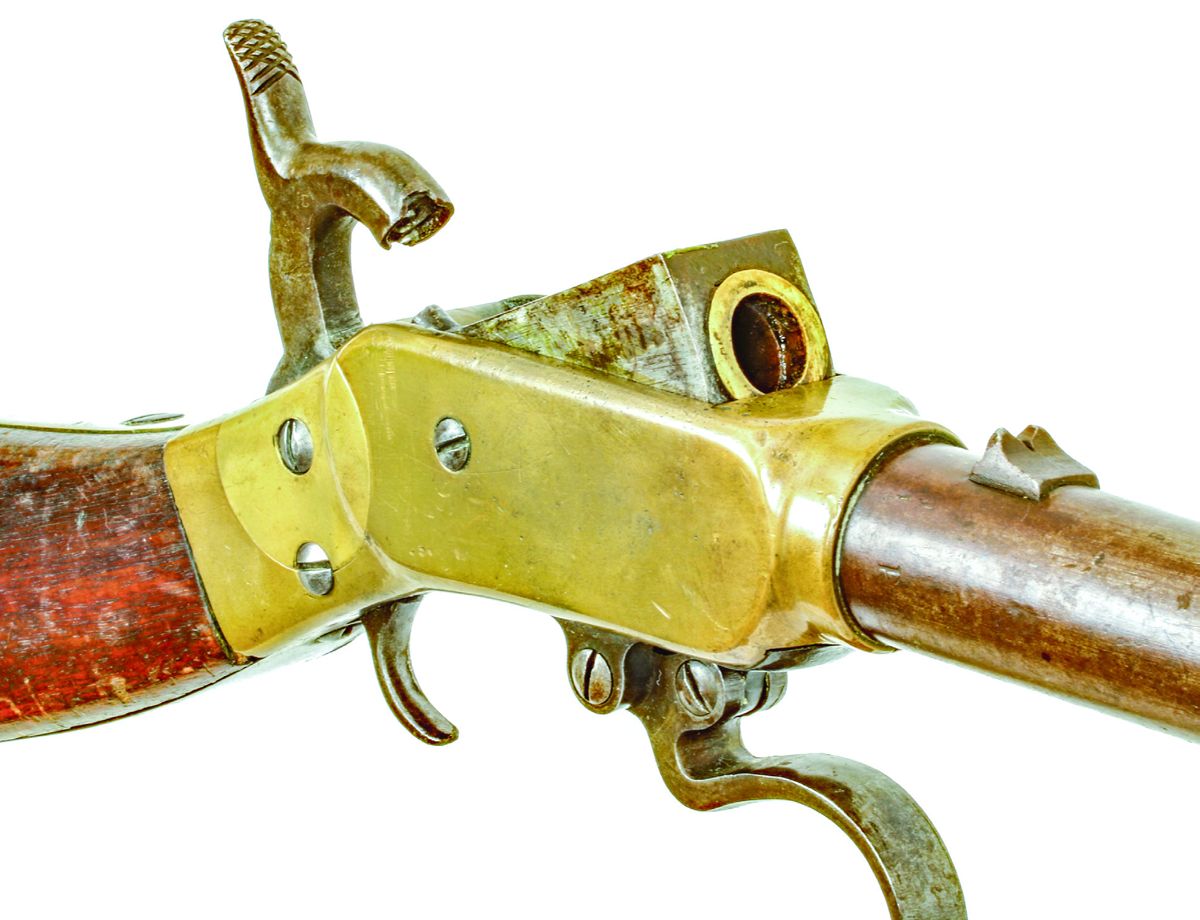
Keen, Walker & Co. carbine.
Fixed rear sight on the barrel of a Keen, Walker & Co. carbine, just forward of the receiver.
Reverse receiver of a Keen, Walker & Co. carbine. Keen, Walker & Co. brass front sight, dovetailed into the barrel near the muzzle.
Keen, Walker & Co. carbine obverse receiver.
carbine. (All photos by Tim Prince)