
The Unfinished Fight
U.S. 1861 Clean-out Screw
By Craig L. Barry · Originally published January 2018 · p. 7
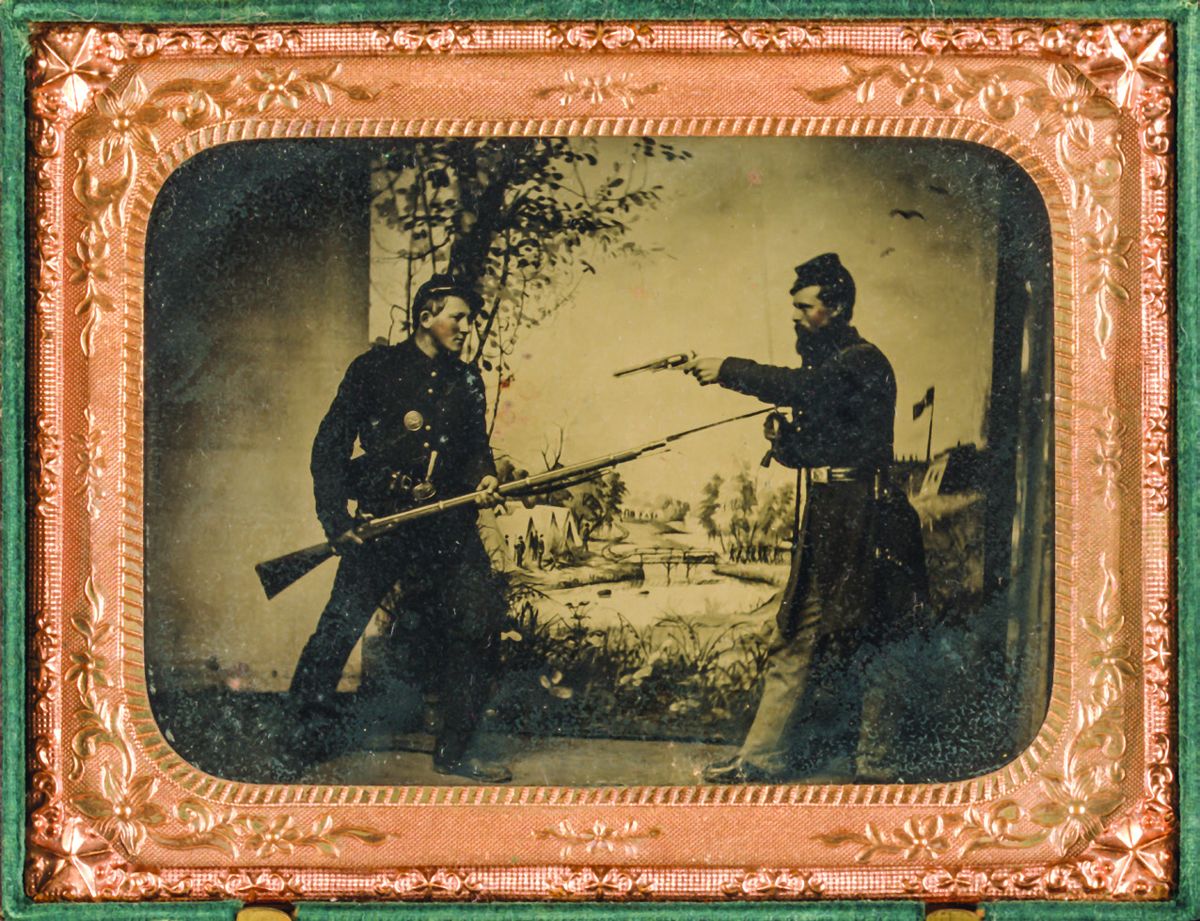
More black powder muskets have been ruined by neglect than all other reasons combined. Cleaning and oiling your musket is necessary to both preserve it and to continue to use it safely. The popular and widely used reproduction U.S. Model 1861 rifle-musket requires some additional steps where this is concerned. The so-called “cleanout” screw has to be periodically removed, oiled, and then screwed back in to the bolster, with extra care taken not to over tighten it. This somewhat contradicts the original manual, Rules for the Management and Cleaning of the Rifle-Musket Model 1855 for the use of Soldiers with Descriptive Plates, of which the U.S. M1861 was considered an updated version. It is true there is no original period manual for the U.S. M1861 specifically. The only other manual was updated for the U.S. M1863. In the manual for the U.S. M1855 it states under “Preservation of Arms in Service” (Erskine S. Allin, Rules for the Management and Cleaning of the Rifle-Musket Model 1855 for the use of Soldiers with Descriptive Plates, U.S. Gov. Printing Office, Washington, D.C., 1862, p. 19): “The soldier should never dismount the guard, side-screw, washers, butt-plate, rear-sight, cone seat screw and cone, except when an officer considers it necessary. The breech-screw should be taken out only by an armorer (gunsmith), and never in ordinary cleaning. The lock should not be taken apart, nor the bayonet clasp taken off, except when absolutely necessary in the opinion of an officer. If proper and regular care be taken of the arm, this will be very seldom necessary.” The Officers Manual is worded exactly the same except in the section directly afterwards under “Taking the Arm to Pieces,” the removal of the cone-seat (a.k.a. “clean-out”) screw is step 12, right after unscrewing the cone. What is clear from all this is that the U.S. Ordnance Department did not intend for the soldiers in the field to remove the clean-out screws when they cleaned and maintained their U.S. Model rifle-muskets, but rather, should that be necessary, an officer or probably non-commissioned officer was to perform that step. Why? One obvious reason is because if the clean-out screw was dropped in the grass during field maintenance by the soldier, the weapon was effectively out of commission. The U.S. M1861 evolved from the earlier U.S. M1855 design which used the Maynard tape primer system. The clean-out screw was probably more of a disadvantage than an advantage since the “improved” U.S. M1863 and later U.S. models did away with it, as did Colt with their Special Model of 1861. It was one of the improvements which Colt claimed among “the simplest changes I can think to make” in his contract with the U.S. Government for the Special Model of 1861. U.S. Springfield Armory-produced M1861 rifle-muskets from the same year of production can show clean-out screws with varying degrees of damage. In some cases it appears that the clean-out screw became stuck and, during an attempt to remove it, the screw head broke clean off. There is no evidence that the rifle-musket was taken out of service or any replacement of the broken part was attempted. Hence, the U.S. M1861 could apparently be satisfactorily cleaned and fired without ever removing the clean-out screw. In other examples the clean-out screw again appears stuck in the bolster, and the screw head is chewed up from unsuccessful attempts to remove it. This is often found on surviving originals that saw heavy use suggesting that difficulty in the removal of this part was a common problem. Some originals show a pristine clean-out screw maintained in “as issued” condition. This suggests it was regularly removed, oiled, and replaced during the service life of that particular U.S. M1861 rifle-musket, which appears to have seen relatively light use. The clean-out screw is still easily removed and replaced, most likely because it was never over-tightened. Since there are clearly established rules in place for the original U.S. Models 1855 & 1861 during the Civil War-era, what are the implications for the “management and cleaning” of modern reproductions used for historic weapons demos and Civil War (re)enactments? Should the cleaning procedure be the same? There are several points to consider here. First, the use of black powder blank rounds results in more fouling in the bore and bolster than live firing. Also, Union Civil War soldiers were issued what were called Williams patent “cleaner bullets.” The concept was that firing the cleaner bullet would remove excess residue from the lands and grooves of the rifling. Whether they were actually used by soldiers is another question, but even firing a regular hollow base conical minie ball removes more fouling than repeated firing with no more than black powder blank rounds. Dean S. Thomas notes this in Round Ball to Rim Fire Part I, (Thomas Publications,
Gettysburg, Penn.). Also, Thomas notes that Williams patent “cleaner bullets” are occasionally found on Civil War battlefields in a cluster with some still in the original wrappers, suggesting they were discarded or dropped by soldiers rather than used as intended. Another important difference is that modern reenactors lack Ordnance officers and Armorers in camp to assist if the weapon becomes unserviceable. The point is that what worked for the soldier 150 years ago does not provide the same results in the modern-era. In fact, the U.S. M1861 reproduction has a well-deserved reputation for misfires for this very reason (and a few others). The best possible solution is as follows: 1. Put a folded patch or small piece of wood between the hammer and percussion cone to plug it. 2. Remove the clean-out screw and put it in your tin cup for safe keeping. 3. Run a stream of hot, soapy water through the bore. It will exit out the flash channel. 4. Use a vent pick and patch to clear any black powder fouling from the flash channel. 5. Put a drop of oil or grease on the threads of the clean-out screw and replace it “thumb tight.” 6. Continue field cleaning the rest of the weapon as you would otherwise. Then, upon returning home from the weekend event, a more thorough cleaning of the bolster area can be performed with the barrel dismounted from the stock and placed in a pail of soapy water. The flash channel and percussion cone should be reamed out with pipe cleaners to remove any accumulation of fouling missed during field cleaning. This should greatly reduce misfires. There are several variables that cause misfires which can’t be controlled like dud percussion caps, etc., however, the overwhelming number of misfires from reproduction U.S. M1861s can be eliminated by keeping the flash channel completely clean and free of fouling. On the other hand, failure to do so can lead to a hardened cake of residue building up that completely blocks the flash channel and will require a professional gunsmith to remedy by removing the blockage with power tools. It is also recommended that you carry a spare “clean-out” screw in the implements pouch of your cartridge box, in case you should drop or otherwise lose this part during cleaning. Craig L Barry was born in Charlottesville, Va. He holds his BA and Masters degrees from the University of North Carolina (Charlotte). Craig served The Watchdog Civil War Quarterly as Associate Editor and Editor from 2003-2017. The Watchdog published both books and columns on the material culture of the mid-19th century and donated all funds from publications to battlefield preservation. He is the author of several books including The Civil War Musket: A Handbook for Historical Accuracy (2006, 2011), The Unfinished Fight: Essays on Confederate Material Culture Vol. I and II (2012, 2013) and three books (soon to be four) in the Suppliers to the Confederacy series on English Arms & Accoutrements, Quartermaster stores and other European imports.