
There Are Two Sides To The Dr. Samuel A. Mudd Story
By Laurie Verge · Originally published January 2018 · p. 20
The Small Talk quiz in the November issue of Civil War News brought up once again the confusing story of the “poor country doctor who was sent to prison in 1865, for setting the broken leg of President Lincoln’s assassin.” Dr. Samuel A. Mudd was not convicted because he did his medical duty in setting a man’s leg; the evidence against him is much stronger. Over the past thirty years, excellent scholars and authors have cut through the curtain of historical propaganda to fully explain why the doctor was arrested, tried, and convicted of being a part of the plot that led to the assassination of President Lincoln on the night of April 14, 1865. There was little thought given to his case after 1869, when President Andrew Johnson issued a full and unconditional pardon to Dr. Mudd, who as a prisoner at Fort Jefferson off the Florida Keys, worked diligently to quell a yellow fever epidemic at the military prison. Both soldiers and prisoners signed a petition for his release based on his humanitarian efforts – not on his guilt or innocence related to the assassination. Dr. Mudd returned to his southern Maryland farm and continued his life, even running for public office later on. He died in 1883. It was not until the 1920s that his case began to make waves once again. One of his grandsons, Dr. Richard Dyer Mudd, mounted a long campaign to “clear” the name of Dr. Samuel A. Mudd. That campaign lasted for over 80 years and caused a great deal of confusion as to the real facts of Dr. Mudd’s participation in the Lincoln conspiracy. In the 1980s, a counter-campaign began among historians in the field to make full disclosure of what facts the military tribunal had to consider as they tried Dr. Mudd and eight
Dr. Samuel A. Mudd.
(Wikimedia)
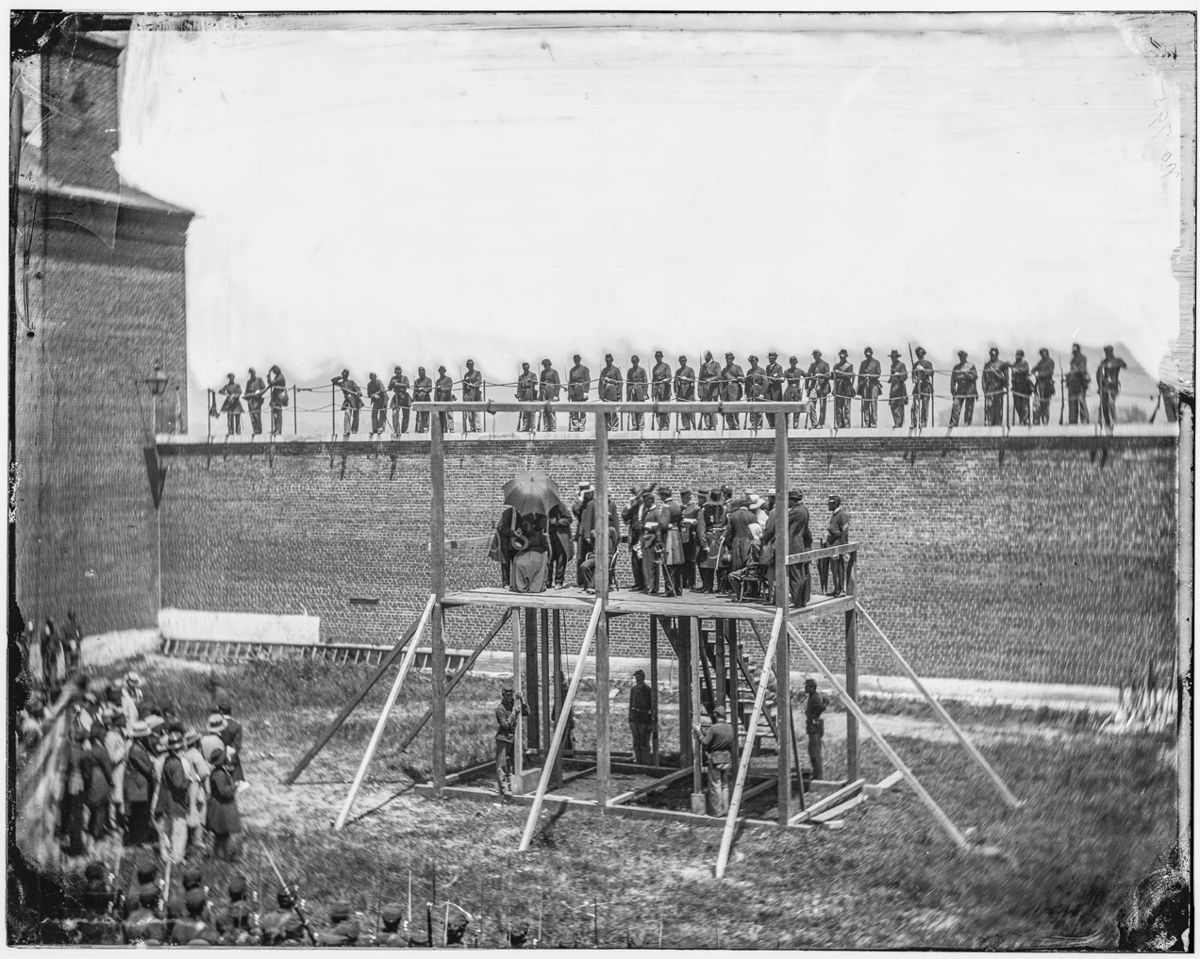
other civilian defendants. Cutting here to the core of this matter, Dr. Samuel A. Mudd was spared a trip to the gallows by one vote. What caused one judge to vote death for Mary E. Surratt, the first woman executed by the federal government because of her connection with John Wilkes Booth, and yet spare the doctor? The case of Mary Surratt can be discussed later; but as for Dr. Mudd, please consider that the doctor had introduced Booth to the Surratt family in order to recruit young John Surratt, had also introduced Booth to the chief Confederate operative in lower Maryland, was a vehement Southern sympathizer, a slave owner and abuser, and had entertained Booth at his home several times in the fall and winter of 1864-65, as the actor was developing his original plot to kidnap President Lincoln. Mudd’s medical assistance after the fact was not the main point, and the fact that he found out about the crime on a visit to the nearby village while Booth and Herold were still in his home on April 15, 1865, did not help.
John Wilkes Booth. (Library of Congress)
Instead of telling the soldiers in the village that two strange men were at his house, he returned home and sent the fugitives off under the cover of approaching darkness. Dr. Mudd also changed stories from time to time while under investigation. His own lawyer, Frederick Stone, would later say that Mudd’s own prevarications helped to seal his fate. Many years later, Mudd’s grandson carried his “Free Dr. Mudd” campaign to the higher levels of government. Letters were sent to both Presidents Carter and Reagan asking them to overturn his grandfather’s conviction. Both men expressed their personal opinions as to Dr. Mudd not deserving the treatment that he received, but Carter put it succinctly, President Andrew Johnson had issued a full and unconditional Presidential pardon in 1869, and that he (Carter) had no authority under law to set aside the conviction – specifically, [I have] been advised the findings of guilt and the sentence of a military commission that tried Dr. Samuel Mudd are binding and conclusive judgments and there is no authority under the law, by which, I, as president, could set aside his conviction. Dr. Richard Mudd continued his fight in 1992, by petitioning Maryland’s U.S. Representative Steny Hoyer and Illinois’s U.S. Representative Thomas Ewing to introduce House Bill 1885 to clear his grandfather. The effort failed in committee. The push was then presented to the Army Board for Correction of Military Records with the point that Mudd was a civilian and should not have been tried in a military court. The term “enemy belligerent” then came into focus. Throughout the Civil War, civilians had taken up arms against the United States and some had been tried by military courts and found guilty. The Mudd efforts were rejected by the Army’s Acting Assistant Secretary William D. Clarke. Undaunted, the fight moved up to the Supreme Court, but was rejected on a technicality in 2003. Dr. Richard Mudd had died at the age of 101 in 2002. The controversy has been dormant for 15 years. There is an excellent book on the subject of Dr. Samuel A. Mudd, written by Dr. Edward Steers, Jr. and now out-of-print. Entitled His Name Is Still Mudd, it brings detailed information to the true case of Dr. Samuel A. Mudd. If our readers cannot locate a copy of this book, we recommend visiting www.historynet.com/dr-samuel-a-mudd.htm where Dr. Steers has contributed an equally excellent synopsis of his book. Laurie Verge is a native of Southern Maryland with an intense interest in her state’s role in the American Civil War and specifically in the Lincoln assassination. She taught history for nearly a decade before becoming a housewife and mother. In 1975, she became a volunteer guide at the historic Surratt House Museum in Clinton, Maryland. Since 1983, she has served as director of the museum.
Brief History of the Surratt House Historic Surratt House has national significance due to its role in the dramatic events surrounding the Lincoln assassination conspiracy. Built for the Surratt family in 1852, the house served not only as their home, but the center of a plantation, a tavern, public dining room, and hotel for traveling gentlemen. It also served the area as a post office and polling place. As the Civil War loomed, it was a gathering place for secessionists and later became a part of the conspiracy against President Lincoln that led to his assassination in April of 1865, when the widow Surratt and her son became entangled with John Wilkes Booth. As a result, Mrs. Surratt was arrested, tried and convicted as a conspirator and went to the gallows on July 7, 1865, marking the first time that a woman had been executed by the federal government. Surratt House opened to the public as a historic house museum in 1976. Its campus includes a visitors’ center with permanent exhibits and a gift shop as well as a nationally recognized James O. Hall Research Center dedicated to the study of the Civil War in Maryland and the assassination of Abraham Lincoln. Visit surrattmuseum. org for further information.
Washington, D.C. The four condemned conspirators (Mrs. Mary Surratt, Payne, Herold, Atzerodt), with officers and others on the scaffold; guards on the wall.