This And That
Evacuating the Stockade and the Asylum
By Gould Hagler · Originally published January 2018 · pp. 18–19
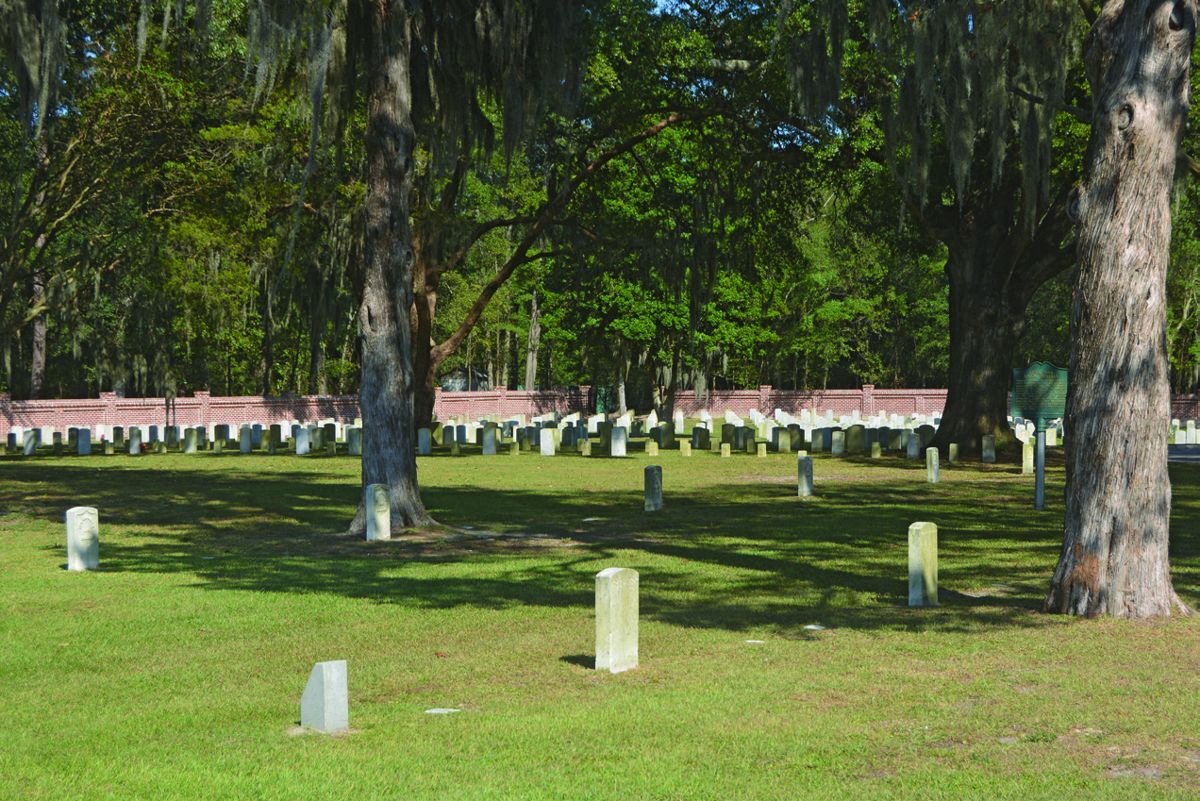
I am at a loss to know where to send the prisoners from Florence. In one direction the enemy are in the way. In the other the question of supplies presents an insuperable barrier. I again urge paroling the prisoners and sending them home. I have consulted the Governor and General Chesnut, who both urge that they be paroled. The guard is very weak and insufficient to take care. At once give full instructions – Brig. Gen. John H. Winder to Gen. Samuel Cooper, Jan. 20, 1865). When General Winder sent this message to the Confederacy’s adjutant general, he was in command of all prisoner of war camps east of the Mississippi. Florence, S.C., was but one of his countless problems, and this telegram was but one of many urgent Confederate communications on the subject of prisons sent in the hectic early months of 1865.* Winder was one month shy of his sixty-fifth birthday, a day he would not live to celebrate. He dropped dead on February 6 as he arrived at the Florence train station to investigate allegations of mistreatment at the Florence Stockade, a prison holding thousands of Federal captives, men cold, hungry, and wretched in every way. Ten days before his death, Winder sent another plea to Cooper, “I hope you will not consider me troublesome on the subject of the safety of the prisoners of war, but it is a question of so much importance, and my information concerning the movements of the two armies being derived entirely from the public print and rumor, I did not feel satisfied to act without the opinion and advice from higher authority.” Meanwhile, what was the condition of the prisoners in the stockade? For this information Winder did not have to rely on “public print and rumor.” He had the inspection report of Col. Henry Forno, delivered on January 27. Six men were dying each day, mostly from diarrhea, smallpox, and typhoid. Regarding food, Forno wrote, “The subsistence department is entirely deficient, and the ration issued daily amounts almost to starvation. There has been but two issues of meat in the last two months and scarcely ever sirup.” Forno also gave a negative report on the quality of the guards. “The guard force inefficient and without proper discipline, and are composed of reserves and about ninety men of the Fifty-fifth Georgia Volunteers.” There were seven endorsements to this report, which give us a view of the military bureaucracy at work. Winder pled for more food. An assistant adjutant general suggested that a commissary officer be assigned to the prison. The matter was referred to the commissary general, who said he had no funds to buy more food. Another endorsement referred the matter to the secretary of the treasury, who had no funds to send to the commissary general. A final endorsement read simply “Respectfully referred to the Secretary of War.” In a subsequent exchange of similar messages, the commissary general penned these blunt words: “The state of the commissariat will not allow the issue of a full ration to our own troops in the field, much less to prisoners of war. It is just that the men who caused the scarcity shall be the first to suffer from it. No need is seen for an additional officer at Florence, S.C. Present appearances indicate the prospective necessity of a still greater reduction of the ration.” Meanwhile, Lt. Col. John Iverson, in command of the Florence Stockade, reported in some detail on the daily diet of the penned Federals who received one pound of meal, one-third pound of peas, and three pounds of salt per 100 rations. The only prisoners given any meat at all were those on work detail. These got a halfpound of beef per day. Iverson wrote: “I have the honor to state that the ration now being issued to the prisoners at this prison is totally insufficient for their sustenance, as large numbers are dying daily, and I am satisfied it is from not being properly fed.” After drawing Winder’s attention to the situation, Iverson concluded with a respectful request that the communication be forwarded to the secretary of war for action if the wherewithal “to remedy the evil” was beyond the commander’s power. The records contain no similar report of conditions in the Asylum Prison in Columbia, S.C., which held Federal officers. Perhaps the absence of a report indicates that there were fewer difficulties there. It is worth noting that the Joint Committee on the Conduct of the War, in its 1864 Report No. 67, stated that according to witnesses their treatment at this prison “was far more humane than that they received at Richmond.” Certainly the Asylum was not a pleasant place to be, and conditions probably deteriorated as the war progressed. The Federals and the Confederates sometimes cooperated “to remedy the evil” by arranging for the shipment of supplies through the lines to the Union soldiers held in captivity. Volume VIII of Series II, Official Records of the War of the Rebellion (OR’s) contains several references to such shipments to the Florence and Columbia prisons, as well prisons in North Carolina, Virginia, Alabama, and Mississippi. Records indicate also that “packages of money” were delivered to prisoners held by the Confederacy. However much each side wished to get such supplies and money to the prisoners, these deliveries could not have more than a minimal impact. On February 4, two days before his death, Winder forwarded Iverson’s report to Cooper, with a request that experienced commissary officers be assigned to prison duty. Considering that the commissary general had no food to deliver, and that the treasurer had no money, would better staff officers matter? What was needed was a resumption of prisoner exchanges, or, if the Federals did not agree, a Confederate decision to parole prisoners with no quid pro quo. No other means existed to prevent more deaths After Winder’s death, responsibility for the prisoners in Florence fell to others. As Sherman’s army marched through South Carolina, these officers in growing desperation tried to move the prisoners held in Florence and Columbia. But they did not know where to send the prisoners; they had great difficulty in securing transportation; they lacked the manpower to guard the prisoners in transit; and they did not know how to feed and quarter the prisoners when they got to wherever they were going. In mid-February messages went back and forth among various army officers and government officials with suggestions or actual orders to move the charges in almost every direction on the compass: to Andersonville; to Salisbury; to Raleigh; to Georgia; to “to points farther north;” and to Greensboro. On February 12 Iverson sent a telegram to an assistant adjutant general in Richmond: “I have been ordered by Col. Forno, at Columbia, to move the prisoners to that point. No trains can pass through Kingsville unless they go to-day. This is impossible. Shall I ship them to North Carolina?” The reply: “Obey Colonel Forno’s orders. He is in charge of South Carolina.” It is not difficult to imagine this officer’s exasperation when he was ordered to send 10,000 sick and starving prisoners to a railroad station that was about to be blocked by the enemy. Some relief seemed to be in sight when word came that exchanges would be resumed. The Florence men and others were to be swapped at Wilmington. However, on February 20 hopes were dashed when Gen. R.F. Hoke in Wilmington informed Richmond officials and generals in charge of prisoners that the Federals were refusing to receive the prisoners. Hoke told them “send no prisoners here” and advised that he was moving those already in Wilmington to Goldsboro. Two thousand were to leave that night. After some delay the exchanges did take place beginning February 26. Three reports made by Confederate officers in March tell of a challenging situation degenerating into chaos as the officers tried to do their duty with woefully inadequate resources and in the face of circumstances changing, and then changing again, with bewildering speed. Major Elias Griswold was in charge of evacuating the Asylum Prison. The first detachment left Columbia without incident on the night of the Feb. 14. Griswold’s Feb. 24 report to Col. Forno paints a vivid picture of the scene in the South Carolina capital as Griswold attempted to ship out the second group of prisoners the following night, two days before Sherman’s army marched in. “It was an intensely dark evening and raining in torrents – the depot and the roads were thronging with fleeing fugitives and wagons of baggage and freight. It was so dark that the guards could not see the prisoners at a distance of three feet, and the guard at best was most inefficient, being composed of raw, undisciplined reserves…On this occasion we must have lost from fifty to sixty prisoners. It could not be prevented. My officers with myself went up and down the line constantly, but no guard, especially such as I had, could have prevented escapes on such an occasion and in such darkness.” Griswold marched the prisoners to their quarters to wait for the next train. (Gould Hagler) When the train finally departed it traveled just one hour before it crashed into some cattle on the track and wrecked. “We had to remain here until a new track was made around the wreck,” reported Griswold. On the evening of the 16th the prisoners reached Charlotte. In Charlotte the men camped in an open field. The small guard was “utterly worthless.” “A sergeant and three men of the guard were bribed and went off in the night with thirty prisoners, and nightly they were escaping.” Faced with these impossible conditions, Forno ordered Griswold to parole all the Federal officers and take them to Greensboro. Col. Forno filed his report on March 11. He summarized correspondence relating to the evacuation of the two prisons, both of which were his responsibility after Winder’s death. Forno’s style is more matter-of-fact than Griswold’s, but the tension and drama are still there. Forno intended to carry out his dead commander’s plans and move the prisoners to southwest Georgia. The first need was to transport the men from Florence to Columbia, so on Feb. 11 he arranged for a train. He then looked for guards. He asked Bragg in Wilmington: no help; Hardee in Charleston:
no help; Gen. Chesnut commanding the South Carolina Reserves: no help; Governor Magrath: no help. Gen. Garlington okayed assigning the Cadet Battalion and a company of provost guards with the proviso that they not leave the state. “This released the South Carolina Reserves…and rendered the contemplated move feasible.” Or did it? On Feb. 12 Forno was informed that Gen. Bradley Johnson in Salisbury had been put in charge of South Carolina prisons. Johnson wanted a report on the number of prisoners and their condition. Forno provided the information and told the general of his plans to move the prisoners to the south. Johnson replied that Beauregard had advised against such a move. What would you do if you were in Forno’s position? Perhaps you would ask your commander to tell you what he wanted you to do. That is what Forno did, by telegraph, twice requesting orders. “The case is urgent,” he said in his second request. Rather than sending orders, Johnson told Forno on the Feb.13 that Richmond had placed Forno in charge of all South Carolina prisons. “You will therefore do as you think best.” General W.M. Gardner in the capital “suggested” that Raleigh or Salisbury would be a better destination for the prisoners than Georgia and told him to call on Gen. Holmes for guards and subsistence. Holmes replied: “I have no soldiers here and can furnish no guards…Can feed the prisoners with bread.” Thus rebuffed, Forno concluded that he had discretionary authority to send the prisoners to Georgia. This is prepared to do, but “rapid changes occurring in the situation rendered the whole plan nugatory.” The railroads needed for transport to Georgia were cut, and exchanges were to be made in Wilmington. On the Feb.15 Forno ordered Lt. Col. Iverson to send the able-bodied men from Florence to Goldsboro, part of the way on foot, the rest via the North Carolina Railroad. Some of these did, it seems, make it to Wilmington for exchange but, due to the breakdown in the exchange plans, Gen. Hoke sent them back to Goldsboro on the Feb. 20, two days before the fall of Wilmington. According to a report made by Capt. J. Louis Smith, an assistant inspector general, nearly 9,000 officers and men (in total from Florence, Columbia, and Salisbury) were exchanged near Wilmington. According to Smith’s report 125 prisoners died in transit and 1,703 escaped. Of the escapees, 1,410 were from Florence. One of the officers, Griswold, was deemed to be “chargeable with inefficiency as an officer,” but the inspector found that most of the escapes were due to circumstances beyond the officer’s control. Why did so many of the Florence prisoners escape? Smith reported that many prisoners were lost during the evacuation of Wilmington. “It was found impossible to drive out before the troops numbers of these men, enfeebled by long imprisonment and crippled by scurvy and other diseases.” It seems likely that many prisoners sent to Wilmington, then marched back toward Goldsboro, were enlisted men from the Florence Stockade. Captain Smith filed his report in Richmond on March 31, two days before the evacuation of the capital and the start of Lee’s westward retreat. Smith decried the large number of escapes: “This loss of prisoners is greatly to be deplored in view of the present exchange of man for man.” He also wrote more generally about the management of prisons and expressed the hope “that, as a mere matter of policy, the Government will hereafter insist upon and enforce more system in the management of the prisons, a better care of the prisoners, and a stricter accountability of those in charge of them.” Man-for-man exchange so more Confederate soldiers could return to battle? Recommendations for the management of prisons in the future? One would not guess from Smith’s report that the end was so near. *All the records used for this article are contained in Volume VIII, Series II of the Official Records. Gould Hagler is a retired lobbyist living in Dunwoody, Ga. He is a past president of the Civil War Round Table of Atlanta and is the author of Georgia’s Confederate Monuments: In Honor of a Fallen Nation, published by Mercer University Press in 2014. He speaks frequently on this topic and other aspects of the Civil War and has been a regular contributor to CWN since 2016. He can be reached by email at gould. [email protected].