
Book Reviews
Book Reviews — January 2018
Originally published January 2018 · pp. 30–37
An Unconventional Way to Discover Gettysburg Discovering Gettysburg: An Unconventional Introduction to the Greatest Little Town in America and the Monumental Battle that Made It Famous. By W. Stephen Coleman. Illustrations, maps, 264 pp., 2017. Savas Beatie, www.savasbeatie.com. $25 hardcover. Reviewed by Mike Shovlin
It’s always great to find a new book on a town that many love and have come to call home. W. Stephen Coleman has attempted to take a different approach to have his book stand apart from all the others. His title, Discovering Gettysburg: An Unconventional Introduction to the Greatest Little Town in America and the Monumental Battle that Made it Famous sets the table to what looks like a feast for the mind. This would be an amazing book if the subtitle stopped at “Greatest Little Town” and left out the “Monumental Battle that Made It Famous.” We have many books written just about the battle by people who have spent their lives in research for a new perspective. Mr. Coleman has tried to write in a narrative style as he walks us across the battlefield and talks of the actions. This can be a difficult read for those who have studied Gettysburg and find myths or opinions written as fact. Wesley Culp was not killed on Culp’s Hill, for example. As Mr. Coleman hikes across the field, he sometimes takes us off on a different subject, going into stories about horses or cannon and then back on the path. Now we must recall where we were and get back on track for the battle. I appreciate the effort which Mr. Coleman is trying to accomplish, in giving a new Gettysburg enthusiast basics of the battle, but there are so many before him who have done the same thing much better. What separates this book from the others are the stories of the many men and women he has met over the years in visiting the town. Coleman has had his mind enriched by the conversations with the people mentioned in his book. We can look forward to see the next person he will be introducing to readers. He writes that we need to meet the shop owners, B&B operators, battlefield guides and town historians to make one’s visit memorable. Each has a collection of wonderful stories to tell. Sue Boardman, Bill Frassanito & Barbara Finfrock are just a few of the awesome people mentioned in the book. We can all appreciate how much they influenced Mr. Coleman in his writings. Another different approach is having illustrations done by Tim Hartman, cartoonist and illustrator. After viewing the caricatures, you can walk up to one of the people and ask to see their “cartoon smile.” I enjoyed this touch and compliment Mr. Hartman’s artistic skill. This book will hold a place on my bookcase to remind me of all the people and organizations the author has come in contact with in his travels. Many trivia questions may derive from the pages about the current townsfolk. I look forward to meeting Mr. Coleman the next time he is in Gettysburg and visits the Rupp House. Mike Shovlin is the Lead Assistant at the Rupp House History Center for the Gettysburg Foundation. He has written for Civil War News and is currently researching the Rupp family history for a book on the house.
The idea of a monolithic antebellum South, and later Confederacy, is one that scholars have chipped away at now for several decades. Works such as Carl Degler’s The Other South: Southern Dissenters in the Nineteenth Century (1974), Daniel Croft’s Reluctant Confederates: Upper South Unionists in the Secession Crisis (1993), and William Freehling’s The South vs. The South (2001) blazed a path that is currently receiving a significant and much needed resurgence, both in academic scholarship and in public history. Much of the past work on southern Unionism—and rightly so—has focused on upland mountainous areas such as East Tennessee, northern Georgia, and western North Carolina. Others have looked at Unionism in the Upper South slave states of Tennessee, Virginia, and Arkansas, or pockets of Union sympathy in urban areas such as Atlanta, as well as back country locales such as Jones County, Mississippi. Providing an additional perspective to these previous studies is Joel McMahon’s Our Good and Faithful Servant: James Moore Wayne and Georgia Unionism. Your first question, as was mine, may be, who was James
A Forgotten Southern Unionist Finally Gets Attention Our Good and Faithful Servant: James Moore Wayne and Georgia Unionism. By Joel McMahon. Photos, notes, bibliography, index, 249 pp., 2017. Mercer University Press, www.mupress. org. $35.00. Reviewed by Tim Talbott
Moore Wayne? This is an important question, for as McMahon contends, Wayne’s legacy is one that fell victim to the Myth of the Lost Cause. James Moore Wayne was born in 1790, the son of Richard Wayne, a British loyalist during the American Revolution. Wayne’s public service included stints as a state legislator, the mayor of Savannah, and U.S. congressman. However, those who know of Wayne likely have made his historical acquaintance through his service as a U.S. Supreme Court justice. Appointed by Andrew Jackson in 1835, he ended up as one of the longest serving justices in history when he died in 1867. Although Wayne’s wife burned his personal papers after his death, McMahon is able to put together a fairly clear picture of the Georgia Unionist through his published speeches, Supreme Court and circuit court decisions, and through others’ comments on Wayne. McMahon bases Georgia’s antebellum Unionism in the state’s particular brand of politics, economics and social dimensions, each of which form the final three of the four total partitions of Our Good and Faithful Servant. The first part of the book provides a wealth of historiographical and methodological information that prepares the reader well for the following sections. McMahon contends that although Georgia remained heavily rural and wedded to slavery during the antebellum years, there was also a sense of industry, progress and diversification that influenced its difference from surrounding neighbor states. Internal improvements such as railroads—by 1860, Georgia had more miles than any slave state except Virginia—influenced some Georgians to think long and hard about secession when the time came. Whether the state could benefit best within or without the Union weighed heavy on the minds of Georgians once the dominos began tumbling. McMahon argues that Georgia would likely have resisted secession longer if not surrounded by South Carolina, Florida, and Alabama, which all went out earlier. Influentially important, too, were national political decisions such as Andrew Jackson’s call to remove Native Americans from northern Georgia, which opened up land and the state’s gold fields to white settlers, who benefited economically. Wayne’s stance on slavery receives significant attention by McMahon. Wayne held as many as 100 slaves during periods of his life, but he was also a proponent of the American Colonization Society. It is not known definitively whether Wayne sent some of his enslaved people to Liberia, but his ownership of African Americans diminished drastically by 1860, when he was credited with ten slaves in that year’s census. McMahon also briefly discusses the possibility that Moore fathered mixed race children, which may have evolved his thinking somewhat on the institution, too. Despite his son’s resignation from the U.S. Army and subsequent enlistment in the Confederate army, James Moore Wayne’s allegiance to the Union apparently never wavered. Unlike fellow Deep South justice John Archibald Campbell (Alabama), Moore remained on the bench throughout the conflict and into the first two years of Reconstruction before he died in 1867. Our Good and Faithful Servant makes a significant contribution to the growing field of southern Unionist scholarship. McMahon provides a well-researched and -written account of James Moore Wayne influence on Georgia’s particular brand of Unionism. This book offers a perspective that will help counter and balance the many biographies of Wayne’s secessionist contemporaries, such as Robert Toombs, Howell Cobb, and Alexander Stephens. Tim Talbott is the Director of Education, Interpretation, Visitor Services, and Collections at Pamplin Historical Park and the National Museum of the Civil War Soldier in Petersburg, Va. He is a native of East Tennessee and has researched his southern unionist ancestors, which in turn, has influenced his interest in this particular subject.
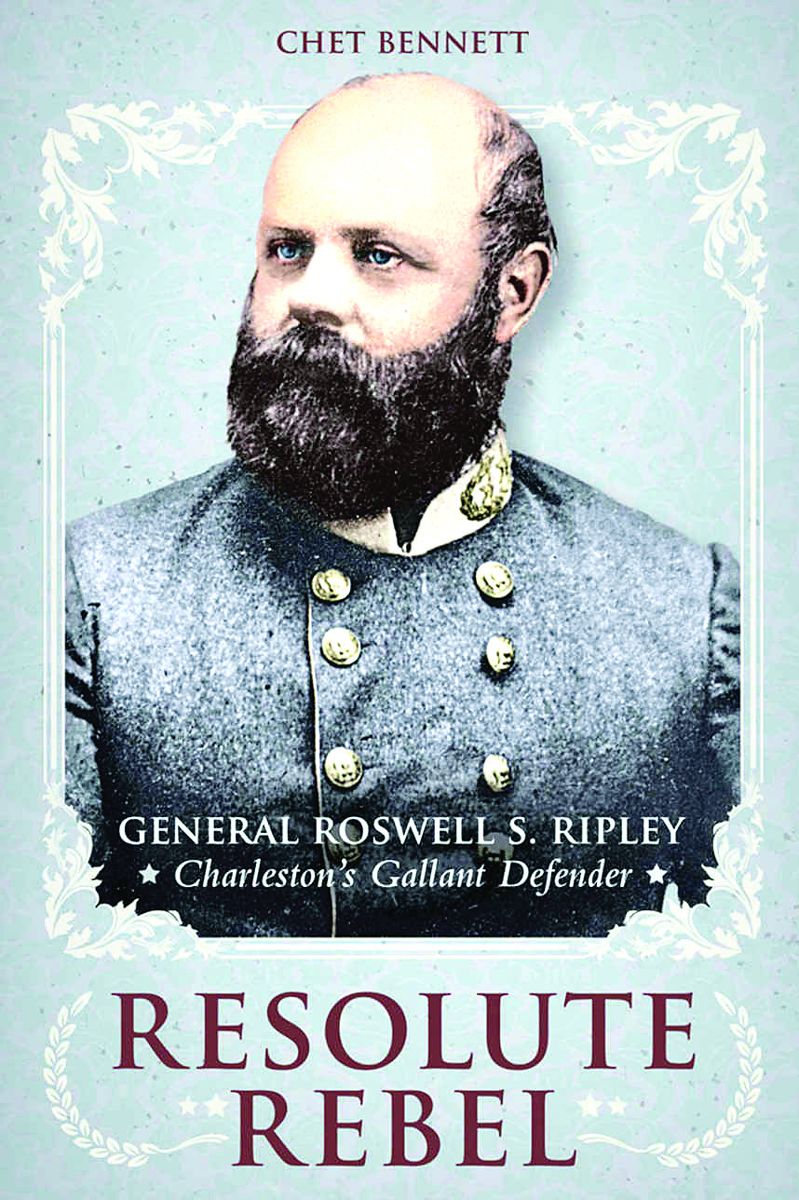
A Yankee Who Wore the Gray An Author Who Really Resolute Rebel: General Roswell S. Ripley, Charleston’s Gallant Defender. By Chet Bennett. Illustrations, maps, notes, bibliography, index, 421 pp., 2017, University of South Carolina Press, www.uscpress.com, $49.99 hardcover. Reviewed by Richard S. Hatcher III
Many general officers played an important role in the war, but most remain unknown. Over the past couple of decades, a number of these leaders have received attention with publication of their biographies. These include both familiar and unfamiliar names, like Jefferson C. Davis, Nathan G. “Shanks” Evans, Robert F. Hoke, Richard S. Ewell, Wade Hampton, and Samuel W. Crawford. Joining this area of study is Chet Bennett’s Resolute Rebel, General Roswell S. Ripley: Charleston’s Gallant Defender. Born in Ohio and raised in New York, Roswell Ripley was a West Pointer and graduated in the same class with U.S. Grant. He was assigned to the artillery and served at numerous peacetime posts, including West Point as an assistant professor of mathematics. Ripley saw service in the Mexican and Seminole Wars, earning brevet promotion to major in the former. Up to this point his military career was much like those of fellow officers, but two events in Ripley’s pre-Civil War years stand out. He authored a work, The History of the Mexican War, which was published in 1849, the first book on the subject, and then while posted at Ft. Moultrie, Ripley married Charleston widow Alicia Middleton and resigned his commission. To support his family, he became an arms dealer for the Sharps Rifle Manufacturing Co. As South Carolina moved toward secession, Ripley was a major in the South Carolina
Artillery Battalion and by April 1861 was its lieutenant colonel. Stationed at Ft. Moultrie, he commanded the artillery on Sullivan’s Island and directed the guns that fired on Ft. Sumter on April 12 and 13, 1861. The Yankee became the first Confederate commanding officer of Sumter upon its surrender on April 14, 1861. Promoted to brigadier general in August 1861, after service on South Carolina’s coast he commanded an infantry brigade in the Army of Northern Virginia from the Seven Days until seriously wounded in the neck at Sharpsburg. Ripley recovered, though the bullet remained lodged in his neck, and returned to serve in Charleston’s defenses. There he played a role from the “Ironclad Attack” of April 7, 1863, through the 1863–65 Siege of Charleston. Upon war’s end, the general and his family traveled to London, England. There, Ripley attempted unsuccessfully to establish a career and support his family. He returned to the U.S. in 1884, fifteen years after separating from his wife and resided in New York City where financial problems plagued him until his death in 1887. He is buried in Charleston’s Magnolia Cemetery. It is clear that the prodigious amount of research and time Dr. Bennett invested in Resolute Rebel has revealed much about an officer who until now languished in obscurity. His quest for information about Ripley’s life led him across the U.S. and to England and Scotland—work leading to a good biographical study. And though the depth of material is readily evident throughout the book, as is his favorable view of the general, there are some areas of this otherwise worthy biographical study that raise questions, some historical and some reference. Bennett fails to address problems associated with the largest and most expensive guns that served in the defense of the Confederacy, two 12.75-inch Blakely rifles. They arrived through the blockade in August 1863, and in September one was mounted in Charleston’s White Point Garden in Battery Ramsay. This was within the 1st Military District, commanded by Ripley. Operation of the 60,000-pound gun was complicated and its manual did not arrive with the giant. Despite this, experimental firing of the gun was ordered and the first round seriously damaged the breech, producing multiple cracks which were impossible to fully repair. Much of the blame for this error was directed toward Ripley. Adj. Gen. Samuel Cooper wrote, “The destruction of this formidable gun was due to a want of forethought, unpardonable in an officer as experienced as General Ripley.” Unfortunately, Bennett misses the opportunity to discuss this serious incident and only mentions it as an aside in a single paragraph which addresses other guns that burst and issues with artillery fuses. Another issue involves Ripley’s status after the war. Upon the Confederacy’s defeat, Pres. Andrew Johnson issued his May 1865 amnesty proclamation. It required many ex-Confederates, including West Point graduates and those with the army rank of colonel or higher, to apply for a pardon; Ripley met both of these requirements. In August, he made his first attempt to go to England via Charleston and New York but was unsuccessful. It was not until the spring of 1866 that he arrived in London. Thousands of former Confederates made this request before the amnesty period ended in 1868. Was Ripley able to make the journey without petitioning the president for amnesty and/or procuring a passport? If so, how was it accomplished? This is an important element of the ex-general’s story which deserves attention, but Bennett does not discuss it. Another area of concern appears several times in the text when Bennett uses an excerpt from one of his many sources. In several incidents, he uses the contributor’s full name and with others, only a last name. Unfortunately, he does not cite in the text if they are Ripley’s contemporaries or modern or current writers when quoting them. It might leave less knowledgeable readers wondering if these are primary or secondary quotes. Despite these issues, Resolute Rebel is a good addition to the study of a lesser known but important general officer of the Confederate army. It not only provides insight into four years of operations in Charleston between April of 1861 and the end of the war, but also the postwar life of a Confederate expatriate. Richard (Rick) W. Hatcher III is the retired Historian of Fort Sumter National Monument. During his National Park Service career, he also worked at Richmond National Battlefield Park and Wilson’s Creek National Battlefield. Rick is the author of several articles, co-author of two books and is currently working on a history of Fort Sumter. He operates Richard Hatcher Research and Tours, LLC in Charleston.
Did His Homework Six Days in September: A Novel of Lee’s Army in Maryland, 1862. By Alexander B. Rossino. Maps, 310 pp., 2017. Savas Beatie, www.savasbeatie. com. $22.95 paperback. Reviewed by John Michael Priest
Far too often historical novels lean very heavily on fiction at the cost of historical accuracy, which is why I generally avoid reviewing them. Six Days in September, however comes with the endorsements of Thomas G. Clemens, D. Scott Hartwig, and, now, mine. Mr. Rossino has successfully made the daunting transition from historian to historical novelist. He has not written the stereotypical Civil War novel. No southern belles in their flowing white dresses, no lecherous preachers with “white trash” daughters, no “heroic” deaths and famous last words. For once, I felt I was reading a no-nonsense, down-toearth accurate portrayal of everyday men and women caught up in the cauldron of war. If anything, Rossino, whether he is describing Robert E. Lee’s frustration with J.E.B. Stuart (for not keeping him advised of the Federal Army’s whereabouts during the South Mountain battles) or an enlisted man in the 6th Alabama thinking about his wife and remembering the loss of a friend earlier in the war, pulls the reader into the heart of the narrative to experience the campaign on an intimate level. As an historian who writes about the war from the perspectives of the front line soldiers, I felt like I was in the ranks with them. Rossino further impressed me with his meticulous attention to the terrain, the uniforms, and the details of the campaign. I enjoyed reading an author who really did his homework. The author frankly and unapologetically portrays slaves and slavery and the attitudes of their owners toward them. Devoid of preaching and moralizing, he allows the readers to form their own opinions about the “peculiar institution.” He treats death upon the battlefield the same way. No famous last words. It happens, often unnoticed in the dense smoke and the confusion, with no time for lamentation. What haunts me about the book the most is the perpetual thread of stark isolation which engulfs his characters, many of whom have to deal with personal struggles as well as military ones. Following their actions from one uncertain day to the next, knowing full well that they could basically do nothing to avert the inevitable tragedy which was engulfing them, pulled me from one brief chapter to the next. At the end, they felt drained because they knew that more battles were yet to come. Praised by Edwin C. Bearss as the “Ernie Pyle” of the Civil War soldier, retired high school teacher John Michael Priest, of Clear Spring Md., has been interested in Civil War history since an early age. He is a graduate of Loyola College in Baltimore and Hood College in Frederick, Md., and has written extensively about the War.
The Confederate States of America were in dire straits as 1864 was coming to a close. Three and a half years of unrelenting warfare had depleted the South of its military-age, white male population. If the Confederacy was to win its war for independence, it was imperative that the South produce more soldiers for its ever-dwindling armies. To address this need, Confederate President Jefferson Davis proposed that black slaves be armed and sent into the trenches on the South’s behalf, a notion that was unthinkable when the war commenced. The Confederate armies had previously utilized black slaves in the war effort. Their roles, however, had been limited to personal servants, camp cooks, teamsters, or heavy manual laborers in digging trenches and building fortifications. The notion of putting armed black men in gray uniforms was not considered. Author Philip D. Dillard points out that Davis’s new perspective did not develop overnight, but was the result of a slow evolution through 1863 and 1864 amongst Confederate political and military leaders as to what it now meant to be a Southerner. Was slavery’s preservation or
Confederate independence the primary war aim? Davis’s “final campaign” seeking approval to arm slaves began with his annual address to the Confederate Congress on November 7, 1864. His chosen battlefield was within the hearts and minds of the Southern people. Davis urged both Congress and the people to reexamine their commitment to slavery in light of the Confederacy’s rapidly deteriorating military situation. This crucial issue gained momentum with the military disasters at Nashville and Savannah in December 1864, coupled with the failure of the February 1865 Hampton Roads peace conference. From Davis’s perspective, sacrificing slavery by utilizing black men as armed soldiers was preferable to military defeat and a forced reunification with the hated Yankees. Davis faced ample opposition against his plan. The Confederacy’s vice-president, Alexander Stephens, had laid the groundwork for Davis’s opponents in his infamous 1861 “Cornerstone Speech” when he proclaimed that the South’s entire social, political, and economic model rested upon the conviction that the African slave was innately inferior to the white man. Gen. Clement Stevens of South Carolina had echoed the vice-president and spoke for those against abolishing slavery when he wrote, “The justification of slavery is the inferiority of the Negro. If we make him a soldier we concede the whole question.” Another of Davis’s harsh critics was the Richmond Enquirer, which opined, “If a negro is fit to be a soldier he is not fit to be a slave, and if any large portion of the race is fit for free labour… then the whole race is fit for it.” The Confederacy’s plan to emancipate and arm its slaves is a topic that scholars have previously explored, starting with Bell Irvin Wiley’s 1938 work titled Southern Negroes 1861– 1865. More recent studies are Robert Durden’s The Gray and the Black: The Confederate Debate on Emancipation (1972) and Bruce Levine’s Confederate Emancipation: Southern Plans to Free and Arm Slaves during the Civil War (2006). Durden primarily focused on the political views expressed within the Confederacy’s capital at Richmond, while Levine focused on the beliefs of political and economic elites, who, Levine argues, were not transformed against slavery by the war’s hardships. Instead of reexamining the slavocracy, Dillard’s new work builds upon this prior scholarship by focusing on the views of the non-slaveholding, common men and women in Texas, Virginia, and Georgia, thus offering the differing perspectives of those in the trans-Mississippi theater, the primary seat of war in Virginia, and the Deep South. The author shows that it was this November 1864-March 1865 time-frame when these average Confederate citizens publicly debated the role of slaves in the war effort via newspaper editorials and letters to the editor, as well as privately within their personal letters and diaries. From those primary sources, the author illustrates what these average Southerners hoped to gain from the war, be it independence or slavery’s preservation. Dillard concludes that, without question, the average Southern citizen believed the slaves should be armed if that ultimately meant Southern independence. Moreover, the strength of that conviction was in direct proportion to the Union army’s proximity to their homes and farms. Many Southern citizens, rich and poor, thumped their chests when word of Fort Sumter reached their homes in April 1861. In a matter of weeks, they thought, the war would be over, since one Southern man could easily whip a half-dozen Yankees. Meanwhile, the South’s slaves would continue to work the fields, happy and content. The idea that these purportedly inferior human beings might gain symbolic equality with the white race by being given a musket and placed in a trench alongside a white soldier was at that time considered laughable and outlandish. In this compelling new work, Philip Dillard shows us how the approaching sounds of Yankee artillery and muskets slowly but surely changed their perspective. Paul Taylor is an award-winning author of numerous books pertaining to the Civil War era. His next book is titled “The Most Complete Political Machine Ever Known”: The North’s Union Leagues in the American Civil War, to be published by Kent State University Press in early 2018.
A Classic Tale from Texas Historiography A Southern Community in Crisis: Harrison County, Texas, 1850—1880. By Randolph B. Campbell. Tables, illustrations, maps, index, 443 pp., 2016, Texas State Historical Association, www.tshaonline.org, $35 paperback. Reviewed by Kenneth W. Howell
In the early 1990s, I was working on my M.A. degree at Texas A&M University—Commerce. I wrote my thesis on the early history of Henderson County, Texas, covering the years 1845 to 1861. During the early stages of research, I examined numerous histories of other East Texas counties, trying to formulate ideas about the region during the antebellum era. Of all the studies that I reviewed, one of the best publications was A Southern Community in Crisis: Harrison County, Texas, 1850–1880 by Randolph B. Campbell, Regent’s Professor of History at the University of North Texas. Originally published in 1983, Campbell’s work was an extraordinary examination of the people of Harrison County and their experiences during three of the most turbulent decades in Texas history. In this work, the author masterfully combines the use of quantitative methodology with new trends in social and political history that emerged in the 1970s and 1980s to produce a groundbreaking study, which examines the lives of both elites and average citizens living in Harrison County. Though my M.A. thesis pales in comparison to A Southern Community in Crisis, Campbell’s publication served as an inspiration and as a model for my own work at the time. Now, more than thirty years later, the Texas State Historical Association has reprinted the book, so that future generations of scholars and students can add this seminal contribution to Texas historiography to their personal library. While some will find it disappointing that the work is not an updated version of the original publication, most, who do not already possess a copy, will rejoice that the publication is available in a paperback edition. Still present in this volume are Campbell’s clear and precise arguments that examine the views of East Texans at the local level on such issues as secession, civil war, emancipation, the Union triumph in 1865, and the trials and tribulations of the Reconstruction years. Aside from a few brief comments in the author’s updated preface, readers will probably glean more regarding the significance of this work in the new foreword written by Andrew J. Torget, Associate Professor of History at the University of North Texas. Professor Torget does an excellent job of placing Campbell’s work within its proper place in Texas historiography. In three succinct pages, Torget manages to capture the essence of A Southern Community in Crisis, concluding that “for all that came after it [this publication] remains essential reading for anyone who wants to understand life in Texas during the coming, fighting, and aftermath of the Civil War … . Few academic volumes remain timely and relevant more than thirty years … . This is one of those exceptional books.” I could not agree more, and might add that this work deserves a place on the shelf of any serious student of Civil War Texas. Kenneth W. Howell is a Professor of History at Blinn College—Bryan Campus. He is the author, coauthor, and editor of several books and articles on Texas history, including Henderson County, Texas, 1846-1861: An Antebellum History (1999), The Devil’s Triangle: Ben Bickerstaff, Northeast Texans, and the War of Reconstruction in Texas (2007), Texas Confederate, Reconstruction Governor: James Webb Throckmorton (2008); Seventh Star of the Confederacy (2009), Still the Arena of Civil War: Violence and Turmoil in Reconstruction Texas, 1865-1874 (2012), and Single Star of the West: The Republic of Texas, 1836–1845 (2017). Professor Howell is currently working on a biography of Gen. Phil Sheridan, focusing on his career during the Reconstruction era.
Publisher’s Note: Ted Savas showed so much enthusiasm for this book that we accepted his book review in addition to Richard Hatcher III’s review on page 31. Resolute Rebel: General Roswell S. Ripley, Charleston’s Gallant Defender. By Chet Bennett. Maps, photos, illustrations, end notes, bibliography, index, 440 pp., 2017. University of South Carolina Press, www.uscpress.com. $49.99 cloth. Reviewed by Theodore P. Savas
Let me admit up front I have always had something of a soft spot for Roswell Ripley. It comes not from his battlefield prowess (which was less than stellar) or any other particular attribute I can put my finger on. Rather, I became familiar with his name during my formative reading years as a teenager and so associate it with the formative months of the Army of Northern Virginia. Historians don’t think much of the man as a general, though most of what we know of Ripley comes to us in dribs and drabs—a few sentences here, a footnote there. This paucity of information ended with the publication of Bennett’s outstanding Resolute Rebel. Roswell Ripley was born in Ohio in 1823, but his family moved to New York and he was appointed to West Point from that state. He was an excellent student, ranked 7th out of 39 cadets when he graduated in 1843, and his future held great promise. Many in the Class of 1843 would rise to prominent positions during the Civil War, including Ulysses S. Grant and William Rosecrans. Roswell would not be among them. Ripley’s Mexican War service offered the young officer a unique opportunity that would ricochet like an errant shot to injure him years later in ways he could have never foreseen. He served as a staff officer for Zachary Taylor and Winfield Scott, participated in many battles, and received two brevets to end the war a major. For those interested in trivia and relationship ripples, Ripley penned The War with Mexico (1849), a two-volume comprehensive account that remains the only one penned by a participant. Some of his fellow officers took umbrage with its pro-Democrat (anti-Whig) slant, and may also have been jealous at his ability to finagle a long leave of absence to write a book almost certain to further his professional career. According to Bennett, Daniel H. Hill didn’t like how Ripley portrayed General Scott, and held a life-long grudge against the Ohioan that would spill over into the Civil War.
Tone-deaf as to how his actions would be perceived by others, Ripley spent much of the balance of his antebellum career making demands for additional leave for personal matters. The manner in which he resigned in 1853 left a bad taste in the mouth of Adjutant General Samuel Cooper, who years later as the highest-ranking Confederate paper-pushing general would be in a position to settle the score with his pen. Ripley was serving at Fort Moultrie when he married local Charleston widow Alicia Sparks, resigned from the U.S. Army, and embarked on a business career. When South Carolina seceded, Ripley volunteered his services to the state and was appointed a major of ordnance. Most of his service was spent defending Charleston harbor, where he put his outstanding skills as an artillerist and engineer to good use. Ripley worked closely with General P.G.T. Beauregard, who thought highly of him and praised his efforts. During the bombardment of Fort Sumter, Ripley led his men “in his shirtsleeves working the guns himself.” Four months passed without a well-deserved promotion until August 15, when he was finally elevated to brigadier general in the Confederate Army. Though talented and generally affable, Ripley was independent-minded and occasionally sharp of tongue (though not in the league of D.H. Hill). His subordinates liked him; some of his superiors less so. When Ripley rebuked South Carolina’s governor Pickens for his irksome micromanagement, the governor kicked the matter upstairs to President Davis and alleged that Ripley despised department commander Robert E. Lee and was saying unkind things to junior officers “well-calculated to do great injury to General Lee’s command.” Lee, however, was generally pleased with Ripley. Douglas Freeman’s handling of this matter has influenced how history judges Ripley. The legendary biographer embellished the affair, claiming Ripley “took a violent dislike for Lee,” who developed a “contemptuous dislike” for Ripley. According to the author, there is no evidence to support any such thing. Ripley was ordered to Virginia in the spring of 1862 to take command of a brigade of infantry, which he led under Lee during the inaugural weeks of the Army of Northern Virginia. Unfortunately for Ripley, his division commander was D.H. Hill. Ripley attacked with his brigade and was bloodily repulsed at Beaver Dam Creek in the Seven Days’ Battles, for which he was criticized
by Hill, who had ordered him to make it. Author Clifford Dowdey, of the same school as Freeman, heaped contempt upon Ripley that appears unjust. This, too, has colored our view of the brigadier. Ripley is often accused of mishandling his brigade on South Mountain, which author Bennett agrees was the case. Still, there is no evidence, as Hill and others claimed, that he did so deliberately to avoid personal exposure. Three days later at Sharpsburg Ripley was in the middle of the action, advancing his brigade across the Mumma farm when he “received a severe wound in the throat, which would have proved fatal but for passing through his cravat.” The brigadier had his throat bandaged and returned to his command with the bullet still in his neck. Ripley’s four-month stint with the Virginia army was at an end. He requested a return to Charleston to serve under Beauregard (though the two would later have a falling-out), and spent most of the rest of the war there in the complicated (and successful) defense of the city. The remainder of the book (nearly 100 pages) deals with Ripley’s unhappy postwar life. The Ohioan traveled to England to leverage his knowledge of armaments, went bankrupt, was left by his wife, and became estranged from his daughter. His writings offered one of the few bright spots of this time in his life. The former general’s health deteriorated and he died of a stroke in 1887. He was buried with honors in Charleston, fondly memorialized by the citizens he helped defend and those who had served with him. Bennett’s Resolute Rebel is a well-written biography that adds substantial flesh to the biographical skeleton that was Ripley. Given all the obvious effort that went into this study, however, the research and presentation are a mixed bag. The maps are barely adequate. Bennett’s handling of Ripley’s Civil War service in Charleston is much more detailed than his time with Lee’s army, but 1861–1865 is thinly researched and the majority of the citations are to the Official Records and a handful of secondary sources. His Antietam coverage is a mere two pages with but little context, and many sources (including the Ezra Carman papers and his now-published three-volume study) were not consulted. Ripley’s postwar years (which are fascinating) are on a more solid archival foundation that includes extensive research in England. Curiously, though there is a colorized image on the jacket, there is not a single photo of Ripley in this study. The oversight is eyebrow-raising for a biography, especially since images of the man abound. Ripley’s contributions to the Confederacy were more extensive than most believe, and the general has long merited a good full-length biography. If Confederate generals and the defense of Charleston are in your wheelhouse, Resolute Rebel deserves to be on your bookshelf. At nearly $50, however, the book seems destined for a much smaller audience, which is a shame because it deserves to be owned and read. Theodore P. Savas is the owner and managing director of Savas Beatie Publishing. The recovering attorney and widely published author appreciates red wine, good cigars, expensive gin, wreck diving, and Mozart. A classically trained pianist, he plays bass (Rickenbacker only) in the hard rock band Arminius. Ted lives in El Dorado Hills, California.
Vignettes about Horses Another Look at Civil War Charleston and their Riders Horses in Gray: Famous Confederate Warhorses. By J.D.R. Hawkins. Photos, notes, index, 208 pp., 2017. Pelican Publishing Company, www.pelicanpub.com. $27.95 softcover. Reviewed by Gould Hagler
Horses in Gray is the first nonfiction book by J.D.R. Hawkins. Her other works include an award-winning series of historical novels and numerous articles. The title of Hawkins’ first effort in nonfiction is something of a misnomer. Relatively little is written about the famous warhorses, while greater space is devoted to their famous riders. As the horses belonging to Lee and Jackson have been written into history and folklore, the chapters on Traveller and Little Sorrel contain mini-equine biographies (and for Traveller some genealogy as well). However, for the mounts who carried others into battle – Forrest, Stuart, Mosby, Turner Ashby, and a few others – we get little more than their names. Most chapters are brief summaries of the military careers of these Confederate generals, with a four-legged companion appearing from time to time as it makes a spectacular leap over a wide ditch, gets shot out from under its rider or demonstrates a special attachment to its human partner.
The book is thoroughly researched, well written and carefully documented. The author has consulted numerous Civil War histories and biographies, memoirs and other primary sources, magazine articles and some online publications, gleaning from them the numerous anecdotes which she strings together into accounts of the lives and wartime exploits of the horse-borne commanders. We are also treated to a brief chapter on camels. Some ended up in circuses; others were eaten by Comanches. One characteristic of the book disappointed this reviewer: it relies on many quotes from secondary sources to relay the exploits of the human and equine Confederates. The author is a skillful writer. Perhaps she could have conveyed more of the story in her own words and in her own style. The best part of the book is the very first chapter, “Life as a Confederate Horse.” This life for most was a very grim one. While the Tom Telegraphs and the My Marylands who carried the Turner Ashbys and the Jeb Stuarts got the headlines, the thousands and thousands of workaday horses and mules were akin to the private soldiers who marched and starved, clashed in battle and died anonymous, agonizing deaths. Their last moments on earth were like the soldiers’ end in the famous ballad. The battle it raged on, though dead and dying men Lay thick all o’er the ground, on the hill and on the glen; And from their deadly wounds, the blood ran like a rill; Such were the mournful sights that I saw on Shiloh Hill. Gould Hagler is the author of Georgia’s Confederate Monuments: In Honor of a Fallen Nation (Mercer University Press, 2014). He will be a featured speaker in CWN’s First Annual Symposium on the War to be held in Dalton, Ga., this coming February 3.
Days of Destruction: Augustine Thomas Smythe and the Civil War Siege of Charleston. Edited by W. Eric Emerson and Karen Stokes. Photos, notes, index, bibliography, 200 pp., 2017. University of South Carolina Press, www.uscpress.com, $29.99 cloth. Reviewed by Salvatore Cilella
A very welcome spate of scholarly works on Charleston and the Civil War has emerged in the past few years that bear notice. They include, but are not limited to Joseph Kelly’s America’s Longest Siege: Charleston, Slavery and the Slow March Toward Civil War, published in 2013 by Overlook Press, and Paul Starobin’s Madness Rules the Hour: Charleston, 1860 and the Mania for War (Public Affairs, 2017). While Starobin and Kelly admirably detail Charleston’s role in South Carolina’s mad slide into secession, Emerson and Stokes’ Days of Destruction puts a human face on the devastation wrought by Southern fire-eaters. Charleston acquired its nickname as the “Holy City” for its myriad of churches. And one church figures prominently in Augustine Smythe’s letters of wartime Charleston. As the war escalated and Charleston became more dangerous, Smythe’s family moved north to Summerton, S.C. Augustine stayed behind and joined the Washington Light Infantry, with which he was introduced to the hell of combat at the battle of Secessionville in the summer of 1862. At the southern end of the Confederate line defending Charleston on James Island, 3,000 Confederates met more than 6,000 Federal troops bent on taking Charleston. Although a minor engagement, a Confederate victory produced increased morale in the city and marked the end of the Union’s attempt to assault Charleston by land and brought about the new Union strategy. The resultant 567-day bombardment of the city gave Augustine Smythe a unique “view” of the war. He was assigned to the Confederate Signal Corps. And therein he began one of the most unusual tours of duty imaginable. His duty stations included a stint in a land operation to capture the USS Isaac P. Smith in 1863 and a period aboard the ironclad Palmetto State as it supported Rebel forces at Fort Sumter, Fort Moultrie and Morris Island. Although he performed these various duties, his most unusual assignment was as lookout in the steeple of St. Michael’s Church. The Episcopal Church, built in the 1760’s, is the oldest building in Charleston and stands at the corner of Meeting Street at 71 Broad Street. Smythe’s home was at 12 Meeting Street; his uncle lived down the street at 31 Meeting. From his post high above Charleston’s battered streets, Augustine was able to view the gradual destruction of his native city. This book, a collection of his letters to his family, marks an eighteen-month journey of his duty “South of Broad” street— through his neighborhood. His most intriguing observations concern the daily damage done by the Federal bombardment of the city. At times, Smythe would venture out from his bird’s eye perch and survey the damage. In excruciating detail, he described the damage done to his family’s and neighbors’ homes and shops. Augustine recounted how terrifying the nighttime shelling was. Writing his mother on Dec. 11, 1863, he lamented the “horrible…shelling [of] the city at night…[and the]…pauses between as if to catch unawares, when they [the Yankees] know that there are women & children in the city.”
This is Emerson and Stokes’ third collaboration on a documentary edition of Civil War letters published by the University of South Carolina Press. This remarkable collection is housed at the College of Charleston. Thanks to Augustine’s descendants these documents are accessible in their original form or in this modest, but poignant transcription. Thousands of books and millions of words have been published about America’s great 19th century tragedy—many written even before it ended. To hear or read the words of those who witnessed, suffered, and survived the war adds an important dimension to our understanding of the great conflict. Thanks to works such as this (and the internet, I might add), scholars and researchers have a much easier job. As one who is an ardent advocate of primary sources, I say keep them coming.
Salvatore Cilella is the retired CEO of the Atlanta History Center. He is the author of Upton’s Regulars (Univ. of Kansas Press, 2009) and editor of The Correspondence of General Emory Upton, University of Tennessee Press, two volumes which have just been published. He will be a featured speaker in CWN’s First Annual Symposium on the War to be held in Dalton, Georgia, this coming February 3.
A Union Cavalryman in a Famous Cavalry Regiment The Better Part of Valor: Albert Drury and His 1st Vermont Cavalry at Gettysburg, the Shenandoah Valley and Beyond During the Civil War. Edited by Cameron Davis. Photos, maps, footnotes, index, 219 pp., 2017. Privately published, www. genoir.com. $19.95 softcover. Reviewed by Robert L. Durham
The 1st Vermont Cavalry was a premier Union cavalry regiment, fighting in seventy-five engagements and many skirmishes. Al Drury served with the 1st, in Company L, from 28 August
1862 until the end of the war. This volume consists of Drury’s diary, kept during Al’s entire service time. He also kept a notebook from the beginning of his service through May 1864. There are also several letters that give a whole lot more information than either the diary or the notebook. The diary, at the beginning, has details that Drury later expanded upon in his notebook. Some of the diary entries are short and repetitious, for example: “In Camp. Cold.” This is repeated, in various forms, several times in one page. This is no worse than many other diaries I’ve read, though. If the reader wants examples of daily soldiering life, the diary entries will give a good taste of the boredom, the discomfort and the occasional excitement. One of the best portions of this volume, in my opinion, are Drury’s descriptions of Farnsworth’s charge at Gettysburg. They are stirring and present personal details not found elsewhere. For those with a special interest in the role of the 1st Vermont at Gettysburg, this and Drury’s description of the pursuit of the Confederate army after the battle may alone be worth the price of the book. There is a history of the 1st Vermont Cavalry by Horace
Knight Ide, who spent most of his time in Company D, finally rising to command the company. Ide’s account concentrates mainly on the actions of his company. Drury’s portrayal of the exploits of Company L, when used in conjunction with Ide’s version, provides a wellrounded interpretation of the achievements of an exceptional cavalry regiment. Sadly, during some of the most exhilarating times in the regiment’s service, General Philip Sheridan’s campaigns in the Shenandoah Valley and at Appomattox Court House, Drury had no time to keep a detailed record. It is during this period that his diary records lose most descriptive comments; they are mostly bare-bone entries. For those who like first person accounts or who have a special interest in the exploits of the Civil War Green Mountain Boys, this is an interesting volume. I enjoyed it a lot and will be adding it to my personal book shelf. Robert L. Durham of Centerville, Ohio has been a devoted Civil War buff for many years. He has written articles for publication in various magazines as well as internet blogs.