
The Confederate ‘Wizard of the Saddle’ Loses His Statue in Memphis
By Stephen Davis · Originally published February 2018 · pp. 1–4
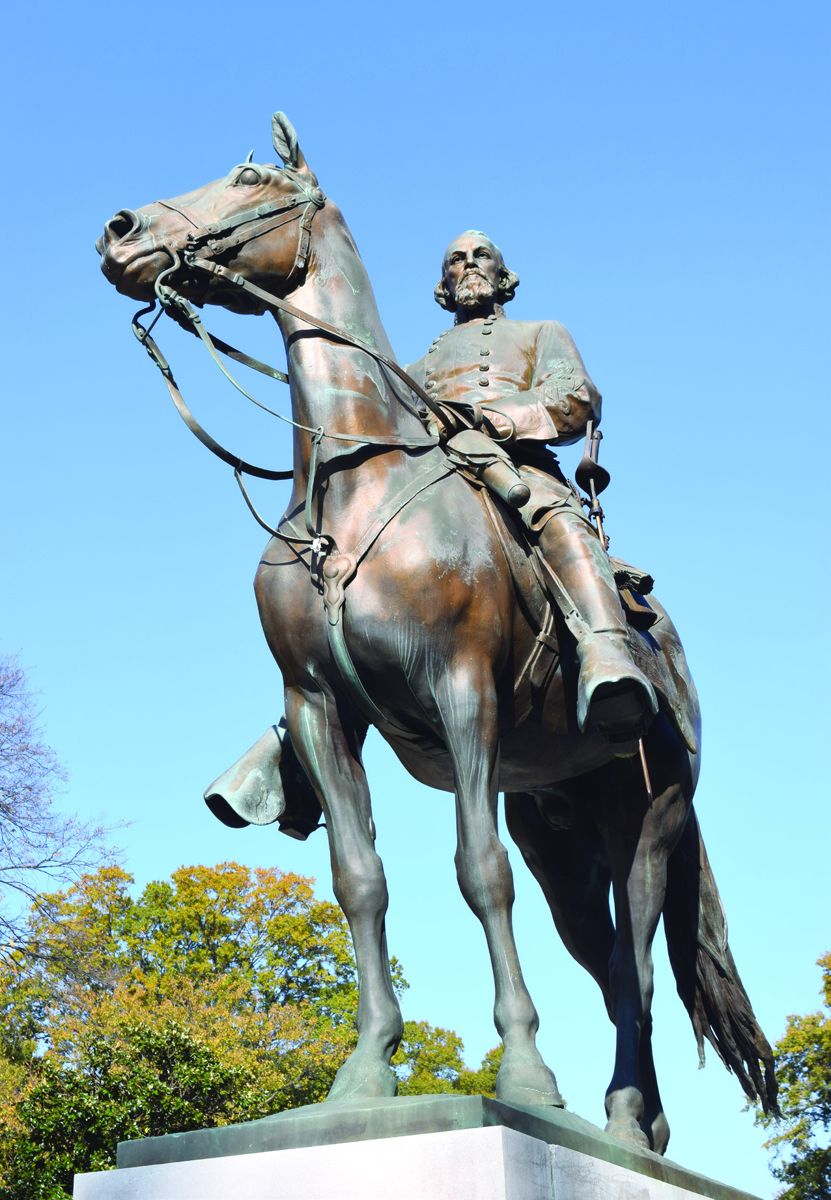
Robert E. Lee commanded the Army of Northern Virginia. Jefferson Davis served as the Confederacy’s only president. Thomas J. Jackson earned the distinctive nickname of “Stonewall.” Nathan B. Forrest commanded Southern cavalry in the Civil War’s western theater. Different men, different paths to historical fame, but they have one thing in common. They all have memorial statues that have been removed from public parks in Southern cities. The recent removal of Forrest’s statue from a Memphis park leads to this reconsideration of the famous Tennessean’s life and legacy.
Antebellum Planter and Slave Trader The man who would become one of the Confederacy’s most famous generals was born in middle Tennessee on July 13, 1821. His father, William Forrest, was a country blacksmith who relocated the family to north Mississippi. Bedford, as he was called (Nathan was his grandfather’s name) was thirteen. When William died in 1837, young Bedford, still a teen, became head of the family—his mother, five brothers and three sisters. There was not much time for education. Bedford probably had only a few months of formal schooling in Tennessee, and not more than that in Mississippi. Working the family’s small farm, he got his own education, “using the wilderness and frontier life as his teacher,” in the words of Brian Steel Wills, the general’s biographer. At the age of 21 he struck out on his own, about the time that his mother remarried. Moving to Hernando, Miss., he joined his uncle’s livestock and livery-stable business, working hard and earning a living. He got married in September 1845, began raising a family, and with them moved to Memphis in the spring of 1852. Soon Forrest started buying real estate and established a business of buying and selling slaves. He made a lot of money in the latter calling. Jack Hurst, another biographer, has estimated Forrest’s annual income in the late 1850’s from the sale of a thousand enslaved African-Americans to be at least $96,000, “a fabulous income.” “It is said Forrest was kind to his negroes; that he never separated members of a family,” wrote Lafcadio Hearn, the noted journalist years after the Civil War. Hurst is openly skeptical of this and other attestations to the slave trader’s “kindness”: “to be successful,” he writes, “a slave trader had to be known as humane.” In his landmark study, Slave Trading in the Old South (1931), Frederic Bancroft asserted, “when traders prospered, were honest, thrifty, and bought plantations, like Forrest…and many others, they enjoyed the essentials of respectability.”
This respectability as a prosperous Memphis businessman led to Forrest’s election as city alderman in 1858 and re-election in 1859. That year, however, he resigned from office, sold his slave business in Memphis, and began raising cotton on a 3,000-acre plantation in Coahoma County, Miss. He bought more land and slaves, and by the time of the war had become a wealthy Southern planter.
Raises a Cavalry Battalion
Tennessee seceded on June 8, 1861, two months after the Confederates’ firing on Fort Sumter. Forrest volunteered six days later as a private in a company of Tennessee mounted rifles. “Forrest did not remain a private long,” the noted historian Ed Bearss has written. According to Confederate Brig. Gen. James R. Chalmers, who rode with Forrest during the war, Tennessee governor Isham G. Harris knew Bedford well and summoned him to Memphis to raise a battalion of mounted troops. Forrest set out to buy arms and equipment with his own money, and advertised for volunteers. By early October, the battalion of eight companies had been raised and organized; Forrest was logically elected its lieutenant colonel. A few weeks later he and his battalion were sent to Fort Donelson, on the Cumberland River near the Kentucky border. Two more companies were added to Forrest’s battalion, bringing his command to regimental size (the 3rd Tennessee Cavalry), though its commander remained a lieutenant colonel. In February 1862, Union Brig. Gen. Ulysses Grant’s Army of the Tennessee advanced on Fort Donelson in conjunction with Northern gunboats. By the 12th the Confederate garrison under Brig.
removal. (John C . Spaziani) Gen. John B. Floyd was hemmed in; a Southern effort to break out failed on February 15. Floyd’s officers met and decided to surrender. Forrest, in charge of his regiment and several hundred other troopers, refused to give up and that night led his men out through enemy lines. The remaining garrison troops were surrendered to Grant the next day. Regimental reorganization in mid-March led to Forrest’s election as colonel. Several weeks later, following the Confederate defeat in the battle of Shiloh, Gen. P.G.T. Beauregard put Forrest in charge of his retreating army’s rearguard. Three months later, he was put in command of a mounted brigade, some 1,400 men. He led them against a Federal garrison at Murfreesboro, Tenn., on July 13. His threat to “have every man put to the sword” scared the Union commander into surrendering his garrison: 1,200 officers and men, a quarter-million dollars’ worth of arms, equipment, and wagons, plus four field pieces. A week later he was promoted to brigadier general; his brigade was assigned to Gen. Leonidas Polk’s corps as Braxton Bragg marched north in August toward Kentucky. General Bragg, however, considered Forrest adept only at partisan activity. On Sept. 25 he relieved Forrest of duty with the army, and sent him back to Middle Tennessee to recruit new regiments for raiding operations there. Two months later Bragg named Joseph Wheeler, not Forrest, as commander of cavalry in the Army of Tennessee. Forrest raised a new command and led it in what historians call his “first West Tennessee campaign.” In December 1862, Forrest’s cavalry wrecked the Mobile & Ohio Railroad so thoroughly, in conjunction with Earl Van Dorn’s capture of the Union base at Holly Springs, Miss., that Grant was forced to give up his advance into Mississippi, and actually retreat for want of supplies. This was one of the few times that a cavalry raid of either side actually achieved a grand tactical result.
Toward Fort Pillow In the spring of 1863, Forrest’s brigade participated in the March 5 fight at Thompson’s Station, Tenn., which led to the capture of 1,200 Federals. In late April Forrest led his command in pursuit of Col. Abel Streight’s cavalry raid through north Alabama. When the hard-riding Forrest finally ran down the exhausted Streight and forced his surrender west of Rome, Ga., Forrest had maybe 600 troopers. Streight surrendered almost 1,700. After the murder of Earl Van Dorn in May 1863, Forrest took over his command, half the cavalry in Bragg’s army. In this capacity he fought through Tullahoma to Chickamauga. After Bragg failed to follow up his victory over Rosecrans in that battle, Forrest objected to Bragg’s lethargy. Before long, on Oct. 5, he was ordered to turn over his troopers to Gen. Wheeler, chief of the army’s cavalry. Forrest characteristically blew up. Storming unannounced into Bragg’s tent, Forrest refused to shake his commander’s hand and launched into a tirade: You robbed me of my command in Kentucky…men whom I armed and equipped from the enemies of our country….You drove me into West Tennessee in the winter of 1862, with a second brigade I had organized, with improper arms and without sufficient ammunition…in spite of all this I returned well equipped by captures…and now this second brigade, organized and equipped without thanks to you or the government…you have taken from me. I have stood your meanness as long as I intend to. You have played the part of damned scoundrel, and if you were any part of a man I would slap your jaws and force you to resent it. You may as well not issue any orders to me, for I will not obey them, and I will hold you personally responsible for any further indignities you endeavor to inflict upon me ….if you ever again try to interfere with me or cross my path it will be at the peril of your life. Forrest turned heel and walked out. “Now you are in for it!” an officer remarked. “No,” Forrest replied. “He’ll never say a word about it.” Bragg didn’t. Indeed, two months later, Forrest was promoted to major general. Forrest was sent to north Mississippi to organize a new command. By the start of 1864, he had gathered some 3,500 men, many of whom belonged to scattered units in west Tennessee. These he formed into four brigades, for which Forrest scrounged to find arms and clothing. They were tested when a Federal force of 6,600 under Brig. Gen. William S. Smith set out from Memphis. Near Okolona, Miss., in a running fight, Feb. 21–22, Forrest, though outnumbered, attacked them so fiercely as to drive them from the field and send them packing back to Memphis. Forrest reported that, with a force of 2,500, he had defeated 7,000 Federals, capturing 162 prisoners and six pieces of artillery. In mid-March Forrest then led a raid into west Tennessee and Kentucky to gather “men, mounts and supplies,” in the words of Robert S. Henry, author of still one of the best Forrest narratives, published in 1944. The most famous episode of the raid occurred on April 12 at Fort Pillow, Tenn., overlooking the Mississippi River about forty miles north of Memphis. Forrest’s Civil War record—and reputation as a Confederate general—is inextricably linked to this event. Forrest’s force of 1,800 troopers attacked Pillow’s Union garrison, consisting of some 550 white Tennessee Unionist infantry and U.S. Colored Troops. Both groups were odious to Forrest’s men. So after the Confederates attacked and stormed the fort, there ensued unnecessary and deliberate killing of Federals, even as they attempted to surrender or run for safety down the river bank. Some 170 blacks and 80 whites were killed among Fort Pillow’s garrison. The Confederates took 226 prisoners: 168 were white, 58 black. As word spread of the “Fort Pillow massacre,” Northerners were enraged. Northern and Southern newspapers tussled over the facts; the U.S. Congress even held committee hearings. General Forrest, for his part, had to defend himself against accusations that he had ordered a massacre of the Negroes and “Tennessee Tories.” With a half-dozen books written about Fort Pillow in the last few decades, the conclusion of historian Albert Castel more than a half-century ago still stands: Forrest did not need to order a massacre at Fort Pillow—he knew his men, knew their hatred of the men in the Union garrison, and watched as they committed their “awful slaughter,” in the words of one Confederate.
No Peace in Tennessee William T. Sherman had a healthy respect for the Confederate cavalry leader, at one point in the war calling him “that devil Forrest.” As he launched his campaign against Atlanta in May 1864, Sherman worried that Forrest would raid into Tennessee and cut railroad lines that supplied his 100,000 men as they pushed into Georgia. Sherman consequently ordered Union forces to keep Forrest busy. One of these assignments fell on Brig. Gen. Samuel Sturgis, whom Sherman directed to “whip Forrest.” On June 1, Sturgis set out from Memphis with a column of 8,300 infantry and cavalry, plus twenty-two cannon. Forrest had only 3,200 troopers, but characteristically on June 10 at Brice’s Cross Roads he attacked, figuring he could whip the enemy cavalry before their infantry came up. It would be a hot day, and the foot soldiers would be blown and winded, reckoned Forrest, who fought that day in shirt sleeves, his general’s coat laid across his saddle pommel. The plan worked. Federal cavalry had been defeated and had withdrawn by 1 pm Forrest ordered his horsemen to charge the infantry—as usual, leading them himself. A member of the Seventh Tennessee Cavalry recalled, “our movement was too slow to suit Forrest, he would curse, then threaten to shoot us himself, if we were so afraid the Yanks might hit us.” Under assault, the Union infantry broke. Forrest ordered his men to “keep the skeer on ‘em” in their pursuit. As a result, by the time Sturgis’ column returned to Memphis three days later, Forrest could count 2,600 prisoners, sixteen cannon and thousands of weapons and ammunition rounds scooped up from the Federals’ retreat. Little wonder that General Sherman wrote in exasperation on June 15, “there will never be peace in Tennessee till Forrest is dead.” Forrest was part of Confederates’ “Third and Fourth Defense of Mississippi, July-August 1864,” as Professor Wills has termed the campaigns (their first and second had been Sooy Smith’s and Samuel Sturgis’). When Confederates could reclaim the initiative in August, Forrest rode straight into Memphis. The next month he raided northward again, capturing garrisons totaling over 2,300 men, burning blockhouses that guarded river bridges, and adding wagons, horses, and cannon to his command. In late October and early November, he again led mounted troops to the Tennessee River, shelling and capturing Union supply ships and several gunboats. On Nov. 4, at Johnsonville his artillery bombarded the Federals’ supply warehouses and river fleet, panicking them into burning steamboats, barges, and supplies worth an estimated $2,200,000. By Nov. 1864, when Confederate Gen John B. Hood launched his campaign into Tennessee, Forrest commanded the cavalry of Hood’s Army of Tennessee.
In this role, he fought Brig. Gen. James H. Wilson’s Federal cavalry in the army’s advance, and guarded the Confederate army’s retreat after Hood’s disastrous battle at Nashville in mid-December. Forrest was promoted to lieutenant general, March 2, 1865, in recognition of his contributions to the Confederate war effort. As the Confederacy collapsed in the spring of 1865, Forrest lacked the strength to counter the Federals’ final campaigns. One of his few battlefield defeats occurred on April 2 at Selma, Ala., as he tried to block the raid of Wilson’s cavalry, which was the largest mounted forced assembled during the war. He and his command surrendered on May 4, as part of Confederate Lt. Gen. Richard Taylor’s department. Edwin Bearss sums up Bedford Forrest’s personal wartime record: “He had had twenty-nine horses shot from under him, killed or seriously maimed at least thirty enemy soldiers, in hand-to-hand combat, and he himself suffered four wounds.”
Postwar Struggling Businessman and Klan Leader After the war, Forrest settled back into the challenge of making a living. He returned to his Coahoma County plantation, but soon had to sell it. He tried and failed as a Memphis cotton factor, and got behind a project to build a railroad linking Memphis with Little Rock. Other ventures failed, and Forrest was forced to declare bankruptcy in Feb. 1867. Forrest’s involvement in the early Ku Klux Klan deserves attention and explanation. In the spring of 1866, six ex-Confederate soldiers in Pulaski, Tenn., formed a social club, according to Wyn Craig Wade, author of The Fiery Cross: The Ku Klux Klan in America (Oxford University Press, 1987). They thought up a hierarchy, drafted rules for rituals, and initiated new members. In costumes of white robes and hoods, they rode out at night, playing pranks on the public. That eventually turned into tricking and scaring newly freed black people. Word spread and Klan “dens” were formed elsewhere in Tennessee and beyond. The Tennessee Klan cemented its organization in a secret meeting held in Nashville in April 1867. Shortly afterward, the position of Grand Wizard—supreme commander of Klans in all states—was offered to Bedford Forrest. He took it. “His Klan began proliferating across the South,” writes Jack Hurst, “and evidence indicates he [Forrest] played a considerable part in its spread.” Meanwhile the Klan gradually morphed into an organization of Southern white men who felt threatened by “unruly” blacks and who opposed harsh Reconstruction measures enacted by Congressional Republicans in March 1867. In the summer of 1868 reports spread of Klansmen whipping blacks, burning their houses, even lynching them. Klan leaders, including Forrest, disavowed such violence. Forrest became involved in Democratic politics and attended the party’s 1868 presidential convention in New York. As he began another railroad venture, he and other Southerners realized that Klan violence was deterring Northern investment in the region—it was bad for business, in other words. Klan leaders in Tennessee consequently disbanded the organization. In Jan. 1869 Grand Wizard Forrest issued a general order for Klan members to burn their masks and costumes. As he pursued railroad building in 1869–70, Forrest distanced himself further from the Klan. By June 1871, when he was called before a Congressional committee investigating the Klan, Forrest virtually denied knowledge of its doings. Forrest resigned as president of the Selma, Marion and Memphis Railroad in April 1874. He leased a 1,300-acre tract of land and arranged with local authorities for convict laborers to work it. Three years later, though, beset by chronic gastrointestinal infection, Forrest’s health began to fail. He died on Oct. 29, 1877, at the age of fifty-six. On October 31, when Forrest was laid to rest in Memphis’ Elmwood Cemetery, twenty thousand people—both white and black—lined the streets to watch the funeral procession, or joined in behind the cortege. Among the pallbearers was Jefferson Davis, ex-president of the Confederacy. “A long line of iron-tired hacks and buggies rolled behind the hearse,” noted Andrew Lytle, another Forrest biographer. In Jan. 1893, the general’s wife, Mary Ann, died; she was laid to rest beside her husband in Elmwood.
A Monument Raised—and Removed In the mid-1880s Confederate veterans began discussing a statue honoring General Forrest. A Forrest Monument Association was organized in 1887 to start fund-raising, which caught on especially with the United Daughters of the Confederacy and Confederate veterans. Members of
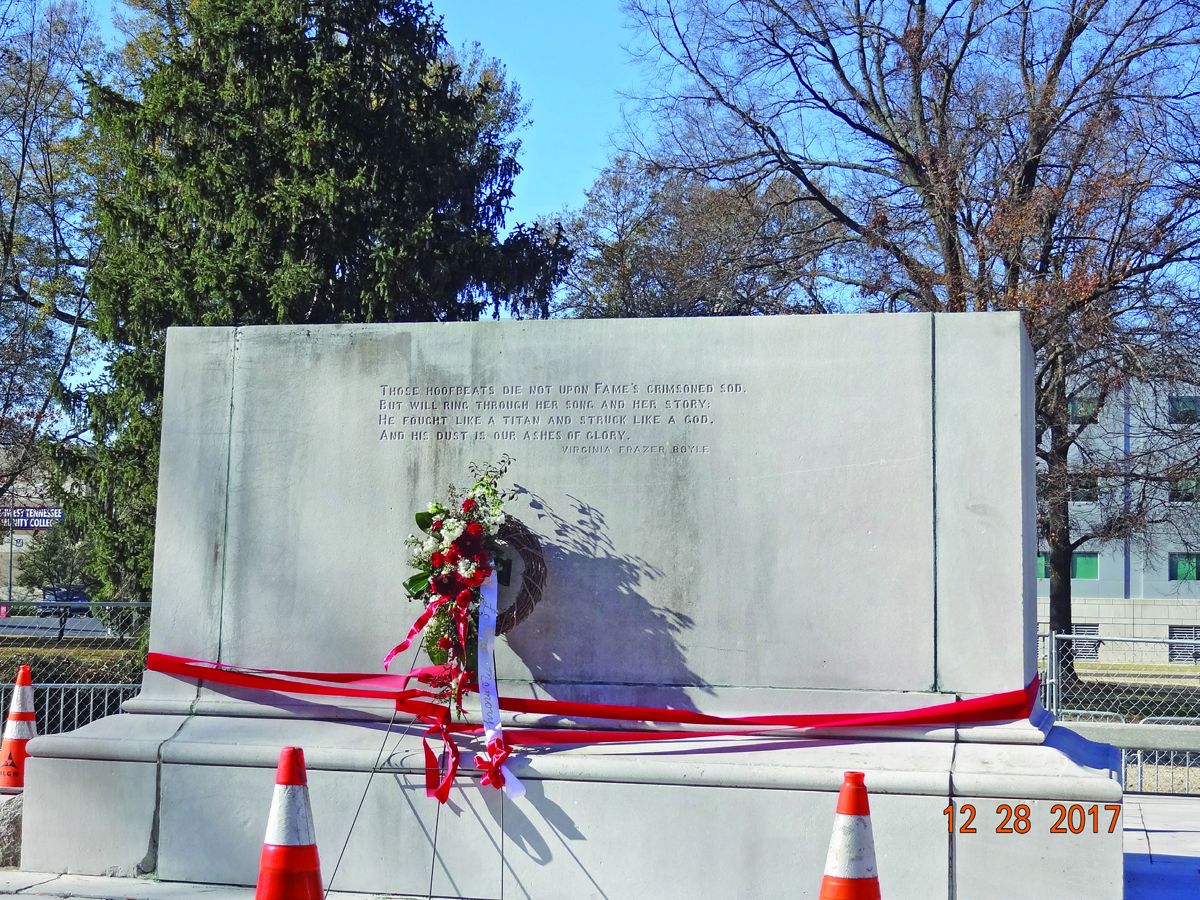
“Forrest’s Escort,” who had ridden with the general, held their own reunions. At one, in 1894, the old soldiers talked of erecting bronze statues of Forrest not only in Memphis, but also in Nashville and Chattanooga. Memphis, however, was the logical site for the statuary, for which fundraising proceeded. Ladies of the Confederate Memorial Association met in 1899 and voted to assess each member $5 for the monument project. The group’s secretary expressed the sentiments of all when she wrote, “We hope the day is not far distant when we can invite our friends to participate in the ceremonies of unveiling a fitting monument to commemorate our inimitable Forrest.” Even Union veterans contributed. One, who sent in a check for $250, voiced his support for “the erection of monuments all over the South in memory of her dead heroes.” In 1901 the city of Memphis opened a new ten-acre public park named for General Forrest. Enough money had been raised by the monument association for the laying of a cornerstone of the memorial. It was to be “a bronze equestrian statue of heroic size,” in the words of Capt. J. Harvey Mathes, an early Forrest biographer. Ceremonies for the cornerstone laying were held on May 30, 1901, during a meeting of Confederate veterans in Memphis. As part of the program, Virginia Boyle (poet laureate of the U.C.V.) recited her poem honoring Forrest and his memory entitled “The Wizard of the Saddle.” Written at the request of the Forrest Monument Association, her lines touched on elements of the general’s reputation with (Lee Millar)
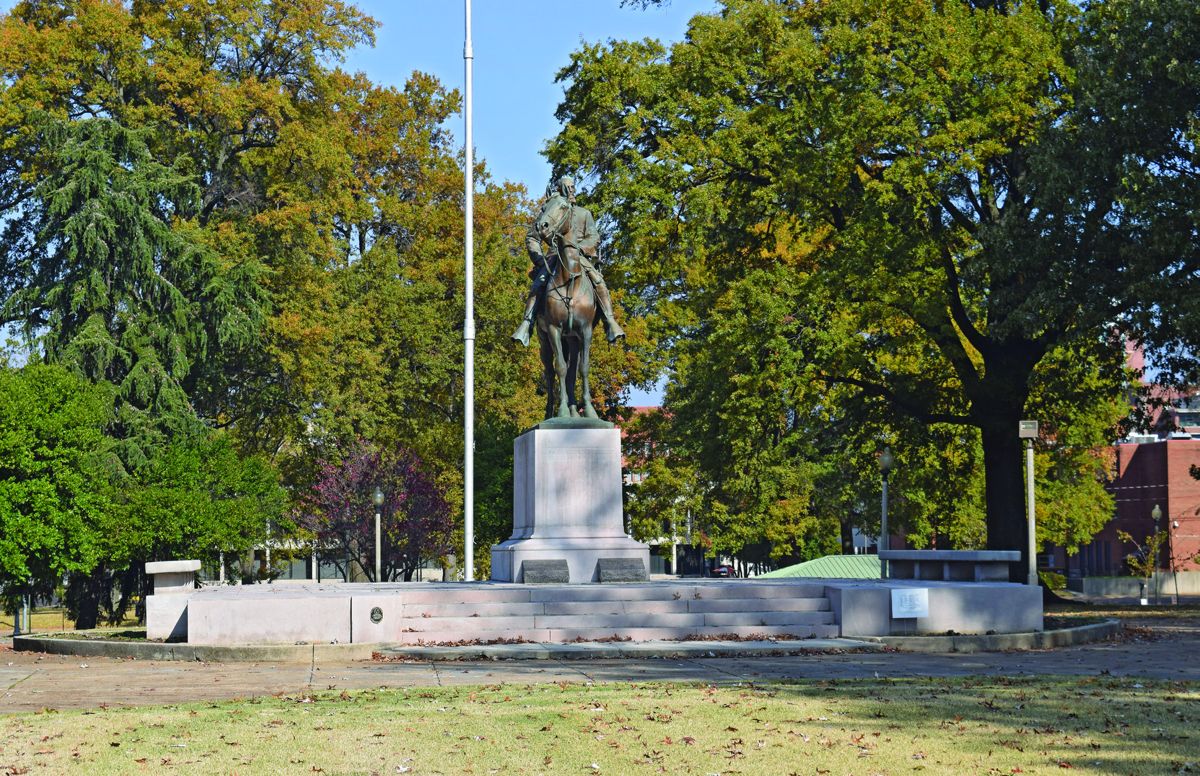
a charming innocence: “Was he devil or angel?” The monument association approved sculptor Charles Neihaus’ design; four years after the cornerstone setting, the statuary had been completed. The monument was unveiled in ceremonies held at Forrest Park on May 16, 1905. According to an article in Confederate Veteran magazine, the bronze sculpture weighed 9,500 pounds, stood nine feet tall, and was said to have cost $25,000. Before the unveiling a parade was held, in which former staff officers of the general participated. Fifteen thousand spectators looked on as J.P. Young, master of ceremonies, spoke of Forrest’s war record. After all the speechifying, Miss Kathleen Bradley, Forrest’s great granddaughter, pulled the cord to unveil “the magnificent equestrian statue.” Beneath it had been laid to rest the remains of Nathan and Mary Ann Forrest, disinterred from Elmwood. American culture has changed, of course, in the century since Nathan Bedford Forrest’s death. In the 1980s African-Americans began calling for the statue of the Confederate general to be removed from the public park in Memphis, as well as the remains of the general himself and his wife. As the Executive Secretary of the Memphis branch of the NAACP said, Forrest Park “is a daily slap in the face to blacks throughout the city.” In February 2013 the Memphis City Council voted to rename three downtown parks: Confederate Park, Jefferson Davis Park, and Forrest Park. “I’m not afraid of our history,” said councilman Lee Harris, who called for the changes. “But I’m afraid of excluding some people from our parks and celebrating the conduct of the Confederacy.” The Council chose new, innocuous names for the tracts: Memphis Park, Mississippi River Park and Health Sciences Park. The latter had been Forrest Park, site of the general’s statue. This past Dec. 20, following a unanimous vote by the biracial City Council, the Forrest statue was removed from its park site, as was a monument to Jefferson Davis, which had stood in Jefferson Davis/ Memphis Park. To circumvent a state law, according to the New York Times, the city sold the parks to a nonprofit group, which then oversaw the statues’ removal. Despite protests from some elected officials and representatives of the Sons of Confederate Veterans, Memphis mayor Jim Strickland declared the next day, “We know we did the right thing.” Van D. Turner, Jr., director of the nonprofit group, said that the monuments were being stored in an undisclosed location.
At the time of this writing, they still are. In 1930 there appeared another biography of Forrest, written by a British army officer, Eric William Sheppard. In his Preface Sheppard wrote, “Life and colour, if false to the facts, are valueless; let our pages be as vivid as we can make them, but let the whole picture they present…be a reality, not an imagination.” I thought of Sheppard’s admonishment as I finished this article. Many of us write about Civil War history. Especially as we write about Confederate heroes such as Nathan Bedford Forrest, let us have the whole picture be a reality, not an imagination. Stephen Davis Cumming, Georgia Sources:
• Edwin C. Bearss, “Nathan Bedford Forrest.” In William C. Davis, ed., The Confederate General, 6 vols. (Harrisburg, 1991), vol. 2, 139-45. • Robbie Brown, “No Longer Evoking a Divided Past, Memphis Parks Sow Battles in the Present,” New York Times, March 29, 2013. • Albert Castel, “The Fort Pillow Massacre: A Fresh Examination of the Evidence.” In Castel, Winning and Losing in the Civil War: Essays and Stories (Columbia, S.C., 1996), 35-50. • James R. Chalmers, “Forrest and his Campaigns,” Southern Historical Society Papers, vol. 7, no. 10 (October 1879), 451-86. • Andrew Lytle, Bedford Forrest and his Critter Company (Seminole, Fla., 1984 [1931]). • Robert Selph Henry. “First With the Most” Forrest (Indianapolis, Ind., 1944). • Jack Hurst, Nathan Bedford Forrest: A Biography (New York, 1993). • J. Harvey Mathes, General Forrest (New York, 1902). • “Monument to Gen. N.B. Forrest,” Confederate Veteran, vol. 12, no. 9 (Sept. 1905), 389-91. • Eric William Sheppard, Bedford Forrest: The Confederacy’s Greatest Cavalryman (Dayton, Ohio, 1988 [1930]). • Wyn Craig Wade, The Fiery Cross: The Ku Klux Klan in America (New York, 1987), • John A. Wyeth, Life of General Nathan Bedford Forrest (Dayton, Ohio, 1975 [1899]). • Emily Yellin and Richard Fausset, “Removal of Statues in Memphis Stirs ‘A Sense of Relief’: By Selling Parkland, City Leaders Skirt State law to Ditch Symbols of Confederacy,” New York Times, Dec. 22, 2017. For permission to reprint contact [email protected]