
The Unfinished Fight
Hot Chocolate
By Craig L. Barry · Originally published February 2018 · p. 9
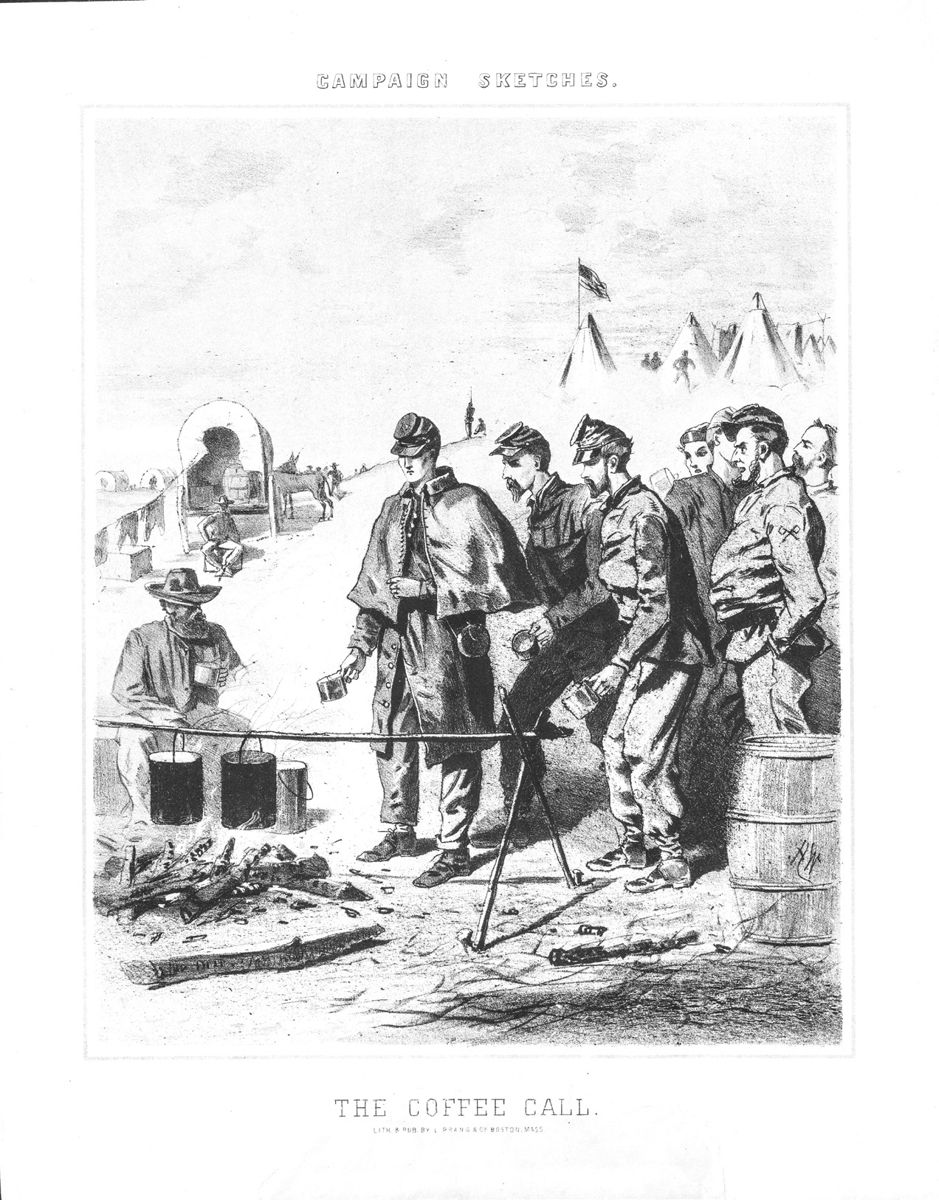
February 22nd 1863. Sabbath, a severe rain with wind and consequently quite dreary without. Lay in tent all day, not going out but once and then to make some chocolate. (Diary of Sgt. Henry Tisdale, 35th Mass. Inf.) Sept. 14, 1864– upon capturing a rebel supply depot, we were quite surprised to find what our enemy subsisted upon. aside from similar particulars including hard tack and smoked meats, it appears our southern brethren quite prefer the taste of peaches, a canned version of what appears to be bologna links, and milk sweetened by what appears to be chocolate. no sooner had we found these peculiar rations than we were fired upon by a rebel ambush. two men were wounded, and the only remaining container of the milk was punctured by a minie ball. (Diary of Henry Pippit, 104th Ohio Inf., Co. G) On a chilly day sitting around the campfire at the battlefield park, I had an idea in the form of a Civil War-era recipe for an interesting chocolate hot drink, a good idea on an aspect of material culture that seemed be more far reaching. I wanted to know how this may have impacted civilian and/or military life in the mid19th century, in my case, more military, but also civilian life. All soldiers were civilians before they were in the war. What do the primary sources have to say? It was interesting that some number of soldiers on both sides were brewing chocolate beverages up on a winter day. I also found references where it was being administered by nurses to wounded soldiers in hospitals, and the soldiers expressed a strong preference for spirits instead. I knew condensed milk was a staple in hospitals but apparently chocolate, too. See the following: Of course soldiers hoped for that elusive package (from home), it was their biggest thrill…in one case the soldier was happy with the contents but said all it lacked was a little gin. The nurse replied, Well if it had, the entire contents would have been confiscated. Unpreterbed [sic] the soldier said, Confiscated indeed? What am
Co., Boston, Mass. (Library of Congress)
I, one of your cream and chocolate men? (Rhode Island’s Civil War Hospital: Life and Death at Portsmouth Grove, 1862–1865, by Frank L. Grzyb). The drinking of hot chocolate became very popular in Europe and then America beginning in the early 1800s. It was probably introduced to Europe much earlier, as there is some evidence that Columbus encountered it during one of his return trips to the New World. In “A Brief History of Cocoa” (www.medicinehunter.com), it was noted that in 1502 Columbus was aboard the Santa Maria, moored off the island of Guanaja on the coast of Honduras, when he was visited by an Aztec chief in splendid raiments, bearing gifts. Among the cloth, copper objects and wooden weapons presented to Columbus were cocoa beans, which neither he nor his crew recognized. The Aztec chief offered to exchange some of the cocoa beans for goods aboard the ship, and this perplexed Columbus and crew. To demonstrate the value of cocoa, the chief had some cocoa beverage prepared by his servants. The Aztec called the drink cacahuatl, which literally means “bitter water.” Columbus found the beverage bitter, spicy, and not altogether pleasant, and was not especially impressed. Though the Aztecs appeared to place high value on cocoa beans, Columbus and crew did not. The Europeans added an additional ingredient to the drink that would change the face of cocoa forever. Sugar sweetened the bitter beverage, making it more pleasing to the European palate. This mixing of sugar with cocoa was the key to realizing an entirely new product, chocolate. It was not the product we would recognize as milk chocolate though. Nestle made the first milk chocolate in 1875. Around 1770 John Hannon and James Baker built the first chocolate factory outside Boston. Chocolate was sold in a block and was still bitter in comparison to what we know as chocolate used in confections. The product became known as “Baker’s chocolate.” The details of the business relationship between the two men appears to be that Baker ground cocoa and made chocolate blocks for Hannon, which he then sold in Boston. Chocolate of fine and good quality is prepared by crushing the roasted and hulled beans between rollers, then mixing them with sugar, vanilla, or occasionally with other spices, and allowing this mixture to cool. The chocolate beverage is prepared in various ways: it is simply boiled with water, with some sugar added to it. But it is also consumed with the unavoidable milk, with a lot of sugar, or with eggs. The product took off in America and by the time of the Civil War about 1/3 of the world’s cocoa was consumed in America. A variation of the drink is called German Chocolate in The Housekeepers Encyclopedia by Mrs. E.F. Haskell (1861). Four large table-spoons of the best chocolate grated fine, two quarts rich milk added gradually to the chocolate, the whites of four and yolks of two eggs beaten light, but not separated; add one gill (about ½ cup) of cold milk to the eggs, beat well; add gradually a coffee-cup of the chocolate to the milk and eggs while hot, beating constantly. Take the chocolate to the milk and egg while hot, beating constantly. Take the chocolate from the fire, keep it hot but not boiling, and add the egg and milk gradually; stir constantly, or it will curdle; flavor with nutmeg, vanilla, or cinnamon, as desired; sugar it to suit the taste. The Germans use no sugar. The egg is to be added just before serving. This makes a very delicious drink. Serve in Chocolate bowls. In the interest of conducting a much needed field test for all our sakes, I made some around the campfire. My cupboard is actually the kind of place where you might find blocks of this kind of chocolate for just such an experiment.
Green Rio coffee beans for roasting and grinding are in there, too, salt pork in the freezer, dried beans, etc. The German hot chocolate is very much like a custard in liquid form, but the drink needed sugar…lots of sugar, in order to be a palatable concoction for the modern taste spectrum which is much more inclined toward sweet than savory. The drink is quite satisfactory on a cold day and it is very rich. Craig L Barry was born in Charlottesville, Va. He holds his BA and Masters degrees from the University of North Carolina (Charlotte). Craig served The Watchdog Civil War Quarterly as Associate Editor and Editor from 2003-2017. The Watchdog published both books and columns on the material culture of the mid-19th century and donated all funds from publications to battlefield preservation. He is the author of several books including The Civil War Musket: A Handbook for Historical Accuracy (2006, 2011), The Unfinished Fight: Essays on Confederate Material Culture Vol. I and II (2012, 2013) and three books (soon to be four) in the Suppliers to the Confederacy series on English Arms & Accoutrements, Quartermaster stores and other European imports.