Inspection, ARMS!
The U.S. Model 1851 Cadet Musket
By Tim Prince · Originally published December 2018 · pp. 26–27
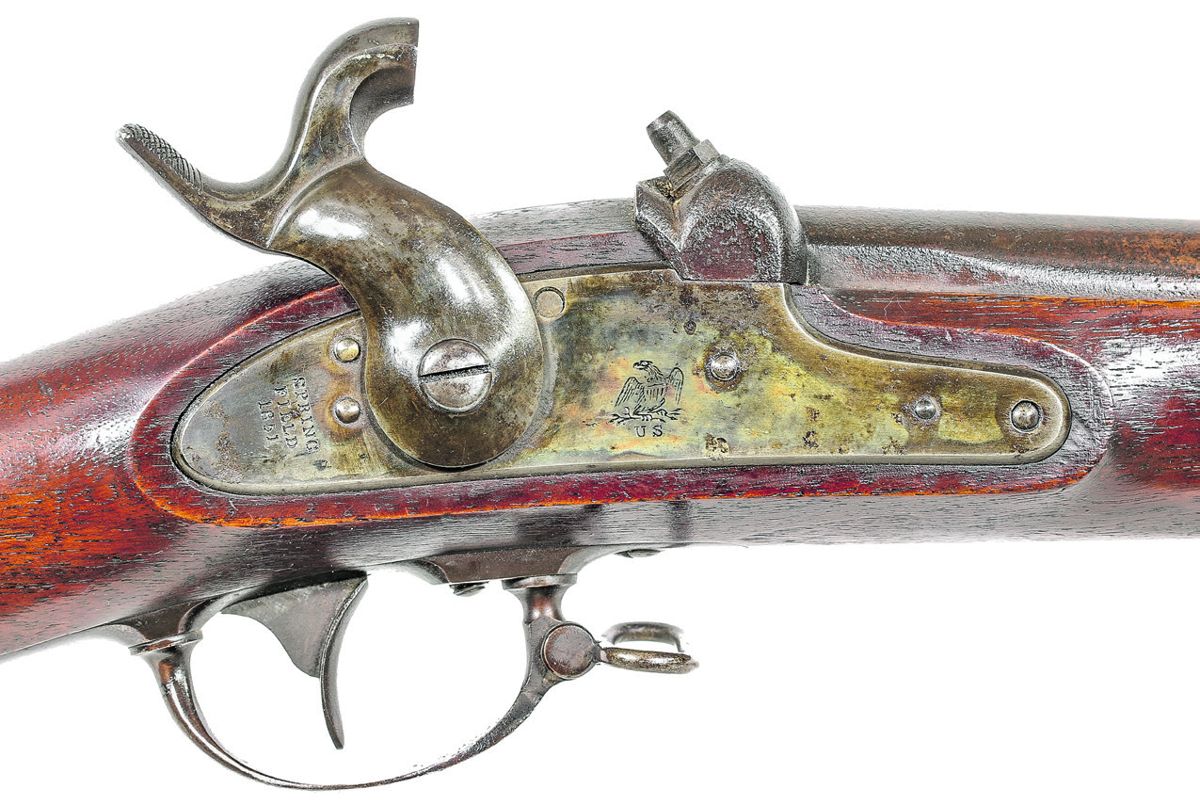
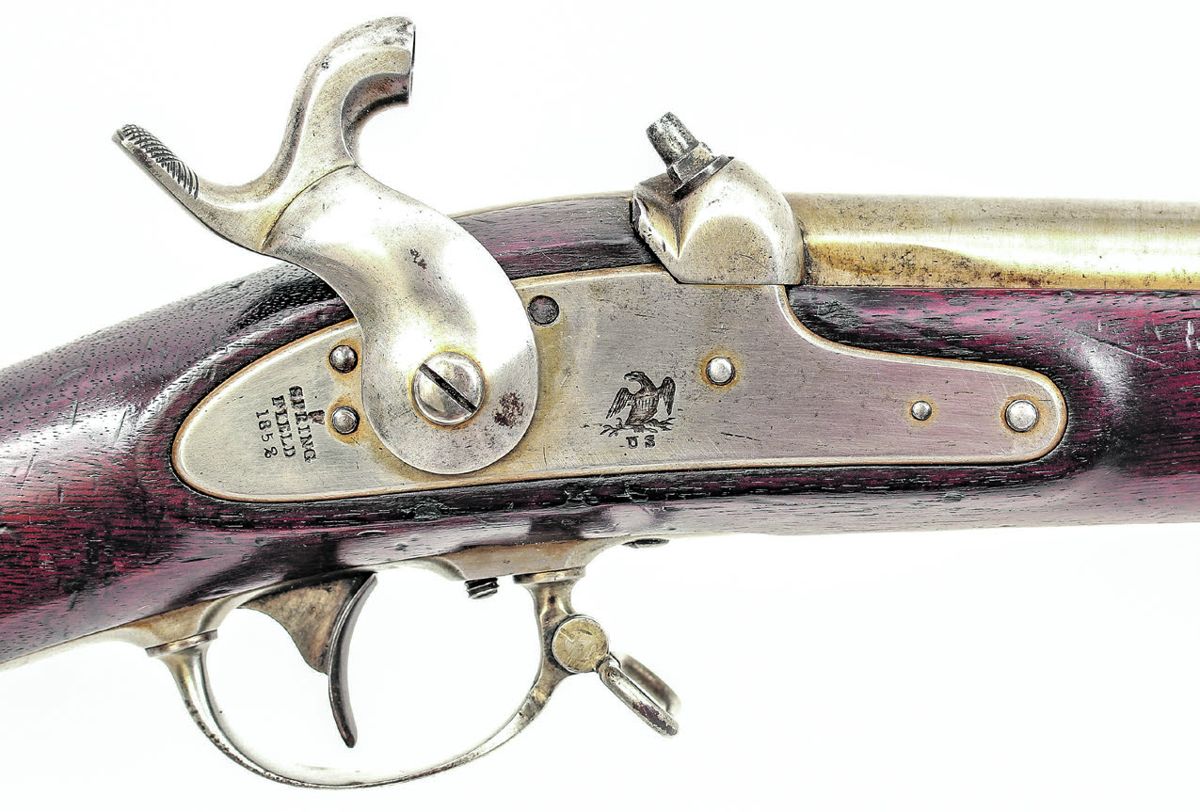
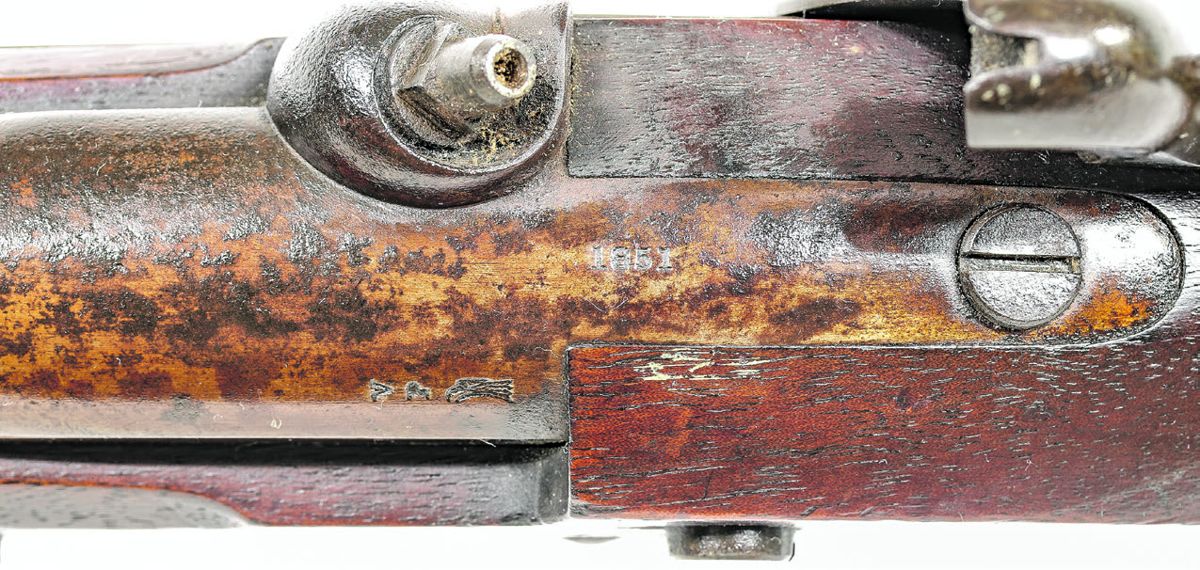
In May 1851, the United States Ordnance Department authorized the manufacture of 2,000 percussion cadet muskets. The production of these muskets was necessary to supply the various state military academies with arms under the Militia Act of 1808. The preceding Model 1841 Cadet Muskets, produced at Springfield between 1844 and 1846, had all been issued to the Military Academy at West Point. As a result, only fullsized percussion conversion muskets were available for issue to the states. These guns were considered too large and heavy for cadet use and this resulted in the authorization to manufacture new cadet muskets at Springfield. The M1851 Cadet Musket was quite similar to the preceding M1841 Cadet Musket; both muskets were essentially scaleddown versions of the current standard issue U.S. percussion infantry musket, the Model 1842. As originally produced, both the U.S. Model 1841 and 1851 Cadet Muskets were single shot, muzzle loading, percussion smoothbore muskets in .57 caliber, rather than the M1842’s larger .69 caliber. In addition to the reduced caliber, the cadet muskets were also slightly smaller throughout when compared to the M1842. The round barrels were 40 inches instead of 42 inches in length and stocks were also proportionally reduced in overall size. This size reduction is most visible in the smaller buttstock and the cadet gun’s much slimmer wrist. The barrels of both cadet musket patterns were secured by three flat, spring-retained barrel bands with the upper band being double-strapped. A bayonet lug for an angular socket bayonet was located under the barrel. Sling swivels were provided on the middle barrel band and the front bow of the triggerguard. The locks of both cadet muskets were smaller than the M1842 lock as well. The Model 1841 Cadet Muskets utilized U.S. Model 1841 rifle (“Mississippi” rifle) sized percussion locks, while the later Model 1851 used locks from the Model 1847 series of percussion musketoons. The Model 1841 Cadet Musket was finished with a color casehardened lock with the barrel and furniture browned. The earliest Model 1851 Cadet Muskets were finished in the same fashion, but the majority were finished “National Amory Bright.” Both muskets used a trumpet head shaped ramrod with threads at the end to accept cleaning implements. Standard lock markings were a spread-winged U.S. eagle forward of the hammer over the letters “US.” The arsenal mark “SPRING / FIELD,” in two vertical lines was at the tail of the lock over the date of production. The barrel breech plug tangs were dated as well, and the usual arsenal V / P / Eagle Head proofs were applied to the upper left side of the breech. Much of the pressure to approve these new muskets came from Virginia, which had been trying to secure percussion cadet muskets for almost a decade. The state had been consistently told that once the supply needed for West Point was produced, any additional muskets would be sent to Virginia for the Virginia Military Institute (VMI). This never occurred, so it is not surprising that President Zachary Taylor, a Virginia native, ordered the initial production of Model 1851 Cadet Muskets sent to VMI. A total of 4,000 M1851 Cadet Muskets were produced between 1851 and 1853. Springfield production records indicate that 2,000 were completed and received into stores in fiscal year 1852 (July 1, 1851 through June 30, 1852) and an additional 2,000 were completed in fiscal year 1853 (July 1, 1852 through June 30, 1853). Of the 4,000 Cadet Muskets produced, the first 300 were sent to VMI by order of President Zachary Taylor. These guns were shipped May 5, 1852. Due to the fiscal year accounting system, these guns were listed as having been “manufactured” in 1852, but the gunlocks and barrels were dated based upon the calendar year, 1851. This explains why all concretely identified examples of VMI issued M1851 Cadet Muskets are dated 1851. An additional group of 200 M1851 Cadet Muskets were shipped to Virginia on Aug. 4, 1852; these appear to be sent to VMI as well. George Moller notes in American Military Shoulder Arms Volume III that an 1858 inventory of muskets at VMI listed 300 browned M1851s and 200 bright M1851s. Thus, it is reasonable to assume that the first 300 U.S. M1851 Cadet Muskets were manufactured with the National Armory Brown finish. This is quite understandable, as the preceding U.S. M1841 Cadet Musket had been produced with a browned barrel and furniture, color casehardened lock and hammer and bright ramrod. At Springfield, the authorization of the new M1851 was initially viewed as a continuation of the old M1841 Cadet Musket program. It is interesting that the both the M1841 and earliest M1851 Cadet Muskets were produced with the National Armory Brown finish. This finish had been abandoned for muskets in the early 1830s due to problems with the muskets literally rusting in the racks. The Ordnance Department discovered that guns with this finish needed to cure for some time with air circulating around them before being crated for storage, which created numerous problems not the least of which was the space to store these muskets in racks, as well as the need to tend to them to prevent rusting while curing. As such, it was deemed easier to maintain bright muskets than browned muskets, and this finish was abandoned for muskets, although it was retained for rifles and some carbines. After the production of the first 300 U.S. M1851 Cadet Muskets, the issues with the finish probably became apparent again, so the remainder of the guns were finished National Armory Bright. It seems reasonable that VMI found it extremely difficult to maintain the browned finish on the guns, which is why browned examples are practically never found on the collector market today. Much like the browned U.S. M1822 muskets, over the years even those that did not “rust in the racks” often ended up being bright by simple maintenance and cleaning over time. Several other southern states received U.S. Model 1851 Cadet Muskets during 1852, all of which appear to have been
Overall view of a scarce, 1851 dated browned U.S. M1851 Cadet Musket.
Overall view of an 1852 dated National Armory Bright U.S. M1851 Cadet Musket.
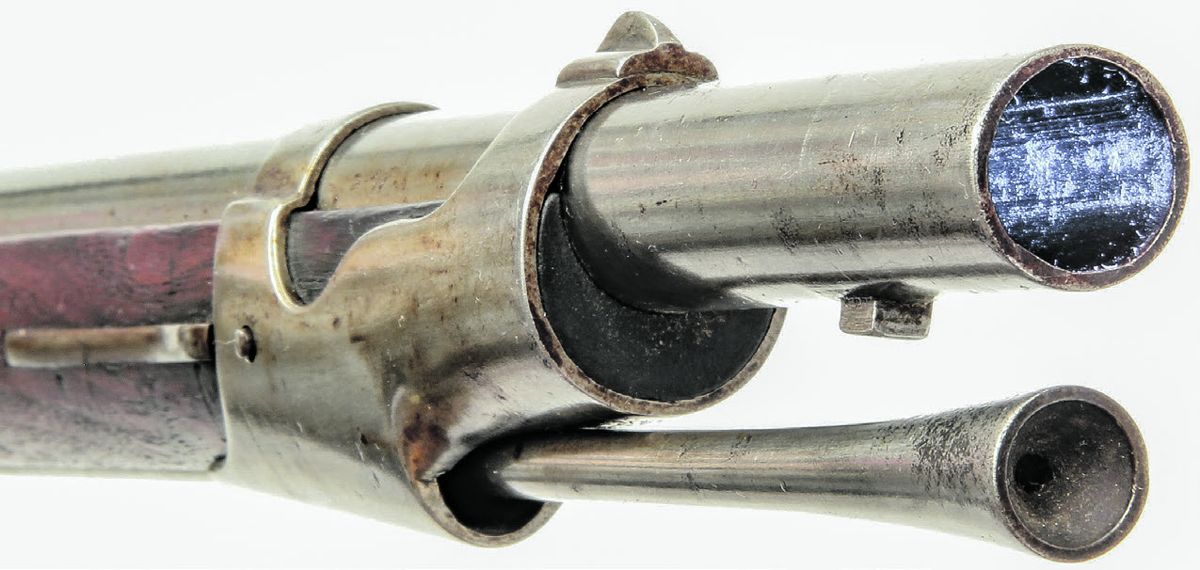
Overall view of an 1853 dated National Armory Bright, rifled & sighted U.S. M1851 Cadet Musket.t
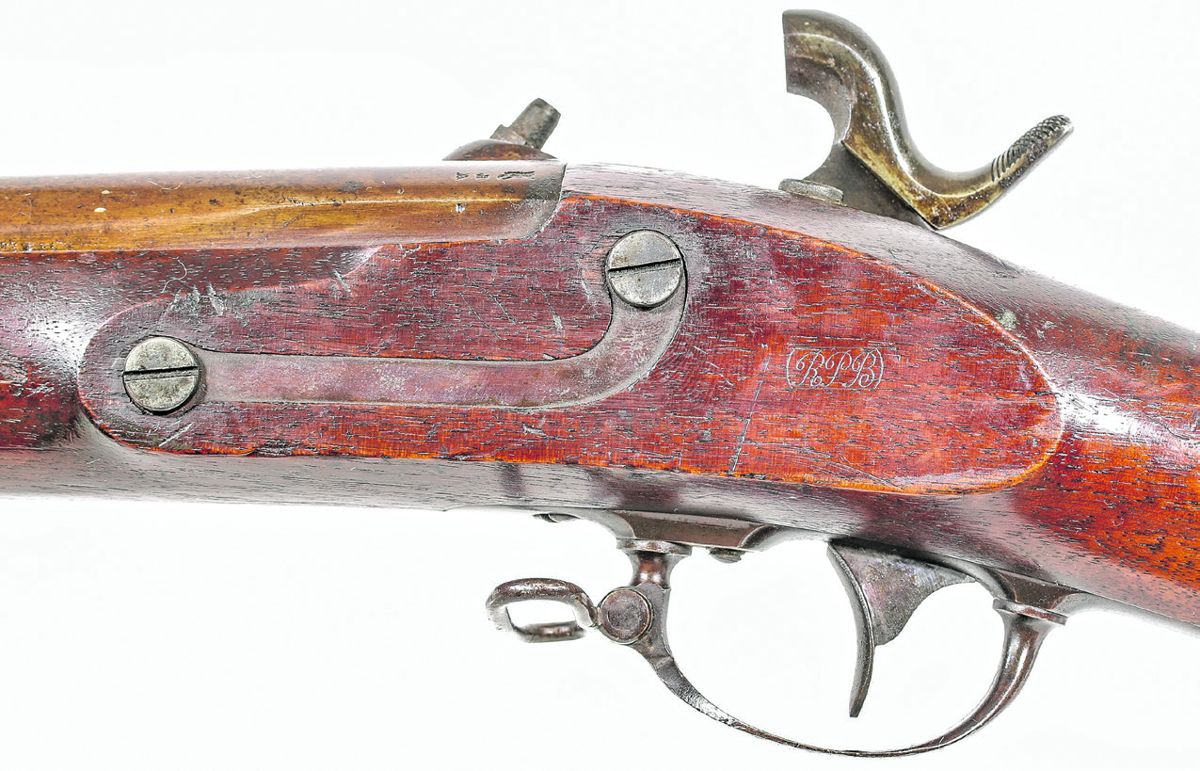
National Armory Bright. These states included: Alabama (245), Georgia (235), Kentucky (225), Mississippi (150), North Carolina (65), South Carolina (100) and Tennessee (80). In 1856, Virginia received 10 more U.S. M1851 Cadet Muskets, and the state of New York received a total of 1,150, with 150 shipping in 1855 and 1,000 in 1857. Up to this point none of the M1851 Cadet Muskets were issued to the U.S. Military Academy at West Point. It was determined that since there was not a substantial change or improvement between the M1841 Cadet Musket then in use by the cadets and the new M1851, there was no reason replace the M1841 Cadet Muskets in service at West Point. This changed in 1855, with the official adoption of the Model 1855 Rifle Musket and the subsequent family of M1855 rifled arms for issue to the U.S. military. It was determined that the cadets at West Point needed to have experience and knowledge about the new rifled and sighted arms that were becoming standard issue. In 1856, 300 M1851 Cadet Muskets in storage at Springfield were altered from smoothbore to rifled arms and had long range rear sights installed. An additional 14 were so altered the following year, with 9 more being altered in 1858, for a total of 323 M1851 Cadet Muskets modified by rifling and sighting. Records indicate that these guns were issued to the Corps of Cadets at West Point and were the first rifled arms to be used at a U.S. military academy. When the Model 1851 Cadet Muskets were altered for use at West Point, they were rifled with three grooves and had Model 1855 pattern long range rear sights installed. The rifling was .2 inch wide and was of progressive depth, being .015 inch deep at the breech end of the barrel and .005 inch deep at the muzzle. The rate of twist was a slow 1 turn in 72 inches, with a right hand twist. The long-range rear sight was attached to the barrel with a dovetail notch for the rear portion of the base and a single spanner screw that secured the front of the base. A new, taller, iron front sight blade was soldered and riveted to the front strap of the upper barrel band, replacing the original brass blade front sight used on the smoothbore version. The trumpet shaped ramrod was also modified from its original configuration by machining a concave recess at its tip. This was to accept the newly adopted Burton designed, Minié style conical ammunition. It is generally believed that all 323
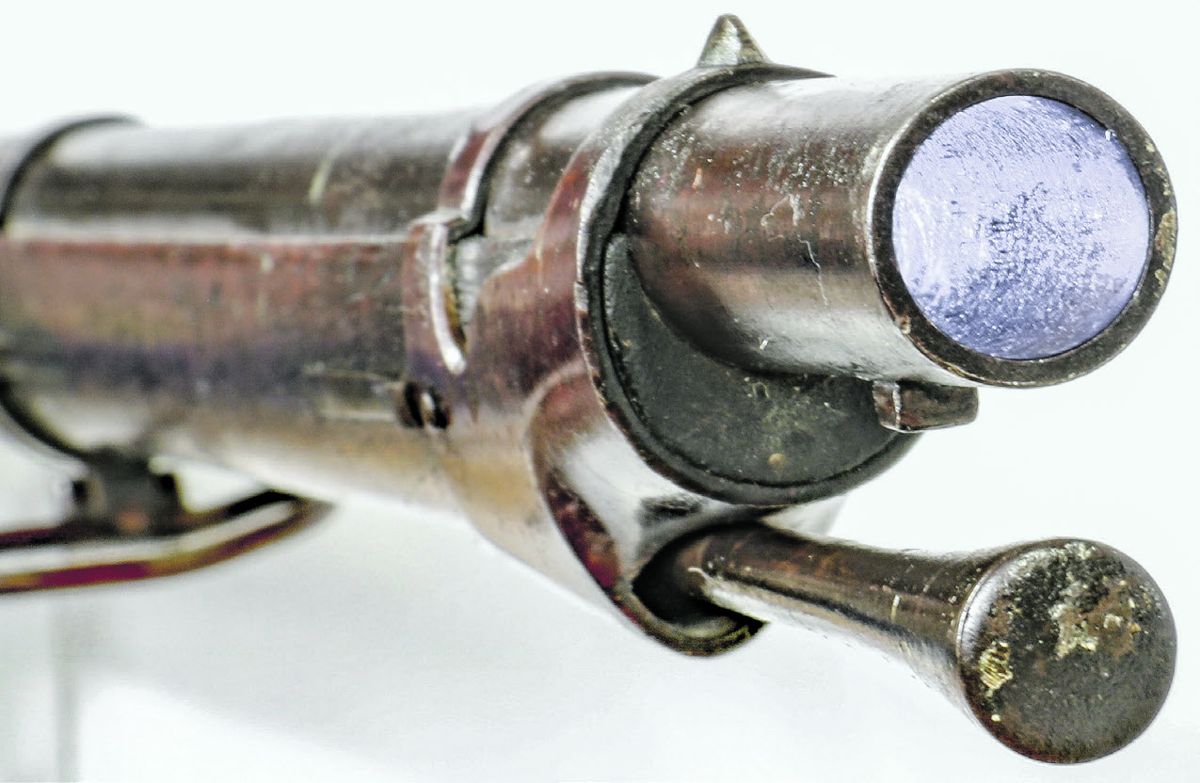
While none of the Model 1851 Rifled Cadet Muskets issued to West Point saw Civil War combat service, many of the smoothbore guns certainly did. With about 1,600 of the M1851s being issued to southern states, it is quite reasonable to assume that most (if not all) of these guns saw some level of Civil War service. This was particularly likely during the Tim Prince is a full-time dealer in early months of the war, when fine & collectible military arms southern infantry regiments were from the Colonial Period through desperately short of arms. It is WWII. He operates College Hill also possible that some cadet Arsenal, a web-based antique muskets issued to northern states arms retail site. saw early war use as well. A long time collector & researchWhile not produced in large er, Tim has been a contributing numbers and not nearly as author to two major book projects powerful and robust as the typ- about Civil War era arms including ical Civil War period infantry The English Connection and a new musket, the Model 1851 Cadet book on southern retailer marked Musket was still an important and Confederate used shotguns. part of the long arms arsenals on Tim is also a featured Arms & both sides. These handy, light- Militaria appraiser on the PBS weight and well balanced arms Series Antiques Roadshow. were instrumental in providing firearms instruction to pre-war cadets on both sides, many of whom would go on to command positions during the war. In the South, these guns also provided much needed early war firepower for some newly raised infantry regiments. The graceful lines and light weight probably made the guns popular with the men who carried them and the guns have one of the more interesting back stories of the various U.S. arsenal arms to see use during the war.
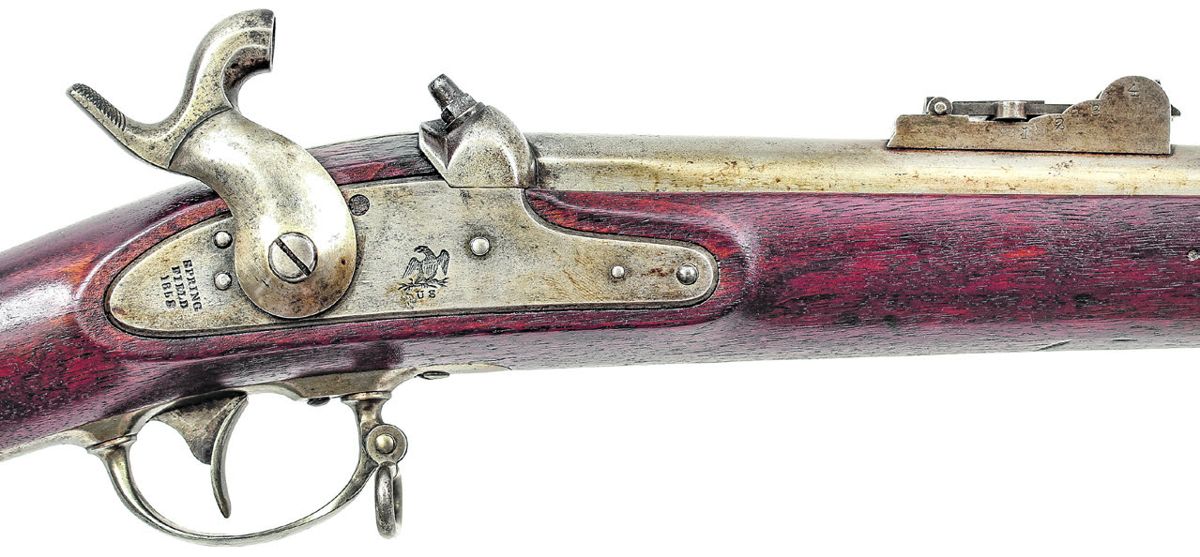
Inspection, proof, and date marks on the breech area of an 1851 dated lock of a browned & casehardened U.S. M1851 Cadet Musket. of the rifled and sighted M1851 Cadet Muskets were issued to West Point, although it is possible that only the first 300 were. The West Point issued M1851 Cadet Muskets are typically rack numbered on their buttplate tang and usually have an additional inventory number on the top of the lower barrel band.