
Through The Lens
The Burning Bridge
By Stephanie Hagiwara · Originally published December 2018 · pp. 14–15
“I thought my time had come and that I passed the balls only to perish miserably on that burning bridge” – W.W. Sullivan C.S.A. On Dec. 11, 1862, U.S. Gen John Foster with 10,000 infantry, 40 pieces of artillery, and 640 cavalry left New Bern, N.C., to attack the Wilmington and Weldon railroad at Goldsboro, N.C. Two thirds were raw recruits enlisted for nine months with less than two months of service under their belts. The railroad was part of the Confederates’ international supply chain through Wilmington, N.C. The Confederates felled trees, burned bridges, and ambushed the Federals along the way. Outside Kinston, N.C., the first major defensive point for the vital railroad, C.S. Gen. Nathan G. “Shanks” Evans had fortified the land and the Neuse River approaches. Between earthworks, swamps, artillery, and dense pine forest, the Confederates believed Kinston was well-nigh impregnable. On Sunday, Dec. 14, about 9 a.m., the Battle of Kinston began as the Confederates, concealed behind trees, fired at Federals advancing 75 yards away. It was a “blind battle of invisible foes” with balls flying fast and thick. In a clearing of about 20 acres, Foster placed six Parrot guns to blast the enemy. Confederate fire compelled the Federal force to split, with a road between them, and advance through a dense, old growth swamp. Underneath the “ooze and slime of the bog” twisted the gnarled roots of huge old trees. The water “in many places it was up to our knees, in some cases it was waist deep. We had to struggle along as best we could; several times I became so enlaced in the vines and shrubbery that I found it almost impossible to extricate myself,” described a Massachusetts volunteer. As the 45th Mass. Inf. passed under Federal artillery fire, “the first shot from the battery carried away half the head of a man in Co. D. …. Killing him instantly, and the regiment passed on. Our Company after witnessing this, was obliged to pass directly in range of this same battery, however, they were loading at the time, so we escaped. Company K, which comes next behind us came up in season for the next fire, and had had several men wounded, and this from our own gunners.” A Federal charge from the swamp forced Evans to withdraw his 2,014 men across the Neuse River Bridge. The bridge, already saturated with turpentine, was set ablaze. Evans began firing on the center right of the remaining Confederate line across the river because he thought it was an enemy formation. The isolated line gave way and was retreating in an orderly manner until they saw the burning bridge. The combatants broke rank and ran towards the flames. Hair singed as the Rebels sprinted over the bridge. A runner tripped midway, causing a “terrible pile-up.” W.W. Sullivan wrote, “I never came so near being mashed to death and suffocated in my life.” The pursuing Federals grabbed the artillery’s water buckets to douse the flames. A loaded musket, “thrown away by a flying rebel, caught fire and exploded,” instantly killing Col. Chas. Gray of the 96th N.Y. The capture of 400 Confederates who had not run the burning gauntlet didn’t compensate for the loss. After four hours fighting in the swamp, both sides moved to Kinston. Foster sent a demand for surrender to Evans who had reformed his troops two miles beyond Kinston. Evans responded, “Tell your General to go to h__l.” Before Foster could ready his attack, Evans retreated, and the Federals settled down for the night. The next day, as the main body of Federals advanced towards Goldsboro, Foster ordered U.S. Major Jeptha Garrard, 3rd N.Y. Cavalry, to proceed toward
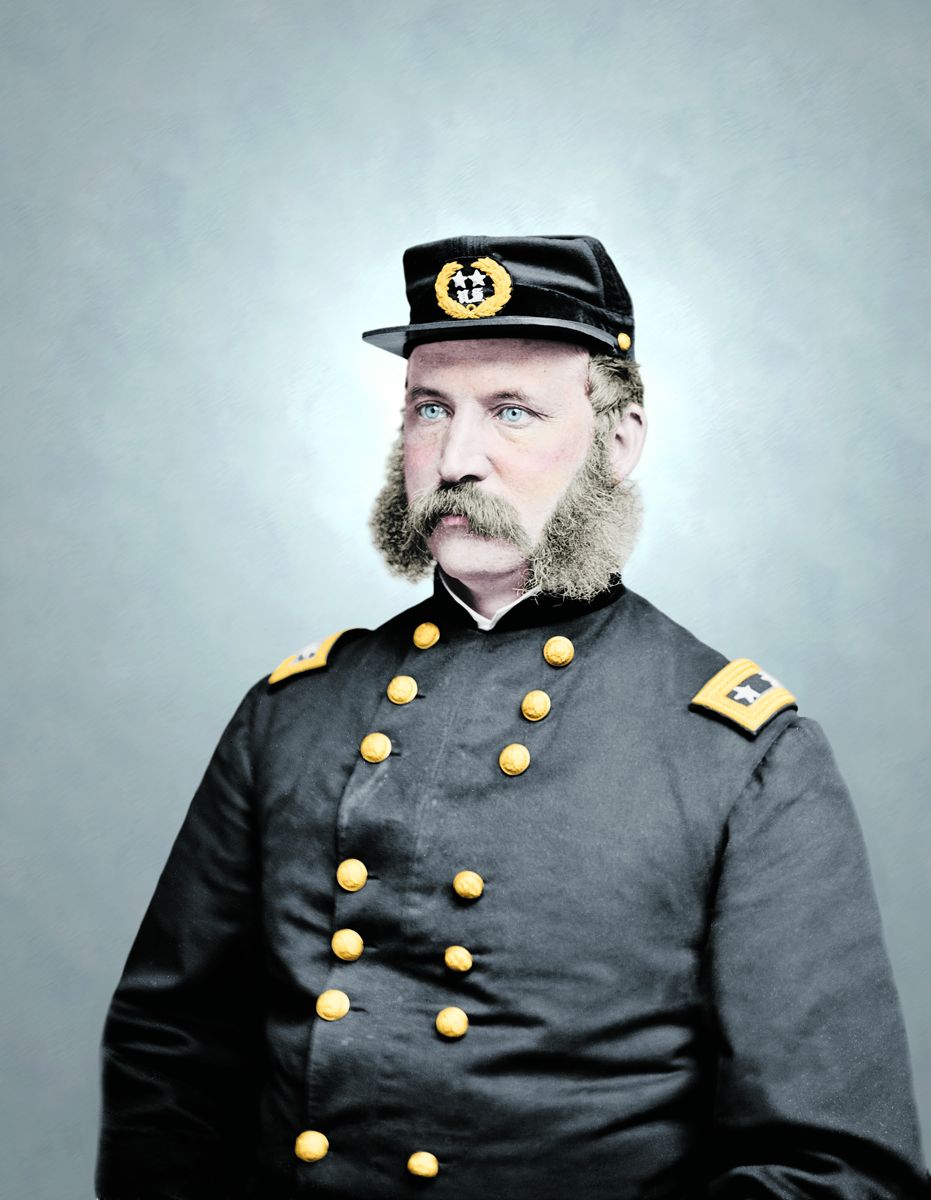
Gen. Nathan G. Evans, C.S.A; Colorization © 2018 civilwarincolor.com courtesy civilwarincolor.com/cwn.
(Library of Congress) the Wilmington and Weldon Railroad’s Mt. Olive Station, 20 miles south of Goldsboro. They arrived about 3 p.m. to the surprise of all. “The ticket agent was selling tickets; passengers were loitering around waiting for the cars, the mail for Wilmington laid already on the platform, and a few paroled prisoners were in readiness to go to Wilmington, probably to fight again.”
The Federals immediately put everyone under arrest and cut the telegraph wires. One group burned the bridge, destroyed track and switches, while another group went farther down the line to do the same, and surprised the mail train. “The engineer on the train, in coming around a sharp turn, observed ahead a heavy, dark smoke, and immediately whistled down brakes and reversed his order of proceeding.” A gun from the Allis’ Flying Artillery quickly got into position to give the “retreating train the force of three shells.” The cavalry left Mt. Olive with the “railroad apparently on fire for miles in extent, huge fires of ties and warping rails, and the blank amazement that was but too evident in the faces of our now released prisoners.” C.S. Brig. Gen. Thomas Lanier Clingman was ordered to protect both a railroad bridge and a “covered” bridge between Dudley and Goldsboro by placing “two pieces of artillery obliquely across the road.” The former U.S. Senator had been promoted from Colonel to Brig. General through his relationship with C.S.A. Pres. Jefferson Davis. It would be his brigade’s first battle. On Dec. 17, the Battle of Goldsboro Bridge began with Clingman’s Brigade holding their ground while Foster’s superior forces fired from a hill. Overwhelmed, Starr’s Battery provided cover as the Confederates retreated over the railroad bridge. U.S. Lt. Graham, 23rd N.Y. Artillery, rushed forward to torch the railroad bridge. To prevent Confederates from extinguishing the flames, Foster had his artillery target the bridge. Considering the deed as done, Foster ordered the troops back to New Bern leaving Col. H.C. Lee to form a rear guard. Meanwhile, Clingman reformed his line in an open field and was moving Starr’s Battery into position for a flanking move as Evans arrived. Evans ordered an immediate advance. “Someone suggested that Evans should wait until Starr’s Battery had reached its position, otherwise Clingman’s “plan would ‘result in disaster,’ but Evans replied: ‘I rank Clingman; move forward at once; I will support you with the Holcombe Legion.’” The men obeyed Evans, advancing to the railroad embankment and with “loud cheers” charged. The Federals’ nine artillery pieces sprayed grape and canister, ending the battle. Foster returned to New Bern with seven additional pieces of artillery—two bronze and five iron captured outside Kinston. The two bronze pieces were the same ones captured from the Federals at Washington, N.C., three months earlier. The Goldsboro Bridge was quickly repaired. The 9th N.J., who did much of the heavy fighting, returned with a captured South Carolina regimental flag and received acknowledgment from an unexpected quarter. In the field, a chaplain from one of the Mass. regiments, “seeing one of the men of Battery B, 3rd N.Y. Artillery, being borne off wounded, said to him: ‘Were you supported by Divine inspiration?’ ‘No!’ was the reply, ‘we were supported by the Ninth New Jersey.’”
Sources: • Barrett, John G., The Civil War in North Carolina • Howe, W.W., Kinston, Whitehall, and Goldsboro Expedition December 1862 • Mann, Albert W., History of the Forty-fifth Regiment, Massachusetts Volunteer Militia • Casstevens, Clingman’s Brigade in the Confederacy, 1862–1865 Stephanie Hagiwara is the editor for Civil War in Color.com and Civil War in 3D.com. She also writes a column for History in Full Color. com that covers stories of photographs of historical interest from the 1850’s to the present. Her articles can be found on Facebook, Tumblr and Pinterest.