
The Unfinished Fight
Roman Numerals and Reproduction Bayonets
By Craig L. Barry · Originally published December 2018 · pp. 12–13
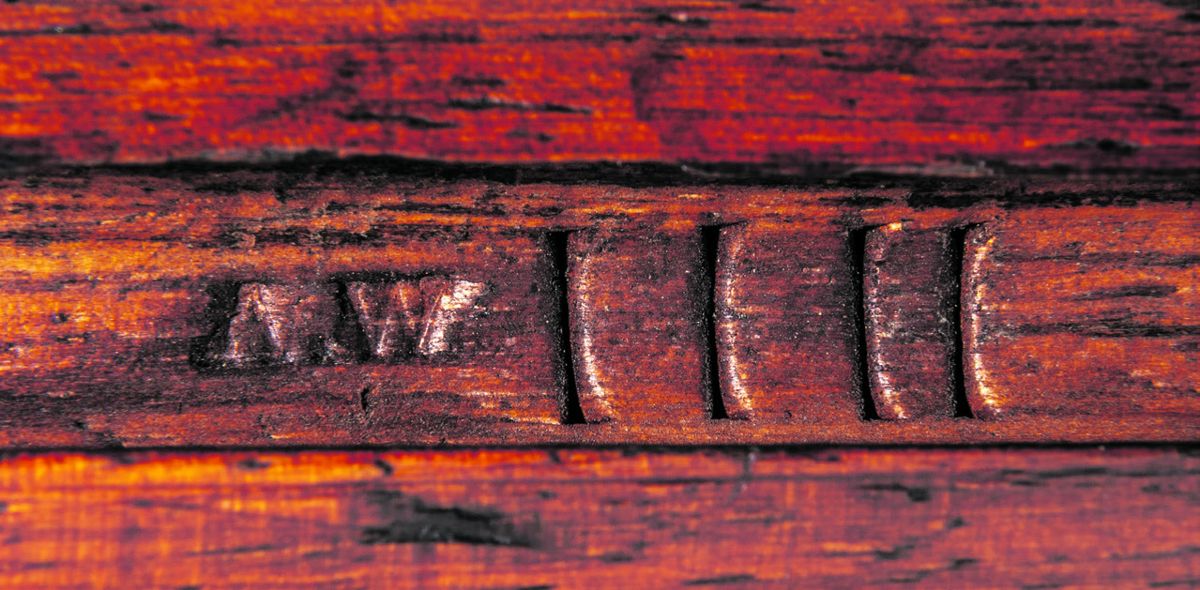
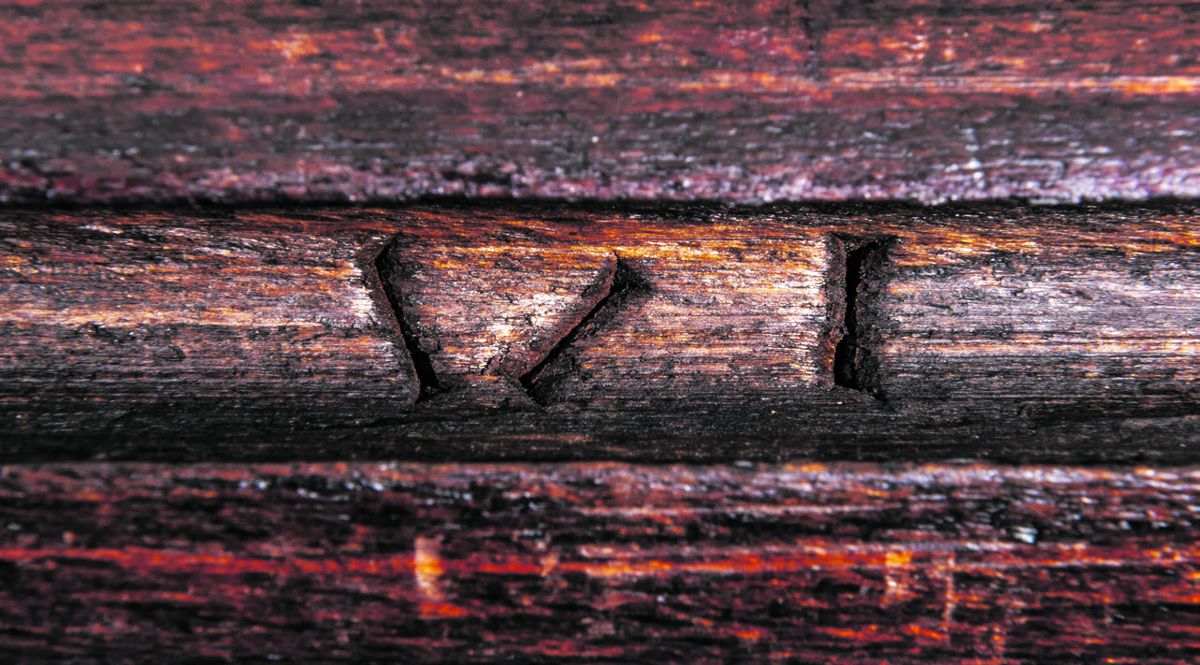
A question came up about the roman numerals that are sometimes found on the bottom of a Civil War-era musket barrel, as well as on other parts assemblies. They are found crudely chiseled into the metal and resemble slash marks. What was the meaning of these marks and why are they there? In the chapter on the Enfield (p. 242) from the seminal book Civil War Guns by William B. Edwards (1962), the author mentions similar marks on a Potts & Hunt P53 barrel made by Ezra Millward, a well-known Birmingham barrel maker during the Civil War-era. Edwards writes, “The Potts &
Hunt gun number, probably of a lot of one dozen or twenty guns fitted up by same set of workmen in their factory is 8. The number (8) appears on the barrel and close by on the bottom of edge of the barrel plug wedge. It is also scribed VIII in Roman characters on the barrel bottom and again with a narrow chisel in the ramrod groove to match the tube to the stock for which it was inletted.” However, the practice of marking with roman numerals was not limited to the commercial gun-makers in England and Europe. The marks can also be found with non-parts interchangeable domestically produced Civil War arms. For example, in the excellent book by Gordon Jones with photography by Jack Melton titled Confederate Odyssey: The George W. Wray Jr Collection at the Atlanta History Center (2014), the authors note of an Alabama contract arm (p. 193) “…the matching slash mark roman numerals underneath the barrel and breech plug tang are consistent with later Davis & Bozeman manufacture. The serial number 57 under the barrel suggests this arm was among the first lot of eighty rifles submitted for inspection in October 1863.” So if the roman numerals are not limited to just European imports but also non-interchangeable arms of domestic manufacture, were they used in any other way during the mid-19th century? According to Gordon Jones of the Atlanta History Center, “I think it’s simply an old personal assembly or (parts) counting trick. It was a way to mark parts that went together, and since it’s just a slash or chisel mark, you didn’t need a set of lettering dies. You see it in wooden beams on ships, locomotive parts, U.S. or British arms made before the advent of interchangeable parts, and probably other things too. In any case, (roman numerals) are commonly seen on Confederate arms, but by no means distinctive to them.”
Overall view of the unmarked rifle believed to be made by Henry J. Davis and David W. Bozeman. to use a circular file to widen or raise the base of the bayonet socket until it is high enough to clear the front sight/bayonet lug. If it is necessary to widen the sides of the channel slot this can be done with a small flat file. A moto-Dremel tool can also be used to widen the channel slot. If this step is necessary, it may be required that you widen the channel slot as it zig-zags all the way up the bayonet socket. The more common problem is that the bayonet socket is too narrow to go over the barrel, or it slides part way down and then gets stuck. In this case a circular file can be used to widen the socket beginning at the base and working up. Only remove enough metal to seat the bayonet socket on the muzzle with a snug fit because if the socket is made too large, the bayonet will rattle around loosely. This process takes time and patience. The most difficult part of fitting a reproduction bayonet is in the rare case when the socket itself is too long and the base hits the nose cap of the stock before the bayonet is properly seated. By process of elimination, you can’t lengthen the musket barrel or shorten the bayonet socket very easily. The simplest and best solution is to remove the nose cap and remove a small amount of wood from the end of the stock. Or throw your hands in the air and start the process over with another reproduction bayonet. Fortunately this particular problem is not common. For some reason, the reproduction U.S. M1842 muskets do not have the same degree of difficulty fitting the bayonet. Perhaps it is because the U.S. M1842 is slightly more expensive, in keeping with the entire musket being better made and more historically accurate out of the box. Whatever the case, fitting a bayonet to the reproduction U.S. M1842 musket is not usually a problem, and the locking ring is better quality as well. To avoid pinching your fingers, take note that the bayonet lug which does not double as the front sight is underneath the barrel. Craig L Barry was born in Charlottesville, Va. He holds his BA and Masters degrees from the University of North Carolina (Charlotte). Craig served The Watchdog Civil War Quarterly as Associate Editor and Editor from 2003-2017. The Watchdog published books and columns on 19th-century material and donated all funds from publications to battlefield preservation. He is the author of several books including The Civil War Musket: A Handbook for Historical Accuracy (2006, 2011), The Unfinished Fight: Essays on Confederate Material Culture Vol. I and II (2012, 2013) and three books (soon to be four) in the Suppliers to the Confederacy series on English Arms & Accoutrements, Quartermaster stores and other European imports.
Changing subjects, another question that comes up quite often involves how to fit a reproduction bayonet to your Civil War musket. If you purchased one of the popular Civil War reproduction rifle muskets, either the P1853 Enfield or U.S. M1861, than you are probably aware that it did not come with a socket bayonet the way “a stand of arms” was issued historically. Hence, to complete your kit it is necessary to buy a bayonet and scabbard separately. If you are lucky, the reproduction bayonet you buy might actually fit your rifle musket. The odds are that it will not. There are good reasons for this. The reproduction bayonet, especially the inexpensive one made in India, is impossible to predict in terms of potential fit to any individual reproduction musket. The variation in socket diameter is simply too great and, being hand-made, no two bayonets (it seems) are identical. The only good thing about them is their low cost. The price of the India-made reproductions begins around $40-$50. If available from the manufacturer of the rifle-musket, a factory made bayonet which is better quality spring steel costs $175 and up. If someone is willing to spend that much, look for an original bayonet. There is some debate about the use of originals because if one is lost or stolen, a piece of history is lost with it. This is a personal decision, but this much can be said with certainty, although original bayonets are more costly they are much better quality than any currently available reproductions and will not bend like a pipe cleaner with ordinary use. The first variable to determine is why the bayonet will not fit over the end of the muzzle or, if it goes over, where is it getting stuck? A good place to check first is the bayonet lug. A couple inches back from the muzzle on top of the barrel of a typical P1853 Enfield or U.S. M1861 is the front sight which doubles as the bayonet lug. The combination front sight/bayonet lug is sometimes too tall or sits up too high to slide over the ring at the base of the bayonet socket or it is too wide to clear the channel slot. If that is the case, you can file the front sight down slightly but generally speaking, do not file the sight or especially the barrel to fit a bayonet to it. It is much better
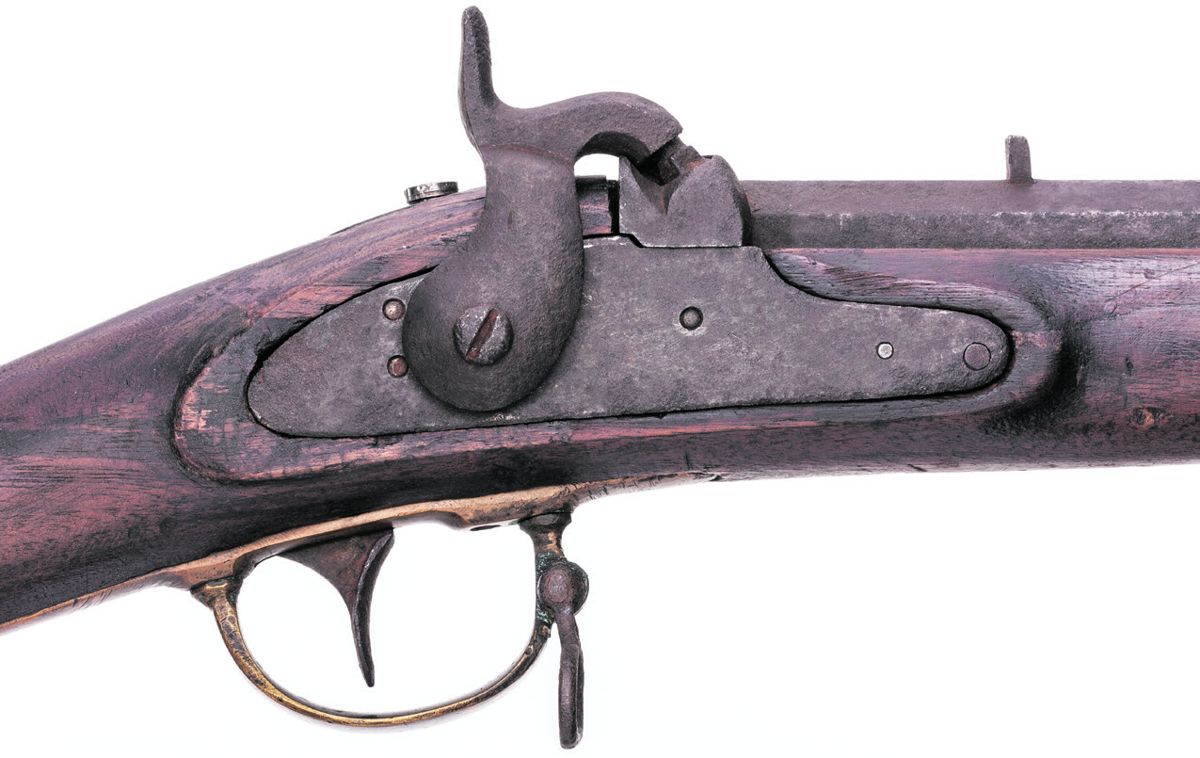
Unmarked lock believed to have been manufactured by Davis Serial number 57 is stamped on the underside of the rifle barrel. The matching slash-marked roman numerals underneath the barrel and breech-plug tang are consistent with later Davis and Bozeman manufacture. (Courtesy The Atlanta History Center George Wray Collection. All photos by Jack Melton.)