
The Graphic War
Otto Botticher: Soldier, Artist
By Salvatore Cilella · Originally published December 2018 · pp. 22–23
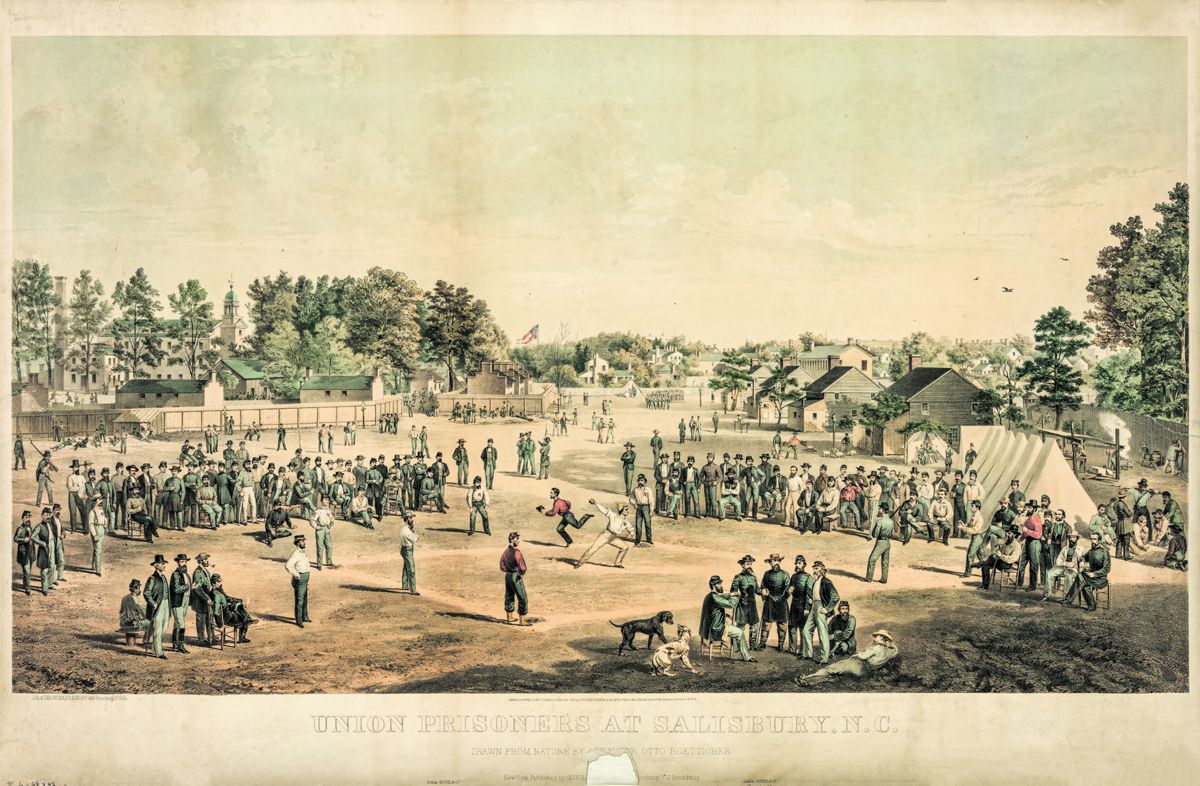
This occasional column highlights prints and printmakers from the Civil War. It discusses their meaning and most importantly, the goals of the print maker or artist. One of the lesser-known facts of the American Civil War is that not all prints—lithographs, steel engravings, and wood engravings, were produced by professional artists. Beyond Winslow Homer, Alfred Waud and Edwin Forbes, amateurs produced many prints. Even more interesting was the fact that soldiers in different units made drawings and etchings that were later translated into prints in volume enough to be sold to their fellow soldiers. This 19th century surge in printmaking was enhanced by the arrival of European emigrants many of whom entered the lithography business. The history of American printmaking is replete with German émigrés who came looking for a better life and a pathway to practicing their trade. Otto Botticher was one such artist, soldier and American patriot. Little is known of his early life. We do know he was born in Prussia, May 19, 1811. His formal education is undocumented, but he obviously had formal art training and “it appears that he was in the Prussian Army.”1 He emigrated with his growing family arriving in New York Jan. 6, 1848, just prior to the European revolutions of that year. Three years later he set up a printing shop in partnership with Charles Gildemeister at 289 Broadway; in 1858 he was listed a few doors down at 333 Broadway. The New York business directory identified both men as artists. Harry Peters, the father of the history of 19th Century lithography, called Botticher “an artist of considerable ability.”2 Before the outbreak of the war, Botticher produced paintings that became iconic lithographs of New York military subjects such as “The National Guard, 7th Regt., NYSM,” and a set of 18 colored plates of uniforms and equipment used by the United States Militia. Peters doubted that “Botticher himself had lithographic presses” so he relied on others to reproduce his oil on canvas to paper.3 According to Botticher’s biographer, Botticher teamed up with Thomas Benecke and located the new firm of Botticher and Benecke at 397 Broadway in 1854. His early work paled in comparison to two paintings that became prints during the Civil War—“Union Prisoners Playing
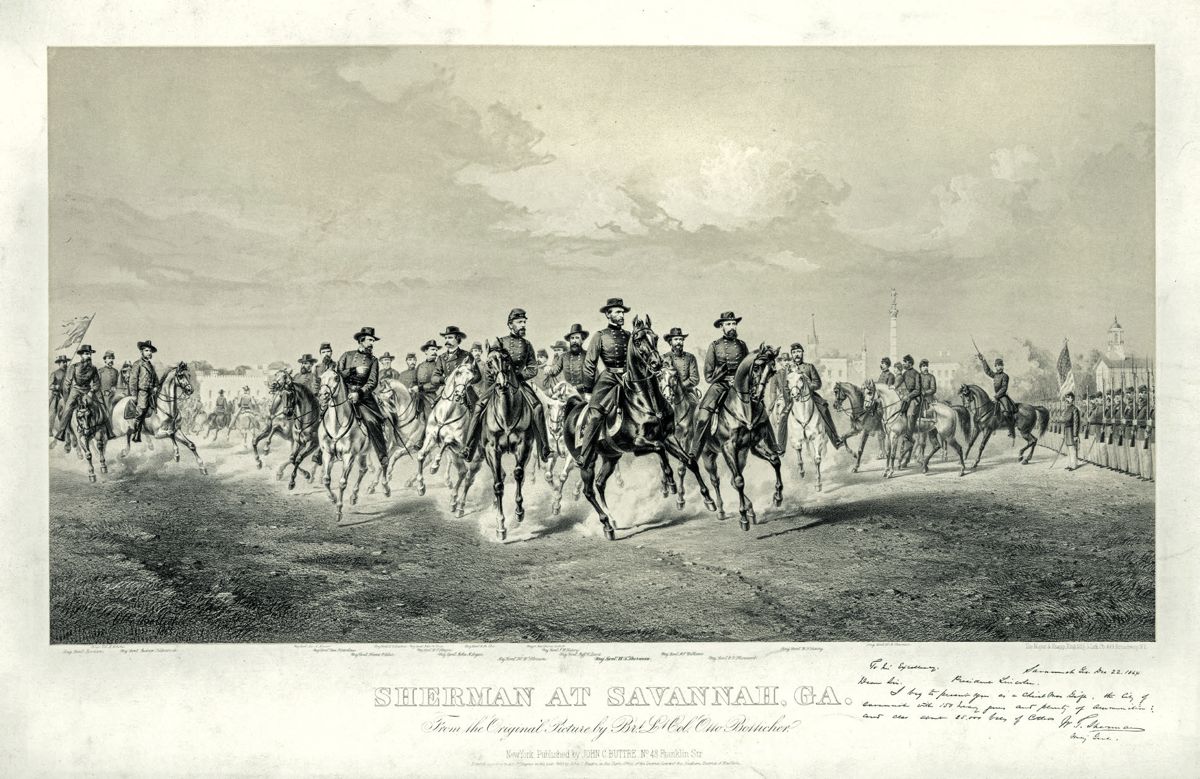
Baseball at Salisbury,” in 1863, and “Sherman at Savannah,” 1865. When war came, Botticher enrolled in the 68th New York Regiment of Infantry, variously known as the Cameron Rifles and the 2nd German Rifle Regiment, July 22, 1861, in New York City. His age at enlistment was given as 45, but he was actually 50. His military career lasted the war. A month after enlistment, he was promoted to Captain in Co. G; he was captured March 29, 1862 (probably around Bull Run); dropped from the rolls, April 18, 1862; paroled September 30, 1862; restored to command Feb. 9, 1863; made captain Co. B, Feb. 28, 1863; discharged, June 9, 1863; and made Brevet Lt. Colonel NY Volunteers, (no date). He fought with Pope in the Virginia Campaign of 1862 when he was captured. He was at Second Manassas, Chancellorsville, and Gettysburg, and then went west to Chattanooga and Missionary Ridge.4 Botticher was held at the Confederate prison at Salisbury, N.C. There he sketched the everyday activities of his fellow prisoners. The time he arrived at Salisbury until his famous print of a baseball game being played in the prison being issued, was a little over a year. In other words, between March 1862 and mid 1863 he was able to turn his sketches into a full fledged painting, have it lithographed by the New York firm of Sarony, Major and Knapp and then published by Goupil and Co. Both firms brought significant capital and marketing expertise to the project, as they “were able to capitalize on the interest in the newly popular American game.”5 The print was both realistic and controversial. According to the Library of Congress, the print shows a similarity to modern day softball, “no gloves are in use, and the pitcher is throwing underhand.”6 Regardless, much more is going on in Botticher’s print. Early war liberal attitudes and fewer prisoners allowed for a more relaxed environment. Salisbury prisoners reported being able to “whittle, read, write letters, attend lectures, perform ‘theatrics,’ play cards such as poker, and go fishing. Prisoners also gambled, as is evidenced by the dice game underway in the lower right corner of the print.”7 Salisbury was noted for its baseball games according to baseball historian, George B. Kirsch. One prisoner noted in his 1862 diary that the Fourth of July was “celebrated with music, reading of the Declaration of Independence, and sack and foot races in the afternoon, and also a baseball game.”8 Botticher caught Salisbury at its progressive best. Conditions rapidly deteriorated as the war dragged on and such a picture could not have been produced later in the war. By 1864 the prison’s population swelled from 5,000 to 10,000. As in other prisons, overcrowding led to disease and death. In a caption for this print in their book, author’s Harold Holzer and Mark E. Neely Jr. The Union Image: Popular Prints of the Civil War North, miss or conflate the timing of this print with later conditions. They write: “The artist could hardly have aimed wider of the mark of national feeling in this image, which created an almost collegiate ambience at a time when Northern patriots were denouncing the undernourishment of Union prisoners…and their suffering in vile conditions.”9 (Library of Congress) With his painting, “Sherman Christmas present. According to Lyon Company, State Printers, in Georgia,” Botticher again Neely/Holzer, Botticher “created 1912, 2680 and Osborne, showed his ability to capture the one of the best of the equestrian “Botticher,” 13. tenor of the moment. Again, he group print portraits of the Civil was there; again, he created an War, a well-drawn picture whose 5. Debbie Schaefer-Jacobs, “Civil War Baseball,” August 2, 2012 iconic image; this time it was horses assume imaginatively varhttp://americanhistory.si.edu/ victorious Federal troops at an ied positions and, for once, kick blog/2012/08/civil-war-basehistoric moment. This compo- up considerable dust.”11 sition is formal, with the perIn 1868, Botticher issued one ball.html. Hereafter, Schaeferspective going off to either side. last print marking Lee’s surrenJacobs, “Baseball.” Whereas “Baseball” is a relaxed der; it bears striking similarity 6. Library of Congress, The scene connecting it to an almost to his “Sherman at Savannah” in American Civil War: A Centennial Exhibition, folk-art tradition, “Sherman” is composition. There are no known Washington, GPO, 1961, 14. more rigid and formal. The view prints after this date bearing his shows Sherman’s officers gallop- signature. By 1869, he had ap- 7. Schaefer-Jacobs, “Baseball.” ing across Savannah’s Forsyth parently abandoned art and be- 8. George B. Kirsch, Baseball in Blue and Gray: The National Place, “looking north. The came an “Agent of the Consulate Pastime During the Civil War, steeples of St. John’s Episcopal General of the North American Princeton, Princeton University and Independent Presbyterian Union” in New York City. He Press, 2003, 43. churches and the tall monument died July 3, 1886, and was burto Casmir Pulaski in Monterey ied in the Lutheran Cemetery, 9. Harold Holzer, Mark E. Neely Jr. The Union Image: Popular Square are visible in the dis- Queens, N.Y. Prints of the Civil War North, tance.” Botticher may have used In a footnote to history, the Chapel Hill: The University of an 1855 engraving of Savannah Cattaraugus County Historical North Carolina Press, 2000, 60. for his inspiration.10 Society in Machias, N.Y., has They concede that it is probably The officers on horseback re- a copy of the Savannah print, the earliest image of the nationviewing troops to the right are all which it received as a donation named: Brigadier General Jordan, in 1923. A Patrick Jones fan, al pastime. Hereafter Holzer, Neely, Union Image. Brevet Colonel L.G. Estes, Major unhappy that this hero was not Dunkelman, “The General Judson Kilpatrick, Major represented, replaced General 10. Mark Doctored Botticher,” Military General Joseph A. Mower, Major Henry Barnum on the print’s far Images, Vol. XXVIII, No. 5, General Peter J. Osterhaus, right with General Patrick Henry March/April, 2007, 17-19, Major General Frank P. Blair, Jones, commander of the 154th 17. Hereafter Dunkelman, Brigadier General L.C. Easton, New York Volunteers.12 “Botticher.” Major General John M. Corse, 11. Holzer, Neely, Union Image, Major General W.P. Hazen, Endnotes: 192.
The officers on horseback reviewing troops to the right are all named: Brigadier General Jordan, Brevet Colonel L.G. Estes, Major General Judson Kilpatrick, Major General Joseph A. Mower, Major General Peter J. Osterhaus, Major General Frank P. Blair, Brigadier General L.C. Easton, Major General John M. Corse, Major General W.P. Hazen, Major General John A. Logan, Brigadier General O.M. Poe, Major General H.W. Slocum, Major George Ward Nichols, Major General J.W. Geary, Major General Jeff O. Davis, Major General W.T. Sherman, Major General A.S. Williams, Major General O.O. Howard, Major General W.F. Barry, Brigadier General H.A. Barnum. In the right corner of the print is a copy of Sherman’s note to Lincoln dated Dec. 22, 1864, offering the city to the President as a Christmas present.
Endnotes: 1. Seward R. Osborne, “Otto Botticher: American Military Artist-Lithographer-Soldier,” Military Images, Vol. XXVIII, No. 5, March/April, 2007, 9-15, 10. Hereafter, Osborne, “Botticher.” 2. Harry Peters, America on Stone, New York, Arno Press, 1976 reprint, 100. Hereafter, Peters, Stone. 3. Peters, Stone, 100. 4. Frederick Phisterer, New York in the War of the Rebellion: 1861 to 1865. 3d. ed. 5 vols. Albany: J.B. Lyon Company, State Printers, 1912, 2680 and Osborne, “Botticher,” 13. 5. Debbie Schaefer-Jacobs, “Civil War Baseball,” August 2, 2012 http://americanhistory.si.edu/blog/2012/08/civil-war-baseball.html. Hereafter, Schaefer-Jacobs, “Baseball.” 6. Library of Congress, The American Civil War: A Centennial Exhibition, Washington, GPO, 1961, 14. 7. Schaefer-Jacobs, “Baseball.” 8. George B. Kirsch, Baseball in Blue and Gray: The National Pastime During the Civil War, Princeton, Princeton University Press, 2003, 43. 9. Harold Holzer, Mark E. Neely Jr. The Union Image: Popular Prints of the Civil War North, Chapel Hill: The University of North Carolina Press, 2000, 60. They concede that it is probably the earliest image of the national pastime. Hereafter Holzer, Neely, Union Image. 10. Mark Dunkelman, “The Doctored Botticher,” Military Images, Vol. XXVIII, No. 5, March/April, 2007, 17-19, 17. Hereafter Dunkelman, “Botticher.” 11. Holzer, Neely, Union Image, 192. 12. Dunkelman, “Botticher,” 18-19.
Salvatore Cilella is retired after 43 years in the museum field. His last position was President and CEO of the Atlanta History Center. He is the author and editor of several articles and books including Upton’s Regulars: A History of the 121st New York Volunteers in the Civil War (U. Press Kansas, 2009) and The Correspondence of General Emory Upton, 1856-1881 (U. Tennessee Press, 2017).