
John L. Porter Designed First Confederate Ironclad Warship
By Bob Ruegsegger · Originally published December 2018 · pp. 30–31
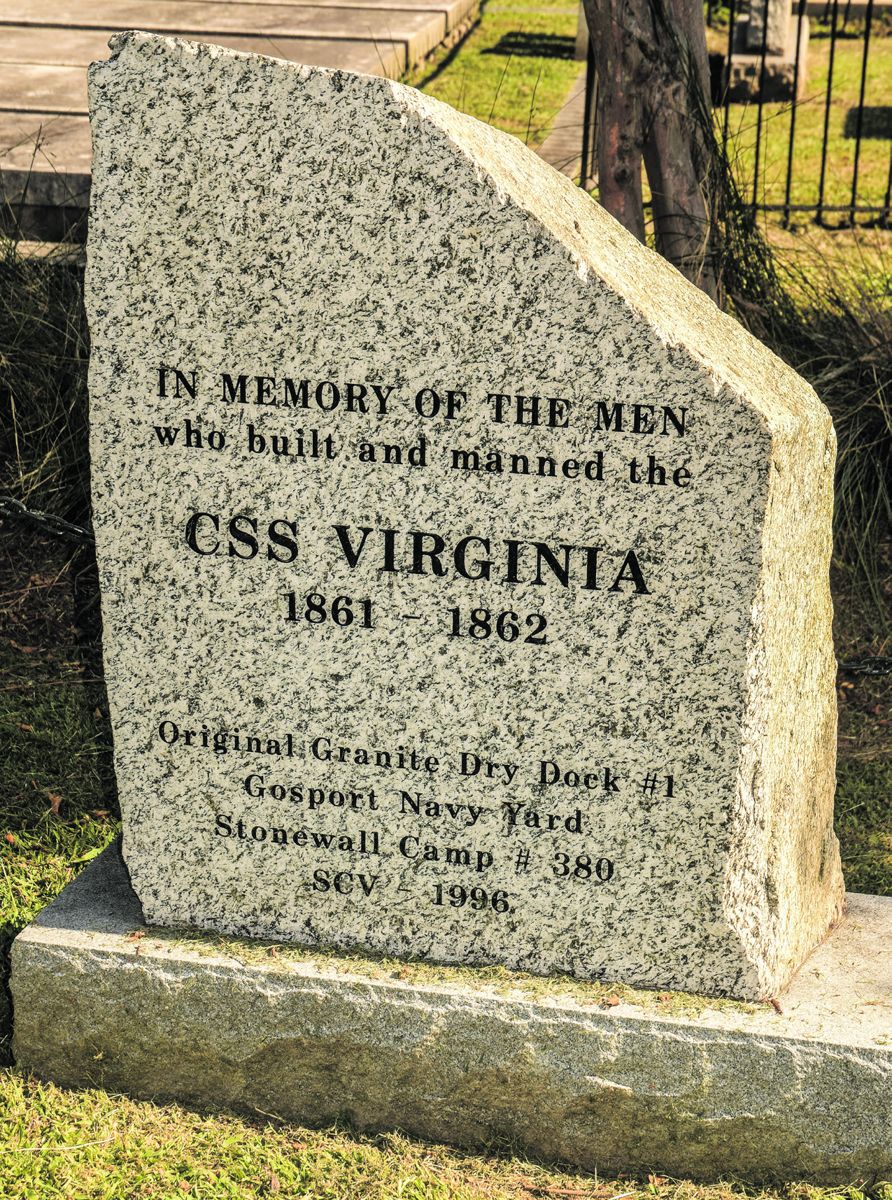
Naval Constructor John Luke Porter did all that he could during his lifetime to make it clear that he was primarily responsible for transforming the charred hulk of the USS Merrimac into the ironclad CSS Virginia. Porter presumably rests in peace in Cedar Grove Cemetery off Effinghham Street in Portsmouth, Va., not far from the old Gosport Navy Yard where he helped to create a revolutionary addition to maritime history. There are no visible signs in the vicinity of his final resting place to indicate that anyone has been—or ever was—spinning in his grave. While Porter readily and graciously acknowledged the contributions that others made in the metamorphosis of the Federal steam frigate into the Confederate ironclad, he always maintained that the design for the Rebel ironclad was his and his alone. After Porter resigned his position as naval constructor with the United States service, he accepted a comparable assignment in the Confederate service. “John Porter was against the Civil War. He was against secession. He was against slavery. He was a very forward-looking Methodist man of his time—very well educated,” observed Alan B. Flanders, naval historian and author of John L. Porter Naval Constructor of Destiny (2000). “The only reason he fought for the South was because Virginia seceded. He was in the Washington Navy Yard and was quite against all of this.” As an experienced naval constructor, Porter realized the huge advantage the United States Navy had over the fledgling Confederate Navy. Porter thought that an ironclad vessel designed for harbor defense might help balance the odds. Much earlier, in 1846, while superintending the construction of the iron steamer Allegheny in Pittsburgh, Porter came up with a design for a floating ironclad battery and produced “a model with the exact shield” ultimately placed on the CSS Virginia. The United States Navy was simply not interested in Porter’s design in 1846. Fifteen years later, with the Union Navy threatening to blockade all Southern ports, Stephen Mallory, Secretary of the Confederate Navy, was extremely receptive to building ironclad warships for harbor defense and seagoing ironclads to break the blockade. Seeing an opportunity to make his design a reality, Porter dusted off his 1846 plan for the floating ironclad battery and offered a modification of the original design and a model to Secretary Mallory. Mallory was instantly convinced of the merits of Porter’s idea and ordered a board to examine Porter’s design and prototype. Constructor John L. Porter, Chief Engineer William P. Williamson, and Lt. John M. Brooke were appointed as members of the hastily-formed committee. The group unanimously recommended, without reservation, the construction of an ironclad built according to Porter’s proposed design. “When they went to Richmond for meetings, Porter was happy to allow Brooke to be the bureaucratic supervisor over the project,” said Flanders. “That didn’t bother him. That was Porter’s personality. He was a very humble man.” Porter returned to the Gosport shipyard with orders from
designs of the Constructor and Engineer Messrs. Porter and Williamson,” wrote Mallory. “As time is of the utmost importance in the matter, you will see that the work progresses without delay to completion.” In his detailed account of building the CSS Virginia (Merrimac), Porter described calculating the hull weight, as he intended to fit the vessel, with great care. He considered everything that was to go aboard, armor, machinery, guns, ammunition, coal, stores, shot and shell. “Porter’s heart and soul were in the project,” said Flanders. “John Porter’s invention changed the course of world naval history—in two days.” Porter ordered the Merrimac
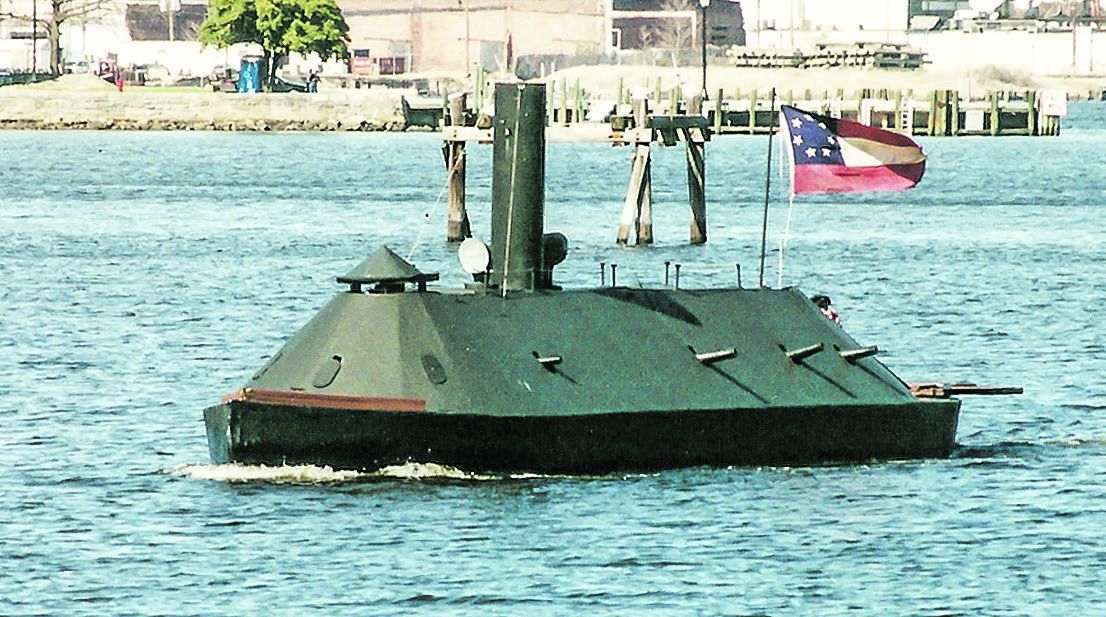
Secretary Mallory to Flag Officer French Forrest, commander of the naval shipyard, to construct an ironclad. “Sir—You will proceed with all practicable dispatch to make the changes in the Merrimac, and to build, equip and fit her in all respects, according to the
The earthly remains of John L. Porter are reputed to rest in peace beneath the simple grave site covered with bricks and a small marble marker.
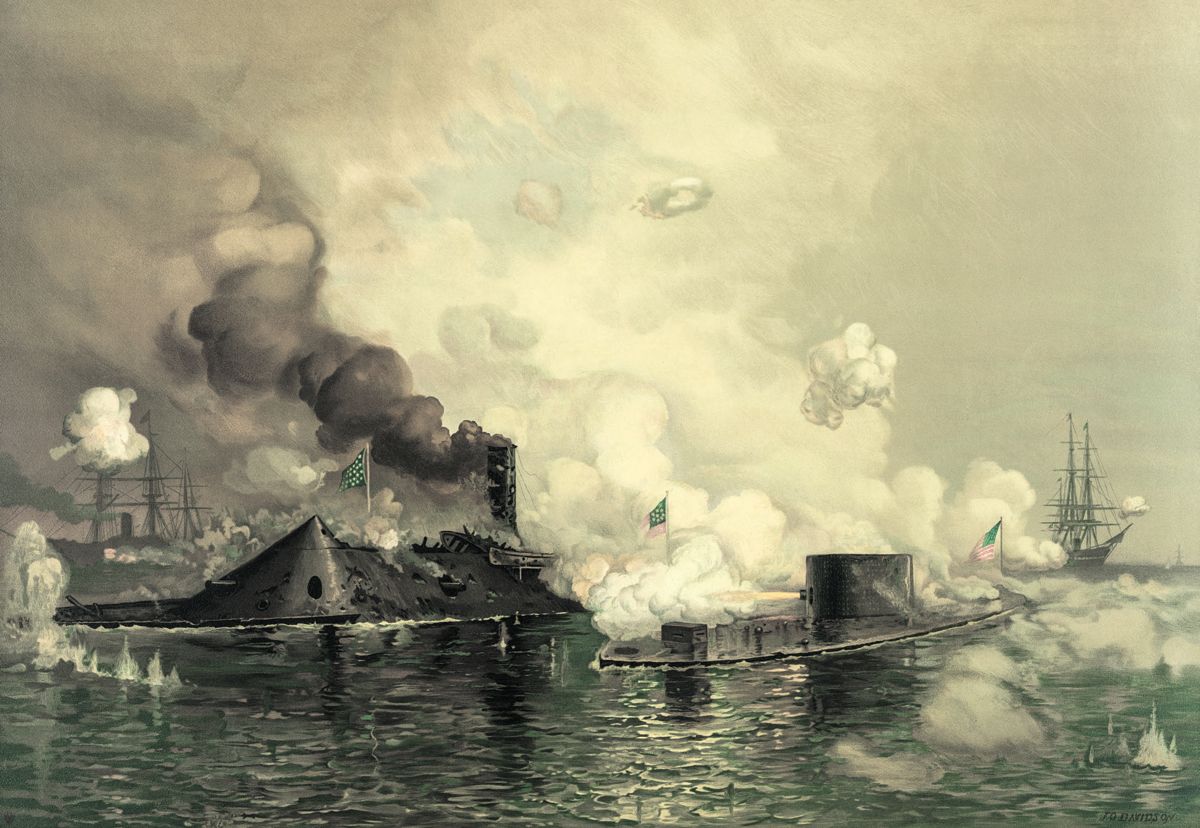
cut down fore and aft. Oak knees were fitted between the original frames and bolted to them. Yellow pine timbers formed a solid frame, 24 inches thick, on which four inches of armor shield were eventually affixed. The vessel’s iron shield was 157 feet in length. Porter’s design called for ten guns in all, four guns on each side and one pivot gun fore and aft. Eight of the ship’s ten guns were 9-inch Dahlgrens. The two pivot guns were bored out to seven inches, banded, and rifled at the Tredegar Iron Works in Richmond where Lt. John Brooke was superintendent. The detailed design for the ironclad warship was drawn by Porter on a scroll that measured more than 17 feet in length. The Mariners’ Museum has plans and drawings in its collection for John Porter’s Floating Ironclad Battery (1846) as well as Porter’s Gun Deck Arrangements for the CSS Virginia (1861). While Porter was confident that his design would provide a revolutionary ironclad warship, others were far less certain of the vessel’s stability. Lt. Catesby Jones who commanded the CSS Virginia during her engagement with the USS Monitor had his doubts. On Feb. 17, 1862, people gathered around the dry-dock to witness the warship’s launching. Some were taking bets that it wouldn’t float. Many believed that the CSS Virginia would keel over or flood. “They looked around in the excitement of the applause, and Porter had walked home to eat lunch at his house here in Old Towne,” said Flanders. “He didn’t even stay for the ceremonial launch. Porter was that confident that it would work.” Following the CSS Virginia’s “wonderful achievements” in Hampton Roads on March 8-9, 1862, articles were published in the Richmond Enquirer and Whig that credited Lt. John Brooke with being the inventor of the CSS Virginia. The articles were written by someone connected with Lt. Brooke’s office. According to Alan Flanders, Porter never expected or wanted notoriety, acclaim, or attention. “That’s the kind of man he was. It wouldn’t have mattered,” noted Flanders. “What really mattered was the truth.” Constructor Porter was extremely unhappy that the rightful claim to his role as designer of the successful Confederate warship had been unjustly claimed for Lt. Brooke. Engineer Williamson had warned Porter that Lt. Brooke had an “aptness to appropriate” the plans of others as his own. Infuriated by the false claim, Porter was determined to set the record straight although he continued to graciously acknowledge contributions others made in the warship’s production. He readily conceded that Engineer Williamson successfully discharged his duties in terms of restoring and modifying the ship’s engines and that they actually performed beyond expectations. Propeller improvements made by Williamson increased the ship’s speed by three knots. Porter also granted that Lt. Brooke was of great assistance to the Department of the Navy in experimenting with the thickness of the armor, assembling her battery, and attending to the shipment of iron. For Brooke to claim credit for designing the ironclad was simply too much for John Porter to bear. An “unpleasant controversy” developed between the two men. “…I shall be excused for defending my claim not only as the constructor but originator of the plan of the Virginia,” predicted John Porter. The obelisk that towers above John Luke Porter’s otherwise modest grave in Cedar Grove Cemetery emphatically notes, construction as well as the ves“He was the designer of the first sel’s performance in battle and iron-clad, ‘The Merrimac.’” her intentional destruction. For John L. Porter, designing and constructing the first *Editorial comment. Prior Confederate ironclad warship to the CSS Virginia, European was a matter of great pride. It builders constructed ironclad was an honor he felt that he had rightfully earned and one that he steadfastly refused to relinquish even in death.
![A granite obelisk towers above the grave of John L. Porter in Cedar Grove Cemetery in Portsmouth, Va. The inscription chiseled into the stone reads: “He was the designer of the first [sic*] iron-clad – ‘The Merrimac.’”](/article-images/cwn-2018-december/cwn-2018-december-john-l-porter-designed-first-confederate-06.jpg)
Note: John L. Porter: Naval Constructor of Destiny by Alan B. Flanders offers readers a detailed account of the construction of the CSS Virginia as well as some interesting additional material on the Porter-Brooke controversy. Confederate Phoenix by R. Thomas Campbell and Alan Flanders also offers an account of the CSS Virginia’s design and construction as well as the vessel’s performance in battle and her intentional destruction.
*Editorial comment. Prior to the CSS Virginia, European builders constructed ironclad warships.
Bob Ruegsegger is an American by birth and a Virginian. His assignments frequently take him to historic sites throughout Virginia, the Mid-Atlantic, and the Southeast. His favorite haunts include sites within Virginia’s Historic Triangle—Jamestown, Yorktown, and Williamsburg. Bob served briefly in the U.S. Navy. He is a retired educator and has been an active newspaper journalist for the last twenty years.