
Critic's Corner
Grant and Twain: The Story of a Friendship that Changed America
By Stephen Davis · Originally published December 2018 · pp. 38–39
Mark Perry, Grant and Twain: The Story of a Friendship that Changed America (Random House, 2004)
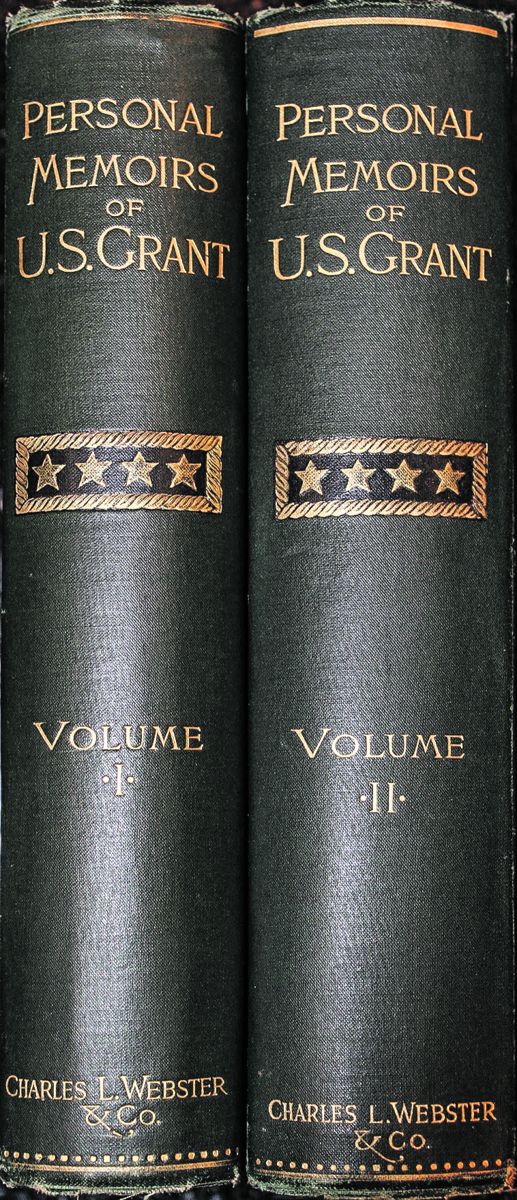
Recently I pulled from my bookshelf Ulysses S. Grant’s two-volume Personal Memoirs, which I bought in a very early edition published by the Charles L. Webster Company in 1886. I’m very proud of these books; photographs of them taken by my grand-daughter Haley Hawk accompany this text. I became interested anew about how Grant wrote his reminiscences late in life while fighting throat cancer, with the help of Mark Twain. Most of us know the general outlines of the story. After consulting Ron Chernow’s new biography of Grant (reviewed in CWN this past June), I turned to Mark Perry’s Grant and Twain. I found his story about Ulysses S. Grant’s and Samuel L. Clemens’ collaboration for the Memoirs, 1884–1885, so intriguing that I chose to feature Perry’s work in this month’s column. It started with “Battles and Leaders.” During 1883–84 Roswell Smith, president of the Century Company in New York, Richard Watson Gilder, senior editor of Century Magazine, and Robert Underwood Johnson, associate editor, planned a threeyear series of articles written by leading Union and Confederate officers about the war in their magazine. Gilder and assistant editor Clarence Clough Buel were soon engaged in “general catching”—securing officers’ agreement to write for the series. In June 1884, Johnson visited Grant to recruit him for writing four articles about his campaigns, offering him $500 for each. Just the month before, the investment firm Grant had established with Ferdinand Ward went belly-up. (“Ferdinand Ward operated what would later be termed a Ponzi scheme,” as Chernow puts it.) The general, needing the money, agreed. Grant would eventually write articles on Shiloh, Vicksburg, Chattanooga, and the Wilderness; he turned first to Shiloh, writing throughout June. To assist in researching and editing his article, Grant got help from Adam Badeau, a close aide during the war who was then writing his own history of Grant’s campaigns. The general’s thirty-four-year-old son Fred also assisted. On the first of July, Gilder was overjoyed to get Grant’s handwritten draft; this would be a coup for Century. “But the article itself was flat,” Perry writes, “it was written on four single sheets of paper and gave a workable account of the battle, but that was all. There was no color or life in the article and almost none of Grant.” Johnson later visited the general, tactfully coaching him on how to improve his article. He had drafted it as a battle report; Century wanted a story, complete with characters and plot. In his conversation, Johnson was impressed that Grant seemed chatty and had excellent memories about Shiloh’s battle details. Johnson urged Grant to include them in his article. He would coax from him these vignettes, and after Grant responded, the editor would say, “Well, you should put that in the article.” Grant was surprised, but once he caught on, he quickly went back to work. He had completely rewritten the piece on Shiloh by the end of August. “Grant’s prose,” Mark Perry writes, “much to the surprise of Gilder, Johnson, and Smith, radiated confidence and had a sense of immediacy that brought the reader into the action.” Grant’s “The Battle of Shiloh” appeared in Century Magazine in February 1885, to considerable acclaim. Smith, Johnson, and Gilder began talking with Grant about writing his memoirs and having the Century Company publish them. On July 22, Johnson met with Grant, who said he was considering the project. At that time, the general was engaged in writing his second article for Century, on the Vicksburg Campaign. Grant found that he was enjoying the writing, devoting more than four hours a day to it. The piece was finished by the end of August. In early September 1884, Smith met with Grant at his family’s summer home in Long Beach, N.J., and presented his company’s offer to publish the general’s memoirs and sell them by subscription. Grant was initially skeptical that anyone would be interested in a book written by him. Smith, surprised, quickly assured him that the public would eagerly respond. During their meeting, Smith noticed that the general, on a warm day, had a scarf wrapped around his neck and that he spoke in a raspy voice. Three months before, Grant had been eating a peach in the company of his wife Julia when he suddenly yelled in pain; his throat throbbed. The episode lasted less than a minute, but during July the same spasms occurred more often, usually at mealtime.
Last photograph of Grant, taken June 1885, at Mt. McGregor, New York, a dozen miles from Saratoga. The general’s physicians had recommended the trip so he could escape New York City’s summer heat. Grant nevertheless spent September at Long Beach writing his third article for “Battles and Leaders,” this one on the Chattanooga Campaign. In late October, Grant and Julia left the beach to return home to New York City. Once there, Grant visited his family physician, complaining of throat pain that hindered his eating. The doctor sent him to a leading throat specialist, John H. Douglas. Dr. Douglas examined the general’s mouth and noticed an inflamed growth at the base of his tongue. Grant noticed his concern and asked, “Is it cancer?’ Douglas would only say that the disease was serious, even though he suspected it was malignant cancer: spreading, incurable, that it would be painful, and would eventually kill him. The general was not deceived by the doctor’s indirect answer; he knew his fate. After leaving Dr. Douglas, Grant went immediately to the Century offices and told Roswell Smith that he wanted to write his memoirs and have Century publish them. Smith explained how it would work. Once Grant’s book was published, agents would sell it across the country: 25,000 sales was not an unreasonable forecast. Century offered Grant a ten per cent royalty that was likely to yield $30,000-$50,000 for the author. By the end of October, Grant had begun outlining his memoirs. A worried Dr. Douglas in November sent a frozen specimen from Grant’s throat to a microbiologist. The diagnosis came back just as Douglas had feared: lingual epithelioma, cancer of the tongue. The condition was inoperable and Grant was given a year to live. By the end of November, pain was worsening and Grant gave up smoking cigars. He also plunged himself into his writing, helped by his son Fred and by Adam
Badeau. When he finished the last of his Century articles, on the Wilderness, the general saw that he could essentially pour the four pieces into his memoirs. Then he turned to writing about his childhood and early years. “His throat wrapped in a shawl, his head often covered from the early winter cold by a simple knitted cap,” writes Perry, “Grant worked from the early morning each day to well into the evening in a small room at the head of the stairs on the second floor at his home on 66th Street….Grant worked at a small desk that was filled with piles of notes compiled for him by the research of Badeau and Fred.” The two also spread maps out on a table for the general to consult. Grant wrote his own draft until he was too weak to do so. Fred and Adam read the text in another room, consulting books on the Mexican and Civil Wars, including Sherman’s Memoirs, which had been published in 1875. They jotted notes in
Grant as brevet second lieutenant in the Fourth Infantry. Recently graduated from West Point in 1843, Grant was 21 at the time. This steel engraving serves as frontispiece in Volume One of Grant’s Personal Memoirs. Photograph from the book by Haley Hawk.
margins of the manuscript, which Grant used in revision. At the end of each day, the three would plan the next morning’s work. By mid-November the general had still not signed Roswell Smith’s contract. Perry chronicles his deteriorating health: “while Grant worked diligently and for hours at a time, the effect of the cancer on his strength was apparent. His cough worsened, his throat seemed always aflame, and his voice began to fail.” Dr. Douglas began to visit the Grant home regularly, even as the general continued to write for several hours a day. During October-November, Mark Twain would leave his home in Elmira to ride to the city and visited Grant several times. He had heard the general was writing his memoirs and that the Century Company was seeking to publish them. Twain had by that time formed his own publishing company, named for his niece’s husband, Charles L. Webster, to turn out his future books (he had been using American Publishing Company, of Hartford, Conn.). Twain began angling to persuade Grant to allow his own company to publish the memoirs. Even after Richard Watson Gilder in early November ’84 told Twain that Century’s negotiations with Grant were nearly concluded, Clemens did not give up. Fearing that the general might soon sign with Century, he went to Grant’s home and indeed found him prepared to sign the contract, as Fred was reading it for the last time. As Grant took up his pen, according to Twain’s Autobiography, he said, “Don’t sign it. Let Col. Fred read it to me first.” Twain then read it and saw Century’s promise of ten per cent royalty on sales. He told the general to strike through that clause and insert twenty. Grant hesitated, allowing Twain to make his argument that Century was stealing his work; by different terms, Grant could earn as much as seventy-five per cent from his potential blockbuster. Grant balked, feeling he was honor-bound to sign with a firm with which he had been in discussions for months. Still, he asked Twain to name another company that might print his memoirs. Twain named American Publishing and offered to provide proof of the Hartford company’s interest in a few hours. Fred Grant was swayed, knowing that American had successfully published several of Twain’s books. Fred suggested that his father lay Century’s contract on the table for twenty-four hours. Grant agreed, but still held out. Twain, however, thought he had won the general over, to the point of thinking how he would sell the memoirs by subscription. The next day, Nov. 20, 1884, Twain returned to press his case anew, mentioning that General Sherman had told him that he had profited $25,000 by the sale of his two-volume reminiscences. Twain told Grant that he would make even more through subscription sales; Sherman’s had been marketed through booksellers alone. Then, as a final tactic, Twain told Grant that he would not publish the general’s memoirs through American Publishing Company, but by himself. “Sell me the memoirs, General,” he declared. “I am a publisher. I will double the price. I have a checkbook in my pocket; take my check for fifty thousand dollars now and let’s draw the contract.” Grant still held out, declaring that he wanted a friend to review Twain’s and Century’s offers. [Book Review Editor’s note: I apologize; this is such a good story, I will ask to conclude it in the next (January) issue of CWN.]
• •
•
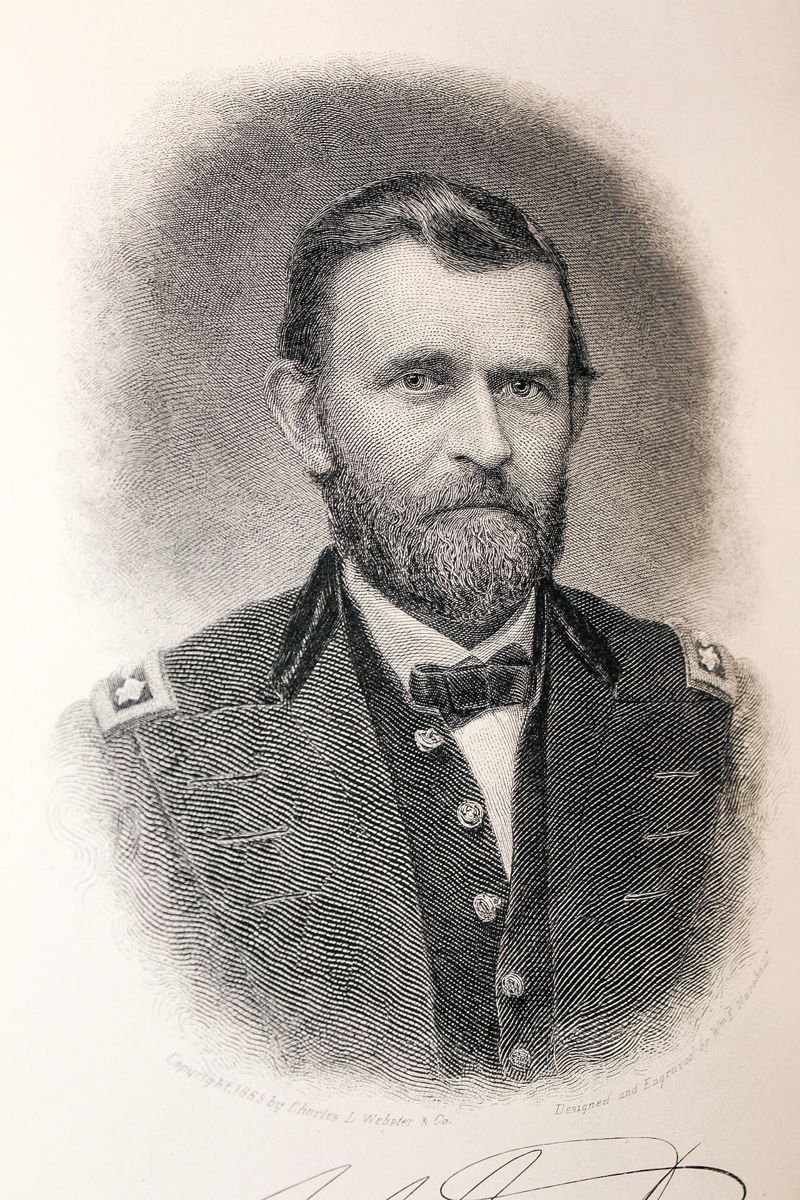
Steel engraving, signed “U.S. Grant Lt. Gen.” Below the image is “Designed and Engraved by William E. Marshall.” Technology of the time still did not permit printing of photographs, so the Charles L. Webster Co. had to arrange for this image to appear as frontispiece of Volume Two of Personal Memoirs. From Stephen Davis’ personal copy of the two volumes—bought a half-century ago for $17.50! Photograph by Haley Hawk.
Other sources consulted:
Chernow, Ron. Grant. New York, 2017. Davis, Stephen. “‘A Matter of Sensational Interest’: The Century ‘Battles and Leaders’ Series.” Civil War History, vol. 27, no. 4 (December 1981). 338-49. Johnson, Robert Underwood and Clarence Clough Buel, eds. Battles and Leaders of the Civil War. 4 vols. New York: Thomas Yoseloff, 1956 [1888].
Stephen Davis of Cumming, Ga., is Book Review Editor for Civil War News and author of “Small Talk.” He is currently writing a study of how the Atlanta Intelligencer, the city’s leading daily newspaper, covered the war, 1861–1865. His co-author is Bill Hendrick, veteran journalist of forty years, writing for the Atlanta JournalConstitution, Associated Press and many other publications. Their book will be published by the University of Tennessee Press. Steve and Bill have presented a paper on their work-in-progress at the Symposium on 19th Century Press, the Civil War, and Free Expression, held in Chattanooga, November 8-10.