Through The Lens
We Will Burn First
By Stephanie Hagiwara · Originally published August 2018 · pp. 10–11
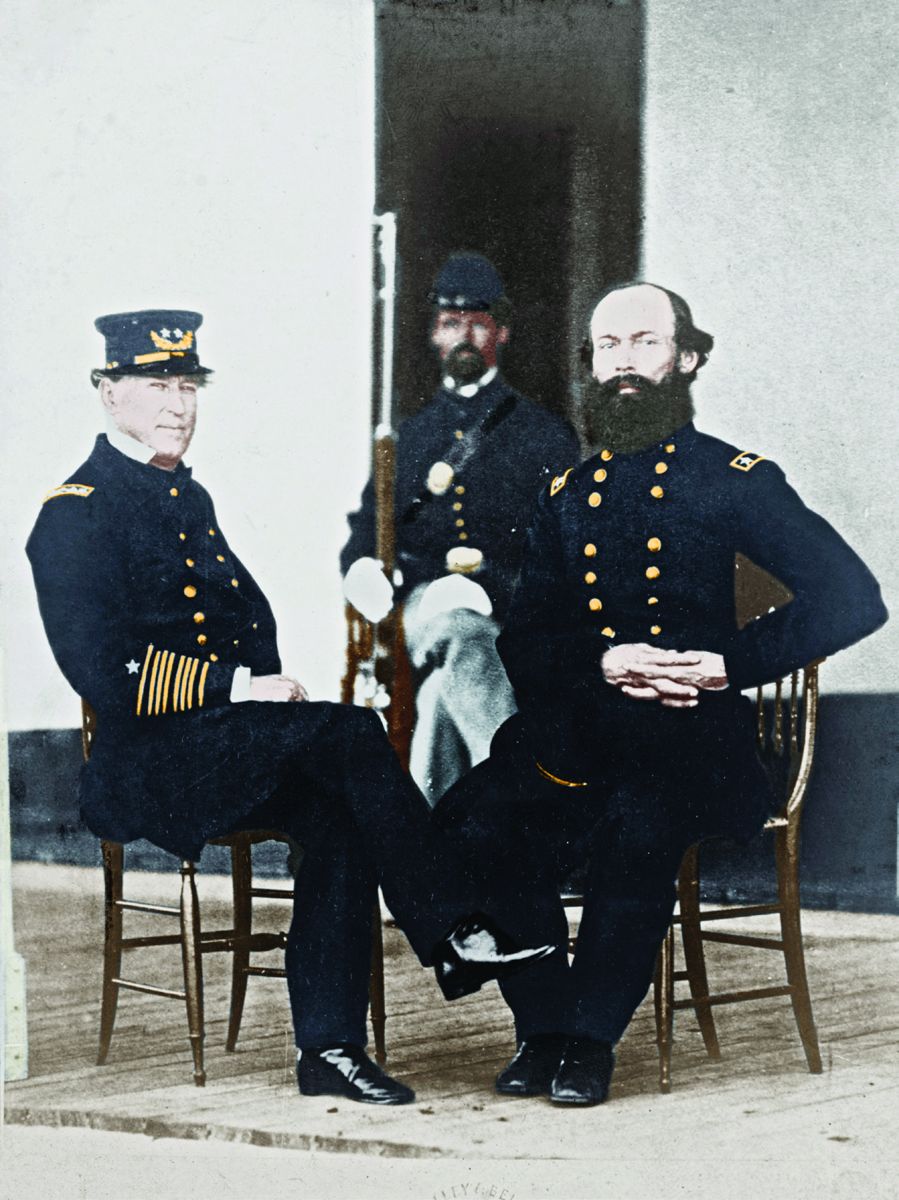
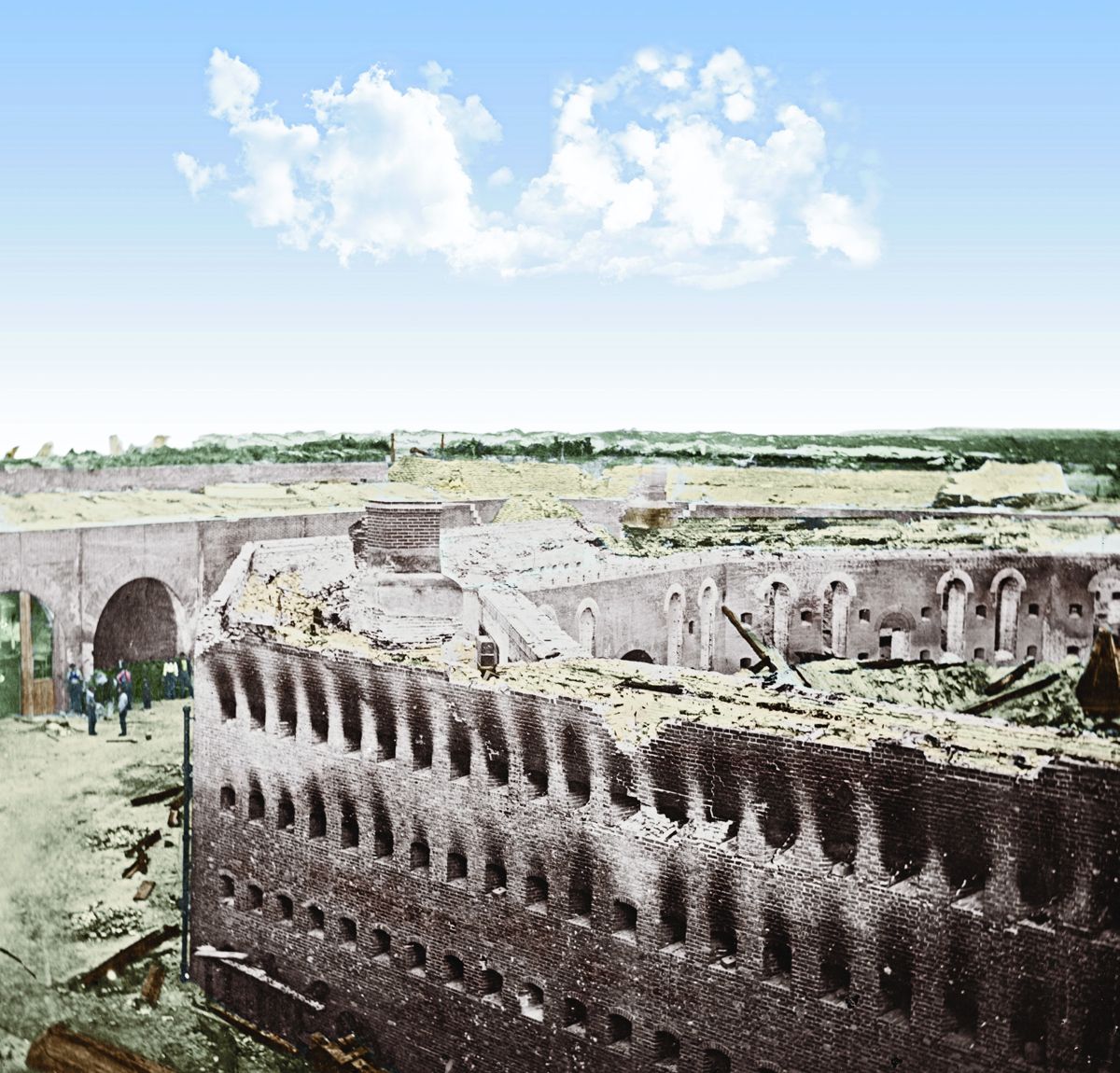
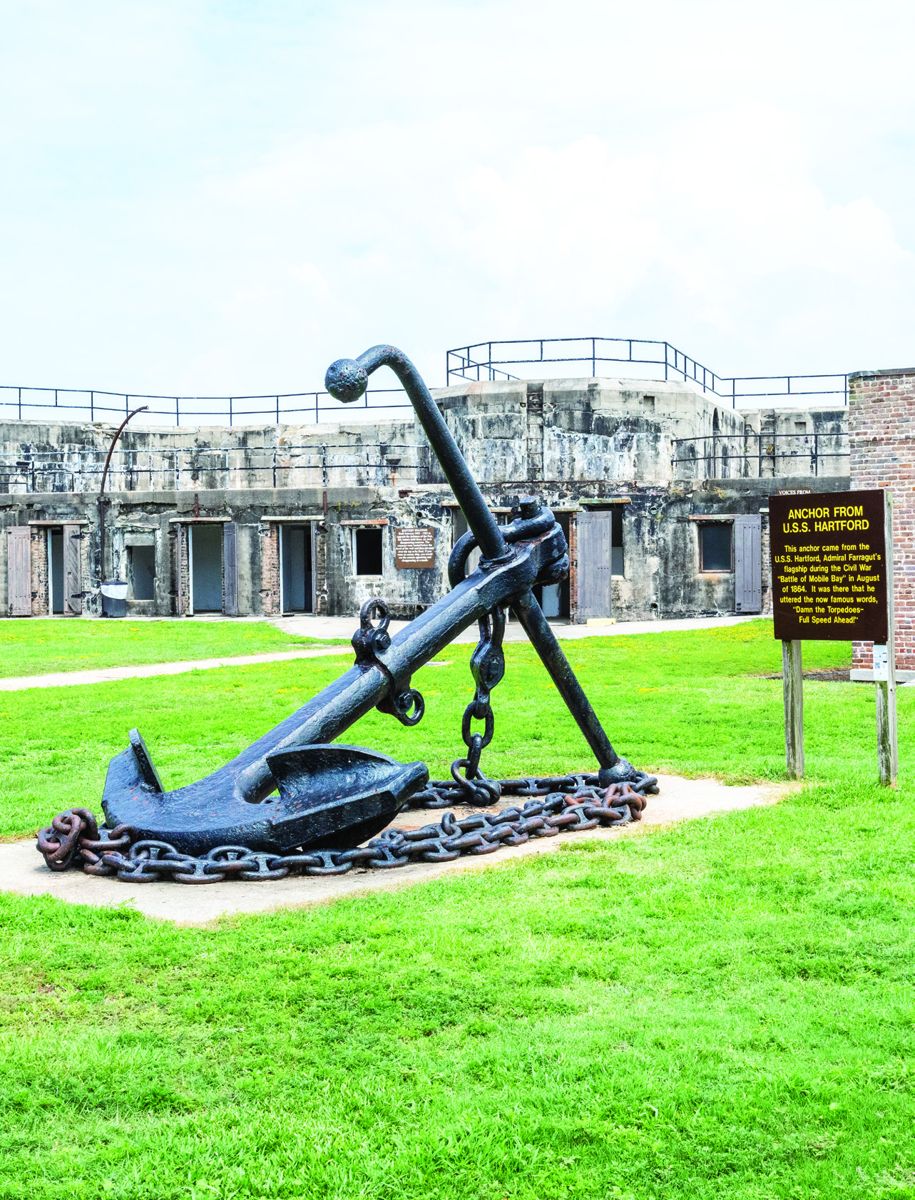
“If he [C.S. Gen. Richard Page] understands military science, he ought now to surrender at once.” – NY Times, Aug 24, 1864 By August 1864, the Federal blockade had managed to shutter all but two major Confederate ports, Wilmington, N.C., and Mobile Bay, Ala. To close Mobile Bay, U.S. Adm. David Farragut and U.S. Gen. Gordon Granger headed a joint land-sea campaign. The Army was tasked with capturing the twin masonry fortifications positioned at the mouth of the Bay, Ft. Morgan on a spit of land known as Mobile Point, designed to guard the shipping channel and Ft. Gaines on Dauphin Island, protecting a sheltered anchorage. Today, West Point graduate Granger is best known for coming to the aid of U.S. Gen. George “Rock of Chickamauga” Thomas during the Battle of Chickamauga, Ga., and freeing the slaves of Texas on June 19, 1865, resulting in the holiday known as “Juneteenth.” Granger was candid and “for the mere tinsel of rank he had no respect.” He was a stickler for following military procedure but earned the ire of Gen. Ulysses Grant by refusing to move without basic supplies for his men. Granger used political pull to return to the field. C.S. Col. Charles Anderson led the 21st Ala., reservists and cadets from Pelham Military Academy, Ala., who made up the 800man garrison of Ft. Gaines. The Federal government had almost finished remodeling Gaines before the War began. Armed with 26 guns, including four 10-inch
Columbiads, the 22-foot high walls were designed to survive a six-month siege, had a rain catchment system and latrines flushed by the tide. It would come as a shock to her defenders that rifled guns had made brick walls obsolete. On August 3, Granger and 1,500 men landed on Dauphin Island, seven miles from Gaines, intent on making the fort a staging area for taking Mobile. On the fourth, they were within 1,200 yards. On Aug. 5, Farragut’s 199gun fleet attacked. As agreed, Granger’s troops began shelling Fort Gaines with six 3-inch rifled guns. His sharpshooters climbed the surrounding sand dunes, shooting down into Gaines. From the north, came shells from monitors Chickasaw and Winnebago. On the sixth, the officers petitioned Anderson to surrender. Although inclined to hold out, Anderson realized, “We could render Mobile no assistance. We could render Morgan no assistance, and we could have done no harm to the enemy.” Furthermore, he could have had a mutiny on his hands. He sent word to Farragut for honorable surrender terms. At 8 a.m. on August 8, Anderson formally surrendered Fort Gaines; the POWs were sent to New Orleans, La., and the Stars and Stripes flew above. “I found the fort in excellent order,” reported Cpt. Miles McAlester, Chief Engineer. He noted that its defenses, “… was [sic] utterly weak and inefficient against our attack (land and naval), which would have taken all its fronts in front, enfilade, and reverse.” Commanding Fort Morgan and all the Mobile Bay defenses was C.S. Brig. Gen. Richard Page, cousin of Gen. Robert E. Lee and former Farragut friend. When Page spotted the truce boat he was livid. He repeatedly sent messages to Anderson via boat and telegraph: “Hold the Fort. …. Stop communicating with the enemy; all terms or stipulations made by you are annulled.” Page called the surrender, “… a deed of dishonor and disgrace to its commander and garrison.” Confederate President Jefferson Davis vowed to put Anderson on trial if exchanged. “I am prepared to sacrifice life, and will only surrender when I have no means of defense,” Page messaged Farragut. During the Battle of Mobile Bay, the guns on both sides blazed as the fleet passed. “The roar of cannon was like one continuous peal of thunder, deafening to the extreme.” Page placed his hopes on Morgan’s 46 guns that were deadly at close quarters, not to the ironclads, but to the wooden-hull ships. He ignored Chief Engineer Lt. Col. Victor von Scheliha’s assessment that Morgan, “… cannot withstand a vigorous bombardment.” To capture Mobile, Fort Morgan had to be taken. Over the next 12 days, Morgan was shelled sporadically. The Confederates worked frantically to strengthen the crumbling walls while Granger steadily moved 16 siege guns and 14 siege mortars 200 yards from the fort walls. Bricks flew as projectiles landed. The Confederate skirmishers and batteries returning fire, “appeared to be terrible full of fight.” On the Aug. 22, Federals began to bombard Morgan from both land and sea “from almost every point of the compass.” On the north side, Cpt. Mark Thomson of the 20th Iowa estimated that Battery Lincoln, “with the mortars they had charge of they throwed 40 shells in an hour & 15 minutes that is about as fast as they could use four pieces.” Page reported that the barrage made it, “useless to attempt to fire my guns, as the sharp-shooters could pick off my men as fast as they would appear at the guns. This bombardment disabled all my guns, save two, partly breached the walls in several places, cutting up the fort to such an extent as to make the whole work a mere mass of débris.” About 9 p.m., the pine beams of the citadel’s roof, a large ten-sided brick and wood structure that could house 400 soldiers caught fire. Asked if he wished to surrender, Page replied, “Never! We will burn first, with our fort!” The fire and disintegrating walls endangered the powder magazines. Into the drinking water 60,000 pounds of cannon powder were dumped. “This was a terrible job. The powder was in kegs, These we had to roll under the flames of the citadel and knock the heads in, then pour the contents in the cisterns. All this time the enemy kept up a continual fire from land and sea. The shells were bursting all around us. By one o’clock we had all the powder under water. There was not enough dry powder to shoot a musket,” wrote Robert B. Tarpley, 1st Tenn. Heavy Artillery.
At daybreak Page inspected the fort with his engineer. The good news, the fire had been put out; on the other hand, the guns, powder, bomb-proof, citadel and more had been destroyed. Page was forced to acknowledge that “I had no means left of defense.” He broke his sword over his knee and had the white flag raised. Sources: • Conner, Robert, General Gordon Granger: The Savior of Chickamauga and the Man Behind “Juneteenth” • Mattei, Eileen, A Tale of Two Forts on Mobile Bay: Fort Gaines and Fort Morgan www.armyhistory.org • Johnson, Robert Underwood and Clarence Clough Buel, eds. Battles and Leaders of the Civil War. Century, Page, Richard L., “The Defense of Fort Morgan.” Vol. 4, pp. 408–410. • The Historical Marker Database, “The Shells Were Bursting All Around Us” The Siege of Fort Morgan Stephanie Hagiwara is the editor for Civil War in Color.com and Civil War in 3D.com. She also writes a column for History in Full Color.com that covers stories of photographs of historical interest from the 1850’s to the present. Her articles can be found on Facebook, Tumblr and Pinterest.