
Black Powder, White Smoke
More Revolver Notes and the oval “NJ” Buckle
By Joe Bilby · Originally published August 2018 · p. 6
Two More Revolver Cylinder Stories Bear with me as I add another couple of footnotes to the extra cylinders versus multiple revolvers story. Yes, I know, I am beating the proverbial dead horse, but one account provides yet another bit of confirmation from a, frankly, unexpected quarter. David J. Silverman’s book Thundersticks: Firearms and the Violent Transformation of Native America is a valuable resource. Despite a few minor technical errors here and there, and a subtitle that seems like an exercise in Political Correctness; since Native Americans, like Europeans of the day, could be quite violent. There are abundant examples of such behavior before the introduction of firearms; the availability of guns just accelerated the process. Thundersticks provides some additional information on the percussion revolver story. In 1867 Colonel Richard Dodge, commanding Fort Dodge, (named after General Grenville Dodge), wrote in a report that “several Indians have visited this post, all of whom had revolvers in their possession. A large majority had two revolvers, and some of them three.” The perceptive Native Americans, seemingly quickly and efficiently took to the use of firearms after the introduction of the flintlock. They were not that interested in the matchlock or wheellock. They no doubt figured out on their own that multiple handguns were a source of convenient firepower. I believe we have finally put the myth of cylinder swapping, in the saddle or out of it, to rest. And then we have the inevitable outlier. In 1869, one Duncan MacDonald, a blacksmith in Mount Pleasant, Ohio, had a habit of carrying a revolver, minus its cylinder, around with him and “snapping” it at people as a joke. Despite the obvious danger of such a practice, he apparently kept a loaded and capped cylinder with him as well. One December day, while in a local saloon, MacDonald “playfully pointed and snapped” the gun at his friend Thomas Corcoran, “and shot him dead.” Unfortunately, he had returned the cylinder to the gun, but seemed to forget that act, since he was described as “being very drunk at the time.” The result is yet another reminder to never point a gun, loaded or unloaded, at anything you do not intend to shoot.
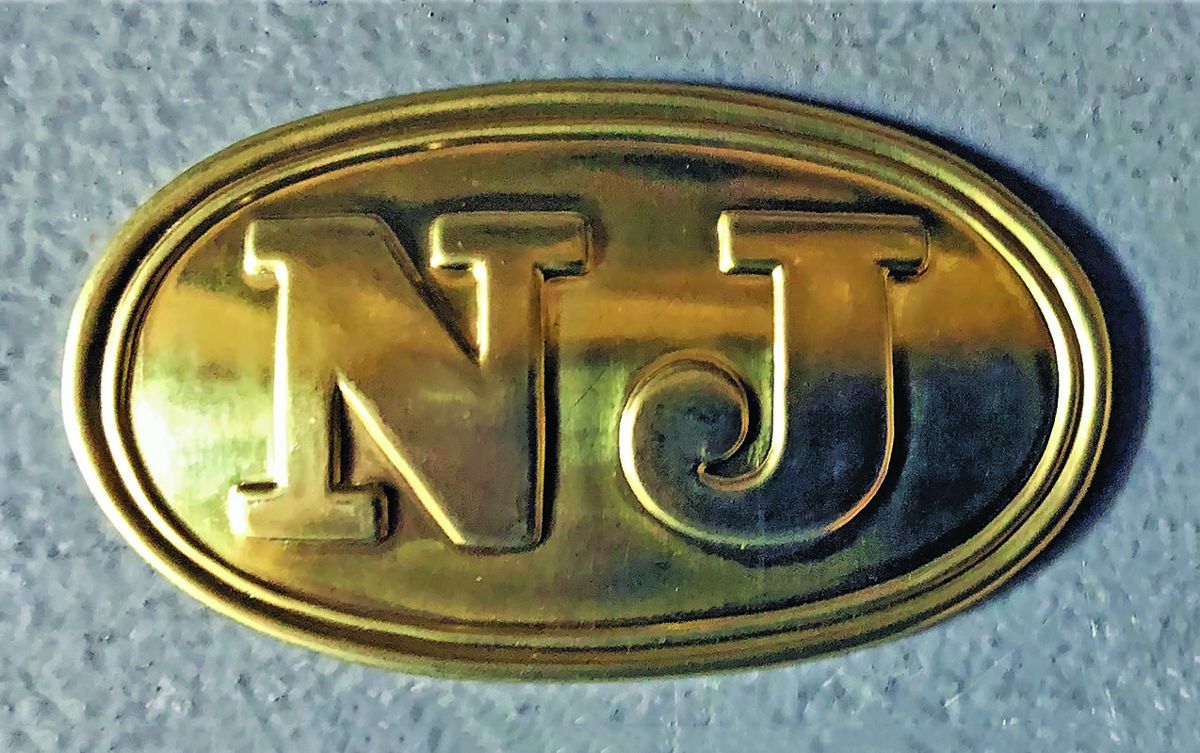
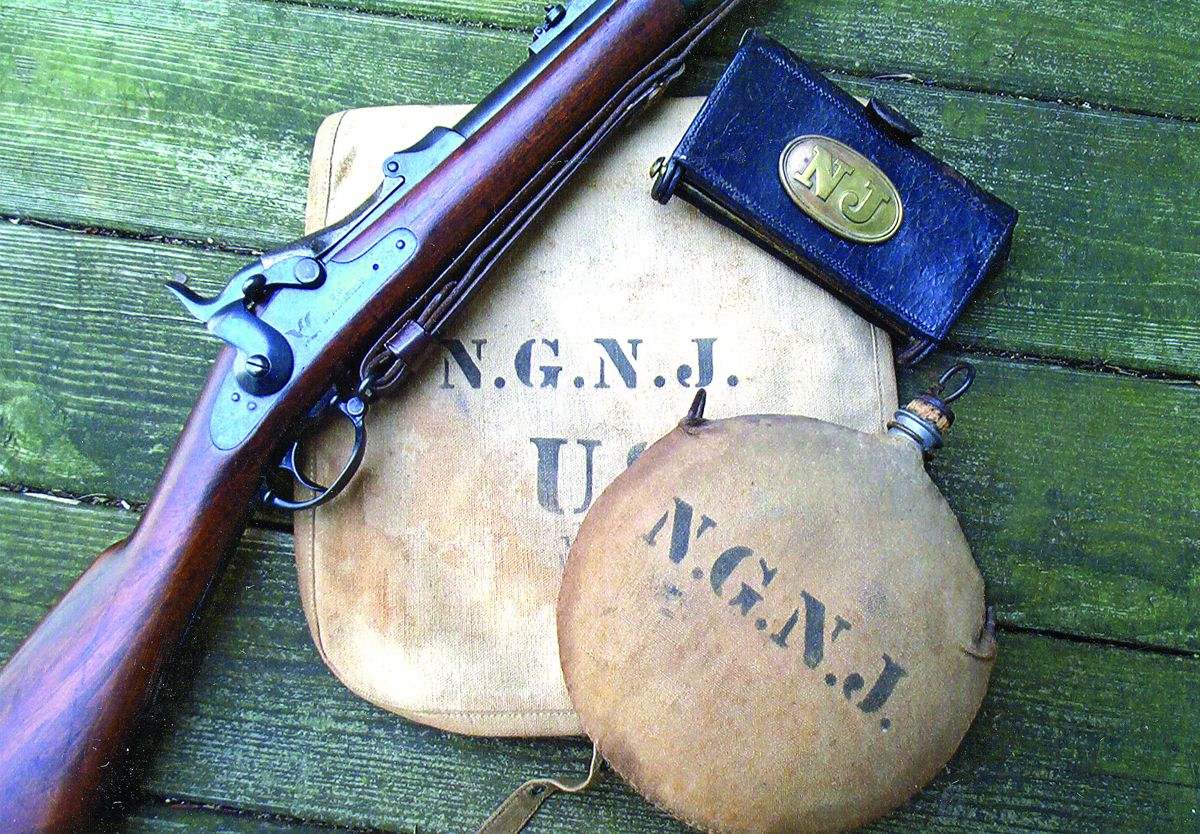
Those “NJ” Buckles and Plates Although this story is not really a Civil War tale, it has its origins in the aftermath of the conflict. Almost everyone involved in traditional black powder shooting, or collecting 19th century military artifacts, has seen an oval cartridge box or a belt buckle plate stamped “NJ.” The shape of the plate and the style of the lettering strongly suggest the Civil War era, and some folks not steeped in the era’s material culture have incorrectly identified them as Civil War relics, but they are considerably smaller and of a demonstrably later date. I recall purchasing my first McKeever cartridge box bearing a “NJ” plate at the iconic Bannerman’s store on lower Broadway in New York City in the 1950s. It cost me a grand total of fifty cents. These plates are unique, to be sure. This is how they came to be, and how you can get a new one today at a reasonable price. In 1875 the state of New Jersey began to receive Springfield Model 1873 .45-70 caliber breech loading rifles from the Federal government to replace the Civil War era muzzleloaders the state’s
National Guard had shouldered since 1864. It took three years to completely rearm the New Jersey Guard with the more modern arms. New Jersey Guardsmen quickly discovered that their issued Civil War era cartridge boxes were not readily adaptable to the new metallic cartridge ammunition, however. There were some attempts to modify the old boxes and experiments with various other options, none of which, however, proved satisfactory. In 1874 the United States army adopted the McKeever cartridge box, a twenty round capacity black leather ammunition carrier with two belt loops featuring an embossed “US” on the front flap. McKeever boxes were available from the Federal government for issue to the state’s National Guard so New Jersey Quartermaster General Lewis Perrine decided to adopt the McKeever box, but with a unique “Jersey” twist. In 1880 Perrine contracted with the Newark metalworking firm of Riley and Lynch to create a die to stamp an oval brass “NJ” plate that could be mounted on a cartridge box or made into a buckle. Another die was made to produce a “NJ” marked swivel attachment for the steel bayonet scabbard. Plates and swivels were shipped to the Watervliet Arsenal in New York, where Ordnance Department employees fitted them to standard issue McKeever boxes and bayonet scabbards destined for New Jersey. The belt buckles were completed in Newark and all ended up in the Trenton state arsenal for distribution to National Guard units across the state. No other state issued McKeever boxes with state marked plates. In his report to the governor for 1880, Perrine noted that “Twentyone companies of the National Guard have been supplied with these accoutrements. In my next report I hope to be able to say that the entire force is furnished with them. They were worn by the Battalion that participated in the Yorktown celebration and added greatly to the soldierly appearance of the men. Their superiority over the old-fashioned accoutrements is unquestioned.” In the early twentieth century, New Jersey sold most of its nineteenth century firearms and ordnance items to Bannerman’s, the famous New York City military surplus sales company. Recently S&S Firearms, a leading antique militaria and firearms parts dealer, acquired one of the original 1880 dies made by Riley and Lynch. They have now produced replicas of both the cartridge box and belt “NJ” plates. The image is of one of those reproduction plates. So, if you want a sample of Lewis Perrine’s great Jersey idea, contact S&S at http://www. ssfirearms.com.
(Joseph Bilby)
Joseph G. Bilby received his BA and MA degrees in history from Seton Hall University and served as a lieutenant in the 1st Infantry Division in 1966–1967. He is Assistant Curator of the New Jersey National Guard and Militia Museum, a freelance writer and historical consultant and author or editor of 21 books and over 400 articles on N.J. and military history and firearms, and as publications editor for the N.J. Civil War 150 Committee edited the award winning New Jersey Goes to War. His latest book, New Jersey: A Military History, was published by Westholme Publishing in 2017. He has received an award for contributions to Monmouth County (N.J.) history and an Award of Merit from the N.J. Historical Commission for contributions to the state’s military history. He can be contacted by email at [email protected].