
The Graphic War
General Grant
By Salvatore Cilella · Originally published August 2018 · p. 24
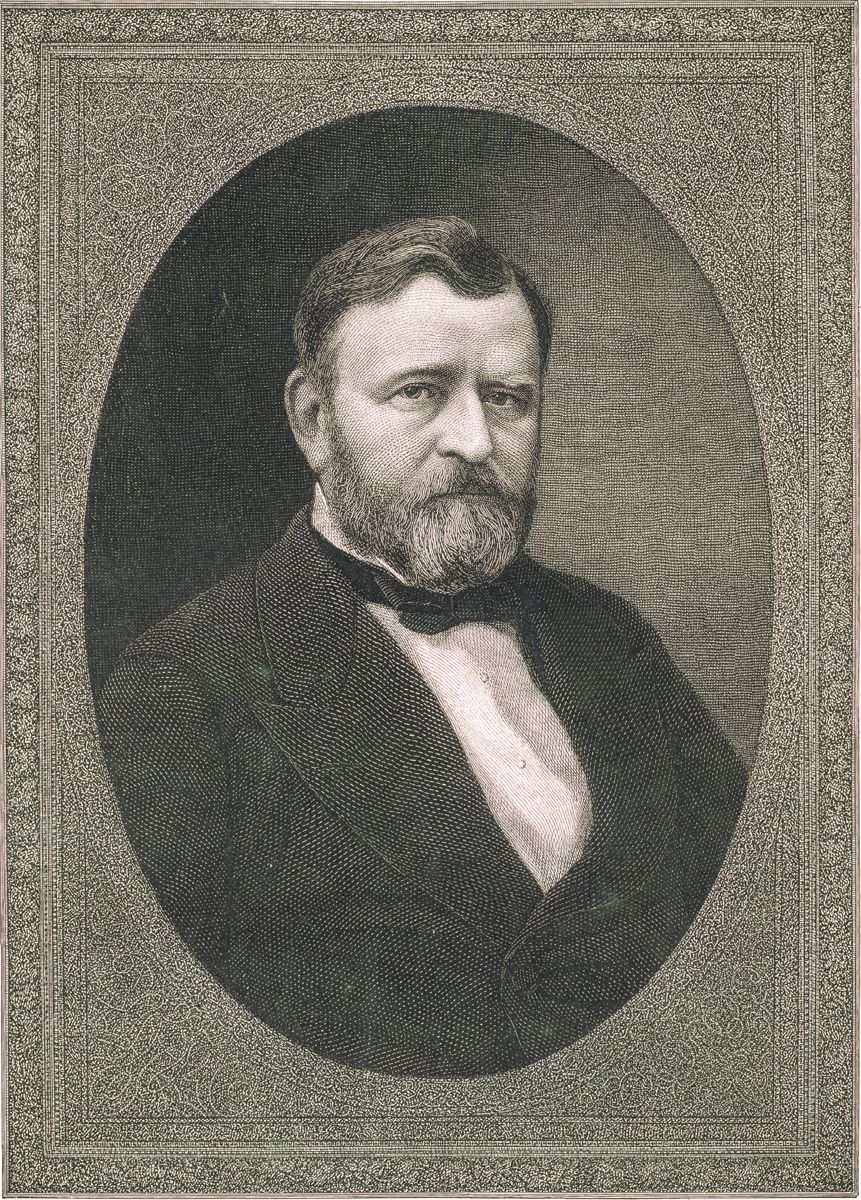
This occasional column will highlight prints from the Civil War. It will discuss their meaning and most importantly, what the print maker or artist was trying to achieve. Long after war’s end printmakers, predominately Northerners but also some in New Orleans and other major, recovering Southern cities, continued producing images of the Civil War. Artist and engraver, George E. Perine produced a mezzotint likeness of Albert Sydney Johnston that was published right after the war and more than five years after Johnston’s death at Shiloh by James H. Hummel, 105 Camp Street, New Orleans. Engravers and lithographers alike found the concept of prints of “heroes” of the rebellion from both sides easy sellers. On the Union side Sherman, Sheridan, Grant, and Farragut gained the most celebrity for putting down the rebellion (with, of course, Lincoln). Since most Americans soon acknowledged the war was fought and won principally on land, Farragut surrendered his position to post war fame to the “three”—Grant, Sheridan and Sherman. In “civil war military portraiture, Ulysses S. Grant eventually reigned supreme.”1 Grant’s popularity in prints was slow to build. His western experience was far from the printmaking centers of the Northeast— Boston, Philadelphia, New York. Images were hard to come by, but as his reputation grew, so did the output of Grant images from northern printmakers. Additionally, Grant had the exposure of a long military and political career. “His long years of prominence provided ample opportunities to brush off wartime engraver’s plates and lithographic stones, or to create new ones, to satisfy the old general’s political admirers.”2 In 1885, the year of Grant’s death, artist and engraver, William Edgar Marshall produced a mezzotint engraving of the former general and president.3 Marshall lived the life of a recluse occupying the same New York studio/apartment on Broadway near Washington Square, “keeping aloof from the ambitions and contests in and out of the National Academy,” so that when he died in 1906, his death was “a surprise to many who supposed he was no longer among the living.”4 He was born of Scottish parents in New York, became a watchmaker in Washington, D.C., and from there moved to the Treasury Department where he learned engraving. His most important print was of Abraham Lincoln, and after a short sojourn in Paris, he returned to America during the war and painted Grant, Sherman, and others “usually executing a line engraving from an oil painting.”5 The engravings then became a marketing tool. In a four page sale’s brochure, Grant’s portrait told the world of “A most masterly work of art: The Standard Steel Line Portrait of Gen. U.S. Grant by the World Renowned Prince of Line Engravers, William Edgar Marshall.”6 The brochure went on to brag about the “Greatest Success in Line Portraiture Ever Attained!,” “A Crowning Success.” Inside were complimentary blurbs from fellow artist John Sartain, the Reverend Henry Ward Beecher, New York Senator William Evarts, John Sherman, Winfield Hancock, and President Rutherford B. Hayes among others. The Boston Watchman called Marshall “An Artistic Genius.” The print was available in different grades of proofs. Pricing was “based upon the artistic skill expended upon the plate, the reputation of the artist, and the number of impressions taken, and the quality of material used in printing.” The artist proofs, selected, approved, and signed by the artist were $20 each, equivalent to nearly $500 in 2016 dollars. India Proofs “on fine British India” paper were $10 while plain proofs on “extra quality plate paper, were a mere $5. The artist proofs were the most desirable then as they are today as the sales brochure indicates: “Only a limited number of artist proofs can be taken and they become historic and valuable with the lapse of time.”7 When Grant passed away that year, many print dealers were left with an oversupply of Grant inventory. Currier and Ives had a generous quantity of several different versions of Grant images they had produced. It is unknown how many of each proof Marshall sold, but copies can be had on the antique print market today for less than the 2016 cost of $500. Endnotes: 1. Mark E. Neely Jr. & Harold
engraver.
Holzer. The Union Image: Popular Prints of the Civil War North. Chapel Hill University of North Carolina Press, 2000. 162. Hereafter Neely, Union Image. 2. Ibid. 3. According to the Library of Congress, Marshall deposited his print March 27, 1885, four months before Grant died July 23. http://www.loc.gov/ pictures/item/2013645299/ 4. “William E. Marshall Dead. The Noted Portrait Painter and Engraver Succumbs to Pneumonia.” New York Times, August 30, 1906. See also https://pfaffs.web.
lehigh.edu/node/59770. 5. Ibid. 6. Sales brochure in author’s collection. 7. Ibid. Salvatore Cilella is retired after 43 years in the museum field. His last position was President and CEO of the Atlanta History Center. He is the author of several articles and books. His most recent books are Upton’s Regulars: A History of the 121st New York Volunteers in the Civil War (U. Press Kansas, 2009) and he edited The Correspondence of General Emory Upton, 1856–1881 (U. Tennessee Press, 2017).