
The Unfinished Fight
Field Repairs: A Battlefield Account
By Craig L. Barry · Originally published August 2018 · pp. 8–9
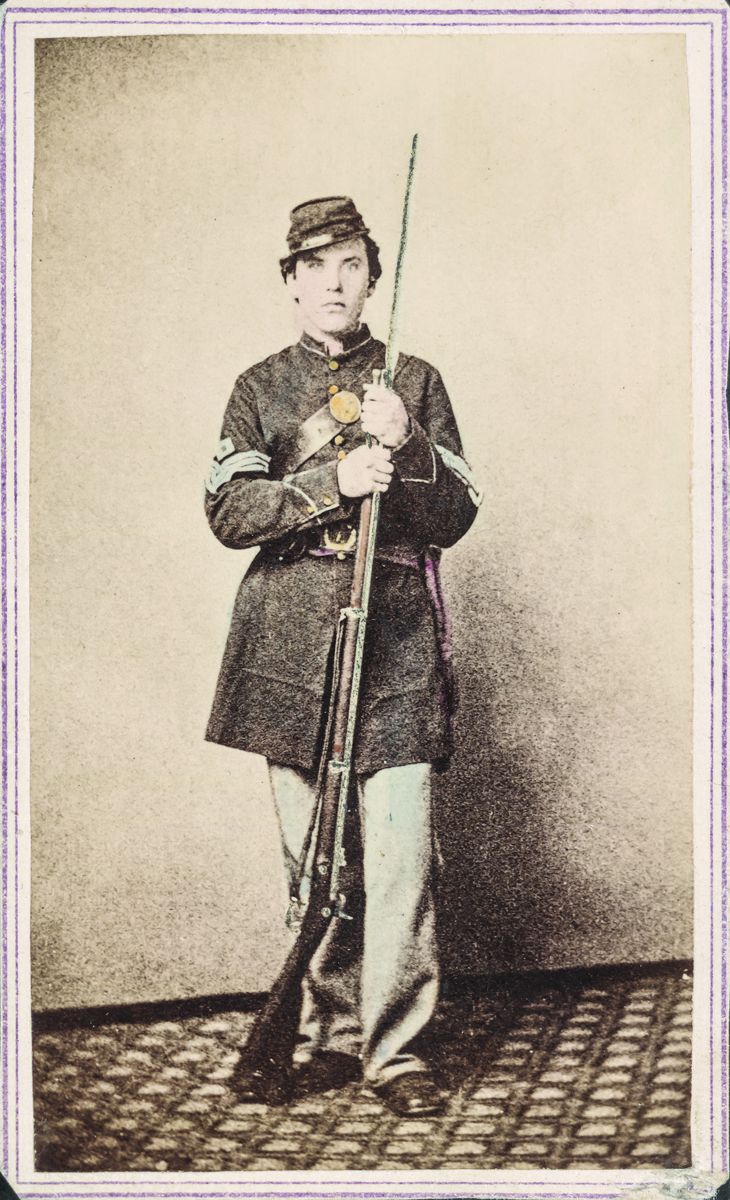
The question came up as to what (if any) repairs a Civil War soldier would be able to perform should his rifle or musket become “degraded”—meaning broken or damaged—while on campaign or in the course of the battle. Obviously, more severely damaged arms would require the services of the regimental armorer, and they were quite creative in returning weapons to serviceable condition, but what about during a battle or in the immediate aftermath of fighting? There are numerous accounts of soldiers dropping one musket after it miss-fired or became damaged and picking up another to continue the fight, but what about minor field repairs afterwards? There is an interesting account which details not just a field repair, but also illustrates the importance of military arms being parts interchangeable, like the U.S. model rifle-muskets. A Confederate soldier from the Army of Tennessee had procured a U.S. M1861 (made at Springfield Armory) of which he was very proud. It was damaged at Stones River during the battle in late December 1862. He recalled
musket. (Library of Congress)
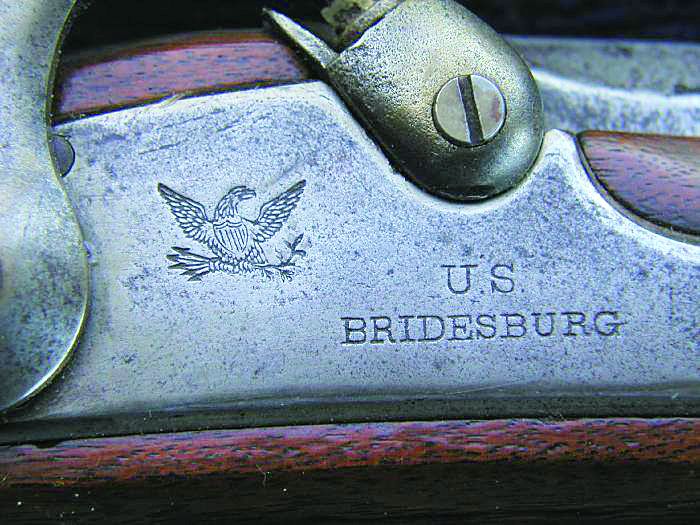
what happened in an article from a Nashville (Tenn.) newspaper article dated 1884, in the form of memoirs from a Confederate Veteran of the 1st Tennessee, titled “A Private in the Rock City Guards.” Here is the passage: “While useful in sending bullets at the battle of Murfreesboro, it (his U.S. model 1861 rifle musket) did me the service to stop one. The ball passed between the two lower bands, taking off half the stock between them, springing the rammer as it passed between it and the barrel. At many a regimental and brigade inspection, I “fessed out,” as the West Point boys say, on that gun. “What’s the matter with that gun, sir,” would say the inspector. “Shot in battle, sir,” would be my answer, and it saved me, for many months, a deal of rubbing and scrubbing…” So the stock was apparently shattered about halfway up the barrel but the weapon was otherwise sound and serviceable? Whatever the case, he kept it and continued to carry it until such time as an opportunity to repair it presented itself. The account is not clear on why he did not have the stock repaired once the retreat from Murfreesboro was finished and winter quarters established. The Confederate soldier in question would only need the screw driver/cone wrench from his implements pouch to break down a U.S. M1861 in the field. It appears that some months later when the opportunity arose he performed this particular “field repair” at night—in the dark—and strangely enough on the battlefield. The account continues: “It was on another moonlight night, of the 20th of September, 1863, the second day’s battle of Chickamauga. It lay inside the Federal works, near their extreme left. It was bright, and perfectly new from the factory. “Bridesburg” was stamped on the lockplate. It was like a foreign country to me, but I knew it was a suburb of Philadelphia. Though twenty years younger than I now
am, I was still too old a soldier to give up a trusted friend, without knowing more of the merits of my new one. So I strung both muskets over my shoulder, and, at the first opportunity, in the firelight of the night, proceeded to examine my new friend. The lock was perfect – bright as a newcoined silver dollar. I drew the rammer, and running it down the barrel, found that it stopped within a foot of the muzzle. I got a ball-screw and drew out ball after ball, with great labor, and found that its previous owner, doubtless a gallant Federal soldier, had simply been snapping caps at us. The job was hopeless. I gave it up, and taking off the barrel of my old musket, made at Springfield
Armory, Massachusetts, soon had as fine a weapon as any Confederate possessed. The parts were interchangeable – our arms were rifle muskets. Just as its brightness attracted me then – it now formed (November 26th), 1863, the last object of my solicitude – I “own a kindly debt of old remembrance” for it. Some Federal, perhaps more worthy, may have the same feeling for parts of the same gun. A kind of love for your engine grows with its use. A good workman comes to like – shall I say love – the machine which seems to share his labor. It is thus I feel toward the “Bridesburg” (rifle) musket.” So what was meant by a “Bridesburg” rifle-musket?
Alfred Jenks & Son of Philadelphia (Bridesburg Armory) made U.S. model 1861s on contract that were right up there with Colt Manufacturing and the United States Springfield Armory in terms of quality. There were five classes that the U.S. Ordnance Department had for grading rifle-muskets made by the twenty or so firms filling U.S. M1861 contracts for the U.S. Government. According to Carl L. Davis in Small Arms in the Union Army 1861–1865, (1979), Alfred Jenks & Son of Bridesburg (Philadelphia), Penn., were owners and operators of the Bridesburg Machine Works. The firm received five different contracts during the Civil War specifying .58 caliber rifle-muskets of the U.S. M1861 pattern. “The first of these, dated July 13, 1861, called for 25,000 arms, all of which were delivered at a price of $20.00 each. The second contract, specifying a like number, was dated October 7, 1861, and resulted in the delivery of 19,000 stands at $25.00 each. Under the third contract, dated July 7, 1863, for 50,000 arms, no deliveries were made, but on December 15, 1863, the offer of this number was repeated, and 48,000 were delivered at a cost of $20.00 each. The final contract came on February 1, 1865, and specified 6,000 rifle-muskets at $19.00 each, all of which were delivered. This total of 98,000 rifle-muskets was augmented on September 27, 1862, when Jenks resubmitted 500 arms which had previously been rejected. Of these, 464 were accepted, though at reduced rates, bringing the total number delivered to 98,464.” Hence, Bridesburg Armory produced nearly 100,000 arms, with over 99% graded in category one, meaning Uncle Sam paid nearly the full contract price, which was unusual. Colt was the only commercial gun-maker to have 100% of their deliveries graded in category one. However, those deliveries were not for the U.S. M1861 but rather for their unique Special Model of 1861. Despite the similar sounding names, the Colt M1861 and the U.S. M1861 do not interchange parts and are quite different in detail, but that is a subject for another day. A source of some minor debate has been the limited number of U.S. M1863 which are found similarly marked “Bridesburg.” The commercial contracts were believed to be only for U.S. M1861 rifle-muskets, with the later models produced at the Springfield Armory. Is it possible that Alfred Jenks, “with his exceptional ability to produce arms under government contract, was the sole contractor who altered his machinery so as to conform to each of the changes made” at the Springfield Armory during the Civil War? Another theory (which seems more likely) has also been offered that Alfred Jenks may have only supplied completed locks to the U.S. government for installation in the later model U.S. model rifle-muskets. Craig L Barry was born in Charlottesville, Va. He holds his BA and Masters degrees from the University of North Carolina (Charlotte). Craig served The Watchdog Civil War Quarterly as Associate Editor and Editor from 2003-2017. The Watchdog published books and columns on 19th-century material and donated all funds from publications to battlefield preservation. He is the author of several books including The Civil War Musket: A Handbook for Historical Accuracy (2006, 2011), The Unfinished Fight: Essays on Confederate Material Culture Vol. I and II (2012, 2013) and three books (soon to be four) in the Suppliers to the Confederacy series on English Arms & Accoutrements, Quartermaster stores and other European imports.