
Etowah Iron Works D-Guard Bowie Knife
By Shannon Pritchard · Originally published August 2018 · pp. 26–27
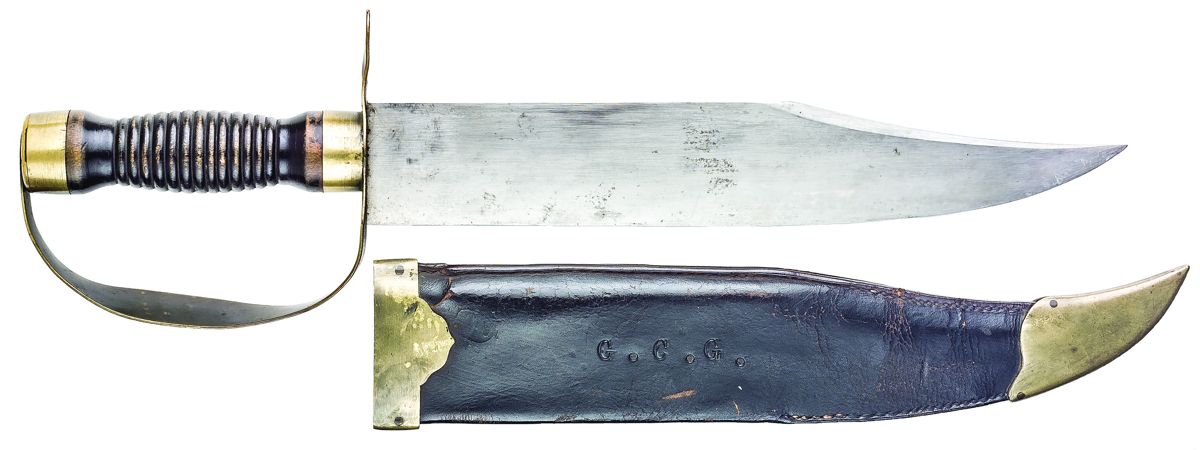
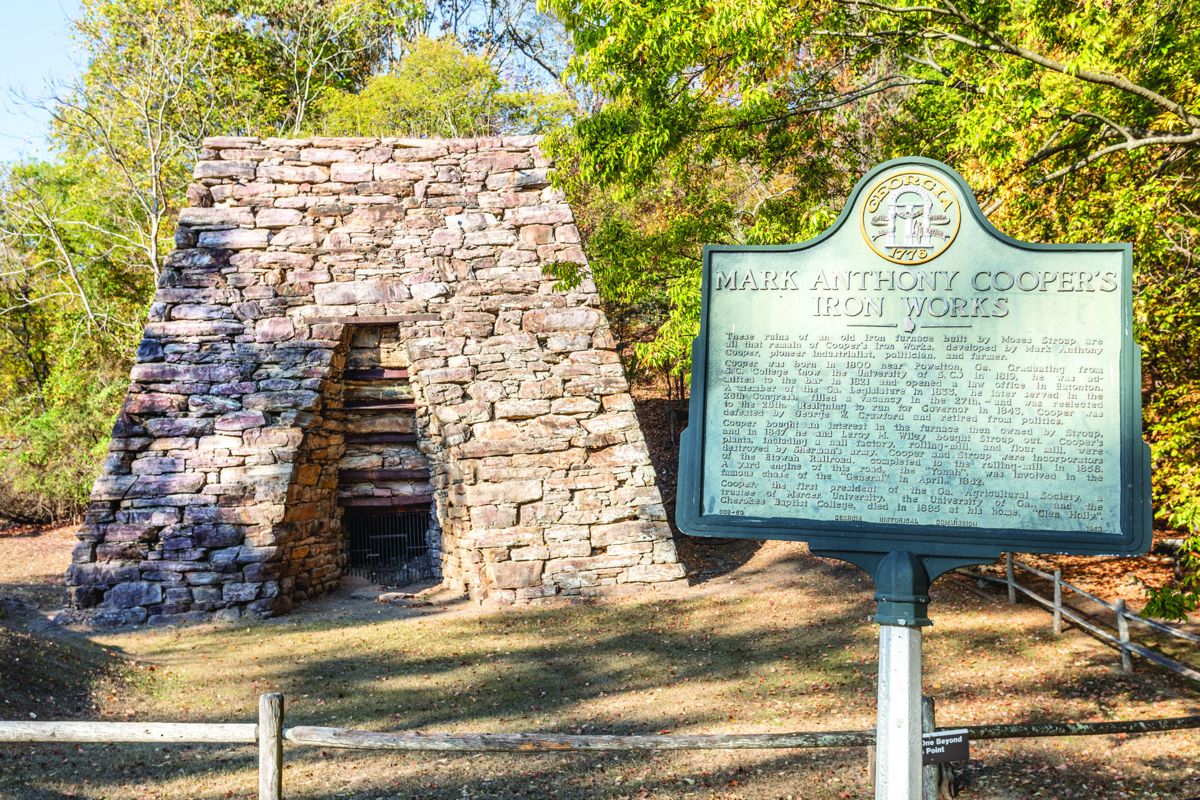
This is the most finely finished, beautiful, historically storied, admired and desired, of all Confederate knives. Only eight are known to exist, with nearly half in museums where they will never again be on the collector’s market. Though only a few remain in private hands, occasionally one does come onto the collector’s market, and when it does it commands a premium. As with buying art work, furniture, rare coins, etc. buying the very best one can afford is always the wisest investment and the most enjoyable to own. The Cooper, or Etowah (as it is sometimes called) Iron Works was founded by a remarkable man named Mark Anthony Cooper. Had the War not come along, he likely would be as familiar to the public as Samuel Colt, but providence decided otherwise. Mark Cooper was born in Hancock County, Ga., in 1800. By the age of 32 he had attended two colleges, opened his own law firm, had married twice due to the death of his first wife, was solicitor general of the Ocmulgee Circuit Court, a major in the Georgia Militia, secured a charter for a railroad from Augusta to Eatonton, and was elected to congress. He did all this by the age of 32. A remarkable man he was indeed. His creed was God, family, and friends, before state and business. Not a man to slow down, in the following ten years he erected one of the earliest cotton mills in Georgia, commanded five companies of Georgia Militia, opened and ran a very successful bank, was elected to the 26th Congress, lost the election for the 27th Congress, but was reelected to the 28th. He resigned to run for Governor, a bid he lost. He also acquired 12,000 acres in Cartersville, Ga., along the Etowah River. Here he retired from political life and settled down with his family. “Settled” for such a man was impossible. His acreage contained a high concentration of iron ore, located close to the railroad, and had water for power and transportation. These things were impossible for an entrepreneur to ignore. In a few years he established the Etowah Iron & Manufacturing Company, better known to history as the Etowah Iron Works. Since the iron works was close to the railroad but still a few miles away, Cooper founded a railroad.
This is how Cooper typically marked these beautiful presentations. other such monument is known to exist in the world. Mark Cooper had long been a States Rights proponent and officer in the State Militia. Obviously a visionary, he could see war was virtually inevitable. He began correspondence with Sam Colt and Eli Whitney Jr. to purchase arms for Georgia. In the fall of 1860, Cooper wrote the Governor, “resolve on secession,” and in December he requested a contract to make arms for Georgia as “they would be needed very soon.” He also wrote the Confederate Secretary of War advising him to arm all the Southern States. Mark Cooper could clearly see what most could not even fathom. Cooper’s plans extended beyond smelting iron; he had intentions of producing firearms for Georgia. Cooper was sent north to meet with Samuel Colt and arrange to purchase $75,000 worth of arms and to study Colt’s Manufactory with an eye to establishing his own arms operation. Then came war. Cooper’s eldest son Thomas, a prominent man in his own right, was elected Captain of the Atlanta Grays. John, Cooper’s second son, who was practicing law in Rome, Ga., helped recruit cavalrymen from Floyd County for Nathan Bedford Forrest while Cooper’s third son, Mark, served as a private in the Floyd Infantry. On May 23rd the Atlanta Grays were presented with a flag during a ceremony filled with speeches of gratitude, honor, sacrifice, and duty. Mark Cooper also presented the officers with bibles and the finest D-guard knives produced in the South. It is believed that he eventually made knives for all the Atlanta Grays and the Floyd infantry which would be some two hundred knives, though only eight* are known to exist today. This would be a remarkably low survival rate for such a fine knife if he did in reality make two hundred. The five surviving
It was he who financed and oversaw construction at Tunnel Hill, a remarkable engineering feat for its time. Only eight years after Cooper “settled down” with his family, he had one of the largest forges of its day and owned singly the rail line connecting the iron works to the Western and Atlantic Railroad, allowing rail service to Atlanta and Chattanooga. Though he could see vast opportunity just over the horizon, the ventures left Cooper in debt. His assets far exceeded his debt, but when his cash flow could not keep up with demand, the Etowah Iron Works had to be sold at auction to pay his creditors. Thirty-eight men of standing, friends who could see his vision, loaned him the funds to buy back the Iron Works for twice the debt he owed. The risk paid off and his friends were repaid early. An excellent example of Cooper’s character stands in the Cartersville town square. It is known as the Friendship Monument, which Cooper erected and where he listed the names of those 38 men, in appreciation of their help. No
Mims’ leather scabbard is marked G.C.G. for the Gate City Guard.
Etowah Iron Work’s D-guards are believed to be ones that Cooper presented to the officers in May 1861. Each has an officer’s name in the guard: Seago, Clark, Hayes, Bell, and W. Mims. As I stated earlier, Mark Cooper was a strong States Rights man, and so were his sons. Though he naturally had a father’s fear of sending his sons to war, and he had such influence he could easily have had them excused, there was no doubt as to their duty and men of such stock could not shirk that duty. Heartbreak was not long in coming. John was mortally wounded July 21, 1861, at Manassas. Thomas was killed on Christmas Eve in an accident. It had been only seven months since Mark Cooper watched his sons march away and two were already dead. Cooper took a month to reflect and then wrote Jefferson Davis “I had three sons, they all volunteered to serve the country and formed a part of the 8th Regt. Ga. Volunteers. The events of the campaign of the Potomac have taken two, on whom my hopes mainly rested.” These two sons had been prominent businessmen and entered service as officers; the surviving son entered as a private. Cooper was 61 years old and needed his son’s help and no doubt needed to save him from his brothers’ fate. The particular knife shown here was presented to twenty-three year old William Mims of the Gate City Guard; the Gate City being Atlanta, Ga. The company entered Confederate service as Company F, 1st Reg’t Georgia Infantry with Mims as a Sergeant. He was last mustered as a Third Lieutenant. The Gate City Guard first served in Florida before being transferred to Virginia. A Georgia soldier wrote a very interesting letter from Florida: “We lost Lieut. Nelms, a fine officer & perfect gentleman. Another brave Georgian gone. One of the Yankees fired on him the ball pierced him through the breast. He cried McDuffie’s rally (he was Lieut. Of the McDuffie Rifles). One of his men standing near rushed on the man who killed Nelms. The fellow cried for mercy. The McDuffie threw him to the ground jumped on him and said, ‘Yes, I’ll show you mercy’ He raised his ‘large knife’ and came down with a lick which cut the Yanks ‘heart out’ He then cut the fellows throat telling him at the same time, If I had 3 thousand of you I’d do with them all just as I have done with you’ ** In Virginia, the Gate City Guard saw very severe service in western Virginia under Generals Garnett and Robert E. Lee. Part of the Guard was cut off when Gen. Garnett retreated without pulling them in from the rear guard. Rather than surrender, these men, already a day without food, traveled through the trackless mountains for four days in the rain without food or shelter. The brush became so thick they had to cut their way through with swords and knives. They traveled in single file, the one in the lead cutting; when he was worn out, the next man moved up and began cutting. In such a way the knives presented by Mark Cooper were a lifesaving aid to them. So severe was their trial, many were driven mad for some time. Some died, others regained their senses, but some remained deranged for the rest of their lives.*** Mims was among the men who made this tortuous march. After the campaign in western Virginia, the remainder of the Guard was ordered to Stonewall Jackson in the lower Shenandoah Valley and participated in his winter campaign against Hancock, Md., and Romney, Va. In the spring, the company was temporarily disbanded, its term of service expired and there were too few men to reorganize. Many joined other units and served until the close of the War.3 William Mim’s knife is the largest known Etowah Iron Works knife; it is also in the finest condition of any of the known knives.
Sources: * Confederate Bowie Knives, Melton, Phillips and Sexton, Mowbray Publishing ** North South Trader’s Magazine, Lori Nash Cosgrove *** Chronicles of the Old Guard, Henry Clay Fairman Shannon Pritchard has authored numerous articles relating to the authentication, care and conservation of Confederate antiques, including several cover articles and is the author of the definitive work on Confederate collectibles, the widely acclaimed Collecting the Confederacy, Artifacts and Antiques from the War Between the States, and Confederate Faces in Color.