
Cook & Brothers Carbine
By John Sexton · Originally published August 2018 · p. 30
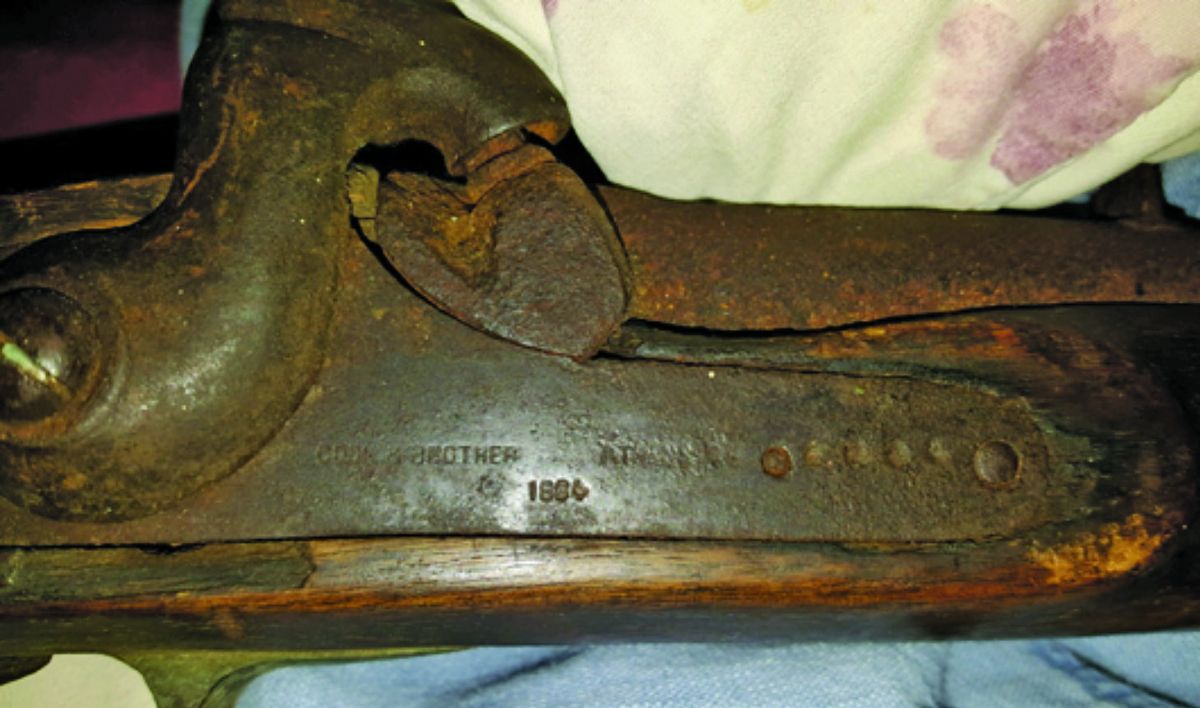
Dear John: We are not sure of the value of it. We have looked them up online and have seen them anywhere from $3,500 to $10,000. Having said that, we know it is not in excellent condition so we do not expect to get $10,000 for it. Do you have an idea of what it would be worth based on the photos? Kim Boyd Birmingham, Ala. Dear Kim: There will be plenty of dealers and collectors interested in buying this gun. It appears to be a nearly untouched, fairly complete and original example of a Cook & Brother saddle ring carbine made in Athens, Ga., in 1864. John Murphy and Howard Madaus in their 2002 definitive book Confederate Carbines & Musketoons tell the history of Cook & Brother and his firearms: Ferdinand Cook was English master mechanic and arms inventor who had immigrated to New York in 1845, then to New
Orleans in 1855. At the beginning of the Civil War, he contracted with the Confederate government for the production of rifles. By early 1862 Cook & Brother had grown to be the largest most productive private Armory in the Confederacy, employing more than 400 operatives, with an output of something like 20 rifles per day. But, as Union forces got close enough to New Orleans to threaten that city, the firm’s guiding genius, Ferdinand Cook, became increasingly anxious for the safety of his Armory. Cook would move his machinery up the Mississippi River and offload in Vicksburg and move it to Georgia where Cook was able to establish a new Armory in Athens Georgia. Not merely content to produce arms for the defense of the South, in 1863 the Cook brothers fortified their Armory with breast works and formed their workmen into a reserve military unit… Ferdinand Cook sought commissions for his brother and himself from Confederate Chief of Ordnance Col.
Josiah Gorgas, and the pair were granted a majority and a captaincy, respectively. On 22 November 1864 the 23rd Battalion played a prominent role in the battle of Griswoldville. After several subsequent engagements, on 11 December 1864 Major Ferdinand Cook was killed by a Yankee sharpshooter while on deployment near Hardeeville, South Carolina. Cook carbines made in Athens range in serial number from about 2700 to over 7000. The serial number on your gun is not easy to read in photos due to the heavy oxidation but appears possibly to be 4002. Most of Cook’s production was in rifles, but survival on carbines and musketoons is as good as the rifles though the production was smaller. The actual number of carbines made is unknown. Regardless of the serial number, the gun appears in the proper configuration only missing the front sling swivel and front blade sight. The ramrod appears original from time of use utilizing a brass tipped Austrian style rod which has been seen on other examples. When originally made, cavalry carbines had stirrup-retained ramrods with large button ends instead of the tulip end rod here. In my opinion with conservative pre-sale auction estimates of $8,000-12,000, the price realized should easily top the estimate. The last cavalry carbine to sell in auction was March 2018, for a whopping $39,100 though it was identified as to the soldier. Dealer pricing on average complete carbines starts about $15,000. John is an certified appraiser with International Society of Appraisers specializing in Civil War memorabilia. He authenticates and evaluates other rare and valuable historic items as well. His website is www.civilwardealer.com. He is coauthor of the book Confederate Bowie Knives (2012) by Jack Melton, Josh Phillips and John Sexton, that was published by Mowbray Publishing Inc. Send “Ask The Appraiser” questions and photographs to [email protected].
Overall of musket with very sound stock with typical “red” patina seen on Cook products.
Reverse of carbine showing brass saddle ring bar. Serial numbers on Cooks are found on most parts including barrel bands and nose cap.
Well struck Confederate first national flag marking is crisp on lock rear of hammer.