
A Connecticut Artillerist Writes Home from Petersburg
By Bruce Allardice and Wayne Wolf · Originally published August 2018 · pp. 18–19
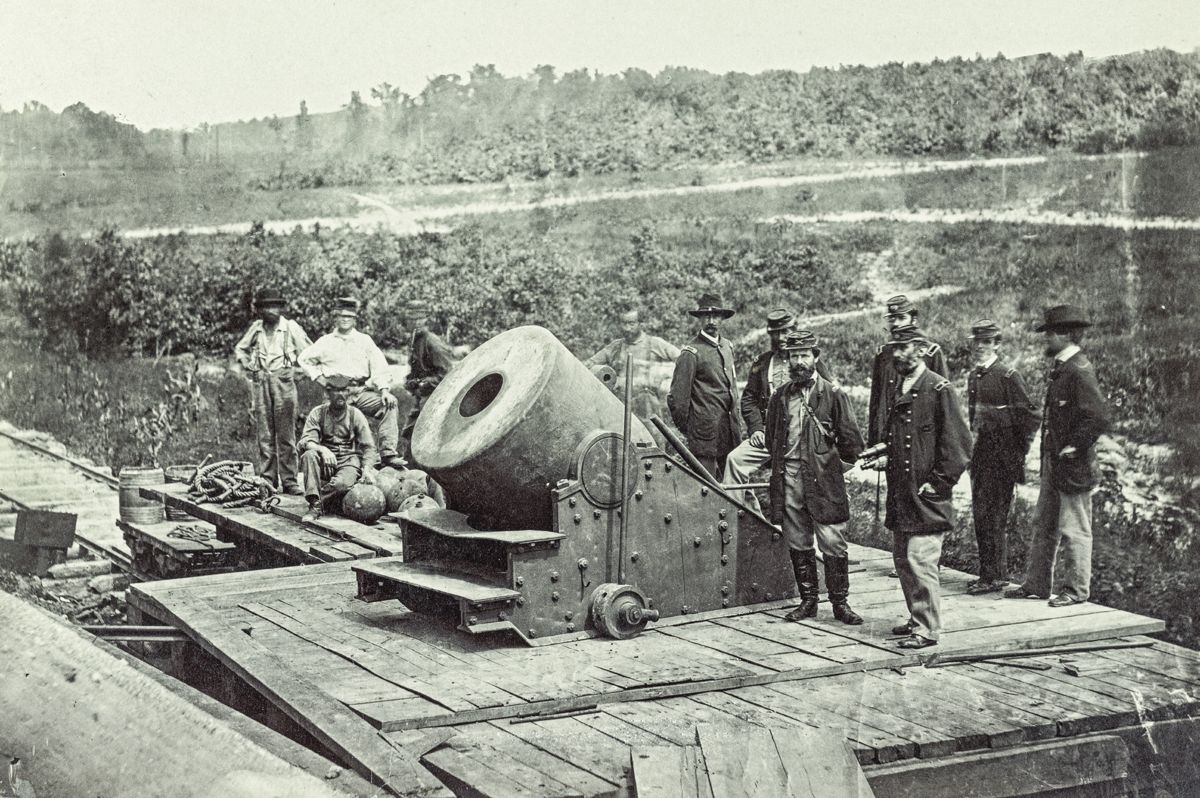
It is always exciting when historians unearth new letters, diaries, or manuscripts that add a bit of personal commentary to an historical event. Four letters, written by Edgar B. Bennett to his beloved fiancée Mary, over a century and a half ago, finally reappeared in a Louisiana sale over a thousand miles from where Mary first received them. History is always being expanded upon, and these letters shed new light on one soldier’s thoughts in the trenches before Petersburg. The son of a Connecticut farmer, Edgar B. Bennett (1842– 1918) was mustered into the 4th Connecticut Infantry May 23, 1861. In early 1862 the unit was redesignated as the 1st Conn. Heavy Artillery. For much of the war, the regiment was stationed in the Washington, D.C., defenses. In 1864 it joined the Army of the Potomac and participated in the Petersburg Campaign, the period when these letters were written. The unit helped man the
“Dictator,” a huge 13-inch mortar mounted on a rail car. Bennett rose to the rank of sergeant. He was wounded during the Petersburg Campaign (a saber cut to the hand) and taken prisoner at the Battle of Fort Stedman, March 25, 1865. During the war Bennett wrote frequent letters to his fiancée, Mary E. (Minnie) Marsh (1849– 1934). Upon his parole, he married Mary. The couple farmed in Connecticut the remainder of
Mary Marsh Bennett
Edgar Bennett and Mary Marsh Bennett, from “The Bennett Family, 1628–1910.”
their lives. Active in veterans’ affairs, Edgar wrote a history of the Bennett family, and a brief history of his regiment. This first letter expresses some doubts as to General Grant’s leadership, and dismisses rumors that the South is on its last legs.
Before Petersburg, Va. Sunday morning, Oct. 30th, 1864 Minnie Dear, It is with pleasure that I now seat myself to answer your kind and ever welcomed letter which I have just recd. and how glad to hear from you and to find you all well. I am well as usual and hope this may find you the same. This is another beautiful Sabbath, but I cannot attend church as I would like and perhaps you are at church but Mary this will not be a life time for us all for I have good hopes thus as long as I have escaped so much. I am good for the remainder of my time although I have a little over two years longer but what is that. It has learned me a good lesson one that I never shall forget and many others will never forget either. For instance Gen. Grant’s move on the left resulted in his leaving the field with his dead and wounded on it for Lee was too strong for him to take Petersburg or Richmond.1 When Grant left the field he left 180 wounded or thereabouts perhaps more for the Rebels to take care of. Oh how sad it will make the mothers and sisters of those that were left on the field to die in such a horrible death as they would have to if they died there. I cannot help feeling sorry for them. Oh the Soldiers say that Lee’s army is all broken up that he will not fight or that his men will not, but they will get disappointed and have some of them. There is no news of interest so I will close by sending my best wishes to all my friends. Love and a kiss to thee. I remain yours truly Minnie, E.B.
The second letter speculates on “great” moves about to be made, but the only action Dec. 5th was by Union ironclads bombarding (to little effect) Hewlitt’s Confederate Battery. Edgar pledges to give up pipe smoking. On Dec. 7th the V Corps launched a raid on the Weldon Railroad, which might be the “move” Bennett forecast. No “grait battle” resulted from the raid. Before Petersburg, Va. Dec. 5th 1864 Mary Dearest I have just recd. your kind and ever welcomed letter of the 29th and how glad to hear from you and to find you all well. I am well as usual and hope this to find you all well. There is grait [sic] moves being made in the army, and we think here that there will be a grait battle fought before long here or not far off. The box has not yet arrived but it is at Head Quarters so I heard and that it would be up here this afternoon. I shall be glad when it comes for I think and know that there is something good in it although you have not told me what was in it. I got a letter from my Brother and his wife but did not get the picture that I expected for his wife says that they are old married folks now so I must not expect one as quick as though they were not married, but I told her that was no excuse so long as I wanted one. Mary don’t you be afraid of my letting those pictures of yours go for I keep them just as choice as I can in my knapsack. I got our dress coats and other that were left in store at Alexandria came to us yesterday the 4th inst. so we have plenty of clothing for the winter if we stay here so we won’t have to throw them away. There is but little news. Oh you know I used to smoke and have for a long time, but today I am to stop with a fellow here with me. We are not to use a pipe nor any tobacco in any way except cigars and we are not to use them until we get into Garrison Duty again so I think it will be a good thing for us both. I think of nothing more so I will close my love to all. My love and kiss to you. I remain yours truly Eddie B. Minnie E.M. Dec. 5th, Evening. I did not mail this so I will write a few lines more since Mon. there has been some hard fighting on the left of us. My box did not come up today as they did not send up the Bread on account of the fighting on the left. Oh I must tell you what I had presented to me for supper, a nice piece of warm bread. They keep flour here all prepared. The yeast and salt is in the flour so all one has to do is to wet it up and put it into a pan and bake it and we have nice bread for it rises while baking. I’ll close. Good night. Truly In the third letter Edgar expresses the common soldier’s wish for peace, as word of the Hampton Roads Peace Conference spreads. Evidently his unit has time to sponsor a school for their enlisted men. Before Petersburg Va. January 11, 1865 Mary Dear, It has been with anxious eyes that I have watched the mail for the last two or three days looking for a letter from you and this morning I recd. one from you and in yours you say you have not had a letter from me in some time. If so the letters that I have written have not reached you for I have wrote several of late and wrote one and sent to you in yours for Father and Mother. They must have got carried away at best as a good many do. But I hope they have not. I am well and was glad to hear that you all were well. There is no news of importance that is war news there is none. Reports around about Peace Commissioners at City Point and I hope the report is true.2 Yesterday and last night it snowed so we have some snow today, but it will all be off before night as the sun is shining very bright and is quite warm. There is no firing today so it makes it quite pleasant. Last night before we retired for the night we all went out and had a good snow ball, the first and I guess the last one we will have this winter. Our schools this winter seem some like going to school in days gone by. We hold them at 2 o’clock in the afternoon and to see twenty of us going there with books we have to stay one hour only and after school to see them lingering around as though they hardly knew where to go. And as we have one this afternoon I will now stop for a while and write more afterwards as it is 1/2 past 1. School is out. We had a good one to as the capt. was very good natured for the first time, for he gets drunk so often he can be no other way. I think I will now close hoping that this may reach you soon. Give my best wishes to all. My love and a kiss to you. I remain yours only Mary. E. B. Bennett please excuse your darling as my ink is poor. In this last letter, he mentions his brother William, who lived in Illinois and who was then serving in Sherman’s Army.
Before Petersburg Va. Jan. 22nd/(18)65 My Dear Mary, It has been several days since I have written to you, but Mary I have been busy all the time on account of the works have all caved in, even to our magazines, and we have been rebuilding them, and we have had to work nights and- days both, as the tops of the magazines are higher than the breast works. So we have had to work on them at night. I have recd. your letter with Fathers & Mothers, and was glad to find you all well. I am well as usual. Oh tell Father I have been thinking of what he spoke of in regard to the corn, and have concluded to remain as I am for I want to get out as soon as I can for this is no place for me. I received a letter from my Brother William today. He is in the 92nd Regt. Illinois and is in Savannah, Ga.3 He did not write anything in regard to the place or the condition of the people there. I see by the paper today that the kind folks of Burlington have made their minister quite a present by presenting him with $80 (besides a large amount of provision and other useful articles) everything is quiet and as yet I have not heard anything from those Companies that left here as they have not been to Wilmington, and we think they have gone to meet Sherman at Charleston. I think of nothing more so I will close. My love and best wishes to all. My truest love and a kiss to you. I remain yours truly Eddie B. Endnotes: 1.
This refers to the Oct. 27, 1864 Battle of Hatcher’s Run or Boydton Plank Road. This refers to the Hampton Roads Conference, at which commissioners from both sides tried but failed to negotiate an end to the war. William Lucius Bennett (1841– 1913) enlisted as a private in the 92nd Illinois, Oct. 6, 1864.
Bruce S. Allardice is Professor of History at South Suburban College in Illinois. He is a past president of the Civil War Round Table of Chicago. Wayne L. Wolf is past president of the Lincoln-Davis Civil War Roundtable.