Inspection, ARMS!
The Pattern 1851 Minié Rifle in Confederate Service
By Tim Prince · Originally published April 2018 · pp. 18–19
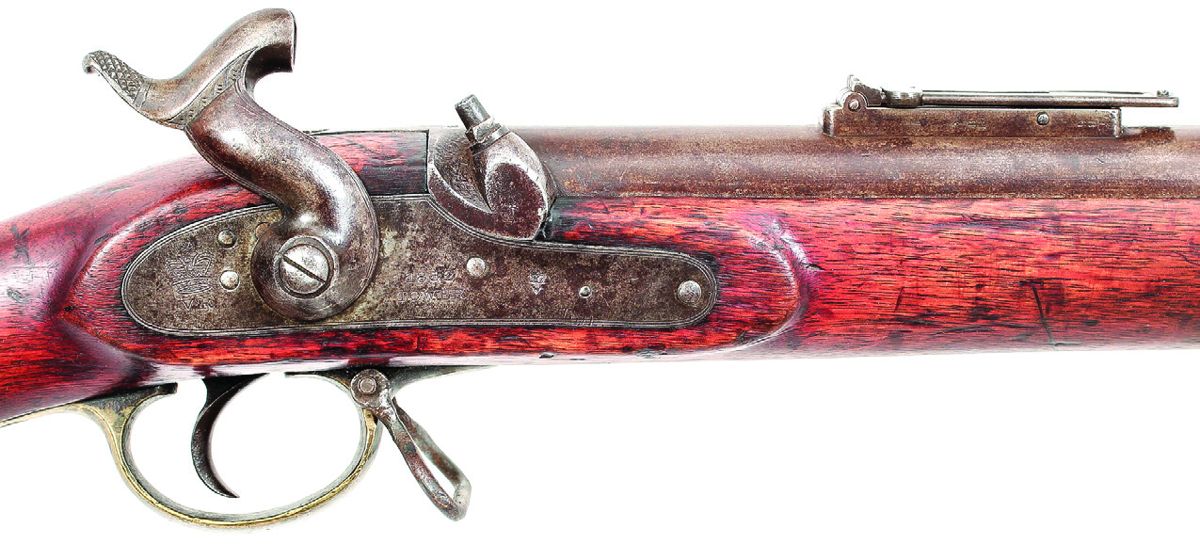
The Pattern 1851 Minié Rifle is one of the least often encountered of all general issue British military percussion long arms. The gun was the first rifled percussion arm widely issued to the British line infantry, replacing the smoothbore Pattern 1842 percussion musket, and foreshadowing the end of the Napoleonic Era “rifle regiment.” The P1851 was adopted in 1851 and was manufactured from 1852 through 1855, with some 35,000 total rifle muskets being produced during that time period. It appears that nearly every one of the P1851s saw service, as
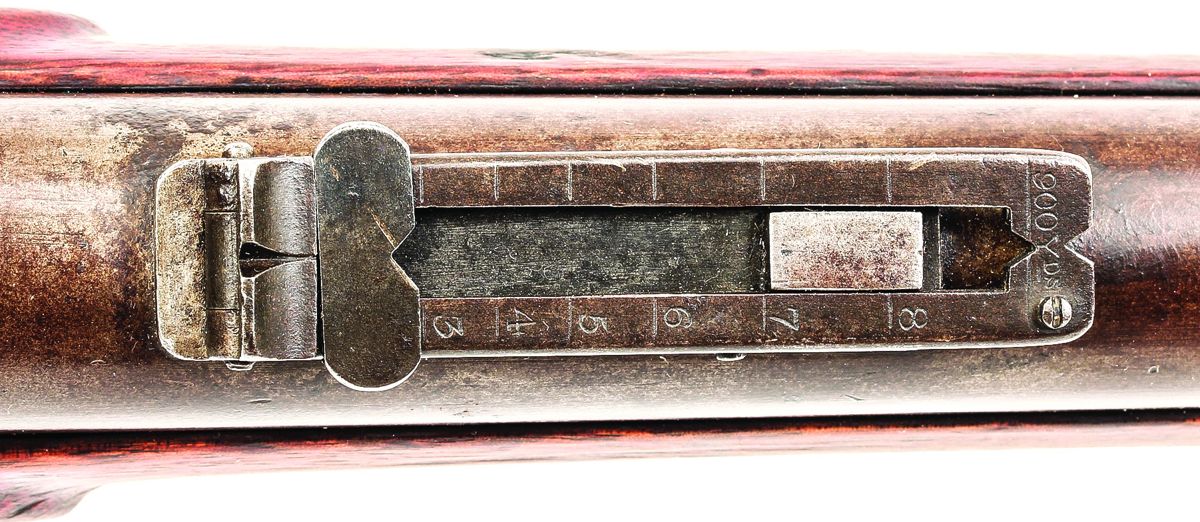
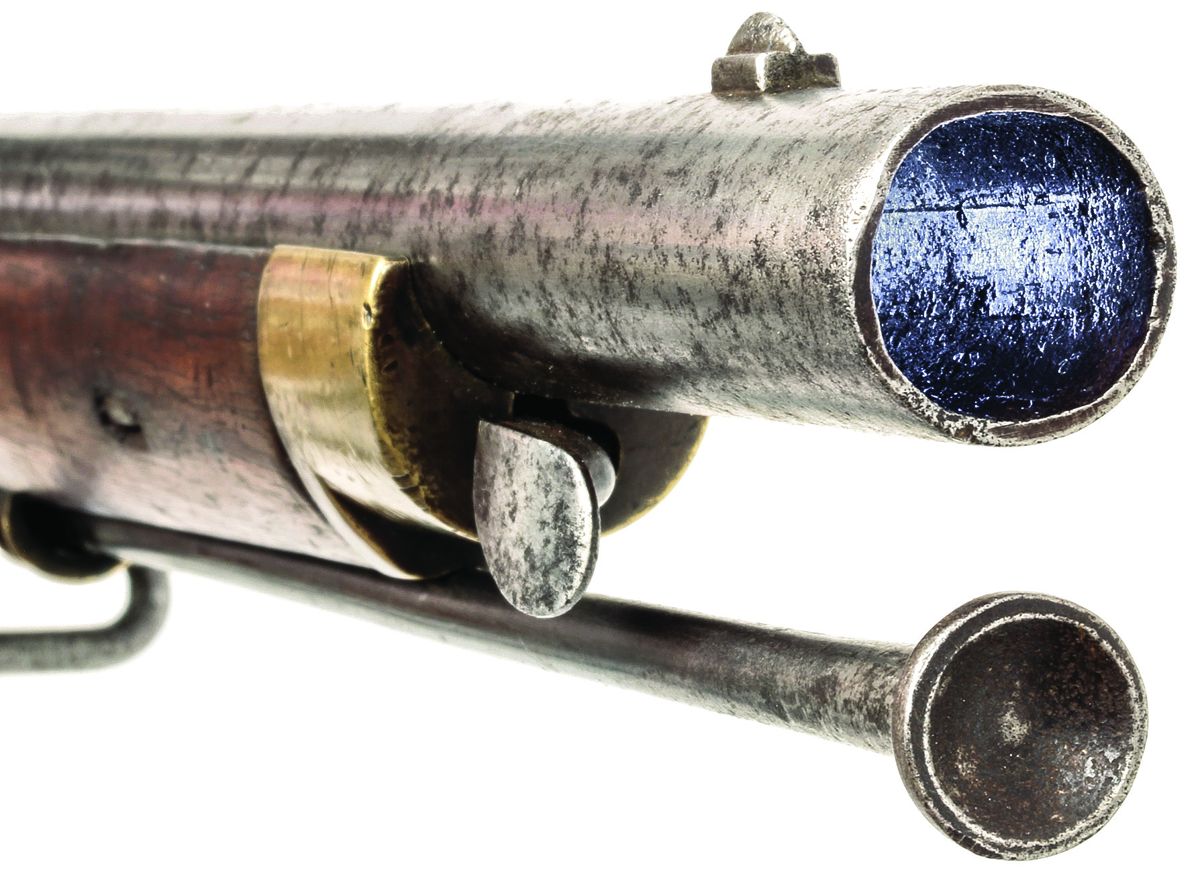
English arms researcher and author DeWitt Bailey noted that by April 1855 approximately 34,000 P1851s were issued for service. At the beginning of the Crimean War (October 1853), the P1851 was the most advanced weapon in the British military small arms arsenal that had been widely issued. It retained much of the “flintlock” styling of its direct predecessors, the P1839 and P1842 percussion muskets, which largely resembled the India Pattern Brown Bess flintlock musket of the Napoleonic Era, with the primary difference being the percussion lock. Like the Pattern 1842 musket that directly preceded it, the 39 inch round barrel of the P1851 was secured by keys (wedges); brass pipes under the stock were used to retain the slightly cupped, button head ramrod. Unlike the .75 caliber smoothbore P1842, the P1851 had a slightly smaller bore, measuring .708 inch that was rifled with four broad, fairly deep grooves of uniform depth. An adjustable long-range rear sight graduated to a maximum distance of 900 yards was affixed to the upper rear barrel. The George Lovell designed spring catch under the muzzle was used to retain a socket bayonet that differed little from bayonets that had been used by the British for some two centuries. The balance of the gun was essentially the same as the earlier pattern smoothbore percussion muskets it replaced, with brass mountings and sling swivels mounted on the bow of the trigger guard and through the upper portion of the forend. The P1851s performed fairly well in the Crimea, particularly when compared to the smoothbore Russian M1845 and M1828/44 muskets that were the general issue arms to that country’s troops. However, the P1851 was already technologically obsolete as it went into production, because the British Board of Ordnance was well on their way to adopting a new, revolutionary smaller bore rifle musket. As a result of the successful experiments in small arms, the P1851 was quickly supplanted by the newly developed and adopted P1853 “Enfield” Rifle Musket. Production of the P1853 quickly ramped up resulting in the P1851 being one of the most short lived small arms in British military history. The “Enfield” Rifle Musket was a major advance in infantry long arm design and featured a reduced caliber bore of .577 inch, a more advanced rear sight, and a barrel secured by clamping barrel bands, instead of the wedges used on the P1851. The P1851 was so quickly replaced by the “Enfields” new technology that by the conclusion of the Crimean War, the guns were considered completely obsolete. The British military hierarchy expected long arms to have a useable service life of ten years and required even obsolete weapons to be held in reserve for emergency issue for at least that long before being offered for sale. The Pattern 1851 Minié Rifle was held in such low regard after the adoption of the P1853 that the guns were “stored” outside exposed to the weather, in an area adjacent to the Tower of London known simply as “the ditch.” More than likely this “storage area” was in fact the old moat that surrounded the Tower in earlier days, and it appears that due to a poorly managed and somewhat corrupt ordnance supply system, much Crimean War surplus materiel suffered a similar fate. With the coming of the American Civil War, and the urgent need for infantry long arms by both sides, a large number of obsolete British small arms were sold as surplus. Most of these obsolete arms were sold to the firm of S. Isaac, Campbell Overall view of a Confederate purchased and inspected P1851 Minié rifle. Close up of a Confederate CH/1 inspection mark, the mark of London contract viewers Curtis & Hughes. & Company. S. Isaac, Campbell & Co. was an English military goods dealer and manufacturer that had wide ranging connections throughout the British arms and military equipment production community. This firm facilitated the sale of the bulk of the arms and materiel purchased by the Confederacy from Great Britain during the American Civil War. According to Confederate purchasing records, some 14,900 British Pattern 1851 Minié Rifles were purchased during the war’s early days. Most were purchased between August 1861 and January 1862, with a handful purchased in the summer of 1862. Records indicate that at least 10,000 of these arms (and probably all of them) were acquired from J.E. Barnett & Sons of London, who had acquired the guns from the British Ordnance Department. Since the arms had been left exposed to the elements for several years, Barnett refurbished them to make them functional. This apparently included replacement of worn, damaged, or missing parts and also involved re-proving the guns at the London Proof House. All known examples of Confederate imported Pattern 1851 Minié Rifles show at least the traces of their original British military proofs, and typically a secondary set of London commercial proof marks, applied during the Barnett refurbishment process. Barnett sold the majority of the arms to S. Isaac & Campbell at a rate of 40 shillings each, including the socket bayonet. S. Isaac, Campbell & Co. then charged the Confederacy 44 shillings for each gun. The summer 1862 purchases were sold to the Confederacy at the lower rate of 40 shillings each. The guns were inspected by Isaac Curtis and Charles Hughes, who had been hired by S. Isaac, Campbell & Co. to act as viewers of arms. The P1851s inspected by Curtis and Hughes bear an inspection mark consisting of the small capital letters “CH” over the number “1” in a small circle, on the upper comb of the stock, forward of the buttplate tang. Confederate documents refer to the Pattern 1851 rifle muskets by a number of different names, including “Old Army Pattern, rifled,” “Second Hand Government Rifles,” “Minié Rifles,” “Second Hand Rifles
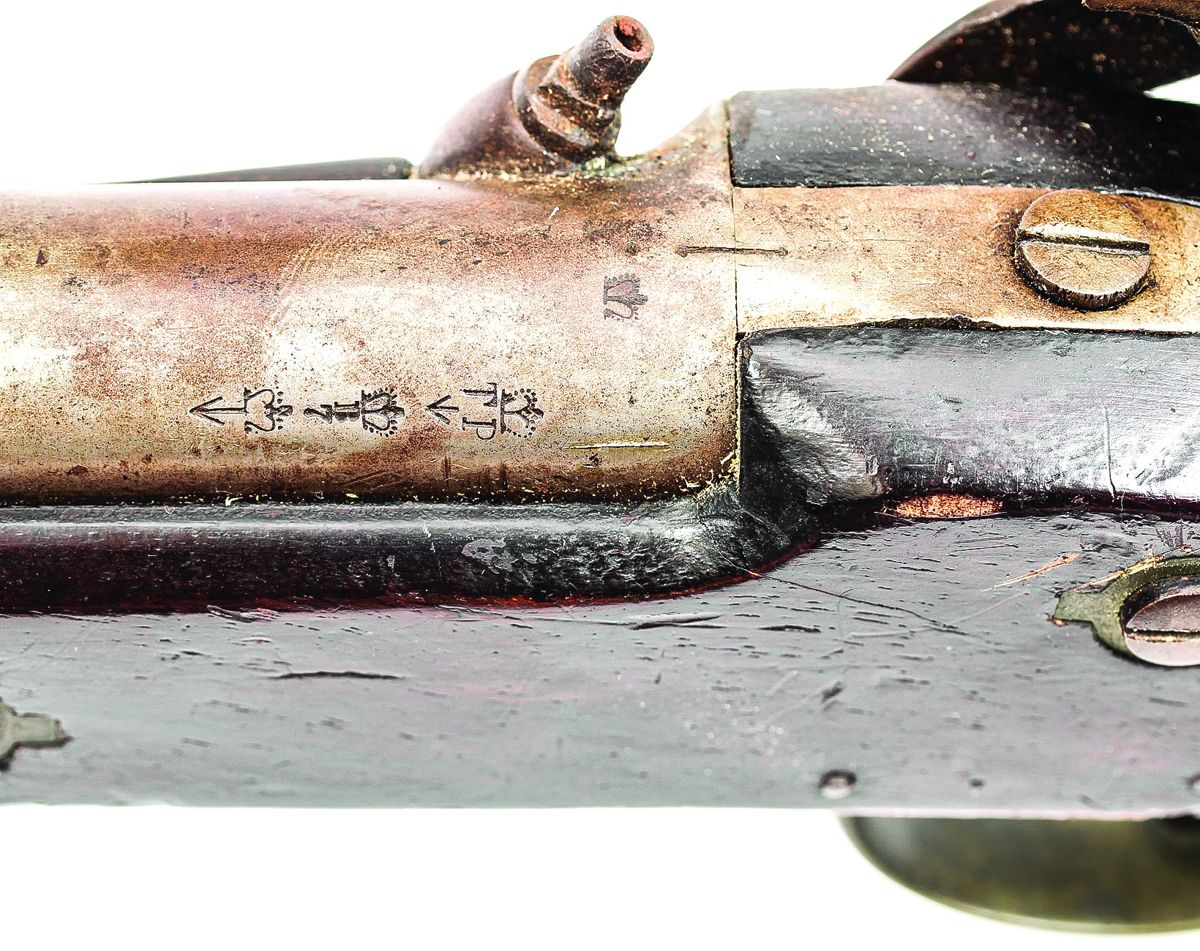
1851 Pattern,” “Brown Bess Rifles 1851 Pattern,” and “Rifled Brown Bessies,” Pattern 1851 Rifle Muskets were arriving in Confederate ports no later than January 1862, with deliveries continuing throughout most of that year. According to the McRae
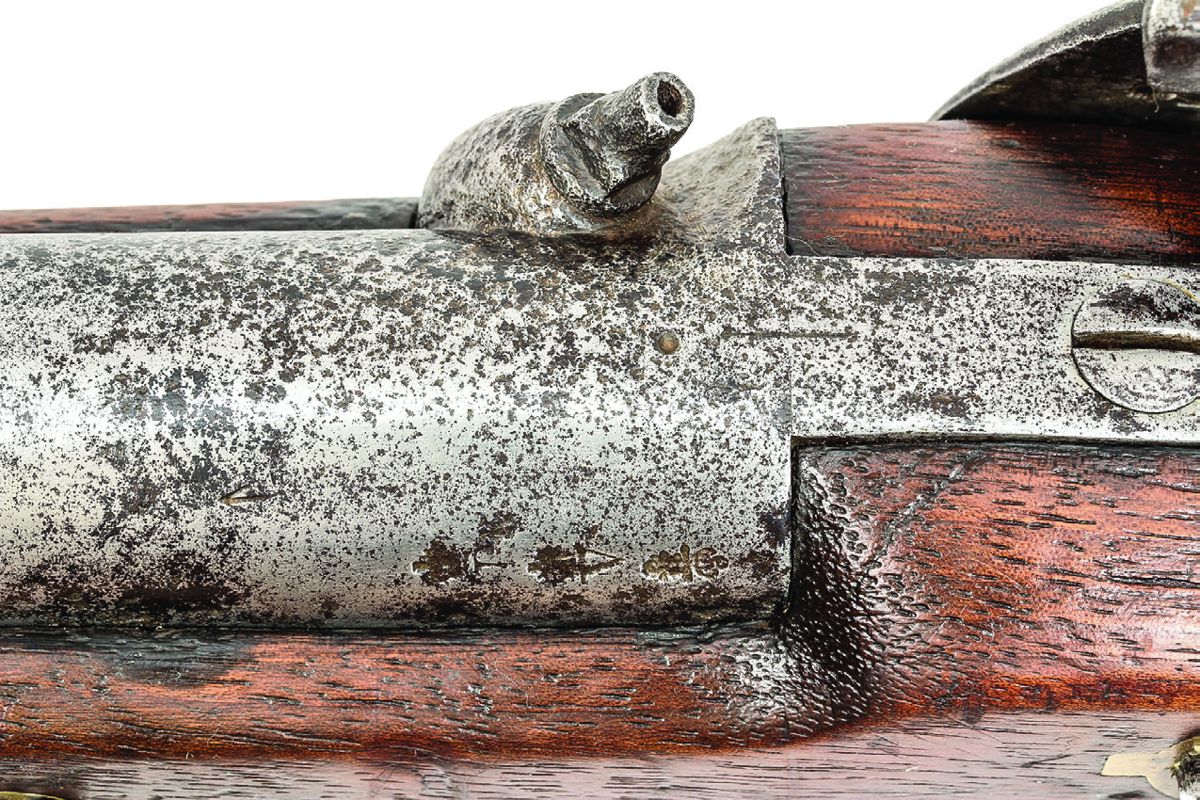
(All photos by Tim Prince) Papers, P1851s were included in the cargos of the southern blockade runners Gladiator, Harriett Pinckney, Southwick, Stephen Hart, and Ella Warly. While the guns aboard the Ella Warley and Stephen Hart (some 3,520 guns) were lost to capture by the Federal blockading squadron, 11,380 Pattern 1851 Minié Rifles were successfully delivered to Confederate ports and subsequently issued for service. The majority of these guns had already seen hard use in the Crimea, and they saw additional hard service in Confederate hands. The end result is that the P1851 Minié Rifle is now a rarely encountered weapon and to my knowledge, less than two-dozen Confederate marked P1851s are known to exist today. Tim Prince is a full-time dealer in fine & collectible military arms from the Colonial Period through WWII. He operates College Hill
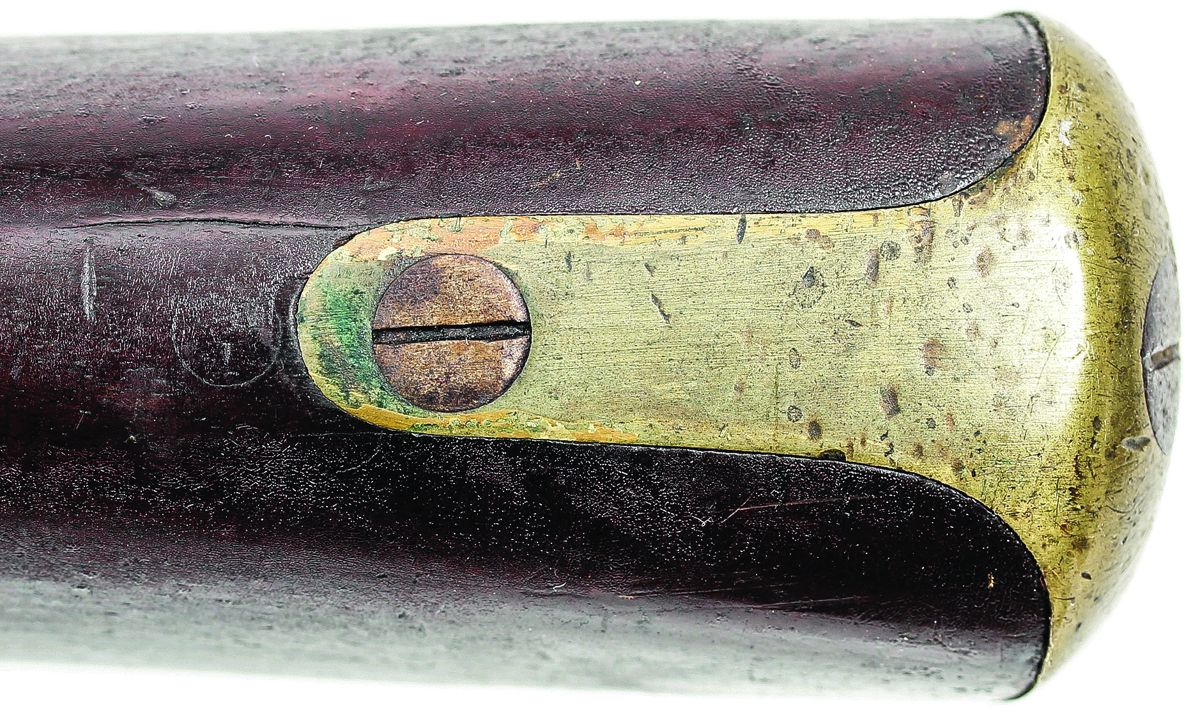
Arsenal, a web-based antique arms retail site. A long time collector & researcher, Tim has been a contributing author to two major book projects about Civil War era arms including The English Connection and a new book on southern retailer marked and Confederate used shotguns. Tim is also a featured Arms & Militaria appraiser on the PBS Series Antiques Roadshow.