
Black Powder, White Smoke
Six-gun Shooting and Historical Myths
By Joe Bilby · Originally published April 2018 · p. 4
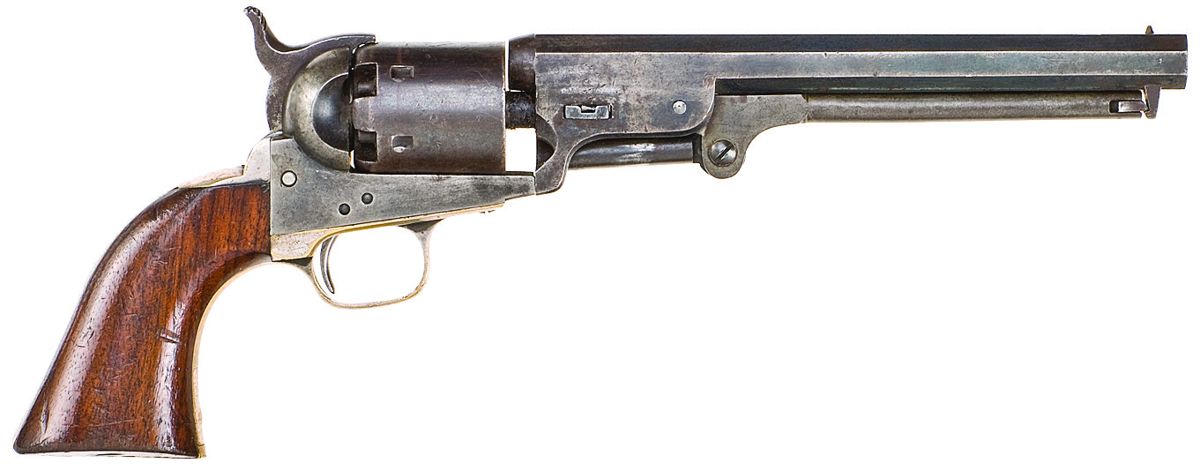
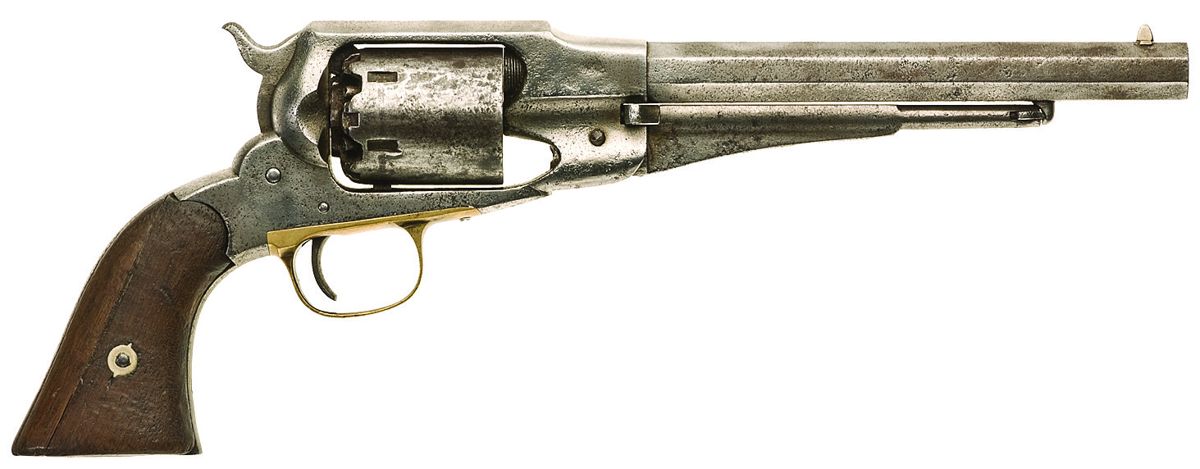
Loading and Firing the Cap and Ball Six-gun The open framed Colt Army and Navy models were the most popular percussion revolvers used in the Civil War. Although the Colt, primarily in reproduction form, is still a favorite with many casual shooters and reenactors, competitive target shooters prefer Remington style six-guns, which have solid frame top-straps with rear sight grooves. The latter guns provide a better and more consistent sight picture than that offered by the Colt’s hammer notch rear sight. Whatever their sights, all cap and ball revolvers, original or reproduction, are loaded the same way. Although I have covered it in the past, a refresher course in revolver loading might be timely. The usual procedure is: first, check the cylinder to make sure the gun is unloaded; second, swab the revolver’s barrel and chamber with a dry cleaning patch to remove any residual oil; third, snap a percussion cap on each nipple to remove any remaining oil in the nipple channels; fourth, load each chamber with a measured charge of FFFG black powder, usually 15 to 20 grains for a .36, 20 to 25 grains for a .44, followed by a soft lead swaged or cast round ball or conical bullet rammed home with the gun’s integral loading lever. The fifth step, once standard procedure in N-SSA and NMLRA matches, was to slather a thick grease, often Crisco, over each chamber mouth; sixth, while pointing the gun in safe direction, slip caps over the nipples. The six-gun was now ready to fire. To reload and fire again, the shooter repeated steps four through six. The addition of grease to the chamber mouths was and still is believed by many to prevent a “chain-fire” or multiple chamber ignitions, as well as provide lubrication to keep down powder fouling. While chain-fires from the front of the cylinder are virtually impossible with tight fitting projectiles, the grease may provide some lubrication. An Ox-Yoke Wonder Wad of appropriate size between powder and ball will most likely provide a better, and less sloppy, solution to the fouling problem, however, sweeping black powder residue down the bore with each succeeding shot. Caps must fit the nipples snugly. Ill-fitting caps were and are the most common cause of chain-fires and misfires in a percussion revolver. A shooter should check several cap sizes and manufacturers to see which fits his gun. Most original .36 caliber guns use .380 diameter slugs, round or conical, while original revolvers use .454 or .457 diameter round balls. Some reproductions work best with .451 balls. An 1864 Ohio newspaper provided rather sketchy instructions on revolver loading from a local gun dealer, who wrote: “Colt’s Navy revolver is not usually loaded with a wad, but it may be used. Colt’s pistols load with a slug ball or round ball of lead; powder and ball together.” By “powder and ball together” he probably meant combustible cartridges. Civil War soldiers loaded their cap and ball revolvers with issued combustible cartridges, simply inserting the prepared cartridge, containing both powder and conical ball, in the front of each chamber, ramming it home and then capping. Some of today’s shooters make combustible cartridges out of nitrated paper, which works much the same way. Another form of cartridge uses the soft plastic tubes sold by sutlers. I load each tube with a powder charge, Wonder Wad and ball in that order for a convenient way to carry ammunition.
Watch That Muzzle Muzzle consciousness is probably the most crucial safety factor when handling a handgun. I can attest to that from personal experience. As a first lieutenant and executive officer of the 532nd MP company at Fort Dix, N.J., back in 1967, I oversaw the company’s annual arms qualification. As military police, our primary arm was the 1911A1 .45 automatic pistol. With the actual military policemen, things went well, but when I had to take the clerks and cooks out, things got dicey, with guys turning around with a pistol in hand. The sergeants and I ran them through as quickly as possible and monitored them closely. The cap and ball revolver is less prone to accidental discharge than a cocked .45 automatic, but accidents did happen during the Civil War era as well. In March 1862, the paymaster aboard the USS Sciota “accidentally shot himself while drawing a load from his revolver. He was stooping over at the time, and the ball entered his body a little over his heart, passing entirely through him.” In April 1865, a New York City bartender was “accidentally killed by the discharge of a pistol in his own hands. He was trying to load a revolver and holding it on his breast it went off and shot him through his heart.” The barman should have known better, as he was said to be a veteran of three years’ service as a sergeant in the 14th Brooklyn.
Enduring Myth There are a lot of bogus stories out there about Civil War guns, and revolver tales top the list. As I have noted previously, the most common one is that soldiers swapped cylinders in combat to reload their six-guns. Since most folks who used revolvers in combat were cavalrymen, that possibility is something to conjure with. Switching cylinders on horseback in the middle of a combat action would be, to be kind, rather difficult, as it requires both hands if you are carrying a Remington and three hands if you are armed with a Colt. The answer to the problem, of course, was to carry multiple revolvers, and we have plenty of primary source information to verify that. Joseph G. Bilby received his BA and MA degrees in history from Seton Hall University and served as a lieutenant in the 1st Infantry Division in 1966–1967. He is Assistant Curator of the
New Jersey National Guard and Militia Museum, a freelance writer and historical consultant and author or editor of 21 books and over 400 articles on N.J. and military history and firearms, and as publications editor for the N.J. Civil War 150 Committee edited the award winning New Jersey Goes to War. His latest book, New Jersey: A Military History, was published by Westholme Publishing in 2017. He has received an award for contributions to Monmouth County (N.J.) history and an Award of Merit from the N.J. Historical Commission for contributions to the state’s military history. He can be contacted by email at jgbilby44@ aol.com